



• About
  • The Germans

A Work in Progress

A Work in Progress

Monthly Archives: November 2016

Sister Aimee

17 Thursday Nov 2016

Posted by ag1970 in Uncategorized

≈ Leave a comment

Tatiana Maslany as Sister Alice on HBO’s Perry Mason.
Kerry Bishe as Sister Molly on Showtime’s Penny Dreadful: City of Angels

_79237805_aimee

Aimee Semple McPherson was, in the 1920s, one of the most famous evangelists in America and was the founder of the Foursquare Gospel Church, which is now 1,400 churches strong. She was a marvelous actress–advised in part by friend Charlie Chaplin, her sermons were framed by elaborate stage settings and she dressed in various costumes, as a little Dutch girl, for example, complete with sabots. The milkmaid-revivalist portrayed by Jean Simmons in the film production of Elmer Gantry was based on Sister Aimee, as was a character in Nathanael West’s dark novel, The Day of the Locust. She was flamboyant, dramatic, attractive and enormously successful.

She was known for her good works. In the 1925 Santa Barbara earthquake, she took the microphone away from a stunned broadcaster and immediately requested aid for the stricken city. Convoys of food, blankets and emergency supplies were soon on their way. She was insistent integrating her congregation, a courageous policy at a time when the power of the Ku Klux Klan, even in California, was at its height. She ran a commissary for the homeless out of her Angelus Temple that was shut down briefly in 1932 when a still was discovered in the kitchen.
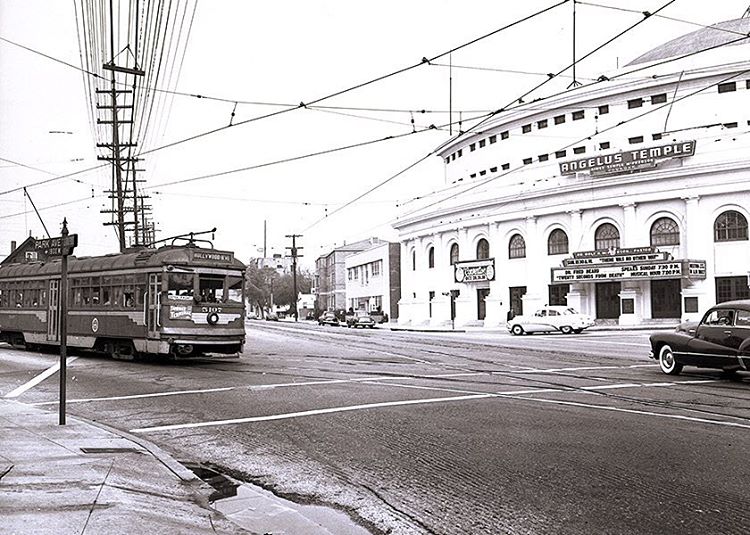
1170577_154786054905660_1503215307_n
An electric trolley passes the Angelus Temple in this postwar photgraph.

In May 1926, Aimee disappeared. Presumed drowned off Venice Beach, a search that included the California National Guard failed to turn up any trace of the beloved Aimee. She was gone.

For a month.

In June, she turned up, disheveled and disoriented, in the town of Agua Prieta, on  the Mexican border, revealing that she’d escaped from an adobe house in Mexico where she’d been held captive by two kidnappers named “Steve” and “Rose.” She was hospitalized in Douglas, Arizona, and the newspaper accounts of her survival were welcome news to her followers: as many as 50,000 Angelenos were waiting for her when her train arrived from Arizona.

As it turned out, Aimee’s story was a fabrication. When her account began to come under scrutiny, she brazenly, and foolishly, demanded the grand jury investigation whose focus soon became Aimee herself.

ht19260603-2-8-a1-330w

Enough character witnesses appeared on her behalf to muddle the case, which was eventually dismissed, but this is what most likely happened: Aimee had an affair with a former employee, a radio engineer named Kenneth Ormiston, and the dates of her disappearance coincided with his rental of a seaside cottage in Carmel.

The plot thickened when Ormiston was identified as the male half of a couple that had registered as “Mr. and Mrs. Gibson”–the female was heavily veiled–when they’d checked in at the Hotel Andrews in San Luis Obispo shortly after Aimee’s alleged drowning.  The Andrews, which stood on the corner where the San Luis Obispo City-County Library today stands, reached the height of its fame in a 24-hour cycle of national newspapers.
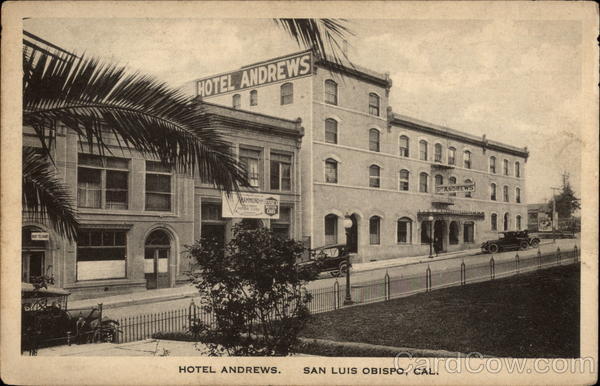
Hotel Andrews San Luis Obispo, CA

Aimee had reached the height of her fame, as well. She continued to preach until her death in 1944, but the luster was gone; in-fighting between Aimee and her mother, Mildred Kennedy, took both a personal and business toll on the evangelist; when her body was found in an Oakland hotel, a bottle of Seconal was found nearby and the coroner’s inquest suggested that both an accidental overdose and kidney problems figured in Sister Aimee’s death.

Admirers sent eleven truckloads of flowers, valued at $50,000, to her funeral at the Angelus Temple. She is buried, along with so many other Hollywood stars, at Forest Lawn in Glendale.

1024px-aimee_semple_mcpherson_grave_at_forest_lawn_cemetery_in_glendale_california

The only Hollywood star who could exceed Sister Aimee, in my mind, was Burt Lancaster in one of the most stunning opening scenes in film history, from Elmer Gantry.
Home

16 Wednesday Nov 2016

Posted by ag1970 in Arroyo Grande, Uncategorized

≈ Leave a comment

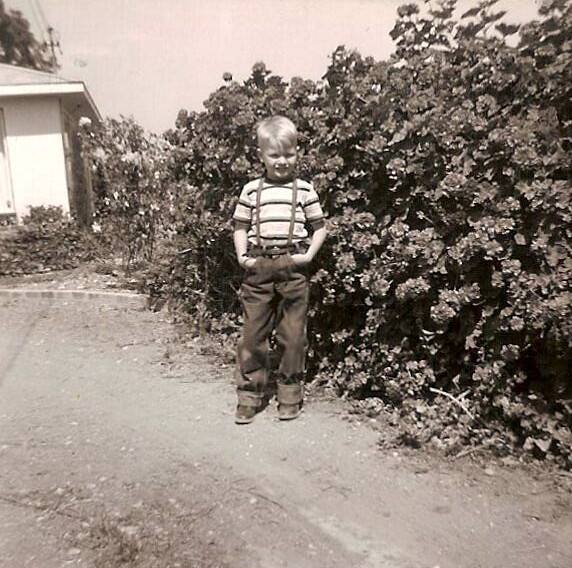
1689864_10203039972623997_595650753_nA ten-mile corridor of land between Valley Road in Arroyo Grande and Mary Hall Road in the Huasna Valley has been the most formative influence of my life. I grew up on Huasna Road in the Upper Arroyo Grande Valley, and I knew instantly the day we moved there, when I was five, that this was home.

We never lacked for guests. There were mule deer, a weasel, red-tailed hawks, an unexplained peacock, and two barn owls that slept together on a ledge beneath the Harris Bridge. Coyotes yipped in the hills and a colony of beavers built a dam in the Arroyo Grande Creek that ran with rainbow trout I did catch and one big steelhead that I didn’t. Once a mountain lion sniffed around our Branch School softball field.

Just over the hill from the two-room school was the Branch family burying ground. I used to visit to wonder what Arroyo Grande Valley must have been like when Francis and Manuela Branch arrived in 1837, wonder at the heartbreak represented by the small tombstones of three daughters taken by smallpox in 1862.

It was in part the Branch family that would lead me to teach history for thirty years, when I found that my life’s calling and greatest joy was to be surrounded by teenagers.

I’ve written two books about Arroyo Grande since I retired in 2015, and I constantly find hope in our past:

• In 1862, a Civil War soldier, Erastus Fouch, lost his eighteen-year-old brother during a firefight with Stonewall Jackson’s forces in the Shenandoah Valley. Thirty years later, Fouch, now an Arroyo Grande farmer, would be the most forceful advocate for the founding of the high school, a perfect memorial to a lost brother.
• Ruth Paulding taught at the high school in the 1940s and 1950s. Her mother, Clara, had taught locally for over forty years, including, at one point, teaching sixty students in eleven grades at Branch by herself. Both Pauldings loved children. In the family home on Crown Hill, there are several tea and coffee services. In one of them, Ruth, at the end of the school year, would serve her students Mexican hot chocolate so rich that the teenagers would remember it the rest of their lives.
• The Ikeda brothers were superb athletes and passionate about baseball, which is the sport that that kept the internees together, body and soul, in the desolate World War II camp at Gila River. More than half of Arroyo Grande’s Japanese internees never came home after the war. The Ikedas did, to teach baseball to two generations of children who will never forget Coach Saburo Ikeda because, as one of them wrote, “Coach always had a smile on his face.”

On the day that we moved to Huasna Road, there had just been a thunderstorm, and the air was pungent with ozone and earth just turned over by a farmer’s tractor. In writing about our past, I am always inspired by chronicling lives as rich as the soil of the Valley, and I always come back to that moment, sixty years ago, when I knew I was home.

Subscribe

  • Entries (RSS)
  • Comments (RSS)

Archives

  • January 2026
  • December 2025
  • November 2025
  • October 2025
  • September 2025
  • August 2025
  • July 2025
  • June 2025
  • May 2025
  • April 2025
  • March 2025
  • February 2025
  • January 2025
  • December 2024
  • November 2024
  • October 2024
  • September 2024
  • August 2024
  • July 2024
  • June 2024
  • May 2024
  • April 2024
  • March 2024
  • February 2024
  • January 2024
  • December 2023
  • November 2023
  • October 2023
  • September 2023
  • August 2023
  • July 2023
  • June 2023
  • May 2023
  • April 2023
  • March 2023
  • February 2023
  • January 2023
  • December 2022
  • November 2022
  • October 2022
  • September 2022
  • August 2022
  • May 2022
  • April 2022
  • March 2022
  • February 2022
  • January 2022
  • December 2021
  • November 2021
  • October 2021
  • September 2021
  • August 2021
  • July 2021
  • June 2021
  • April 2021
  • March 2021
  • February 2021
  • January 2021
  • December 2020
  • November 2020
  • August 2020
  • July 2020
  • June 2020
  • May 2020
  • April 2020
  • January 2020
  • December 2019
  • November 2019
  • October 2019
  • September 2019
  • August 2019
  • May 2019
  • April 2019
  • March 2019
  • February 2019
  • January 2019
  • December 2018
  • November 2018
  • October 2018
  • September 2018
  • July 2018
  • June 2018
  • May 2018
  • April 2018
  • March 2018
  • February 2018
  • January 2018
  • December 2017
  • November 2017
  • October 2017
  • April 2017
  • March 2017
  • December 2016
  • November 2016
  • October 2016
  • September 2016
  • August 2016
  • July 2016
  • June 2016
  • April 2016
  • March 2016
  • February 2016
  • January 2016
  • December 2015
  • November 2015
  • October 2015
  • September 2015
  • August 2015
  • July 2015
  • June 2015
  • May 2015
  • April 2015
  • March 2015
  • February 2015
  • January 2015
  • December 2014
  • November 2014
  • September 2014
  • August 2014
  • July 2014

Categories

  • American History
  • Arroyo Grande
  • California history
  • Family history
  • Film and Popular Culture
  • History
  • News
  • Personal memoirs
  • Teaching
  • The Great Depression
  • trump
  • Uncategorized
  • World War II
  • Writing

Meta

  • Create account
  • Log in

Blog at WordPress.com.

  • Subscribe Subscribed
    • A Work in Progress
    • Join 68 other subscribers
    • Already have a WordPress.com account? Log in now.
    • A Work in Progress
    • Subscribe Subscribed
    • Sign up
    • Log in
    • Report this content
    • View site in Reader
    • Manage subscriptions
    • Collapse this bar
 

Loading Comments...