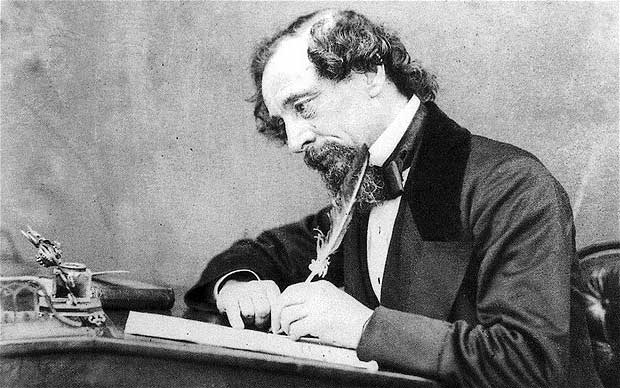
We keep coming back to A Christmas Carol, in all its variations, from Alistair Sim’s film archetype to the Muppets, and it suddenly, since November, means as much now as it did when it was first published at Christmas in 1843.
Unlike another cinematic descendant, It’s a Wonderful Life, Dickens’s novella was an instant sensation. It was beautifully timed: the Prince Consort, Albert, was bringing German Christmas traditions to England and transforming it into the holiday, down to gloriously lit Christmas trees, that Americans recognize today. I can still remember the German words to “A Christmas Tree” from Branch Elementary School:
Du grunst nicht nur zur Sommerzeit,
Nein, auch im Winter, wenn es schneit.
O Tannenbaum, O Tannenbaum
Wie treu sind deine Blatter!
And for that I have to thank Albert, doomed to perpetual marblehood by his neurotic widow. But even she read Dickens. (And Harriet Beecher Stowe: Uncle Tom’s Cabin made the Queen weep.)
And the rest of England was moved, as well, by literature, thanks to Dickens. Since most of his novels were serialized in newspapers, the Queen’s subjects were as addicted to them as modern Americans are to soap operas or to the next Star Wars release.
What we miss–and what Dickens intended–was that this little work was every bit as much about the nature of evil, especially when it’s deliberately chosen, as it was about Christmas. What saved Scrooge from his choices was the chance at redemption, a theme constant in Dickens’s works, from Pip to Sidney Carton.
Here is the evil that was England’s freight in 1843: Already the white moths that lived on birch trees in the Midlands and in London’s suburbs were disappearing. because the birch bark was no longer white: it was soot-gray, painted by the waste pouring out of coal-fired factories. The white moths became fodder for hungry birds, you see, and, as the devoutly Christian Darwin realized, nature selected the grayish mutations who were less conspicuous.
Other victims happened to be human beings. Child labor, like little Copperfield, Dickens’s equivalent in the bootblack factory, was commonplace and so were the debtors’ prisons where Dickens’s father, thinly disguised as the feckless and delightful Micawber, spent time. Parliament’s Sadler Commission toured and gathered the testimony of children who had watched numbly as their friends’ arms were crushed in the maws of power looms and of mothers whose lives were so fragile that they were never quite sure of just how old they were.
`Are there no prisons?’ asked Scrooge.
`Plenty of prisons,’ said the gentleman, laying down the pen again.
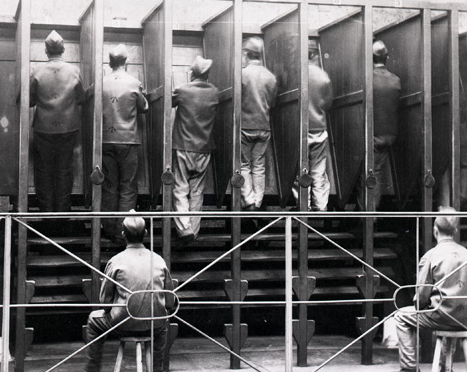
`The Treadmill and the Poor Law are in full vigour, then?’ said Scrooge.
`Both very busy, sir.’
`Oh! I was afraid, from what you said at first, that something had occurred to stop them in their useful course,’ said Scrooge. `I’m very glad to hear it.’
This is a treadmill, adapted, with the moral superiority attendant to imperialism, to India. Its ultimate purpose was to humiliate the poor.
Unlike the poor, Scrooge is uncommonly and inscrutably lucky (he doesn’t much deserve it, does he?) , of course, because Dickens offers him salvation through a series of haunts. First he is greeted by that inimitable “indigestible bit of beef:” his former partner, Marley.
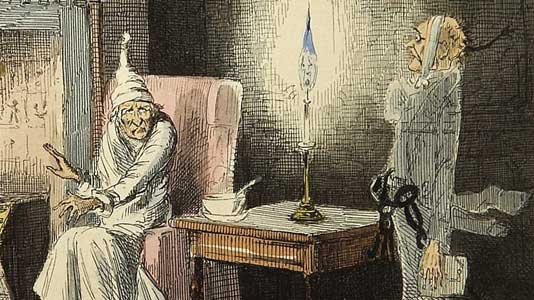
Marley’s ghost.
“But you were always a good man of business, Jacob,’ faltered Scrooge, who now began to apply this to himself.
“Business!’ cried the Ghost, wringing its hands again. “Mankind was my business; charity, mercy, forbearance, and benevolence, were, all, my business. The deals of my trade were but a drop of water in the comprehensive ocean of my business!”
It was the business of Victorian capitalists to magnify profit at the expense of humanity. They were helped by an influx of country folk whose land had been enclosed, accompanied by an ironic burst in population made possible by the food provided by the progressive farmers–Thomas Hardy’s folk– who had done the enclosing. There were an infinite number of prospective industrial workers and a finite number of industrial jobs.
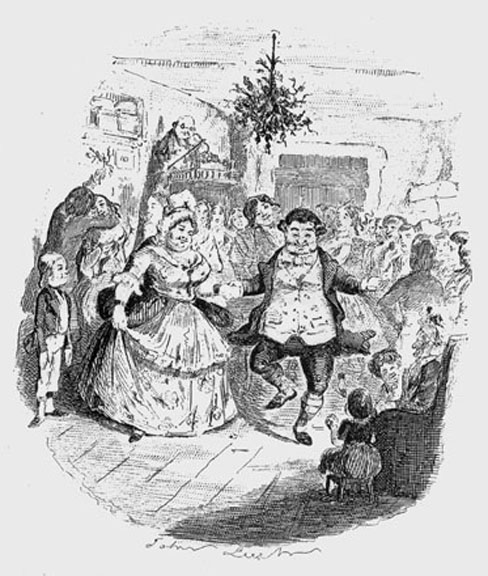
Fezziwig at Christmas.
It is the pleasant duty of the Ghost of Christmas Past to remind Scrooge of what a good man of business Fezziwig was. This was not a man prone to hiring and exploiting ignorant foreigners, to stiffing subcontractors, to using attorneys as if they were pit bulls. Not Fezziwig. And Scrooge is, course, such a vivid contrast:
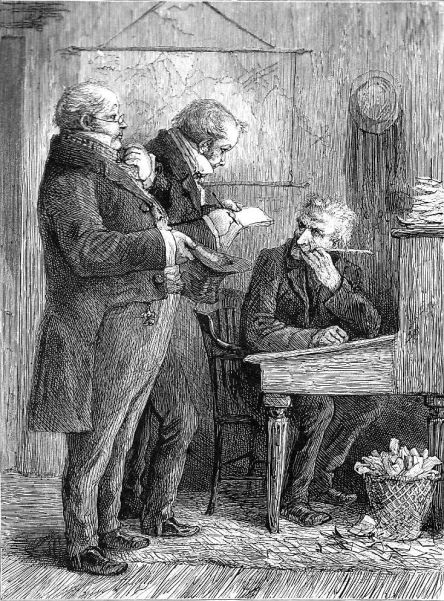
The Charitable Gentlemen visit Scrooge and Marley.
`If they would rather die,’ said Scrooge, `they had better do it, and decrease the surplus population.'”
In this passage, Dickens is mocking the economics–then called “the dismal science”–of Thomas Malthus, who argued that while the food supply increased arithmetically, the population increased geometrically, so starvation was a necessary and inevitable corrective. So, argued David Ricardo, Malthus’s acolyte, were depressed wages: since there were always more workers than there were jobs, wages, obedient to the laws of supply and demand, would always be depressed. It was a law of nature, and the capitalist was powerless to oppose it.
The Ghost of Christmas Present introduced Scrooge to reality:
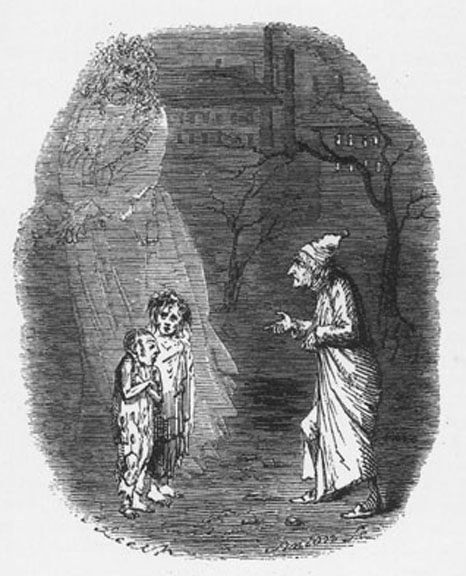
“This boy is Ignorance. This girl is Want. Beware them both, and all of their degree, but most of all beware this boy, for on his brow I see that written which is Doom, unless the writing be erased.
“Have they no refuge or resource?” cried Scrooge. ‘Are there no prisons?’said the Spirit, turning on him for the last time with his own words. ‘Are there no workhouses?'”
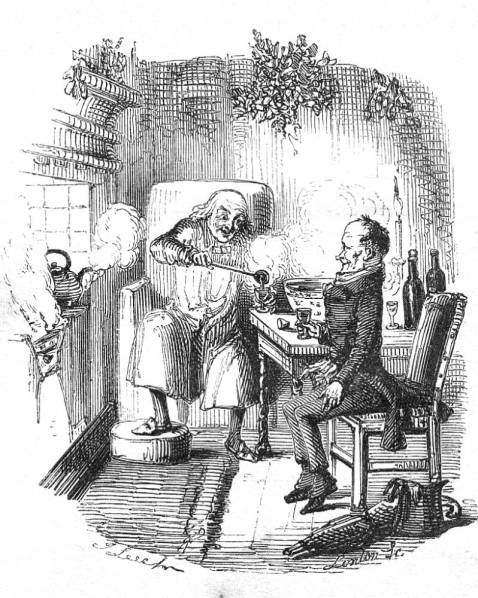
Scrooge and Cratchit keep Christmas
Scrooge’s one positive quality was that he was teachable. That smoothed his path to redemption.
At Christmas we celebrate the hope, incarnate in a newborn, that we will find redemption. Many of us–perhaps all of us?–hunger for a force powerful enough to recognize, understand, and then burn away our shame. Beneath it is our core: the person who is our truest self.
The ultimate source of this kind of power, of course, was the child born in poverty. Perhaps it was his confrontation with poverty, and not with ghosts, that allowed Ebenezer Scrooge to discover the meaning of Christmas.

 A Work in Progress