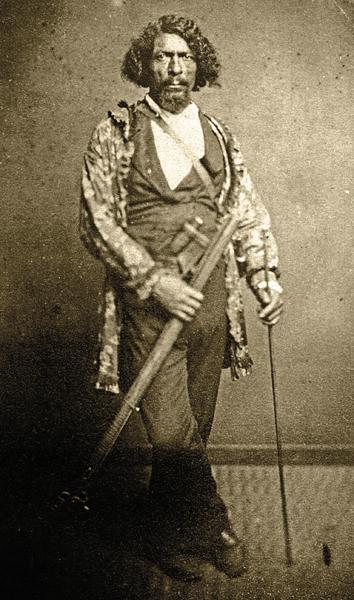
James Beckwourth
The horse’s hooves punctuated the long ride with a steady tattoo of crunches as they crushed grass stiffened by winter. His rider had to admit that it was getting harder to leave the warmth of a December hearth. He was nearing fifty now, in mid-century, and, truth be told, he shouldn’t have lived this long, but he had an instinct for detecting death and pulling his horse up short of it. That’s what had happened when he’d found what was left of Hugh Glass back on the Yellowstone. Glass was the army scout, the famed survivor of a grizzly attack, the man who’d taken months to heal himself and then to track down the trappers who’d left him for dead. He wanted it back. Later, the Arikara got Glass. That was fifteen years ago, in 1833.
There could be no greater contrast with the somber discovery of a cold scalped white man than the Christmas ribbons and the children who had surrounded the rider, James Beckwourth, in the adobe ranch house he’d left sixty miles ago. He’d picked up the mail there, in Nipomo, California, at the home of a Yankee ranchero named William Dana. Beckwourth liked children, didn’t mind them climbing on him, and there were seven young climbers so far, at the Dana adobe and two more in their teens, nine of the twenty-one Dana and his wife, Josefa, ultimately would bring into the world. They would lose half of them in infancy or a little beyond. Beckwourth’s children were lost, too, but in a different way. There were four that he knew of, mothered by Crow and Mexican women he’d left behind in a lifetime of trapping, exploring, scouting, and now, carrying the mail north along El Camino Real, the old highway the Franciscans had traveled, north to Monterey.
It was long enough between Nipomo and the Dana children and his next stopping place, San Miguel and the Reed children, so that as he got close, Beckwourth clucked encouragement to his mount, who responded eagerly because there would be oats and the great relief of a currying and a rubdown with blankets once the saddle and the mailbags had been removed.
But even the horse might have sensed something wrong, either in the scent that reached his nostrils or in the dark that cloaked the mission colonnade at San Miguel. There should have been light, even if it was the flicker of a single candle. There should have been voices from the warmth of the tavern William Reed kept in the old adobe outbuildings, now beginning their inexorable decay back into the California earth. Most of all, there should have been children.
Beckwourth’s instincts, for once, almost failed him. Maybe he was getting too old. When he dismounted, slowly and stiffly, he walked cautiously into the Mission grounds, toward the tavern kitchen the Reed family kept so well, along with the other black man, other than James Beckwourth, in this part of California.
Dark comes quickly in December, and Beckwourth tripped over something in the kitchen doorway. When he kneeled next to the obstacle and ran his fingers over it, it was cold as Hugh Glass. He realized it was a corpse. Beckwourth sprang to his feet and went back to his mount to retrieve his pistols from their saddlebags, and the animal shied and retreated a step when he reached for them.
Beckwourth didn’t know it, but his horse did. They weren’t alone.
 A Work in Progress