
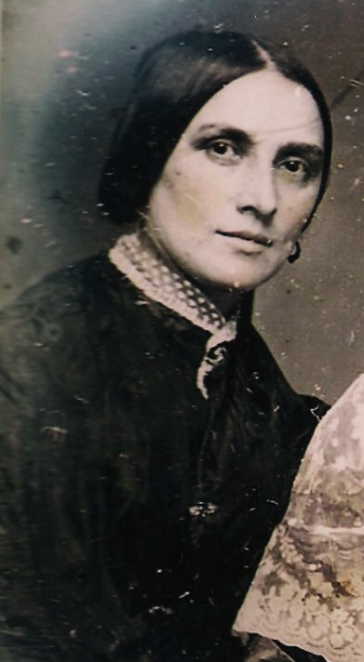
Her full name was Maria Ramona de Luz Carrillo Pacheco de Wilson. I think. I accidentally found this photograph of her, age 37, while I was looking for something else entirely, which is how I usually find the material I need the most for writing history. It’s a puzzler, that.
She, more importantly, was born a Carrillo, in San Diego, which immediately assigns her a special place in our history. There was no family more prominent in Mexican California. Her father was the commandante of the Santa Barbara Presidio, her son would become the twelfth governor of California, and her (second) husband, Yankee sea captain John Wilson, owned the lengthily-named Rancho Canada de Los Osos y Pecho y Islay, which translates in modern terms, to pretty much everything between Montana de Oro and Cambria.
Owning that much land boggles my mind. I grew up on three acres, and thought that much land immense.
Here is the point: She is, at 37, a handsome woman. It is difficult to imagine the self-assurance a man must have felt with a woman like this on his arm.
And she must have been, at sixteen, a delight.
To watch her dance must have been mesmerizing, and Californio women didn’t expend that much energy at fandangos. Dancing was prized, but it was a male pursuit. Young men, and even older men, like Juan Bandini, reputedly the best dancer in Mexican California, did the dancing, like Mick Jagger roosters on Dexedrine, and sixteen-year-olds like Maria moved chastely and modestly, their lacquered Chinese fans held aloft and their long lashes cast downward, while the young men, as is the the perfect right of young men, made fools of themselves in public.
Even Maria Ramona’s downcast eyelashes, I believe, must have been devastating. I would consider giving one or more arms to get the chance to go backward in time to see her at sixteen.
But this photograph–undoubtedly, part of a group portrait, because you can detect, at lower right, the wedding lace or First Communion lace or the quinceañera lace of another woman–is a revelation. It’s one more reason why I love women. I don’t “cherish” them. You don’t “cherish” a human being who can give birth to another human being with the density of a bowling ball and the kinetic energy of a herd of buffalo on the Yellowstone. No. You love them. You acknowledge your own gender’s fragility, then you move on, loving them, and trying to keep up with them.
Maria, for example. She was born in 1812 and died in 1888, the same year my two-room school, Branch School, was built. When my parents drove me to that school for the Hallowe’en carnival (Houses were too far apart in the Upper Arroyo Grande Valley for trick or treating. You’d wind up in Pozo.), I could see, in the limbs of California oaks, bandidos reaching to snatch me from the car, especially if the moon was full. There was always history, in my little-boy imagination, just beyond the moonlight.
One of my first memories in the Valley was that of the home of another Californio matriarch, Manuela Branch, as it caught fire, about 1958, in the corner opposite the Valley from our home on Huasna Road. I had never seen anything burn so bright, and it would take me a few years to realize how costly that fire had been, how completely it had erased the traces of a woman so important. She was buried over the hill from our two-room school, alongside her husband–from Scipio, New York, of all places–-and alongside him, three little girls taken by smallpox in 1862, and, a few yards beyond their tombstones, the common tombstone of a father and son lynched in 1886.
How did they endure? Maria Josefa Dana gave birth to twenty-one children and lost more than half of them at birth or within five years. Nine of Manuela Branch’s survived, but she lived thirty-five years beyond her husband, who died in 1874. Maria Ramona de Luz Carrillo Pacheco de Wilson’s progeny was modest by Californio standards: seven children, but three of them would die before they’d reached twenty-five.
So here she is, in 1849, looking squarely at the photographer without flinching, and this was an age when the camera lens remained open so long because the “film” in those days, on glass-plate negatives, was so slow, that chancing a smile, even a faint one like hers, likely meant that her face would be lost to posterity. It would be a blur. Matthew Brady, in his Washington City studio, kept on hand a variety of neck and head braces, reminiscent of the Inquisition, to keep his subjects, including Lincoln, perfectly still.
And here she is, smiling, albeit faintly, like some kind of San Luis Obispo County Mona Lisa.
What is she smiling about?
It is, more than likely, an event in which she is a peripheral character. If it is a First Communion, a quinceñeria, or a wedding, it is certainly not hers. She is merely a guest. But the fact that she is included, even at the edge of what seems to be a group photo, one in which the celebrants wanted her presence, is indicative of her prominence and indicative of so much more: her personal strength, her unshakable calm, her dignity, and, most of all, her integrity.
You cannot “cherish” a quality like integrity. You either understand it, or you don’t. This woman was bred into it, born into it, grown into it, and she would impart it in the generations who lived far beyond her death in 1888.
Her husbands were lucky enough to live with it, and with her.
She lived a life as strong as Christ’s rock—Jesus, fond of puns, changed Simon’s name to Peter, or “rock”—and soft as velvet. This is a proud woman.
She has every right to be.
 A Work in Progress