
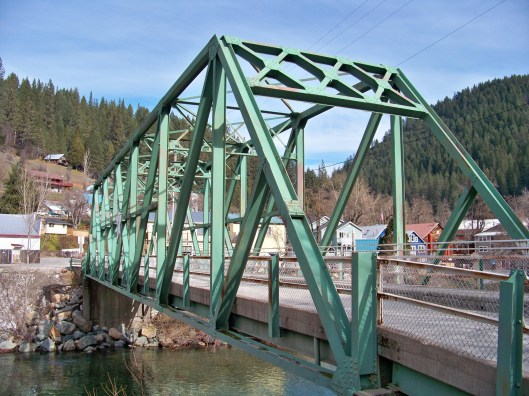
The modern Durgan Bridge, Downieville, marks the spot of the earlier bridge that served as Juanita’s gallows.
His name was Joseph Cannon, and he was just that subtle. He was a big man, over six feet tall and two hundred thirty pounds. On July 4, 1851, in the mining camp at Downieville, even though Cannon was an Australian, he was determined to celebrate the Fourth and he had decided that every miner in the settlement needed to celebrate with him. So big Joseph Cannon began pounding on the cabin doors, causing them to shudder, since they were held gingerly in place by wooden latches and leather hinges. The inevitable happened: he broke down the door of a cabin belonging to a young couple who occupied a precarious place in Downieville’s social order. The cabin belonged to José, a gambler. He and his kind were seen as parasites, and they were a bit too well-dressed and smooth-talking for the rough-and-tumble miners. His lover, or common-law wife, was a prostitute named Juanita. José and Juanita were Mexicans, and that, too, made them vulnerable in a place like Downieville.
Meanwhile, Joseph Cannon, either despite or because of his boisterous nature, was a popular miner. But he compounded his error by knocking down the cabin door and then falling with it, tumbling into the private space of the horrified young couple. In a society were order was based on the respect of property rights, Cannon was the most egregious of trespassers. A drinking companion righted the big man and pushed him back outside.
It was José who took up the issue of trespassing the next day when he confronted a reasonably sober Cannon with the issue of the broken door. The conversation between the two began amicably, some said, but soon grew heated, bilingual, and profane as the massive Cannon began to jaw at point-blank range with the smaller gambler. That’s when Juanita, perhaps out of protectiveness, joined the argument. Cannon called her a whore. Juanita raised the ante with a Bowie knife. She killed Joseph Cannon with it.
A platform had been erected for the Fourth of July observance and it now became the stage for an extemporaneous murder trial as 5,000 enraged miners crowded around it, howling for Juanita’s execution. They got it, and promptly, despite the intervention of a local doctor, who maintained that Juanita was pregnant. The crowd nearly turned on him, too.
Juanita was perhaps the calmest person in Downieville on July 5, 1851. She carefully climbed a ladder, along with an executioner, to a noose suspended from the crossbeams of the Durgan Bridge. She told the men below her that she would do the same thing again had any of them insulted her honor the way that Cannon had. The last thing she did was to free a braid of her hair from the noose before it was cinched tight.
 A Work in Progress