
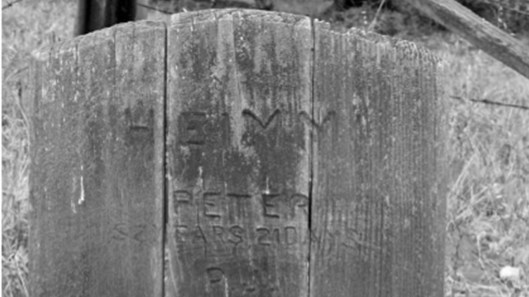
From the San Luis Obispo Tribune:
County Correspondence
SANTA MANUELA SCHOOL
EDITOR TRIBUNE:–Following is a report of the Santa Manuela school for the month ending November 2nd, 1883. Total days attendance 299 1/2; days absence 22 ½, whole number of pupils enrolled 19; average number belonging 15. Present during the month, Joe Branch, Julius Hemmi, Leroy Jatta, Charlie Kinney and Addie Hemmi.
CLARA GANOUNG, Teacher.
Arroyo Grande, Nov. 3, 1883.
When the Lopez Dam was completed in the Upper Arroyo Grande in 1969, San Luis Obispo County officials were hopeful that it might fill in five years. It filled in one. So much rain came in 1968-69—the opposite of the terrible 1860s drought−that the dam spilled in April. During the winter, Arroyo Grande Creek filled to twenty feet deep where it flowed under Harris Bridge, at the intersection of Huasna Road and today’s Lopez Drive. School had to be canceled some days. With the high school built on top of hardpan in the floodplain of the Lower Valley, upperclassman joked that the standing waters were too deep for freshmen,so the school board had chosen wisely at placing such short people on a separate campus, atop Crown Hill. One of the great examples of historical foresight came when authorities moved the historic one-room Santa Manuela School away from what would have been lake bottom. Today it sits near the swinging bridge that spans the creek in downtown Arroyo Grande. It is a lovingly preserved and charming evocation of the kind of education that mattered most to 19th century farmers.
That meant, for students like Julius Hemmi, the wisdom of the basics. Julius would have been one of the bigger boys of the nineteen students and near the end of his education, because the high school was still thirteen years in the future. Julius, if he was attentive, and his father was a clever man, would have mastered, by the time the 1883 notice appeared in the Tribune, his times tables and percents, his state and his European capitals, would be able to recite “The Gettysburg Address” and to write, for a boy, passable longhand. That was all that Julius would need to take up farming with his immigrant father, Peter. If Julius was a big boy, and he probably was, there is always the chance that he got to practice the kind of tyranny over his younger classmates depicted in novels like Tom Brown’s School Days. But, with nineteen students, a big boy like Julius would have been on Miss Ganoung’s short leash. If she was typical of rural schoolmarms in the late 19th century, she kept that leash tight, she protected the younger children, and she kept a small circle on her blackboard against which saucy students would press their noses, without moving, for an hour at a time.
Julius, and we don’t know this, may not have needed the chalkboard circle at all, because the other names in the newspaper notice—Branch and Jatta, for example−belonged to families far more important and far more established than the Hemmis. Joseph Branch’s grandparents had been the first to settle the Arroyo Grande Valley, in 1837, and his grandfather had had to contend with monstrous grizzly bears and Tulare Indian raids, and he had vanquished both threats. Leroy Jatta’s family, Canadians, were more recent arrivals, but the Jattas would marry into the Loomis family and together they would form the foundation of Arroyo Grande’s merchant class, families together that would be important to the Valley deep into the twentieth century, families known for their enterprise and, even more, for their integrity. We do know this much about Julius: he had a little sister, Addie, to look after at school, and he would always know that she was looking at him. We know, too, that Mrs. Hemmi adored her son.
It was April Fool’s Day, 1886, so the teachers in town, at the two-story school that stood on the site of today’s Ford agency in Arroyo Grande, would have refused to believe the boys that morning, a little ashen-faced, as they walked into the Arroyo Grande Grammar School to hang their coats and hats on two tiers of brass hooks, and below place them their lunches, wrapped in oilcloth. These boys attended a school monstrously bigger than Santa Manuela. (The Arroyo Grande kids would have seen Santa Manuela as a school for country hicks.) Since they were boys of the town, a little more sophisticated and a little more jaded than the children from the one- or two-room schools of the Upper Arroyo Grande Valley, Los Berros, Edna, or Nipomo, no teacher with more than two years’ experience would have believed for a moment any of them when they insisted that they’d seen two men hanged from the Pacific Coast Railway trestle at the upper end of town, just below Crown Hill. No teacher would have hesitated to rebuke a little boy with such a cruel April Fool’s joke, one so tasteless that it merited a circle on the blackboard or, even better—far better−a mouthful of powdered soap.
But the little boys weren’t lying.
There were two men hanging from the Pacific Coast Railway trestle, and they would remain there until the coroner drove down that afternoon from the city, from San Luis Obispo, stared up at them, testily convened a work party that doubled as a panel for his inquest, and ordered them finally cut down for examination. One of the bodies belonged to Addie Hemmi’s big brother. He had strangled at the end of his rope.
Julius was fifteen years old when the good citizens of Arroyo Grande lynched him from the little railroad bridge over the Arroyo Grande Creek. He would have been as stiff as a dead mule deer buck by the time the awed little third-graders found him the morning of April Fool’s Day. This was the only kind of death these little boys might ever have seen, a hunter’s death, dealt at the hands of their fathers. Above the empty stiffness of his body, Julius Hemmi’s face would have been the color of clay. So would the face of his father, Peter, who was hanging next to him. The little boys did not yet know that these deaths, too, were dealt at the hands of their fathers.
 A Work in Progress