
“The past isn’t dead. It isn’t even past.” William Faulkner

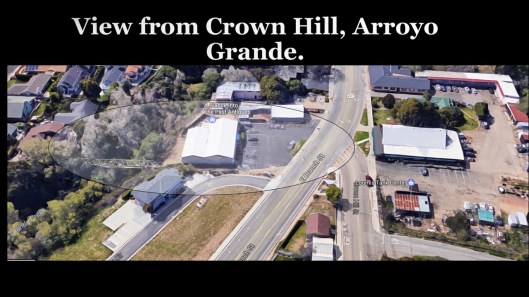
Branch Street, courtesy of Google Maps. The EC Loomis store is on the right. Circled is the antique store and its parking lot, along with the pipeline that crosses Arroyo Grande Creek.
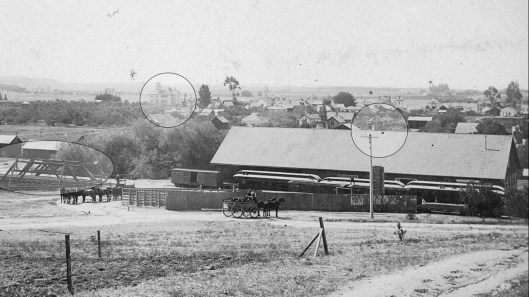
The antique store’s site, about 1890. That’s a lumber mill, with Pacific Coast Railway passenger cars pulled onto a siding. Circled are the elementary school, where Mullahey Ford is today, the History House Museum, and the PCRR trestle. Children on their way to that school found two men hanging from that trestle.

The two were a father and his son, now buried two miles away in the Branch family graveyard. Nearly everything from their time, from 1886, is gone now.

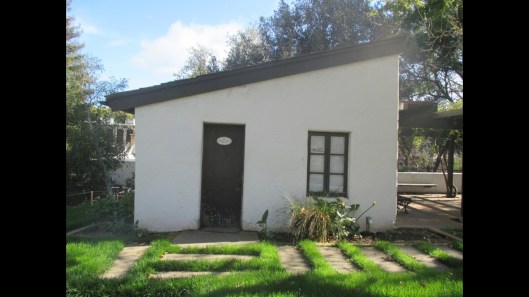
Except for this. This is P.J. Hemmi’s schoolhouse. Miss Ganoung was his teacher in 1884. Two years later, he was lynched, and his school is only a few hundred yards away from where his life ended at fifteen years, five months. He’d shot a neighbor and the neighbor’s wife in Lopez Canyon over a property dispute.
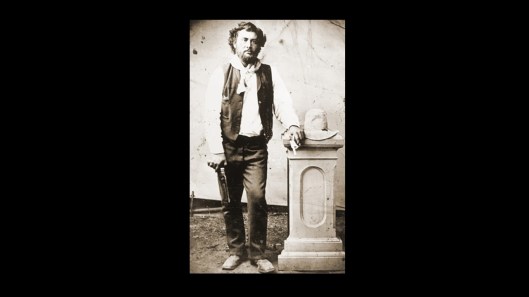
This is Pio Linares. He was an outlaw who ran with the Jack Powers gang, men who terrorized El Camino Real during the 1850s. He was shot to death near Turri Road in the Los Osos Valley in a running two-day gunfight in 1858. He was 28.
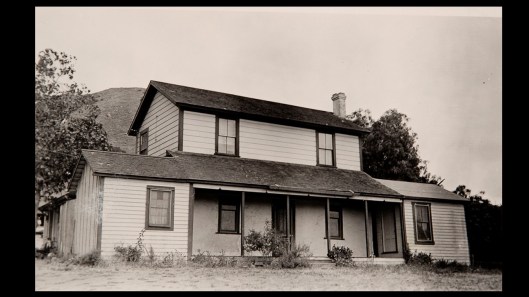
This was Pio Linares’ home, in the hills above what is today the San Luis Obispo High School campus. A posse led by Sheriff Francisco Castro fought a gunfight nearby in an attempt to arrest Linares. He escaped, but not for long. Sheriff Castro eventually retired and moved to Ontario Road. When a neighbor shot him at point-blank range during an argument twenty years later, Castro beat the man to death with his revolver before he died of the gunshot wound.
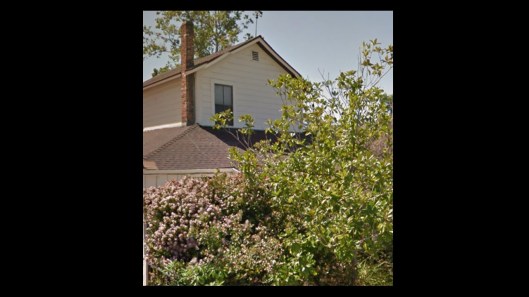
This is Pio Linares’ home today. Is it haunted? According to the people who live there: Yes.
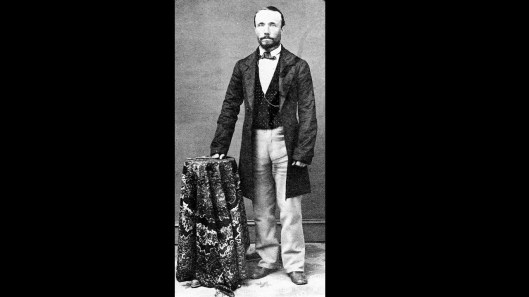
This was the man who went after Linares and his gang. He was Walter Murray, attorney, founder of the San Luis Tribune, and a judge. But in 1858, he founded the Vigilance Committee that would hunt down Linares and hang six of his suspected gang members in front of Mission San Luis Obispo. All of them were Californios, or Californians of Mexican descent. It would be easy, especially after reading some of the passages in Murray’s early reporting, to call him a racist. Especially for me, whose college history major was focused on Mexican history.
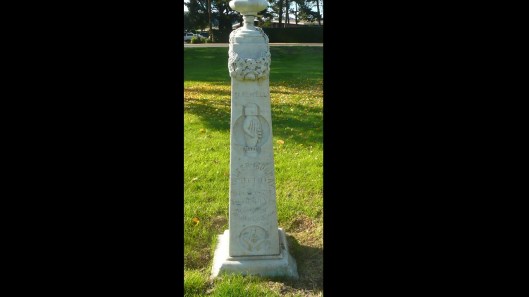
Here’s the problem. Murray was married to a Latina, a Chilean widow whom he’d met in the gold fields. (And a third of the Vigilance Committee’s members were Californios, with Latino surnames.) Murray died young, at 49. Look carefully at the tombstone–a woman’s hand holds fast to a man’s. It tells you something about his marriage, doesn’t it?
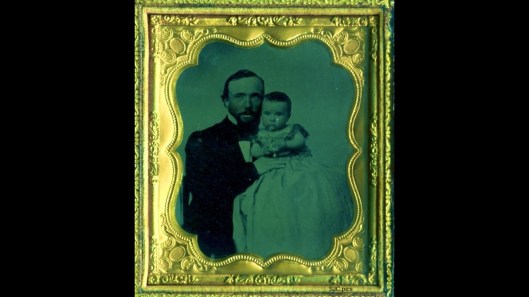
This is Murray and his little girl, one of five children born to the Murrays after they’d moved to San Luis Obispo. I think this photo suggests the motivation for the Vigilance Committee: Murray wanted his children to grow up in safety.
The remnant of his in-town home and law office in today’s Mission Plaza. He also had a ranch and ranch house about where the Apple Farm is today. A little bit of Murray is still with us–including his newspaper.
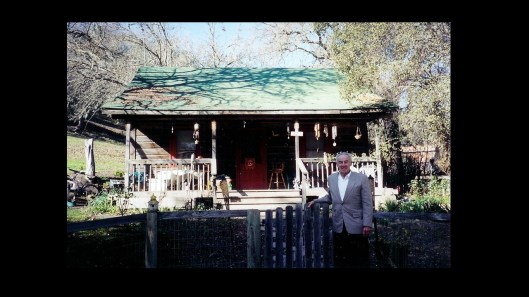
This is a photo from a big family reunion in 2002. Members of this family converged on this little ranch house near Paso Robles. They came from all over America. The man you see is a very respected judge, James R. Ross.
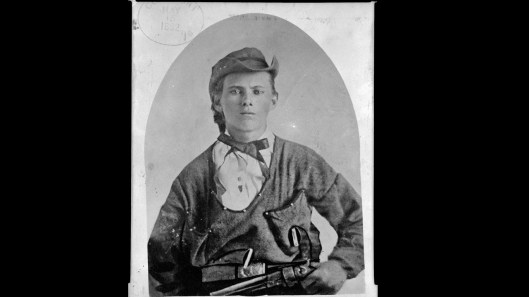
The name “James R. Ross” should mean nothing to you. But his first name is “James” because the family reunion was meant to commemorate this common ancestor. This is a photograph of Jesse James, taken about four years before he and Frank lived for a year in that little house near Paso Robles, on the ranch of their uncle, Drury James. A generation later, in 1891-92, another outlaw family, the Daltons, lived nearby.
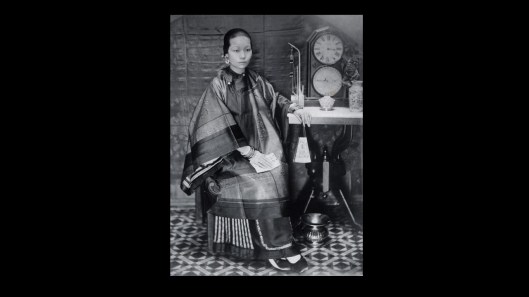
Her name was Gon Ying, or “Silver Dove.” She was twenty-eight years younger than her husband when they married in San Francisco in the 1880s. She would bear him eight children. Those children would grow up to be businessmen and businesswomen, athletes, military officers, musicians, philanthropists. She was, I think, a wonderful mother.
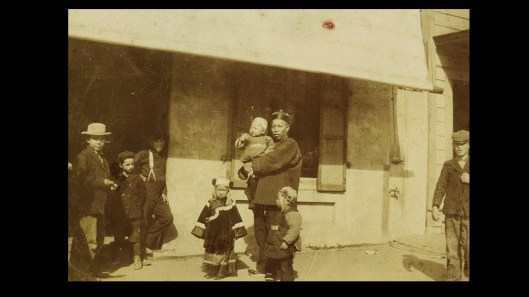
But Gon Ying raised her family in a California that was plagued by racism. Someone dynamited a Chinese laundry in her new home, San Luis Obispo. There is just a hint of the tension between the races in this photograph taken on Palm Street, just in front of Gon Ying’s home. In the twenty years that she lived there, she left only twice, once for a visit to the dentist. She was dead when she left the third time.
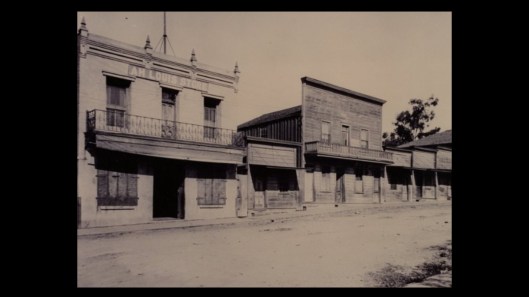
Gon Ying lived on the second floor of her husband’s Ah Louis store on Palm Street. In that tiny space, she raised eight accomplished children. In 1909, after her husband left on the train to meet with flower grower Lewis Routzahn in Arroyo Grande, an intruder shot her to death in her sleep as she lay next to her baby boy, Howard.
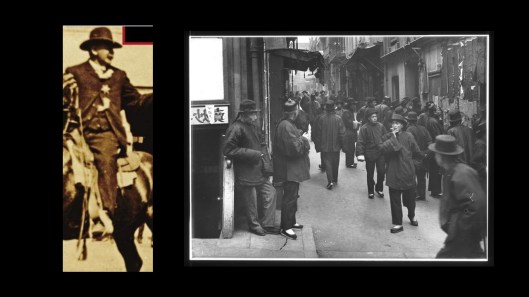
The county sheriff in 1909 was the Irish-American Yancey McFadden, born and raised in Paso Robles. McFadden surveyed the scene in the upstairs apartments in the Ah Louis store and, three days later, he took the train to San Francisco and to Chinatown, the subject of the image at right captured by documentary photographer Arnold Genthe at about the time McFadden was there, three and a half years after the earthquake and fire.
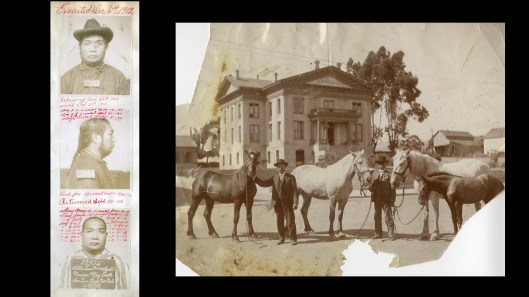
McFadden brought back Willie Wong Luis, Ah Louis’ son from a previous marriage. Willie Luis had accompanied his stepmother’s casket to San Francisco, where it was to be shipped back to China. Luis confessed to McFadden. He had stolen his stepmother’s jewelry and cash. The two hated each other. That little apartment above the store had to have been thick with tension that had been building up for years. Willie Luis was tried–he spoke little English, and so understood almost nothing of what was being said by witnesses and attorneys– in the old county courthouse (torn down single-handedly by Alex Madonna in 1939), across from the Fremont Theater. He was convicted and would be hanged at San Quentin three years later. These are his booking photos. They issued Willie prison stripes and shaved off the queue mandated by the Qing Dynasty. A reporter claimed that he was smiling on the platform on the day he died.
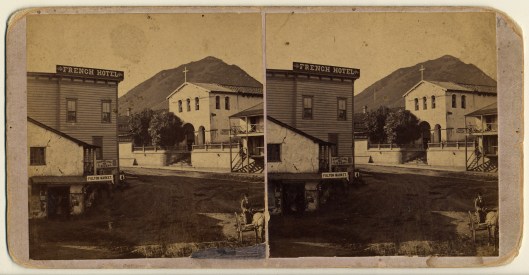
So, many of these places are still with us. That means, I think, that the people who lived their lives here can’t be so far away, either.
 A Work in Progress