• About
  • The Germans

A Work in Progress

A Work in Progress

Monthly Archives: October 2017

Kids who can breathe.

15 Sunday Oct 2017

Posted by ag1970 in Uncategorized

≈ Leave a comment


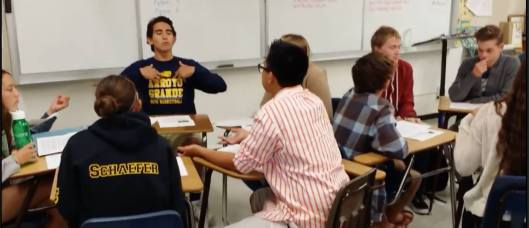
11021332_10206180776982143_8018641079003443320_o

My kids, as JFK’s ExComm, debate what course they should take in the Cuban Missile Crisis. Life is short: Bunn, the young man in the striped shirt, was a delightful person and a gifted student. He was killed this year in an automobile accident.

I found the article below heart-breaking, in part because it was so familiar to my thirty years of teaching high school, in part because it was so alien to my own experience.

What marked my childhood and teens was the relative simplicity of those years. We got three TV channels, on a good day, on Huasna Road. There were land lines and, after school dances, pay phones, not “smart phones.” If I needed to take the pressure off, I would sneak into my Dad’s car, turn on the radio, and listen to Wolfman Jack and the wonderful rock ‘n’ roll that came from somewhere in Mexico via station XERB.

Another blessing was how unstructured our time was. I had endless room to breathe–lost in the pages of books, exploring the hills of the Upper Arroyo Grande Valley, learning Spanish from braceros, trout-fishing in the Arroyo Grande Creek.

I am not suggesting an idyllic childhood. I grew up in an alcoholic, sometimes violent home, but my parents tried hard to be the best parents they could be, and the values I inherited from them made me decide to become a history teacher, and allowed me, in the teaching, to recognize and to love the vitality in the 32 teenaged lives arranged in rows before me every class period of every day for thirty years.

I have my parents to thank for that.

But I saw this anxiety, the kind documented in the Times article, over and over again in the kids I taught every class period of every day for thirty years.

It was as if they had to prove themselves, to prove their worthiness to themselves and to their parents, and there was no reliable inner measure for them to rely on. They had, instead, to do things–club volleyball, student government, six Advanced Placement classes (I would never have allowed my child to take six AP classes, and I taught AP for most of my career), or winning awards. If they didn’t have these extrinsic measures, they would never get into the college of their choice, never have a career that was rewarding, never have the spouse they deserved, never have the kind of validation that, ironically, God never requires nor desires.

Sometimes, when they were taking a test or writing an essay, I would just stare at them, my heart full, at the miracle of their youth and the promise of their future. (It saves me from the despair that is so much a part of our present political life. It is about all that saves me.)

Those were moments every good teacher experiences, and that fullness of heart stays with you all your life.

They never had anything to prove to me. I just wish I had made that clearer.
The most famous sinner in America

13 Friday Oct 2017

Posted by ag1970 in Uncategorized

≈ Leave a comment


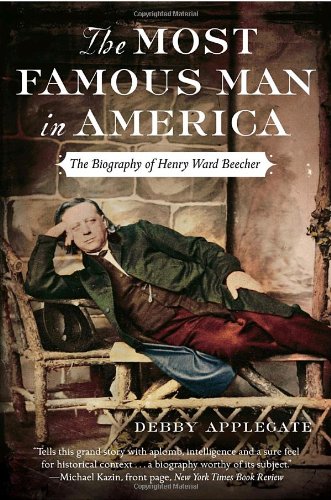
51JQ5z85TkL

The shamelessness of powerful, predatory men has reminded me of Debby Applegate’s superb biography of the Civil War-era preacher Henry Ward Beecher, “The Most Famous Man in America.”

Beecher, a New England Congregationalist, was progressive,an immensely powerful preacher, a committed abolitionist, and he came from a stellar family (sister Harriet wrote “Uncle Tom’s Cabin” and my AP Euro students may remember sister Catharine as the inventor of the modern kitchen and a formative influence on the Victorian “Cult of Domesticity”)

The family’s patriarch, Lyman, was an unbending man who knew with certainty that Catholics, Unitarians and Methodists were going to hell, postage-paid. Lyman also forbade Catharine’s marriage to a young minister because the elder Beecher was unconvinced of the depth and authenticity of the young man’s conversion. The young preacher then sailed for England, in part to rededicate his commitment to Christ, and drowned in a shipwreck. Catharine never married.

H.W. strayed from his father’s path and instead preached a message that emphasized God’s mercy and love. The younger Beecher was never able to keep his trousers in order, however, was accused of multiple affairs, and was charged with adultery in one of the most sensational trials of its day.

Applegate’s biography won the 2006 Pulitzer Prize. She is an enormously talented writer and a steady, dogged and meticulous historian. It’s one of those books that’s more than a “mere” biography. It’s also a fascinating education on mid-Victorian American religion, politics and sexuality.


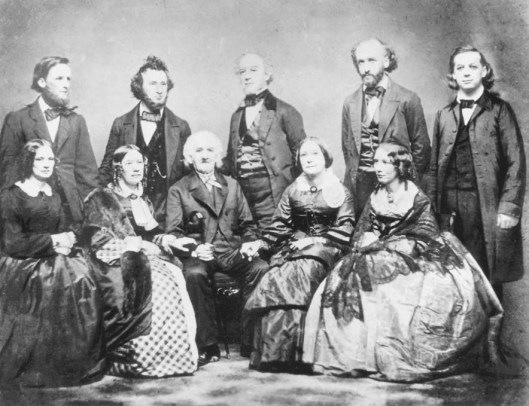
1300224636_lyman-beecher

The Beechers. Lyman at center, Catharine on her father’s immediate right, Harriet Beecher Stowe at far right, her brother Henry Ward Beecher standing at far right.

.

Hallowe’en in the Branch District

07 Saturday Oct 2017

Posted by ag1970 in Uncategorized

≈ 2 Comments


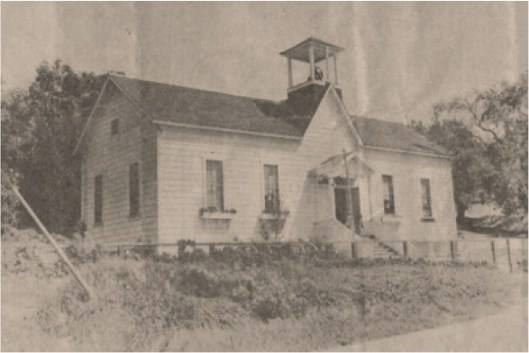
Branch

Branch School during, probably, the early 1950s. They had taken away both the steeple and the side windows by the time I went there, probably after an episode of Cupcake Mania at Hallowe’en.

We did not trick or treat on Huasna Road in the 1950s and early 1960s. The problem was that the houses were so far apart that children from the Upper Arroyo Grande Valley, during the Great Depression, desperate for caramel corn, had been found wandering in Pozo with their sad, greasy little paper bags empty except for crushed candy wrappers, rusted “Keep Cool with Coolidge” campaign buttons, or  brown, withered apple cores.

The other problem occurred whenever there was a full moon. If you know the Arroyo Grande area at all, then you know that in moonlight the gnarled, twisted oak trees assume human shapes. Some of them have gaping knotholes in their trunks, just big enough to swallow unwary third-graders. Many children, in the 1930s Branch District, went trick or treating and were never found, not even in Pozo.

So, to avoid the alarming loss of Branch School children and the tax dollars they represented, we had, by the 1950s, a relatively safe Hallowe’en Carnival at Branch, at the two-room schoolhouse–the one with the pink asbestos shingles, which has had no discernible effect (pardon me: hack!) on my personal life as a large person.

The thing was, all the fathers would gather cornstalks for a properly decorative motif at school  (I don’t know where they got them. Branch Dads grew Brussels sprouts and cabbage, neither with strong Hallowe’en associations).  Stiff, dead, dry cornstalks, vaguely resembling skeletons, are very nearly as scary as the carnivorous oak trees that lurked at the edges of Branch Mill Road, menacing, silent, sometimes sibilant in the wind, occasionally belching. Moms would put out carved pumpkins, too, relatively harmless until you, at age seven, got around to watching Disney’s “Legend of Sleepy Hollow,” narrated by Bing Crosby, whom you never trusted again.

I actually went to the carnival as “The Headless Horseman” one Hallowe’en. None of my classmates–not one of the seventy-four–spoke to me until Christmas vacation was over.

Damn you, Bing Crosby.

But we would have “fishing booths” at the carnival, where little kids tossed fishing lines –strings attached to willow branches– over the top of a newsprint-paper enclosed booth (Where did our teachers get the energy to do this stuff? They must have been worn out from the corporal punishment that was as indispensable as the Parts of Speech and State Capitals.) and reel in a small toy or bite-sized Tootsie Rolls, which we imagined to be fish doo, but only momentarily, because it was obvious that they were chocolate, which is the third-grade equivalent of catnip or, for the typical college student, grain alcohol mildly diluted by Hawaiian Punch.

The fishing booths were for Minor Leaguers. The climax of the night, after the Costume Parade–which, we all agreed, was pretty lame–was the eighth grade’s Haunted House. The eighth graders were monstrous and mature people to us. They all seemed to be in their mid-thirties and so with enough life experience to reduce the smaller children to gelatinous puddles of terror in their dark, spooky, cavernous Haunted House, also known as a “classroom.” They laid in enough dry ice, for dramatic vapors, to freeze-dry every airman in the Soviet Air Force–a group we feared, in those Cold War years, only a little less than the eighth-graders.

They had discovered, when third-graders are blindfolded, that cold spaghetti is a splendid facsimile for human brains, and that Jello does a passable job of resembling the Digestive System we had just finished memorizing for Mrs. Kaiser. The third-grade girls loved the Haunted House, which allowed them to emit high-pitched decibel-busting screams, which put most of us off girls altogether until the sixth grade, when they were suddenly taller than us and vastly mysterious.

Those who survived the Haunted House–and there were a few–were allowed to partake of the Hallowe’en Climactic Meal, which consisted of tens of dozens of heavenly cupcakes, in every flavor and color imaginable, except for Brussels Sprout or Cabbage, baked by mothers driven by a still-persistent, albeit rural, late Victorian maternal urge: namely, the more cupcakes you baked, the better the harvest would be for your husband’s farm.

So we ate them.

We ate the chocolate ones, of course, most of all.

We did not sleep for three days. We bounced off the walls of our two-room school, with Mrs. Kaiser using a steel-shod yardstick to herd us (sadly, they did not allow cattle prods, not even in the 1950s) back to our wooden desks with the vestigial inkwells, until we were quiet again, studying our spelling lists, our times tables, and our American history dates. And so we learned: Communism was Evil. Chocolate cupcakes were sublime.

I still  know my American history dates, my times tables, and my state capitals. I am a little weak on my measures–how many pecks in a bushel?–but that might have been a lesson that came the day after Hallowe’en.

Subscribe

  • Entries (RSS)
  • Comments (RSS)

Archives

  • January 2026
  • December 2025
  • November 2025
  • October 2025
  • September 2025
  • August 2025
  • July 2025
  • June 2025
  • May 2025
  • April 2025
  • March 2025
  • February 2025
  • January 2025
  • December 2024
  • November 2024
  • October 2024
  • September 2024
  • August 2024
  • July 2024
  • June 2024
  • May 2024
  • April 2024
  • March 2024
  • February 2024
  • January 2024
  • December 2023
  • November 2023
  • October 2023
  • September 2023
  • August 2023
  • July 2023
  • June 2023
  • May 2023
  • April 2023
  • March 2023
  • February 2023
  • January 2023
  • December 2022
  • November 2022
  • October 2022
  • September 2022
  • August 2022
  • May 2022
  • April 2022
  • March 2022
  • February 2022
  • January 2022
  • December 2021
  • November 2021
  • October 2021
  • September 2021
  • August 2021
  • July 2021
  • June 2021
  • April 2021
  • March 2021
  • February 2021
  • January 2021
  • December 2020
  • November 2020
  • August 2020
  • July 2020
  • June 2020
  • May 2020
  • April 2020
  • January 2020
  • December 2019
  • November 2019
  • October 2019
  • September 2019
  • August 2019
  • May 2019
  • April 2019
  • March 2019
  • February 2019
  • January 2019
  • December 2018
  • November 2018
  • October 2018
  • September 2018
  • July 2018
  • June 2018
  • May 2018
  • April 2018
  • March 2018
  • February 2018
  • January 2018
  • December 2017
  • November 2017
  • October 2017
  • April 2017
  • March 2017
  • December 2016
  • November 2016
  • October 2016
  • September 2016
  • August 2016
  • July 2016
  • June 2016
  • April 2016
  • March 2016
  • February 2016
  • January 2016
  • December 2015
  • November 2015
  • October 2015
  • September 2015
  • August 2015
  • July 2015
  • June 2015
  • May 2015
  • April 2015
  • March 2015
  • February 2015
  • January 2015
  • December 2014
  • November 2014
  • September 2014
  • August 2014
  • July 2014

Categories

  • American History
  • Arroyo Grande
  • California history
  • Family history
  • Film and Popular Culture
  • History
  • News
  • Personal memoirs
  • Teaching
  • The Great Depression
  • trump
  • Uncategorized
  • World War II
  • Writing

Meta

  • Create account
  • Log in

Blog at WordPress.com.

  • Subscribe Subscribed
    • A Work in Progress
    • Join 68 other subscribers
    • Already have a WordPress.com account? Log in now.
    • A Work in Progress
    • Subscribe Subscribed
    • Sign up
    • Log in
    • Report this content
    • View site in Reader
    • Manage subscriptions
    • Collapse this bar
 

Loading Comments...