
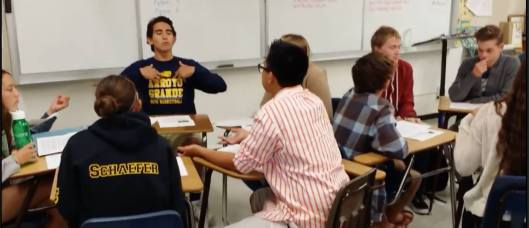
My kids, as JFK’s ExComm, debate what course they should take in the Cuban Missile Crisis. Life is short: Bunn, the young man in the striped shirt, was a delightful person and a gifted student. He was killed this year in an automobile accident.
I found the article below heart-breaking, in part because it was so familiar to my thirty years of teaching high school, in part because it was so alien to my own experience.
What marked my childhood and teens was the relative simplicity of those years. We got three TV channels, on a good day, on Huasna Road. There were land lines and, after school dances, pay phones, not “smart phones.” If I needed to take the pressure off, I would sneak into my Dad’s car, turn on the radio, and listen to Wolfman Jack and the wonderful rock ‘n’ roll that came from somewhere in Mexico via station XERB.
Another blessing was how unstructured our time was. I had endless room to breathe–lost in the pages of books, exploring the hills of the Upper Arroyo Grande Valley, learning Spanish from braceros, trout-fishing in the Arroyo Grande Creek.
I am not suggesting an idyllic childhood. I grew up in an alcoholic, sometimes violent home, but my parents tried hard to be the best parents they could be, and the values I inherited from them made me decide to become a history teacher, and allowed me, in the teaching, to recognize and to love the vitality in the 32 teenaged lives arranged in rows before me every class period of every day for thirty years.
I have my parents to thank for that.
But I saw this anxiety, the kind documented in the Times article, over and over again in the kids I taught every class period of every day for thirty years.
It was as if they had to prove themselves, to prove their worthiness to themselves and to their parents, and there was no reliable inner measure for them to rely on. They had, instead, to do things–club volleyball, student government, six Advanced Placement classes (I would never have allowed my child to take six AP classes, and I taught AP for most of my career), or winning awards. If they didn’t have these extrinsic measures, they would never get into the college of their choice, never have a career that was rewarding, never have the spouse they deserved, never have the kind of validation that, ironically, God never requires nor desires.
Sometimes, when they were taking a test or writing an essay, I would just stare at them, my heart full, at the miracle of their youth and the promise of their future. (It saves me from the despair that is so much a part of our present political life. It is about all that saves me.)
Those were moments every good teacher experiences, and that fullness of heart stays with you all your life.
They never had anything to prove to me. I just wish I had made that clearer.
 A Work in Progress