
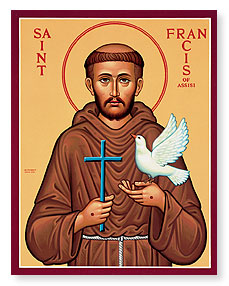
Francis
When I was a high school history teacher, I took my students to Italy. We visited Assisi. We sat quietly in front of Francis’s little tomb–fitting, because he was such a little man–and we sat in perfect silence. It was in the silence where I felt the solemnity and the joy of Christ’s spirit washing over me and claiming me again. At the same time, and very appropriately, little Francis made me feel very small again. He made me, a man in his fifties, a child.
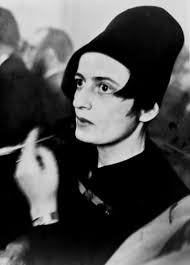
Ayn Rand
This woman, the writer Ayn Rand, seems to be our secular saint today. It’s her nihilistic spirit that washes over Congress today, in late 2017, as it gleefully passes a tax bill so regressive that it would make Dickens’s Scrooge blush in shame. I have never seen anything like what they all tax “reform.”
And then I remember, of course I have!
I spent thirty years teaching history: I remember the English traveler Arthur Young’s letters home in 1788, scored with his disbelief in the inequity and illogic of France’s tax burden, which fell most heavily on those who could afford it least. He predicted the inevitability of revolution.
It came only a year later.
I recognize, too, the disparity in today’s distribution of wealth., and I remember that there has been nothing this illogical in our own history–at least, not since the summer of 1929.
Of course, the politicians must be right: the poor deserve to be poor. They are hungry because they are lazy–or worse, because they are both lazy and less than Caucasian. The wealthy rise to the top because they are genetically and inherently superior–haven’t we heard this somewhere before? They must be inherently superior, for example, to my own father, a mere accountant.
And, easily, the most brilliant man I’ve ever known.
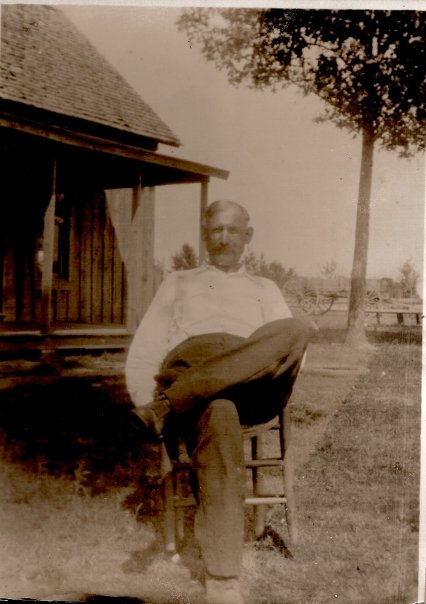
My Grandfather, John Smith Gregory.
My father inherited little from his father, an Ozarks tobacco farmer, except for a little lined notebooks, from the 1920s, kept in a little lined notebook that I still have, that recorded the sales, to his neighbors, of ginseng, of all things, because my Grandfather John ventured a century beyond tobacco and cotton and hogs and landed squarely in the frontier of New Age farmers of the 21st Century. Beyond that, he had a gift for numbers that was both so imaginative and so precise that he could, as a lumber estimator, calculate a thousand-acre stand of Missouri hardwood to within 100 cubic feet of its eventual yield in a sawmill owned by wealthy men dressed in double-breasted suits, felt hats and silk ties who lived in an impossible place that was far away, called Kansas City.
It was silk-tied men from Boss Pendergast’s notorious Kansas City machine who left bank-bags full of five-dollar bills on my grandmother’s kitchen table on the weekends before Tuesday elections in the Depression years. She was the local head of the Democratic Central Committee and one of the first women invited to a national political convention–1924, in Madison Square Garden.
A decade later, FDR never would never lose an election in that part of the Ozarks. In return, the Hill People who came down my grandmother’s home town, who came to schoolhouse to vote, never starved.
That was her doing.
Dad inherited that arithmetical gift from my grandfather, that gift for mathematics. Since gifts like that seem to skip generations, I inherited, from Dad, a gift for telling stories and from my grandmother, a love for history and politics.
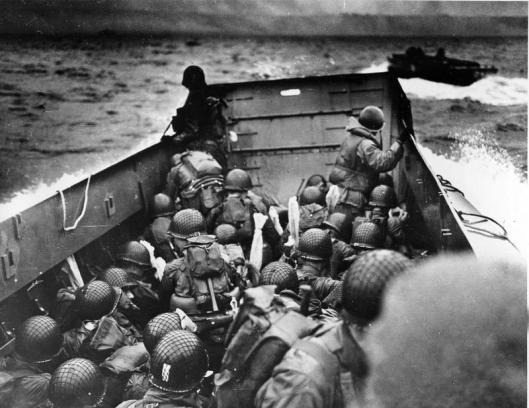
A Higgins Boat headed for Omaha Beach, June 6, 1944.
And then–I am confounded by the irony of this–Dad’s generation, many of then rejected by the Draft for their teeth, rotten after a decade of poverty like that visited on many of the Hill People of Missouri-went to faraway places: New Guinea, Tarawa, Iwo Jima; to North Africa, Normandy, the Ardennes.
This generation repaid the injustice visited on them in the Depression by dying in hedgerows, their bodies caught within tangles of roots that had been planted in Agincourt’s century. Their only company, lying in the fields the hedgerows enclosed, were the bloated bodies of Norman milk cows killed in the crossfire.
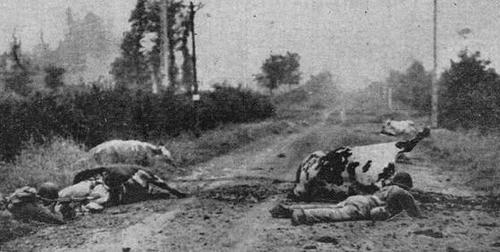
Normandy, Summer 1944
In 1945, my father taught Army Quartermaster burial teams the basics of forensics: his students were boys who had hoped to become heroes, but were born too late, so they came to a war that had become history.
Instead, their duty was finding dead teenagers, graduates from high schools the year before the teens in Dad’s Quartermaster Corps burial teams had graduated. They disinterred Lettermen and student body officers and what were once called “juvenile delinquents,” but these boys remained only in scraps of viscera and bone, sinew and hair that lay on heads once stroked gently by their mothers, and the young Quartermasters identified them, if they could, for burial.
I inherited, somehow, the memory of those boys, living and dead, from Dad.
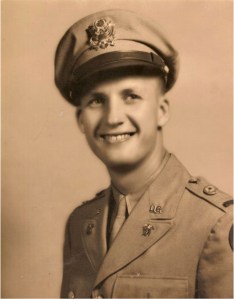
Dad, 1944.
I inherited from Mom the steel she’d kept deep inside to overcome the shame of her own father, a stereotypical Irish drunk and laughingstock of an oil boomtown in the San Joaquin Valley of California.
Yet beneath the steel, she became the kind of woman who would teach her children that there was nothing more important on this earth–there must have been something in her DNA that recalled in her ancestral memories of County Wicklow’s hunger in 1847 Ireland–that there was nothing more important, beyond the arts, than empathy, and generosity, and kindness. Most of all, there nothing more dignified than Poverty.
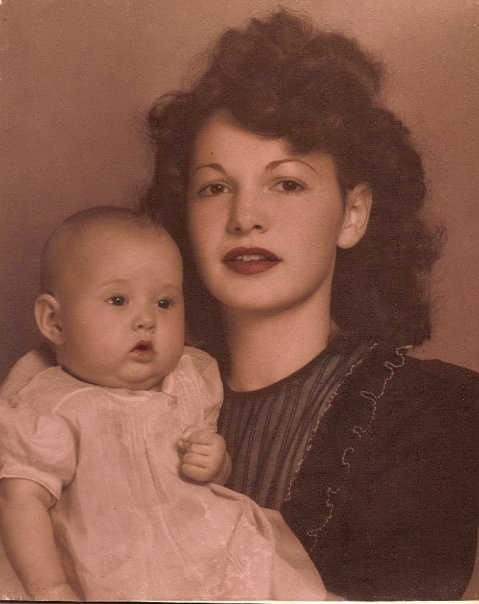
Mom, and big sister Roberta, 1943.
She understood Francis completely. More than that, she accepted him completely. That took steel, too
These are the lessons I’ve drawn from my father’s stories and from my mother’s example. I’ve thought about them, still and quiet before her grave, in my California home town, and before Francis’s grave, in faraway Assisi.
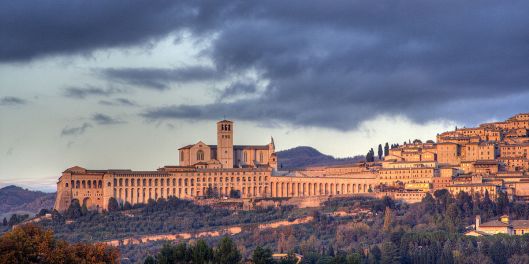
Assisi.
Here is what I wish for you:
I wish that you get the chance to gaze, in perfect silence, at the beauty of Umbria below you from Assisi’s hilltop, from that little town of stone and cobblestone. That is where it is so much easier to understand that what Jesus intended for us was love, what Jesus wished for us was love, what Jesus taught us until–and within–the agony of His death by suffocation, was love.
I am just beginning to understand, too, that what Jesus gave us, from His first moments of consciousness, shivering in the arms of his young mother, was His love.
 A Work in Progress