They’re layin’ eggs now, just like they used to…
31 Wednesday Jan 2018
Posted in Uncategorized

31 Wednesday Jan 2018
Posted in Uncategorized
30 Tuesday Jan 2018
Posted in Uncategorized
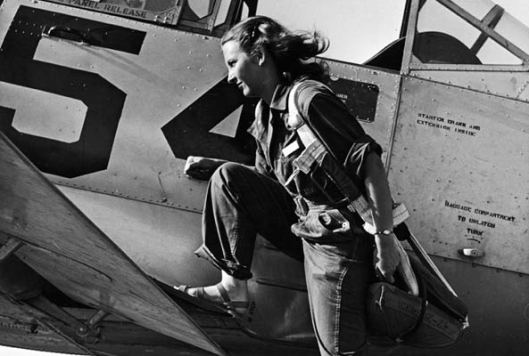
A WASP, World War II
I guess, as a teacher, I always felt more at home and comfortable with boys. The problem was, and it’s mine, that I worried so much about the girls.
I hope they understand now, as women, how much it meant to me to teach them, to give them just a little confidence, and how much their humanity meant to me. They were two thousand precious and irreplaceable surrogate daughters.
I hope they understand, too, the burden I’m putting on them in how much I trust them to redeem the damage older people like me—our childhoods littered by acres of gifts beneath tinseled Christmas trees and our childhood heroes blown apart by gunshots—have endured and have inflicted. We’ve left a terrible bill to pay.
But they, the two thousand young women I’ve taught, may understand, I hope, from my teaching that we’ve been here before as a people, and that we’ve paid similar bills, healed similar hurts, and come out stronger than we were before. From the history I’ve been taught, I am constantly moved at how much women have moved us along, no matter how painful the moving can be. I am moved today by how many women are running for office.
I’m to speak to middle-grade students next month. I’m going to use what I’ve learned from World War II to remind the girls (and, just as much and even more, the boys) in 4th and 5th grades that it’s women who have so selflessly redeemed us before. I hope some of the children blush, if only for a moment, when they realize that it’s the little girls among them who will grow up to accept such terrible greatness.
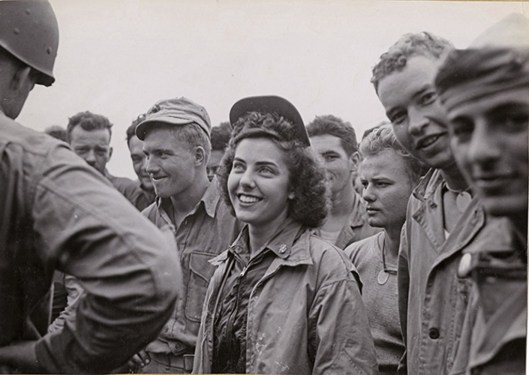
U.S. Navy Nurse, Iwo Jima, 1945.
In the link below, some images of women who’ve accepted their inherent greatness.
https://drive.google.com/file/d/14Ahf8ijpjm8G02W9mn-NS_heHlwMmmSv/view?usp=sharing
28 Sunday Jan 2018
Posted in Uncategorized

The fourth book, Central Coast Aviators of World War II, will be about war again, and it will be about my parents’ generation again. That doesn’t mean I haven’t learned anything new.
I’ve found a couple of scholarly treatises on this generation, written during the mid-1930s, that bewailed them, negated their promise and despaired for civilization’s future. They were seen by those scholars as shallow, easily distracted by trivialities like popular music and films. They were pleasure-seekers intent on immediate gratification.
And then evil descended on a mythic scale–it was Tolkiensesque–and the Jitterbuggers and hot-rodders and bobby-soxers proved that the scholars, in this case, were idiots.
There is no parallel for what Tom Brokaw called “The Greatest Generation” until and unless you look at the voting patterns and the political candidacies of the Millenials. Yes, many of them are struggling: many are jobless and hopeless, some are in jail, some have succumbed to early-onset cynicism.
But if you look at the World War II generation closely–especially at the few lost fliers who left behind their high school photos– you experience the shock of recognition.
Had I been misplaced a few decades, these kids could have been my kids, back-row wise-crackers or front-row hand-raisers, in any of my history classes. I would have been watching them proudly in the 1930s when they turned their tassels; I would have kept tabs on them, with them gone on to college or trades, gone on to families (three of these boys died with toddler girls back home) and then I would have lost them in the dislocation of wartime America.
They were gone, with events moving so rapidly, to the Army Air Forces, gone to die in a war that made them vanish, because, in so many cases, there was no body to bring home to San Luis Obispo or Templeton or Arroyo Grande. They had fallen from the sky to leave nothing to the rest of us, earth-bound and bereft.
What they left behind–what they died for, even if they could not have articulated it, because that’s the job of historians–was the ideal of republican democracy and the belief in our common humanity.
If you believe in those things, as I do, then the best part, the best part, is that they are not gone at all. They are not vanished. They are not dead. I can see them, coming home to us in a generation born a half-century after these young men had flown five miles above us.
19 Friday Jan 2018
Posted in Uncategorized
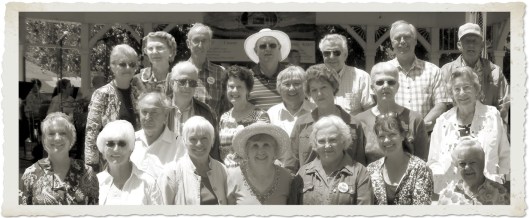
Don Gullickson of Arroyo Grande has passed away at 91. He’s at the top right in this photo of the South County Historical Society.
There are many reasons this is a big deal.
I knew Don, but only slightly. I talked to him three or four times, found him intelligent, articulate and very funny. I wished I had talked to him more and listened to him even more than that.
He told me a little about bootlegging days, when he was just a little fellow. His Dad, Ole, was among a group of hunters, including the local pharmacist and other luminaries, who liked to secure a supply of Powerful Beverages before they went up north to hunt deer.
I am not, mind you, advocating the combination of Powerful Beverages and 30.06 rifles. That was their deal.
They bought their bootleg booze from a supplier in Shell Beach. Don, when I talked to him, couldn’t grab his name, but he was Greek.
So was Alex Spanos, the owner of Alex’s BBQ and known to be a modest bootlegger.
Ole and his friends would always take Don along with them when they made their booze purchases, sometimes right on the beach. Their reasoning was that no deputy sheriff would be suspicious of a bunch of guys with a five-year-old tagging along.
They were right.
Ten years later, Don was one part of a kind of Four Musketeers: Himself, John Loomis, Gordon Bennett and Haruo Hayashi.
Haruo, an AGUHS sophomore, was at home recovering from appendicitis surgery when the Japanese hit Pearl Harbor. He was anxious about getting better and returning to high school.
He was relieved when one of the toughest kids in school, Milt Guggia, beckoned to him. “Haruo,” Milt told him earnestly, “If anybody calls you a ‘Jap,’ I will beat the shit out of him.”
What a wonderful thing.
So, too, were the Four Musketeers. They stood by all their Nisei friends, but they stayed especially constant to Haruo, a painfully near-sighted boy, an Equipment Manager in high-school athletics, a boy who had to learn English from a kind little girl who was his classmate at the old grammar school on Traffic Way, where the Ford agency is today.
In April, the buses came and took Haruo Hayashi and his family away, along with the Kobaras, the Fukuharas, the Fuchiwakis, the Ikedas (except for Kaz, who stayed after to care for his father, his back broken after a team of farmhorses ran away with him), and so many more.
Haruo went first to the Tulare Fairgrounds, where the animal stalls where they kept our neighbors still stank of livestock.
Then he and our neighbors went to Gila River, where the temperature hovered at or above 100 degrees for the first month they were there. Then the desert winds came up, carrying the spores for Valley Fever, and that is what began killing off the grandparents who had first come to our Valley from Japan, most of them from Kyushu, a few from Hiroshima-ken.
Haruo finished high school there, taught by Quakers who insisted on living their faith. He continued to receive letters from the Four Musketeers, including Don.
Maybe “Boococks” would be a better term than “Musketeers.” That’s what their little circle called themselves. They were all members of the AGUHS Stamp Club.
Three of them fought in the Pacific. John, the Marine, fought on Peleliu and in the last terrible campaign on Okinawa. He didn’t know it, but his cousin Gordon Bennet was just offshore, on a fleet oiler like the ones the green kamikaze pilots—they were essentially children—excitedly mistook for heavy cruisers or battleships before they went in for their dives. Don was a swabbie, too.
Haruo joined the 442nd Regimental Combat Team, but the war in Europe ended before he had his chance. The razor-thin little near-sighted teenager was a heavy machine-gun instructor when word came that he could go home.
When he did, he found that the Phelans and Taylors had taken care of his father’s land and his farm equipment. He lived with the Bennetts during the period of transition—not always peaceful—until he could take up farming again.
John, Gordon and Don all came home, too. The Boococks were together again, and they remained that way for seventy-five years.
I think there can be no finer compliment to a man like Don Gullickson that to call him a true friend to his friends.
He was an Arroyo Grande boy, you see.
09 Tuesday Jan 2018
Posted in Uncategorized
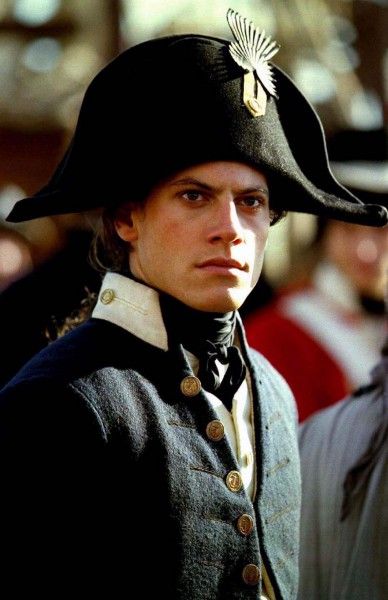
Ioan Gruffud as a hunky Lieutentant Horblower
in the television miniseries
My first adult reading had to have been, at least in terms of fiction, the trilogy of Horatio Hornblower novels my father had bought some time during World War II, possibly when he was stationed in London. He liked the books and they may have inspired him to take the steam train down to Portsmouth to see Admiral Nelson’s HMS Victory. One of the souvenirs he brought home with him, besides several bottles of Cointreau, was a little tin box of hard candy, its lid embossed with the image of the great ship on which Nelson–Hornblower’s real-life inspiration, just as Hornblower would inspire Captain Kirk– had died in 1805. My mother kept the box for years to store bobbins of her brightly-colored sewing-machine thread.
Hornblower, like Nelson, was a Royal Navy officer during the Napoleonic Wars, and he became so popular the his creator, C.S. Forester, could not get rid of him, in much the same way L. Frank Baum could not get rid of Dorothy nor Conan Doyle kill off Sherlock Holmes. Forester would eventually write nearly twenty in the series that followed the hero from his days as a green (This is meant quite literally. See below.) midshipman, with feet the size of shovels, to his last posting as an admiral in the West Indies, and in the process, his novels would spawn a little trailing fleet of fictional acolytes: Nicholas Ramage, Richard Bolitho and, of course, Jack Aubrey, the creation of Patrick O’Brian, a writer–like spy novelist John LeCarré–who has, through the force of his prose, leaped the gap between popular fiction and literature.
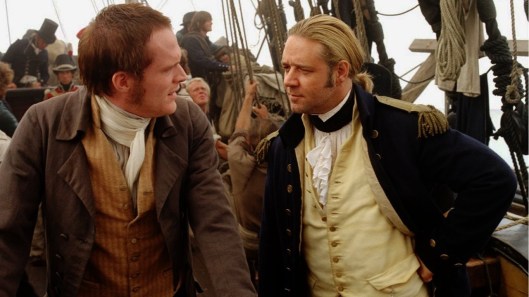
The best of friends: the logician Dr. Maturin and the passionate Captain Aubrey in director Peter Weir’s Master and Commander.
If Hornblower’s leap didn’t quite make it, blame his big feet. But that was what immediately lovable about Forester’s character: He was imperfect, a little cranky, relentlessly critical of himself, and modern. In the first few pages of the first novel in series, we learn he is disgusted because he, a frigate captain in his thirties, is beginning to develop a pot belly. He is given to shouting “God damn your eyes!” at his coxswains and servants, a phrase, sadly, that I never revived. Like his real-life inspiration, Lord Nelson, he starts each voyage confined to his cabin, where he is violently and spectacularly seasick. He sits a horse, elbows akimbo, buttocks and saddle at war with each other, with no more grace than Ichabod Crane did. He is trapped in an unhappy marriage with the unhappy Maria (“simpering” is the adjective Forester chooses) —had they lipstick in Napoleonic Europe, Maria’s would have been very red, liberally and inaccurately applied, and since she was constantly weeping at her husband’s departures, her mascara would’ve run like printer’s ink.
Fortunately for Hornblower, Forester kills Maria off by the third novel, replacing her with the far more elegant Lady Barbara, sensitive to and soothing of her husband’s many moods. She is, I think, a fictional counterpart to the sensitive and soothing Clementine Churchill, who deserved a Victoria Cross for not only putting up with Winston, but for her courageous persistence in loving him. Hornblower’s men love him, too–a phenomenon he can’t quite understand, which is charming in itself–because he inspires them and he is, in his prickly way, devoted to them, despite their tendency, in battle, to be skewered by splinters or reduced to jelly by enemy cannonballs bouncing their way along the main deck. (“Jelly” is a favorite of Forester’s, since it was in such short supply, I suppose, in wartime England)
Not that this moodiness of Hornblower’s was ill-earned: As a very young officer, his first prize ship—a “prize” was a captured enemy vessel that meant money for a crew, and Hornblower was given command of this one—was a French coaster hauling a cargo of rice. What Hornblower and his prize crew didn’t realize was that the little ship was holed below the waterline. So sea-water rushed into the hold and the rice did the usual thing that rice does when it gets flustered and wet: it expanded, tearing young Hornblower’s little command into pieces, the ship’s planks exploding like gunshots, before he and his crew had to be rescued. Hornblower has a history of leaks. In a later novel, Hornblower and the Atropos, as a junior post-captain, he’s given the honor of commanding Lord Nelson’s funeral barge—and balanced on the barge is the massive coffin that contains the tiny admiral—when, in mid-Thames, it begins to spring leaks. Hornblower manages to bring the barge safely to its destination, St. Paul’s, for Nelson’s funeral—I’ve seen that barge, in the Royal Naval Museum in Portsmouth—but not before suffering what has to be the most epic panic attack in English-language fiction.
Even his fighting ships betray him. His first ship-of-the-line, an early 19th century equivalent to a battleship, Sutherland, is Dutch-built and so is shallow-drafted—she’s meant to protect a coastline on which Hans Brinker occasionally skates—and so sails with all the grace of pig iron. The French sink Sutherland, good news for Hornblower, but capture him and Mr. William Bush, his stolid and mildly dim-witted First Lieutenant, which is not so good. Hornblower will escape eventually to go on to command, as a commodore, a little fleet of ships in the Baltic, including a bastardization of naval architecture called a bomb-ketch, which is essentially a floating mortar and so graceless as to make Sutherland look like a clipper ship.
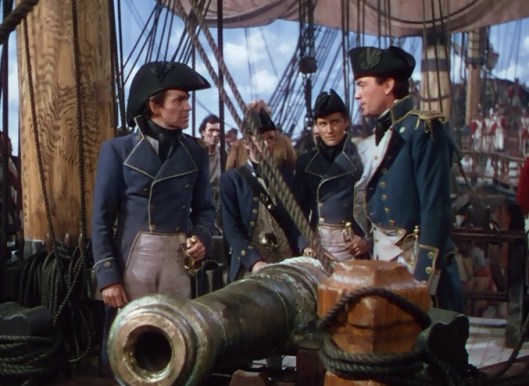
Robert Beatty, as Lt. Bush, at left; Gregory Peck, as a mysteriously American-sounding Hornblower, at right, in the 1951 film version of the first novels.
Forester wrote so many Hornblower novels and wrote them so well that one of my favorites was not a novel and was not written by him at all. A gentleman named C. Northcote Parkinson, thanks to his discovery of the mythical Hornblower Family Papers, wrote a biography, The Life and Times of Horatio Hornblower, as if his subject was not mythical at all. It is enchanting.
The best part reveals another facet of Hornblower’s character that redeems his crankiness and his seeming ill-luck: He is a man of immense courage. His moral center, part of what makes him so critical of himself, is clear from the first moment we meet him, as a midshipmen. A little later, as an immensely junior lieutenant, he is assigned to the luckless ship-of-the-line Renown, whose captain, Sawyer, is mean-spirited, vengeful, and flagrantly paranoid. He makes Bligh look liked Billie Burke’s Glenda the Good in 1939’s Wizard of Oz.
Before Sawyer can foul up a mission against the Spanish by court-martialing his officers on trumped-up charges of mutiny, he mysteriously tumbles down a hatch, fractures his skull, and so command passes to a far more capable man, First Lieutenant Buckland. Buckland will then lead the Renowns to a daring victory (the shore party is commanded by Bush) over the perfidious Spanish, who, in Hornblower’s world, are just as perfidious as they’d been in 1588, Good Queen Bess’s time.
At a much later time, 1970, it is Parkinson, thanks to the Hornblower Papers, who reveals the ultimate and shocking truth. Sawyer was in part right: There was a mutiny, but it was, according to C. Northcote Parkinson, a mutiny of one, on the part of the lowly Fifth Lieutenant, Horatio Hornblower. While Renown’s coterie of officers fretted about what to do about their mad captain—they were seized with paralysis with the enemy virtually within sight—it was Hornblower who shoved Sawyer down the open hatchway. It was an action motivated by Hornblower’s unfailing devotion to his duty, and it was the mad Captain Sawyer who was preventing Renown from doing hers.
07 Sunday Jan 2018
Posted in Uncategorized

I hope Hollywood doesn’t screw this up. The plot involves Indian fighter/army captain Christian Bale, who is charged with escorting a captive Cheyenne chief, in what seems to be a brief moment of compassion in Indian policy, back home to die.
The escort, which is made up of Buffalo Soldiers (accurate to the setting, 1892) is set upon by a common enemy–Comanches, easily the most feared tribe on the Great Plains.
You know all those old Westerns that show Indians firing at full gallop while hanging along their horses’ flanks? Only the Comanches could do that. All the other Plains tribes–even the Lakota, the majority present at the rubbing-out of Custer’s command–fought dismounted, just as the Bluecoat cavalry did.
All the other Plains tribes reckoned their wealth in horses. The Comanche saw their horses as utilitarian only. They would ride them to death, it is said, and then eat them. The formidable Apaches, who shared territory, very briefly, with the Comanches, were terrified of them. I think that’s what makes one of my favorite Westerns, The Searchers, so riveting: when the Comanches show up, unseen except for a flickering mirror-signal and unheard except for their mimicking of bird calls, you know the settlers they’re about to attack are doomed.
The book about them, Empire of the Summer Moon, and about their leader Quanah Parker–and about the raid and kidnapping that inspired The Searchers–is first-rate. It would turn out that the only fighters equal to the Comanches were the Texas Rangers, and what gave them their edge was their scrappiness (think Woodrow and Gus from Lonesome Dove), and, even more important, the technological advantage the Rangers gained once they’d armed themselves with Samuel Colt’s revolver.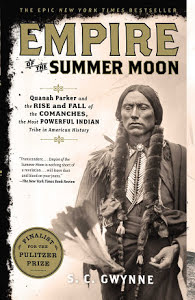
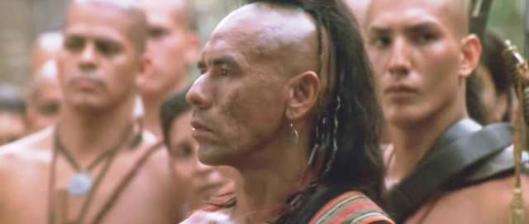
The about-to-get-here film features Wes Studi, a wonderful actor, as the dying Cheyenne leader. He was Magua in Last of the Mohicans [a book it is not at all necessary to read: Mark Twain’s essay “Fenimore Cooper’s Literary Offenses” is far better] and the title character in Geronimo: An American Legend, which was a far better film that the stupid title would indicate.
My favorite Studi role, however, came on a chance viewing of Reading Rainbow. He read a Native American version of “Cinderella” to very little kids, who were enthralled. His remorseless Magua was just a role. This is a very gentle man.
04 Thursday Jan 2018
Posted in Uncategorized
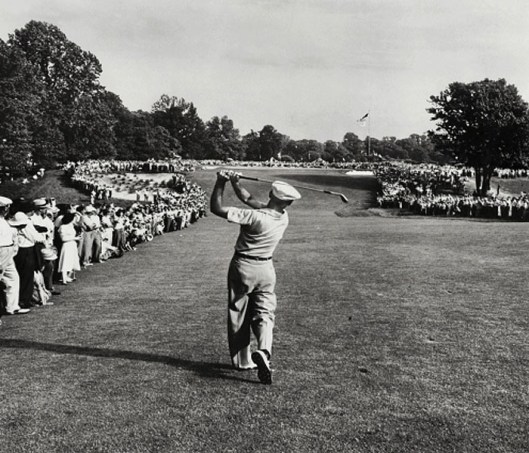
Number One Son got me not one, but TWO books about golfer Ben Hogan. This is a photo of his one-iron to the green to win the 1950 U.S. Open on the last and 72nd hole.
Hogan was not a warm man. He loved golf. He loved his wife, Valerie, and there it ends. But the year before this shot, he’d thrown his body, instinctively, in front of Valerie’s as their car crashed head-on into a bus that emerged suddenly from a dense Texas ground-fog while they were on the road between tournaments.
The impact nearly crushed Hogan. He walked with a limp for the rest of his life. But he’d saved Valerie’s life, and his own, in that moment. Had he not loved her so much, had he not thrown himself in front of her, the steering column would have impaled him.
So the next year, limping, he won the U.S. Open with this one-iron, with a club so difficult to hit that almost no modern golfer carries it anymore. His shot ranks with breaking the sound barrier, with an Olympic triple-axel triple-toe, with climbing Everest, with baking a weightless souffle.
His talent was modest, compared to that of his contemporaries, naturals like Sam Snead, Byron Nelson and Jimmy Demaret. But he had an engineer’s mind, and he rationalized the elusiveness of the golf swing and broke it down into component parts in a way that made sense to him. In so doing, he practiced , it’s said, until his hands bled, but he wasn’t a drudge. He loved to practice, loved to live for the moment when his timing and the impact point met to create a perfect one-iron–his described a gentle fade–in a way that seemed (it was a lie, of course) to be effortless.
Shagging balls for Hogan wasn’t effortless, because he could be merciless with the young boys who shagged for him in practice: he grew so accurate that he hit them repeatedly, and it hurt. He didn’t notice. He was focused on the impact as much or more than the shot’s destination. His cigarette glowed furiously between shots. Impatient, he motioned his shagger to move backward ten yards, out of the line of fire, until he changed clubs and started to hit him repeatedly with a six-iron rather than a seven.
Once a knot of overbearing Kern County oilmen begged Hogan, playing an exhibition in Bakersfield, to give them lessons. He would be paid handsomely. He looked at them narrowly through his cigarette smoke, and flat turned them down. He was angry. Didn’t they know what he knew? They already had the best teaching pro in America, a stubby little guy named Eddie Nowak.
Nowak, many years later, would teach me how to play at Black Lake, in Nipomo. Hogan was right: Nowak was one of the best teachers I’ve ever had, and one of the toughest. The discipline and the work ethic he taught me has lasted me all the days of my life, one in which golf has been mostly absent. Eddie didn’t just teach me golf. He taught me how hard you have to work to take on life. He was my Hogan.
02 Tuesday Jan 2018
Posted in Arroyo Grande, Uncategorized
One of the reasons I decided to write books was this man, Stanford’s David Kennedy.

Dan Krieger (European history) and Jim Hayes (Journalism), two Poly professors in a lifetime of wonderful teachers, are among the other reasons I wanted to teach history and write about it, as well.
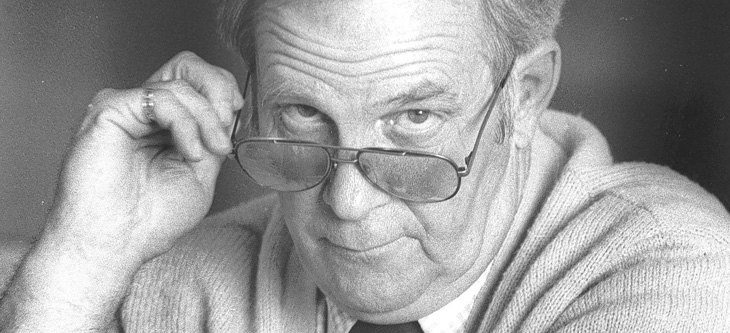
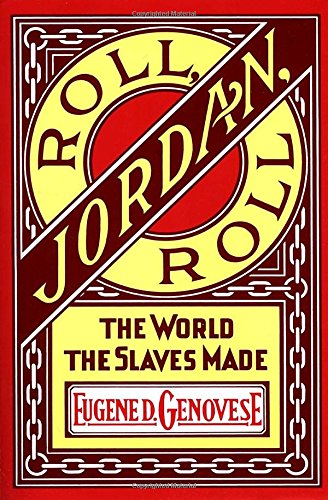
At the University of Missouri, Charles Dew’s teaching on the history of African-American slavery–another book that was formative to me was Genovese’s, part of Dew’s required readings–David Thelen’s teaching on Populism and the Progressive movement, Winfield Burggraff’s teaching on Latin American history, and Richard Bienvenu’s teaching on the history of socialist thought all made me want to be like them.

Here’s the surprising part: Mrs. Kennedy is Alex Madonna’s niece, and my Dad was Madonna Construction Company’s comptroller in the 1950s and 1960s. It is, after all, a small world, and still rich with stories to be told.

 A Work in Progress