
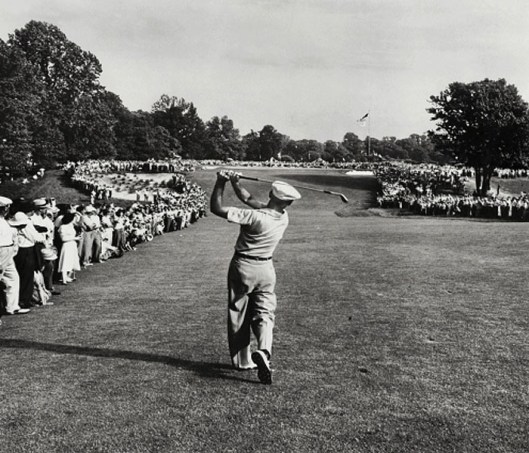
Number One Son got me not one, but TWO books about golfer Ben Hogan. This is a photo of his one-iron to the green to win the 1950 U.S. Open on the last and 72nd hole.
Hogan was not a warm man. He loved golf. He loved his wife, Valerie, and there it ends. But the year before this shot, he’d thrown his body, instinctively, in front of Valerie’s as their car crashed head-on into a bus that emerged suddenly from a dense Texas ground-fog while they were on the road between tournaments.
The impact nearly crushed Hogan. He walked with a limp for the rest of his life. But he’d saved Valerie’s life, and his own, in that moment. Had he not loved her so much, had he not thrown himself in front of her, the steering column would have impaled him.
So the next year, limping, he won the U.S. Open with this one-iron, with a club so difficult to hit that almost no modern golfer carries it anymore. His shot ranks with breaking the sound barrier, with an Olympic triple-axel triple-toe, with climbing Everest, with baking a weightless souffle.
His talent was modest, compared to that of his contemporaries, naturals like Sam Snead, Byron Nelson and Jimmy Demaret. But he had an engineer’s mind, and he rationalized the elusiveness of the golf swing and broke it down into component parts in a way that made sense to him. In so doing, he practiced , it’s said, until his hands bled, but he wasn’t a drudge. He loved to practice, loved to live for the moment when his timing and the impact point met to create a perfect one-iron–his described a gentle fade–in a way that seemed (it was a lie, of course) to be effortless.
Shagging balls for Hogan wasn’t effortless, because he could be merciless with the young boys who shagged for him in practice: he grew so accurate that he hit them repeatedly, and it hurt. He didn’t notice. He was focused on the impact as much or more than the shot’s destination. His cigarette glowed furiously between shots. Impatient, he motioned his shagger to move backward ten yards, out of the line of fire, until he changed clubs and started to hit him repeatedly with a six-iron rather than a seven.
Once a knot of overbearing Kern County oilmen begged Hogan, playing an exhibition in Bakersfield, to give them lessons. He would be paid handsomely. He looked at them narrowly through his cigarette smoke, and flat turned them down. He was angry. Didn’t they know what he knew? They already had the best teaching pro in America, a stubby little guy named Eddie Nowak.
Nowak, many years later, would teach me how to play at Black Lake, in Nipomo. Hogan was right: Nowak was one of the best teachers I’ve ever had, and one of the toughest. The discipline and the work ethic he taught me has lasted me all the days of my life, one in which golf has been mostly absent. Eddie didn’t just teach me golf. He taught me how hard you have to work to take on life. He was my Hogan.
 A Work in Progress