
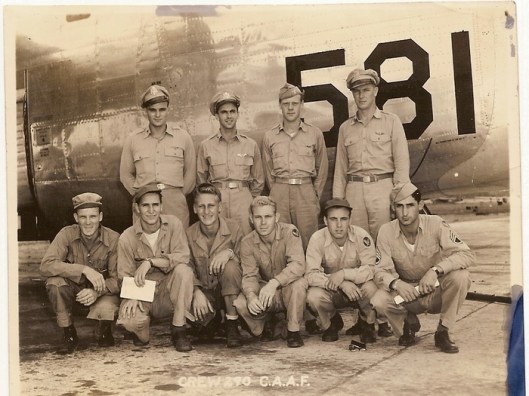
Jess Milo McChesney, B-24 pilot, top right.
The reason I write books is to disabuse us of the notion that, because we’re from a rural California county, we’re not all that important to American history. This is not so.
The McChesney family of Corbett Canyon–I was taught by a relative, Eva Fahey, at Branch School, went to Arroyo Grande High with another, Leroy McChesney III, and finally, taught a third, Kathryn, who is quietly but incandescently brilliant–is a perfect example of what I’m talking about.
They ran a dairy out there (the McChesney children would lay out milk cans on a trestle for the Pacific Coast Railway and, magically, have it return to them as ice cream from the Golden State Creamery in San Luis Obispo), but dairy cows were far from their chief interest.
Leroy McChensey Jr., tall and rangy, would take breaks from the milk barn to, in borrowing Whitman’s phrase, “stare in perfect wonder” at the vultures drifting effortlessly overhead. He caught the flying bug early.
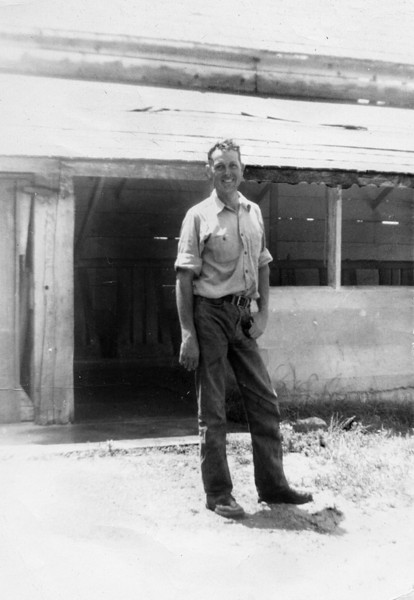
Leroy McChesney Jr.
The urge to fly got worse when a wrong-way biplane from Santa Maria landed in a pasture alongside the McChesney farm, which the pilot, in 1922, had mistaken for his landing strip in Santa Maria, most likely another pasture just a tad bit farther south.
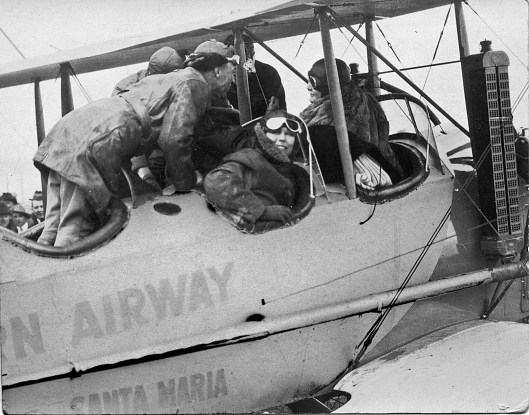
The wrong-way airplane, with passengers who don’t seem too upset, Corbett Canyon, 1922.
The proof that Leroy had been bitten badly by flying came long after he’d earned a pilot’s license, once he’d married and started a family. He began building a full-scale glider, for whatever reason, in the living room. It grew. The kids had to dodge the fuselage to make their way to the kitchen for Golden State ice cream in the freezer. I think eventually Leroy’s project migrated outside, but his love for flying remained such a constant in the family that, years later, after he’d suffered a heart attack, his wife, Grace, took up flying. She reasoned that she’d have to land the damned plane. Truth be told, she, a member of the “99’s,” a women’s flying group, may have been the better pilot.
But, unlike Leroy, she didn’t get the country airport, McChesney Field, named for her. It was Leroy’s boundless energy as an advocate for fellow fliers and as a member of several state and national aviation boards that got that well-deserved honor.
His little brother, Jess, caught the bug, too. And he was a war hero, like the more famous son of another dairy family, the Edna Valley Righettis, who gave us P-51 pilot Elwyn, an enormously gifted flier and leader, lost in 1945.
Jess flew his thirty-five B-24 combat missions, in the Fifteenth Air Force, out of Italy, a pilot whose career was book-ended by crash landings on both his first and final bomb missions, which wended their way over the Alps and into Austria, Germany, and Hungary, where civilians lynched downed aircrews. On both those book-end missions, the latter a belly-flop on a British airfield, the big bomber he piloted had been shot to pieces.
One of his gunners tried to contact the family many, many years later, and learned, over the phone, that Jess had died. He was devastated.
“I would fly to the gates of hell with that man,” he said simply over the long-distance connection.
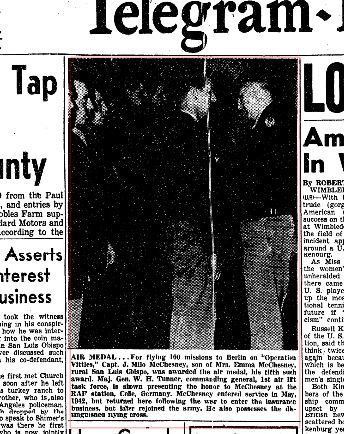
Jess’s career did not end with the end of World War II. He would win his fifth Air Medal in “Operation Vittles,” which we know better as the 1948-49 Berlin Airlift, when Stalin, determined to starve the western Allies out of Berlin, deep inside East Germany, closed the borders to ground traffic.
Of course, it wasn’t Allies who were going to starve. It was German children. So in one 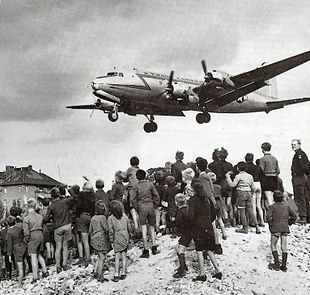 of, I think, the most heroic episodes in our history, veteran World War II pilots who had been shot to pieces by German 88-mm flak or by German fighters, FW-190s, turned instead to airlifting fuel and food and medicine to Berliners, and especially to children. That’s when Jess Milo McChesney was activated from the Reserves and flew the 100 missions that would add a fifth Air Medal to his DFC.
We tend to downplay the Berlin Airlift in favor of the “Memphis Belles” of World War II but, truth be told, what Jess did in 1948-49 was nearly as dangerous. The relief flights were so relentless and so constant–one of the biggest cities in the world had to be supplied completely by air–that exhausted pilots made mistakes that killed them and their aircrews, or exhausted airframes failed and plunged, in pieces, into Berlin suburbs. These were enormously courageous and compassionate young men.
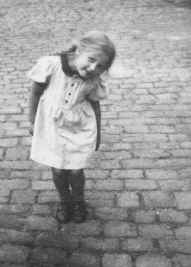
An American GI in Berlin’s occupation force recorded this image of a little girl in 1945.
Of course, the most famous of Jess’s comrades was Gail Halverson, “Der Schockoladen Flieger,” who tied handkerchiefs to Hershey Bars and dropped them, in their little parachutes, to the children of Berlin on his approach to the airfield at Templehof.
Halverson did this because he loved children. I watched a story, on CBS news on, I think, the fiftieth anniversary of Halverson’s chocolate campaign. When he landed in Berlin, he was immediately buried by a mass of adoring and middle-aged German hausfraus, who had never and would never surrender their love for Americans.
And Jess Milo McChesney, far less famous than Halverson but just as brave and just as bound by duty and by compassion, is just as important to American history. There is a powerful connection between Berlin and Corbett Canyon, California.
 A Work in Progress