
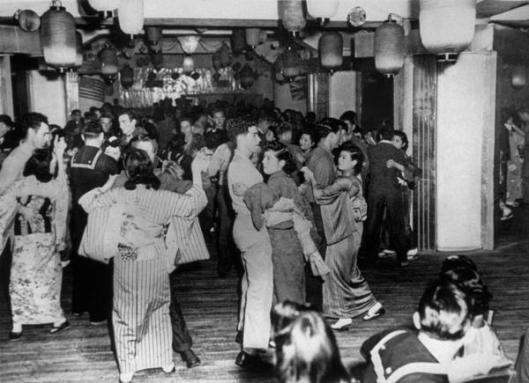
GI’s and their dates at a Tokyo jazz club, 1945.
“You are from Atascadero?”
“No, ma’am. Arroyo Grande.”
“Oh. I am from Paso Robles. My husband built us a house there. Now I live here. But I still have that house.”
She was Japanese, and before I could show off my fancy-pants history knowledge, wondering if she had come from Kyushu, like the ancestors of so many of my childhood friends, I realized: She was Japanese.
She was a war bride.
“You are from Atascadero?”
“No, ma’am. Arroyo Grande.”
“This is my husband. He built us a house in Paso Robles. Now I live here. But I still have that house.”
She fished inside her purse and brought out two photos. The one that caught my eye was black and white, frayed at the edges from so much handling, and the image was that of a handsome young serviceman.
“Air Force?” I asked.
“Yes!” she brightened. “Air Force! He built our house.”
In Paso Robles.
Stop yourself. Don’t pity her.
“You are from Atascadero?”
I let her take a book with her because she promised to pay me when I came back to visit in June. That was twenty dollars well lost.
You could tell, easily, that she had been a beauty sixty-six years ago, the year I was born, when her husband had built that house. She is still beautiful.
You could tell just as easily that there was more than a little steel in her personality.
There had to be.
She had made the leap from postwar Japan—they must have met during the Korean War– to the United States when this nation was at full tide, in the boom of the 1950s and 1960s, and she’d left everything she’d known behind to take up a new life in a strange place with a Byzantine language that she had mastered nearly completely except for the conjugation of verbs.
But she stayed.
She must have loved him dearly.
But sixty-six years later, she is the only Asian in the retirement home. Was she lonely because of that? [You remember Filipino soldiers in 1943, many from our county, on short passes into Marysville, where the first place they hit wasn’t a bar. It was a Chinese restaurant. They were desperate for rice. They were, of course, refused service, because they were Asians.]
She must have made him rice. Maybe, in the years after the war, he got odd looks from his co-workers when he opened up his lunch box and munched contentedly on the rice balls she’d made for him that morning, flavored with nori paste.
Kimi Kobara had made a similar cultural leap when she came to the Arroyo Grande Valley, twenty years before the war, as a picture bride. She’d wept every morning for weeks, every morning as soon as her husband, Shig, was out of the house and into the fields, where it it was just light, with his horses and their plow, or their cultivator, or their harvester.
Kimi, a middle-class girl from Kyushu, had no idea that life could be so hard in California.
But she must have loved Shig dearly, because she persevered, and she raised a beautiful family. Kimi had steel, too.
This woman—I am so sorry that I don’t remember her name, but I have never been good with names—elicited in me a wave of pity at first.
Stop yourself.
It wasn’t hard to let the pity wilt in the face of her dignity.
She had been a great beauty with great courage, and her husband had built her a house and she kept his photographs from as far back as his service days, their courting days, and you hope (and you know) that they will meet again, perhaps in a Kyoto park, like the one that enchants and haunts Scarlett Johannson’s character in Lost in Translation, she, elegant, in a pale yellow kimono, he in his Air Force dress blues, and when they embrace this time, they will never have to let go.
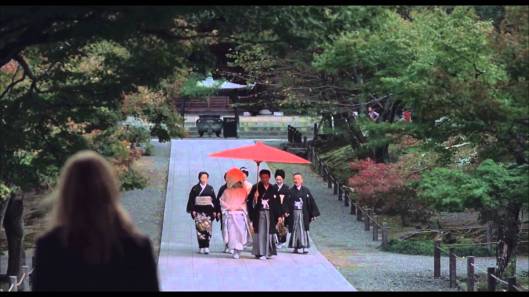
A wedding in a Kyoto garden, from Lost in Translation.
 A Work in Progress