
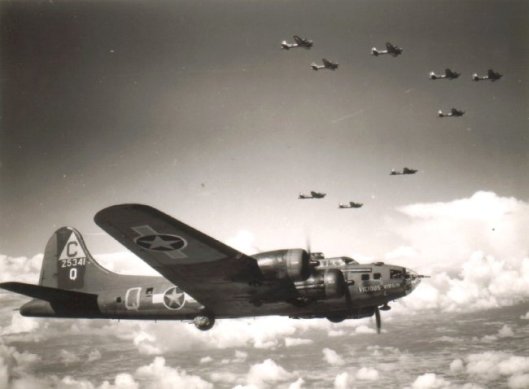
B-17s from Clair Abbott Tyler’s 303rd Bomb Group.
I wish I could write fiction. I have neither the talent nor the patience: I would put protagonists, antagonists and all those minor characters and plot-advancers in front of a firing squad before I got to Chapter Five.
End of book.
This is not a bad thing. A well-trained firing squad would save both me and my potential readers substantial agony and would be no loss to the Literary Canon.
The good news—I think— is that I was a history major, and that devotion to a college major with such a dismal financial future stuck through thirty years of teaching the teenagers that I still miss three years after my retirement. What being a history major meant, additionally, is that I am hopelessly addicted to historical research. That’s a pursuit, for writers of both history nonfiction and fiction, that is as infuriating and tedious as it is rewarding and fascinating.
For the book Central Coast Aviators in World War II, that meant four hours of research inside a World War II database of every American military aircraft built during World War II, in this case to match a B-17’s serial number with the name of the B-17. Was it “Flaming Mayme?” or “Flaming Maybe?” I decided on the latter. That particular B-17 collided with Mr. Skiddaw in the Lake District in September 1943, killing every airman aboard.
One of the passengers on “Maybe,” who was just hitching a ride for a weekend pass to Edinburgh—my father’s favorite city during his World War II stint in Great Britain—was from my home town, Arroyo Grande.
His name was Hank Ballagh. He was the Class Valedictorian, 1938, of the high school I attended and where I later taught. He graduated from Cal with an engineering degree, did his training as a B-17 co-pilot in Florida, fell in love and married Frances Marie Hogan there, in Broward County, and the two would become the parents of a little girl who was just beginning to walk when “Flaming Maybe” ran into dirty weather with a pilot, new to flying on instruments, who flew the bomber into the face of Mr. Skiddaw.
This happened three weeks before Hank’s first combat mission. He would almost have certainly been killed on one of those. His B-17 was a “Pathfinder,” with a radar bulb in place of the ball turret underneath, designated to pinpoint the aim point for the bombers following. As the first in over the target, the Pathfinders were usually the first planes downed. But Hank didn’t die taking the war to the enemy. He died in a terrible accident.
His wedding band—Hank-Fran 7-17-42, the inscription inside read—was returned to Frances Marie Hogan Ballagh, who lived on Cornwall Avenue in Arroyo Grande, in 1949. (The wristwatch of San Luis Obispo ball-turret gunner Donal Laird, killed on his very first B-17 mission in 1945, was returned to his family in 2016.) Hank and Frances’s little girl, Enid, pressed her small handprints into the fresh concrete of a sidewalk, dedicated to her father’s memory, just outside of her Dad’s Methodist church on Branch Street in Arroyo Grande.
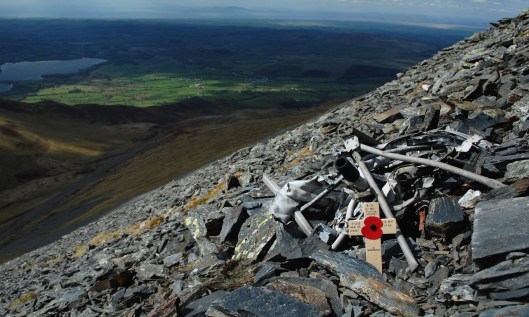
Fragments from “Flaming Maybe” remain on Mt. Skiddaw today.
The sidewalk is gone now. My job is to make sure, in some small way, that Hank Ballagh’s memory isn’t. The problem is, even for a research nerd for me, is how attached the writer becomes to characters who lie wholly and thankfully outside his invention.
Second Lt. Clarence Abbott Tyler of Morro Bay had a little girl, too. He married a local girl, a Renetzky, who was descended from an old-time ranchero family, the Danas. Alex Madonna, he of the Inn, was the best man at their wedding. Two years later, cannon rounds from a Focke-Wulf 190 obliterated him in his co-pilot’s seat and so from his toddler’s memory on a B-17 mission over Lorient in March 1943.
Nick Covell’s fifth-grade class toured the local newspaper offices of the San Luis Obispo Telegram-Tribune and plugged their ears in the din of the press room; he attended Patsy Berkemeyer’s birthday party, and the Berkemeyers were bakers, so the cake must’ve been terrific. He went to Cal Poly and the steer he exhibited at the Los Angeles County Fair won a ribbon. The B-29 he piloted was on fire when it went down over the Kawasaki District of Tokyo in the spring of 1945.
In researching an earlier book, I met Mess Steward Felix Estibal, essentially a U.S. Navy servant–his was a rating reserved for Filipino- and African-Americans—who provided me with a touching and hilarious letter home (the boatswain’s mate was “the leather-lunged whistle-blower”), written from his destroyer in the South Pacific, which I found published in an early 1943 edition of the local weekly.
Three hours later, I found the article that listed him as “Missing in Action” after a Japanese Long Lance torpedo had blown the bow off his little fighting ship, USS Walke. Some of Walke’s sailors survived the sinking, I found out later, only to be killed by the concussion of the ship’s depth charges as they exploded while tumbling to the seabed of Ironbottom Sound off Guadalcanal. Felix Estibal’s body was never recovered. Reading the bare-bones little 1943 newspaper article about Felix’s death so soon after reading such a warm and life-affirming letter did what it should have done. It broke my heart.
So that’s the problem with writing historical nonfiction. You make friends or you adopt surrogate sons—ironically, mine are from my father’s generation—and sometimes you lose them.
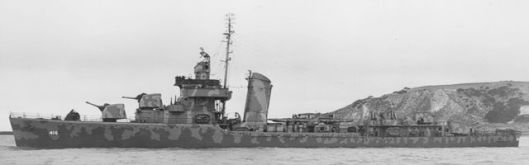
August 1942: After a refit at Mare Island Navy Yard, USS Walke (DD416) leaves San Francisco for the last time.
For the book Aviators, I made friends that I will never forget. Lucy May Maxwell, young enough to be my daughter—or, I fear, my granddaughter—is a British researcher with the Imperial War Museums and its Duxford branch, the American Air Museum in Britain, which has more information on the American air war in Europe than any three comparable American organizations. Lucy was invaluable to me in tracking down photographs, identifying planes and fliers, and she reminded me, no matter how strained it becomes, of that “special relationship” the United States and Britain share.
The sources for Aviators included MACRs (Missing Aircrew Reports), the aforementioned and endless lists of aircraft serial numbers, mission reports from websites dedicated to bomb groups in England, Italy and South Pacific—some included strike photos, aircrew lists, and even formation diagrams for bomb squadron missions–four local museums and their staffs, The New England Journal of Medicine (for the tropical diseases Pacific fliers had to endure), aviation archaeology groups who locate and memorialize crash sites around the United Kingdom and Hawaii, training and personnel manuals from the 303rd Bomb Group, part of the Eighth Air Force, genealogical websites like ancestry.com and genealogybank.com (the latter is invaluable for its newspapers), video interviews of local fliers that are now part of a Library of Congress collection, and, best of all, interviews with two new friends, two 94-year-old Army Air Forces veterans.
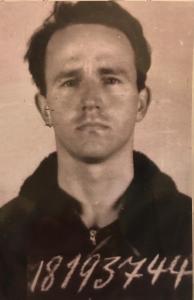
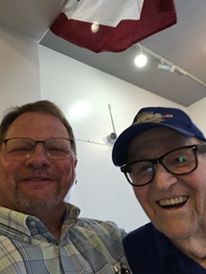
Al Findley Jr. as a German POW; Al and me, 2017
Al Findley Jr., a B-24 radioman, was shot down twice. The first time was over a newly-liberated French town, Epernay, whose residents were so delighted with their crash-landed American guests (they put them up in warm straw or even feather-beds and the wine, as the saying goes, flowed) that one became pen-pals with Al’s mother, in Oklahoma. Al’s squadron commander finally had to buzz Epernay to drop a canister that contained the sad order for the aircrew to get their sorry rear ends back to base. There was a war on.
The second time Findley was shot down was over Germany, and that was less pleasant, made even less pleasanter by getting strafed, twice, by American P-51 Mustangs. Thankfully, Findley not only survived but became a lifelong Air Force sergeant—a Command Master Sergeant—who opened a little antique shop, in England, with his wife after his retirement. He moved to Los Osos. Seventy years after his wartime service, Sgt. Findley drives to a retirement home outside Morro Bay every Sunday and takes his World War II friends out to breakfast.
The other nonagenarian (that’s the only chance I’ll ever get to use that word!) is John Stuart Sim, a longtime Cal Poly architecture professor and, in the war, a P-47 Thunderbolt pilot who flew out of his Ie Shima base on August 9, 1945, to witness the blood-red flash and then the mushroom cloud of the Nagasaki bomb.
A year before that mission, John was a flight instructor with his two closest friends at an Army Air Forces base in Pierre, South Dakota, when he met a young woman named Mary at the Hopscotch Inn (The Hopscotch Inn was in another time zone, which meant an extra hour of beers for Stuart and his two friends, a kind of Army Air Forces version of the Three Musketeers). John and Mary met at the Hopscotch every night for the next week. They decided it made no sense to wait to get married, so they didn’t.
A few months later, at a party on an isolated little base in Texas, one of John’s flight-instructor friends, one of the musketeers, told Mary quietly and earnestly that he was certain her new husband would survive the war. He wasn’t as sure about the others–and he was one of them. He was right, of course. John made it. The other two—one, after an engine failure over the East China Sea, the other in a fiery crash at the edge of Hickam Field on Oahu—didn’t.
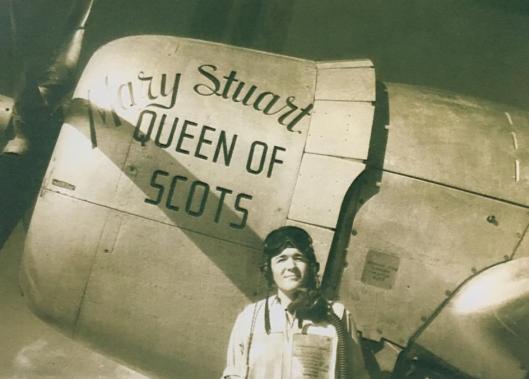
Lt. John Sim Stuart and the P-47 Thunderbolt he named for Mary.
But seventy-three years after that first meeting at the Hopscotch Inn, John and Mary Stuart are still married.
The deaths stay with you. The lives do even more.
 A Work in Progress