
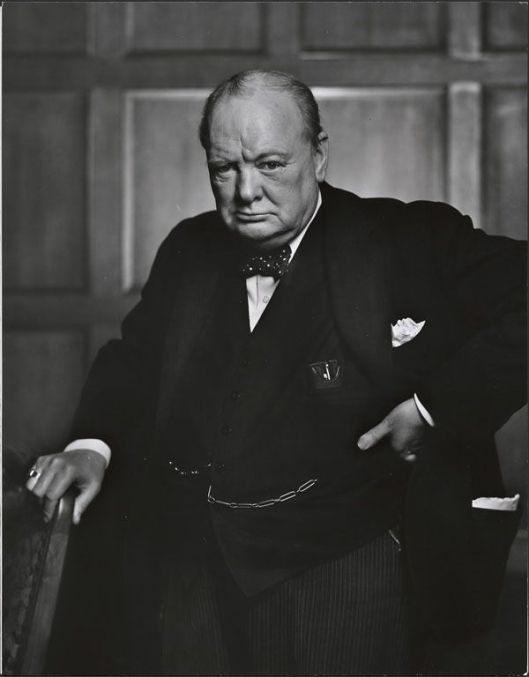
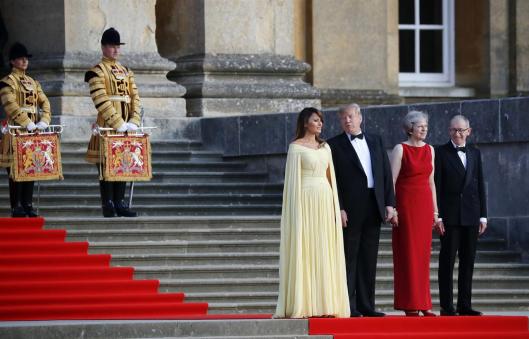
The photos above are of Churchill’s famous portrait (Cecil Beaton got the expression by reaching out and snatching the cigar out of Winston’s mouth) and of Trump visiting Blenheim Palace today.
Blenheim Palace was Churchill’s birthplace, named for the victory his ancestor, Marlborough, won in Bavaria, fighting for Queen Anne and for Britain in the War of the Spanish Succession, when the Bourbons aimed at disrupting the balance of power in a manner only slightly blunter than Putin’s. The intent, the malevolence, was otherwise the same.

Capability Brown’s work, Blenheim.
The palace is magnificent—-my wife, Elizabeth, and I have visited—but it’s the estate that’s even grounder, with the grounds so beautifully and carefully designed, yet with a seeming artlessness that gives hillsides and lakes and copses of trees the appearance of happy accidents, and all of it was executed by my favorite landscape architect, Capability Brown, a man I used to explain the Enlightenment, in visual language, during nineteen years of teaching history to the high-school sophomores I loved so much. Churchill proposed to Clementine in a neoclassic Greek temple recessed in Capability Brown’s shade, cast by trees that he hadn’t planted yet. He had faith that the shade would be there when it was required. That kind of faith leads to the imperfection we call “democracy.”
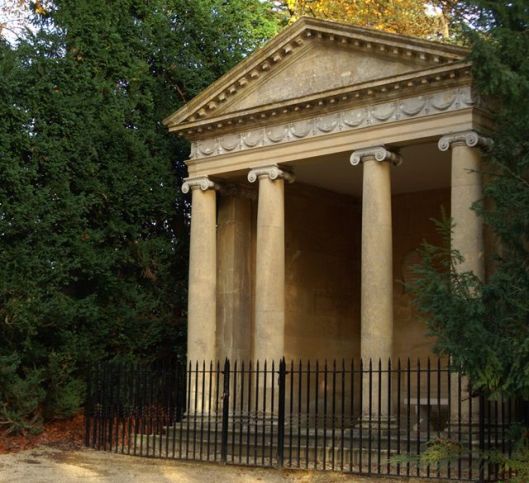
Temple of Diana, Blenheim.
The two men, Churchill and Trump, have much in common. Both had emotional lives that were stunted by neglectful mothers. Winston’s Jennie, a Philadelphian, resented his very birth, in a cloakroom, because his arrival made her miss a ball, and in revenge, she practiced premeditated and cruel neglect on her son until she discovered her love for him, finally, in the moment that he began winning elections.
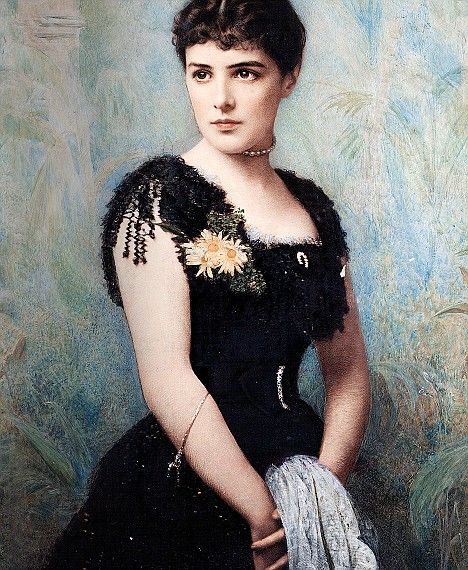
Jennie Jerome Churchill
Trump’s mother grew ill when he was a toddler and she was so consumed with staying alive that he was, for several years, a virtual orphan.
As a result, both men grew up terribly insecure, petulant, self-centered, childish and given to bouts of anger that were frequently cruel. Both men were impatient with arcane bureaucracies and took cudgels to them, beating shortcuts through the red tape that often proved disastrous. The disasters resulted from their certainty that they were smarter than every expert summoned to counsel them.
Both men were racists: Churchill witnessed with satisfaction the salutary effect the Maxim Gun had on North Africans and he loathed Gandhi; Trump delights in making orphans by the hundreds, as long as they’re brown.
Both held forth interminably at social gatherings, impatient with the contributions of their guests because they interrupted the flow of their own brilliant monologues.
But only one of them was brilliant, and brilliant, most of all, in our language.
Only one of them was a statesman.
Only one of them instructed, elevated and inspired his people.
Only one of them studied history, understood it, after his fashion, and appreciated the depth of history’s lessons and used them to shape his decisions.
Only one of them was a patriot.
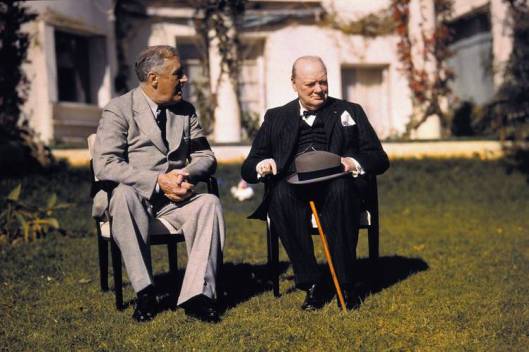
FDR and Churchill
Only one of them was a man so profoundly gifted, and so determined to use his gifts, that he was able to transcend his deepest and most grievous flaws. For Churchill, the most crippling flaw was the depression, the trait he shared with the one man he admired more than the Duke of Marlborough, and that was Lincoln–the Black Dog, he called it–that he fought, admittedly and in part with generous doses of brandy and champagne, but he found his steel in fighting it, in pushing it aside in every waking hour of his life.
Trump finds his steel–his is no stronger than tin– in insults and in cruelty. There is none of Churchill’s spine in the man. There is no man there at all.
Yet Trump was at Churchill’s ancestral home today. In keeping him away from London, in evoking Churchill’s birthplace, Her Majesty’s Government may have reminded us, deliberately or not, of Trump’s tragic smallness.
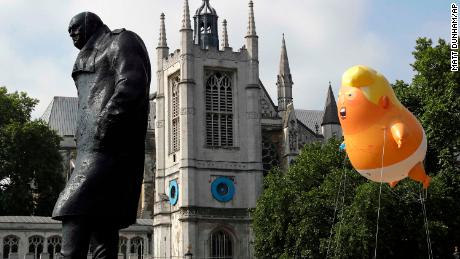
Trump is Shakespearean, but only in a minor key: He is Rosencrantz, or Guildenstern, or perhaps, in his best moments, Polonius. He is a character best dismissed offstage, behind an arras, where he can’t harm the plot.
But the same was said, and I’ve read the journalists who said it, about Mussolini and Hitler. They were, seemingly, petit-bourgeois clowns, nearly as crude as Trump, yet they dragged the world down with them, and they made orphans from the Atlantic to the Urals. And then, having dispatched the parents, Hitler burned the orphans.
Where is our Churchill? Where is the statesman with the talent to remind us all of our own greatness? That’s the faith, naive as it might seem, that Churchill kept and that Americans as diverse as Abigail Adams, Thomas Jefferson, Walt Whitman, Abraham Lincoln, Willa Cather, Dorothea Lange, Frank Capra, and Martin Luther King Jr. kept. It’s a faith I try so hard to summon in the little books I write. one that’s been validated in places as far away as Antietam and Cold Harbor, Papua New Guinea and Iwo Jima, Normandy and Berchtesgaden.
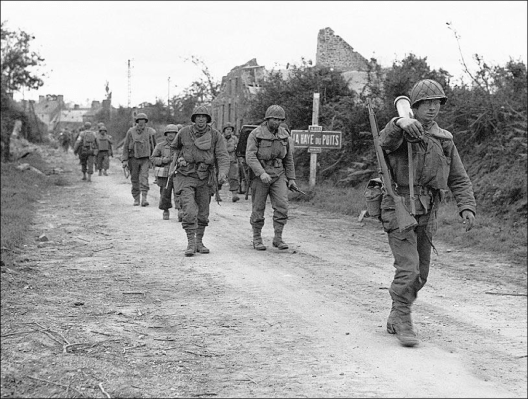
Exhausted 79th Division soldiers leave Le Haye du Puits, in Normandy, July 1944. One of them, local farmworker Domingo Martinez, was killed during the assault on this crossroads town.
It’s a faith that was lived by Army nurses who whispered gently and urgently into soldiers’ ears to keep them alive. It was a faith lived by the big Missouri farm boy, a B-17 waist gunner, who got his comrades out in their parachutes but went down with his bomber. It’s a faith that was lived by the Japanese-American teenager, sent from Arroyo Grande to a desert concentration camp, who answered this insult by becoming an Army intelligence officer serving his country in the mountains of China: he won a Bronze Star, he won a Congressonal Medal of Freedom and he never came back to Arroyo Grande again. Until he died. He told his son, a Texan, to bring his ashes home to Arroyo Grande, seventy years after the buses had taken him and his family and his friends away.
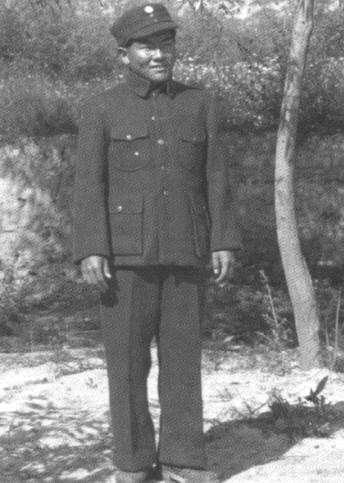
Arroyo Grande intelligence officer George Nakamura, dressed in a Chinese uniform, 1945. Nakamura disguised himself as a Chinese peasant to rescue an American flier behind Japanese lines and won both a Bronze Star and a battlefield promotion to lieutenant. He was twenty years old.
So where is our Churchill? Today reminded me that we don’t need him. We need ourselves. We need to remember who were are. There was Churchill’s genius: it was all in the reminding.
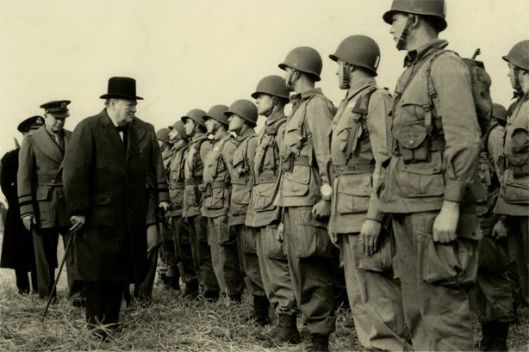
Churchill, with Ike, inspecting the newly-arrived GI’s of the 101st Airborne.
 A Work in Progress