
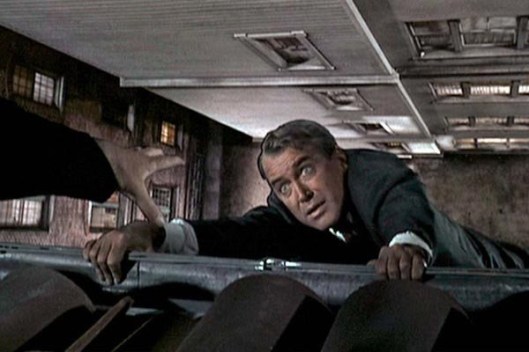
Scottie (James Stewart) in the film’s opening scene.
I really should not read essays about films. The one I read yesterday has messed with my head, because, citing the British Film Institute, it put Hitchcock’s Vertigo (1958) at the top of the all-time greatest films list, bumping Citizen Kane from the top spot.
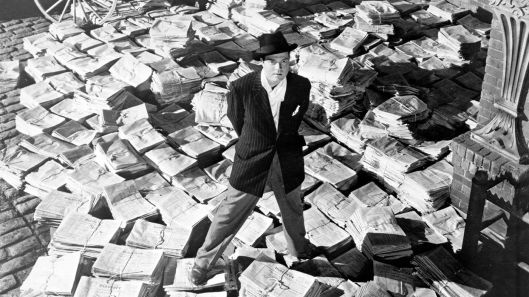
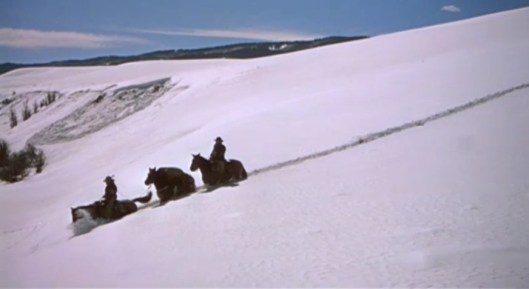
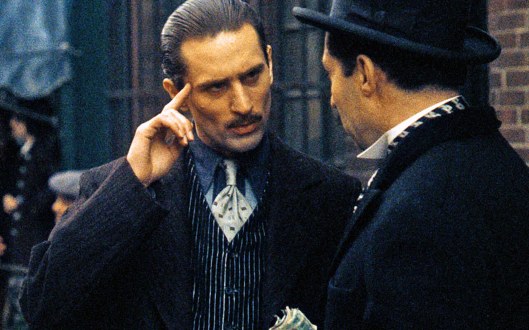
Welles in Kane; Wayne’s Ethan and Jeffery Hunter’s Martin descend a winter hillside in The Searchers; DeNiro in Godfather II.
I have never doubted Kane to be a great movie, but it would never be my #1. It is stylistically and technically stunning, but it’s cold at the heart. My picks, if I were in charge of things—which would be a mistake—at least for American films, would be John Ford’s The Searchers, one of the most gorgeous films ever made, or Coppola’s The Godfather Part II, for the incredible history it retells while leaping from one part of the twentieth century to another. And I’ve never seen a more arresting appearance than Robert DeNiro’s as the young Don Corleone. I was, I think, pinned to my movie-chair seat (so I hope it was comfortable) because I immediately recognized Brando’s Don and also connected emotionally with DeNiro’s portrayal, which was no imitation: the character’s coiled, implicit power, tempered by a kind of gallantry, and his devotion to family, the fundament of the whole film series, was deeply moving and deeply authentic.
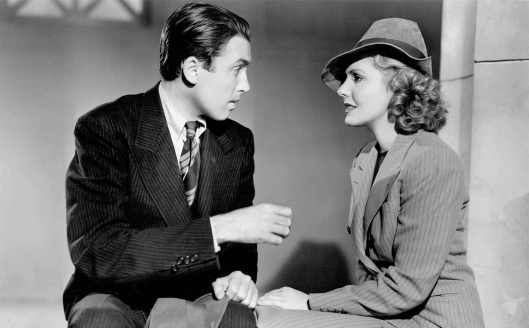
Stewart and Jean Arthur, Mr. Smith Goes to Washington (1939).
But in Vertigo, James Stewart is the lead—Scottie, the washed-up SFPD detective—and if I immediately connected with DeNiro, I was repelled by Stewart. He’d betrayed me: This was the James Stewart of Mr. Smith Goes to Washington (and with Jean Arthur, one of my favorite actresses), The Philadelphia Story and It’s A Wonderful Life. This was the war hero. This was the man, an arch-Republican, whose best friend was Henry Fonda, a Henry Wallace Democrat.
And in Vertigo, he is—to borrow Keenan Wynn’s pronunciation from Dr. Strangelove—a damned pree-vert. He’s a stalker, obsessed with Kim Novak’s Judy because she looks so much like a lost love, done away with in the second reel, Kim Novak’s Madeline, who fell from a church tower to her death (supposedly) because Scottie the police detective was afraid of heights and so failed to prevent her death (something he’d done earlier in the film, when Madeline jumped into the Bay off Fort Point with the Golden Gate Bridge, much more efficient for suicide, standing conveniently in the background.)
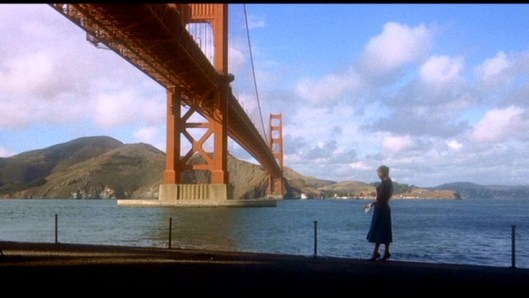
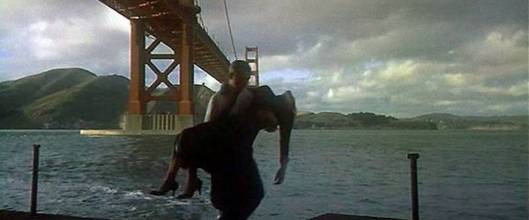
Scottie saves Madeline off Fort Point…
Scottie saves her that time, brings her home (his apartment was on Lombard Street) and she awakes wrapped in his robe. In 1958, this was explosive stuff. Scottie had seen her nude, a precondition to getting her dry. My mother would not have let me see this film.
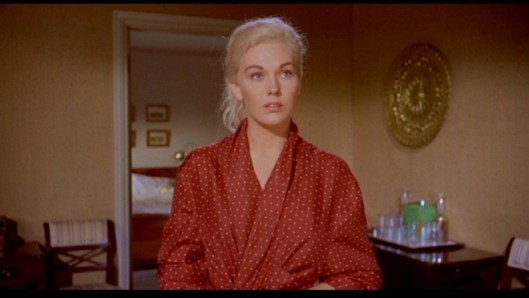
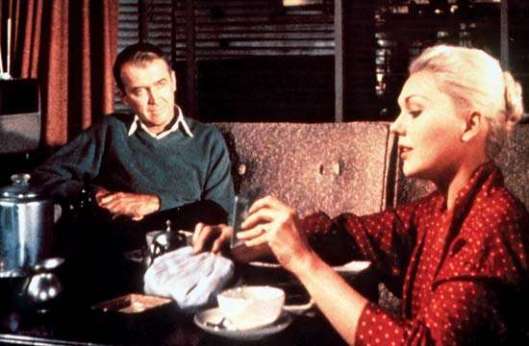
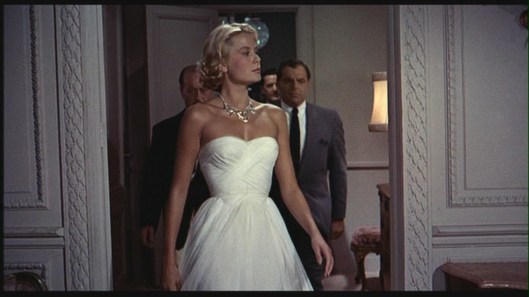
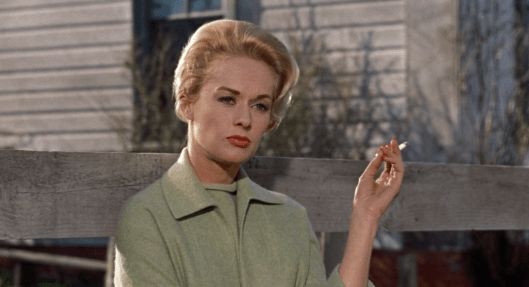
…and brings her home. Novak’s vulnerability in the top frame is such a soft counterpoint to the Judy she plays later in the film. Hitchcock’s obsession with cool blondes, of course, would continue with (below) Grace Kelly–in my humble opinion, the most beautiful actress in American film history– and Tippi Hedren.
And then he loses her anyway, with her jumping off that church tower at San Juan Bautista (it turns out that she was murdered, anyway). Are you confused yet? So was I.
To be even more confusing, some smart-aleck has written that Hitchcock was fascinated by the Ambrose Bierce (Bierce was a San Franciscan) short story “Occurrence at Owl Creek Bridge,” in which a Union Army detail hangs a Confederate saboteur. The rope breaks, the condemned man escapes after a harrowing journey, returns home to his loving wife and family and…
…Realizes that he’s imagined the whole thing. He’s back at the bridge, swinging slightly after the drop, thoroughly dead.
![bscap0143[1]](https://jimgregory52.com/wp-content/uploads/2018/09/bscap01431.jpg?w=529)
A scene from the French film version of “Owl Creek Bridge.”
The scene ends. The next time we meet Scottie he’s on disability retirement—the trauma of that moment on the rooftop. But Mr. Smart-Aleck argues that Scottie died up there, too—after all, no one was around to rescue him and his grip was slipping—so everything that follows, for the next two hours, is just a dream, like the condemned man’s dream in “Owl Creek Bridge.”
I’m not buying it.
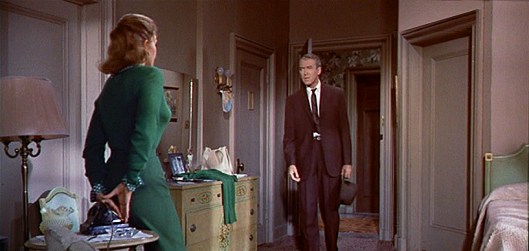
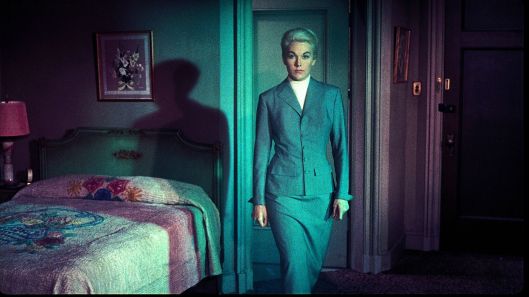
Judy and Scottie meet; Judy, now fully remade in Madeline’s image, emerges, in the proper gray suit, from that sickly green light that floods her apartment.
But this guy’s essay added another layer of disturbance to a movie that already disturbed me. Stewart loses Madeline, then finds a girl walking on a San Francisco street—Judy, also played by Kim Novak—who reminds him immediately of Madeline. I’m not sure why. Judy is no Madeline: she is coarse, with eyebrows layered thicker than Van Gogh pigment. She lives in a cheap walkup apartment bathed in sinister green light from a nearby sign. She’s from Salina, Kansas. Yet Scottie somehow intuits the refinement that both Madeline and her early California ancestor, Carlotta, shared–a painting of Carlotta figures in the Madeline part of the film. So Scottie spends the greater part of the film’s second half trying to remake Judy into Madeline in a kind of creepy Pygmalion way: she dyes her hair, wears the same gray suit Madeline favored—after an excruciating scene at a fashion house in which model after model fails to meet Scottie’s requirement for the exact gray suit–dines with Scottie at the same steakhouse—Ernie’s, an actual City restaurant—and so they fall in love on the pretense that she’s not Judy: She’s Madeline.
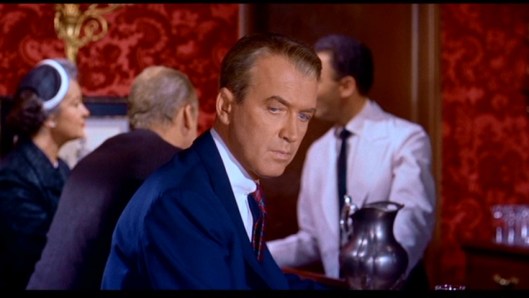
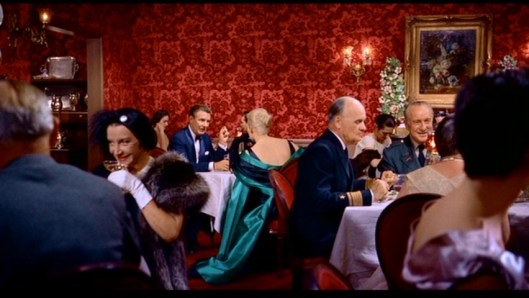
Real San Francisco places: Scott first meets Madeline by eavesdropping on her, as a private detective, at Ernie’s Restaurant.
Yes, it’s weird.
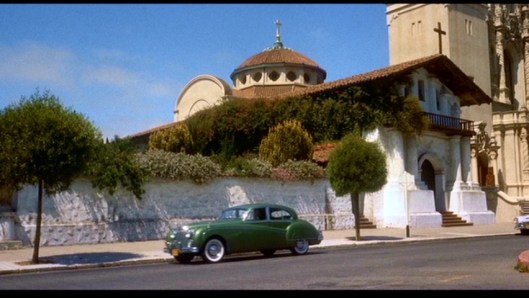

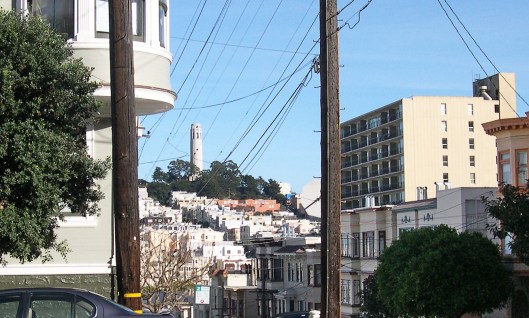
Madeline’s car, a 1956 Jag, outside Mission Dolores, in front of Scottie’s apartment; the view from Scottie’s includes Coit Tower.
But, for me, it’s resonant because location filming, in 1957, would’ve been about the same time I first saw San Francisco, as a little boy (there was a lightning storm atop the skyscrapers, something I’ll never forget) when my Dad was bidding a job there for Madonna Construction. So the film that in many ways repels me is intimate—in the way DeNiro was—because it’s in so many ways familiar, and it’s a betrayal because the James Stewart I know best is so unfamiliar. But I think that’s why it’s a great film (it was panned on its debut; Hitchcock blamed Stewart, at fifty, he thought, too old to have been Kim Novak’s love interest) and one that needs to be watched several times. It’s unfamiliar, it’s disturbing, and it leaves you as disoriented and disheartened as Stewart’s Scottie must have been.
In the final scene, he’s staring from a mission belltower—not really there; the original was in such disrepair that Hitchcock had to substitute an artificial replacement— into the space below. He can look down now, for the first time in a long time, but there’s nothing left for him below. He is completely alone.
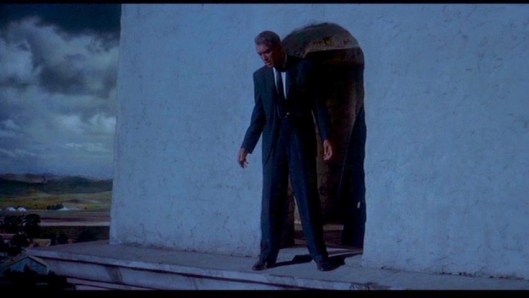
The final scene.
 A Work in Progress