This gallery contains 17 photos.
Even though it befuddled me, The Favourite reminded me of how much I loved teaching history, including art history. And …

29 Tuesday Jan 2019
Posted in Uncategorized
This gallery contains 17 photos.
Even though it befuddled me, The Favourite reminded me of how much I loved teaching history, including art history. And …
17 Thursday Jan 2019
Posted in Uncategorized
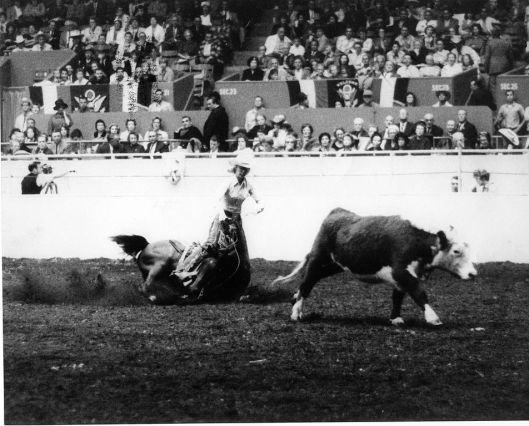
Ronteza and Sheila during their near-fall
The Polish-born Arabian stallion’s name was Witez II—“Chieftain” or “Hero” in translation, and he was at sea, bound for a new home in post-World War II America. But as his ship entered the Bay of Biscay, it was hit by an intense storm that produced monstrous waves. Its cargo—Witez and 150 other prized European horses—began to make noise below decks: the terrified animals screamed, kicked at the bulkheads and began struggling among each other, and wounding each other, in confusion and panic.
A U.S. Army officer, Capt. William Quinlan, was in charge of the Liberty Ship Austin’s precious cargo. Quinlan and his soldiers worked frantically to separate and calm the horses—Arabians, like Witez, along with Thoroughbreds and Lipizzaner from Vienna’s famed Spanish Riding School.
Quinlan lurched toward Witez and found him quiet and unafraid, focused fiercely on maintaining his balance as the ship straddled another wave. Writer Elizabeth Letts describes the encounter:
Quinlan stroked the horse’s nose for a moment, whispering a quiet word of thanks. Witez, the chieftain, had been bred to maintain his composure in the fury of battle—and here on the Stephen F. Austin, he had won his warrior’s stripes.
Sixteen years later, another horse would demonstrate the same composure and focus that Witez did that day in the Bay of Biscay. She, too, was an Arabian. She, too, was a warrior. The smallish, hard-muscled mare, named Ronteza, was Witez’s daughter. Her home was Corbett Canyon, near Arroyo Grande, and in 1961 she would prove herself to be her father’s daughter in front of 20,000 spectators who watched, momentarily hushed, as the little horse stumbled and fell in competition.
Her rider was Sheila Varian.
* * *
It was, of course, Walter Farley’s classic book The Black Stallion that first made Sheila Varian, along with many generations of little girls, fall in love with horses.
Varian was raised in Halcyon in a family marked by brilliant individuality—two uncles were the founders of one of the first electronics firms in what is now known as Silicon Valley. She learned to ride during gallops one the beach at age eight on Judy, little Ronteza’s opposite. Judy was a sixteen-hand Morgan/Percheron cross, so it was a long way to the ground. Varian wouldn’t be gifted with her first saddle until she was twelve, but she, wearing feathers in her hair, in her imagination a Plains Indian, would gallop for miles on Judy, the horse her father rode hunting deer in the hills above the nearby Arroyo Grande Valley. She was fifteen when her parents bought her first Arabian, a mare named Farlotta. Varian describes the intensity and the symmetry of that relationship:
I don’t know if I’ve ever loved anything as I loved Farlotta. She was frightened, belligerent, thin and wormy when I got her, but nothing mattered except that she was mine. I ate my dinner in her manger. I dreamed in the sun lying stretched out on her back. For a long time she bolted and ran, half a dozen times every ride.
It was a tribute to Varian’s emerging gift in working with horses when she and Farlotta, a few years later, began winning awards up and down the state—including the All-Arabian Show at the Cow Palace, where another Varian mare, Ronteza, would make her debut a few years later, in 1961.
By then, her parents had surrendered to the realization that this particular Varian’s genius lay with horses. As Sheila finished her education at Cal Poly and began working as a P.E. teacher at Arroyo Grande High school, the Varians acquired the twenty-one acres in Corbett Canyon that would be the nucleus of today’s 230-acre Varian Arabians, now home to over 150 horses. Her parents’ support was unswerving: her father, Eric, built fencing did the ranch’s maintenance work; her mother, Wenonah, became a self-taught expert researching the pedigrees of the Arabians that were potential Varian horses.
They decided to buy a “the blocky little mare,” as Varian described her affectionately, with a near-flawless pedigree: Ronteza’s dam was named Ronna; her sire was the stallion who had stood so calmly on the heaving deck of the Stephen F. Austin, Witez II.
* * *
The horse whose life almost ended in the Bay of Biscay in the fall of 1945 was foaled in the spring of 1938. Witez was born at Janow Podlaski, a farm that bred horses for the Polish cavalry. Elizabeth Letts describes a foal whose beauty was recognized almost instantly: he showed from his first wobbly moments a potential for perfect proportions and, fittingly, he was marked by a large white star on his forehead “that looked remarkably like an outline of his native Poland.”
Poland would be swallowed by the first act of World War II the next year. As Witez’s homeland was invaded by Hitler’s Germany and Stalin’s Soviet Union, Witez would almost become a casualty of war.
On September 11, 1939, ten days after the outbreak of war, the staff decided to evacuate the 250 Arabians at Janow Podlaski and drive them east, away from the German blitzkrieg that had been unleased for the first time in history on Poland. Their destination was a refuge in Rumania—500 miles away.
The trip almost claimed Witez. After days of a forced march—mostly at night, to avoid strafing by Luftwaffe fighters and Stuka dive-bombers—the colts began to tire, including Witez and two of his brothers. When the procession blundered into a vast Polish military convoy in the middle of the road east, Witez was among some eighty horses who panicked. He and his brothers disappeared into thick forest.
Their handlers were despondent. They pressed on, but, by September 20, their way blocked by artillery fire and by the news that the Soviets were advancing from the east, they turned back to Janow Podlaski.
Eventually, Witez would return to the farm, as well. Emaciated and exhausted, he was among some thirty of the runaways who’d been found and sheltered by Polish civilians, horse-lovers, as foreigners subdued their country.
For the next six years, Witez’s homeland, and his life, would be dominated by German authorities, including a self-proclaimed Nazi expert on breeding, Gustav Rau, who became the master of Janow Podlaski and who would become determined to produce prize animals—including Arabians and Lipizzaner—that would constitute, in the Nazis’ sinister view of genetics, “the perfect horse,” the kind of animal that could, for example, tirelessly pull an artillery piece for miles on European roads and then rush it into combat. Rau’s breeding program, he believed, grounded in stallions like Witez, would lead the Wehrmacht, the German Army, to ultimate victory.
* * *
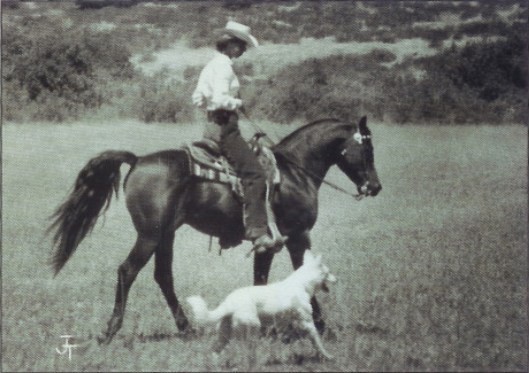
Sheila Varian and Bay-Abi, the foundation stallion she would breed to Ronteza.
Sheila Varian was seeking a victory of a different kind. As Varian Arabians began to grow in Corbett Canyon, the California native was learning californio horsemanship from another woman, a widow, Mary “Sid” Spencer, who bred Morgans and ran Herefords on the ranch she and her late husband had established in Lopez Canyon.
Spencer was an archetype, not just a rancher. She was a widow who ran a ranching operation on her own and so was fiercely independent and fiercely protective of the ranch she’d worked so hard to develop. In the early 1960s, my father and some friends went dove-hunting in Lopez Canyon when they inadvertently crossed onto Sid Spencer’s ranchland. Their first encounter with Sid was at the business end of a 30-30 carbine. “Why don’t we just sit here quietly,” she told the trespassers, “until the sheriff gets here?” All the parties involved thought this was a sound idea.
Spencer was also a masterful teacher, generous with her time and space to those who rode into her life on horseback. As tough as Sid could be on trespassers, she introduced Varian to a gentle kind of horsemanship—the California vaquero tradition—that her student believed could work as well for Arabians as it did for Spencer’s Morgans or the more common California working horse, the Quarter horse.
“Working” at the Spencer ranch was frequently celebratory: Photographer and writer Jeanne Thwaites described a typical calf roundup—an all-female occasion—at Spencer’s 1,900-acre ranch in the 1960s:
While men may make a roundup into a serious and even dreary business, the girls turn it into a riotous picnic. They try their roping techniques without inhibition, race after and throw the calves, and with gleeful gloat that no man is present to witness their shrieks, giggles and other unprofessionalisms. They wail about their bumps and bruises and make a lot of their own lack of brawn, but at the end of the day the job is complete and they are still full of fun.
Varian incorporated the kind of light-hearted approach to training her horses that typified Spencer’s ranch. “All good horses,” Sheila remarked, “like smart children, need good instruction, but they don’t need harsh instruction.” The vaquero way of training a cattle horse fits that philosophy, and Varian adapted it to training Arabians, beginning with them about age three with a bridle and snaffle bit in a process that where the horse would eventually graduate, as a full-fledged cow horse, to a spade bit. It is a training process that emphasizes, in every stage, patience, gentleness, a light hand and the development of intuitive communication between horse and rider. What Varian insisted on doing, in 1961, was proving a point: Her Arabians, with the proper training, could compete with any other breed—most commonly Quarter horses—in cattle work. The venue she chose to prove her point was the Cow Palace in San Francisco, the site of the ultimate in competition for working horses, the Reined Cow Horse Championship. Her mount would the little mare she didn’t think about much–at first— Ronteza—Witez II’s daughter.
* * *
Nearly six years after the opening of the war, Nazi Germany was crumbling, ironically, under the same kind of pressure—pressure from vast armies on both the nation’s western and eastern borders—that had crushed Poland in the fall of 1939. By the spring of 1945, Witez had been moved by the Nazis to Hostau, a farm in the modern Czech Republic.
But as the war turned rapidly against Germany, Witez was once again in danger, as he had been as a colt. The Soviet Army was approaching and destroying everything in its path, including horses, which they either expropriated as draft animals or shot on sight to provide meat for hungry soldiers. Conditions to the west were not necessarily safer: 200 Arabians fled Janow Podlaski and headed west, away from the Soviets. Among them were Stained Glass and Grand Slam, two of Witez’s brothers. The exhausted horses arrived in Dresden on the night of February 13, 1945, just as the Allied command unleashed the notorious fire raid, involving over 700 British and American heavy bombers, on the ancient city.
After a wave of bombers had dropped its incendiary bombs, one of the Polish handlers watched, horrified, as Grand Slam’s tail burst into flames. He held on as best he could to the powerful horse and closed his eyes. When he dared to open them again, the flames that had engulfed Grand Slam’s tail had sputtered out and the bombers were gone. So were over half of the Polish Arabians, incinerated in the fires or asphyxiated by the oxygen-consuming firestorm the incendiaries had been intended to produce. By the time the surviving animals reached their ultimate destination in western Germany, fewer than fifty remained.
But now Witez II’s survival at the Hostau farm in Czechoslovakia was in doubt. In late April 1945, he was among some 1,200 horses, including Arabians, Thoroughbreds and the Lipizzaner brood mares and their foals, the breeding stock for the Spanish Riding School. Ironically, it was the imminent end of the war that now endangered the Hostau horses: the Soviets were closing in.
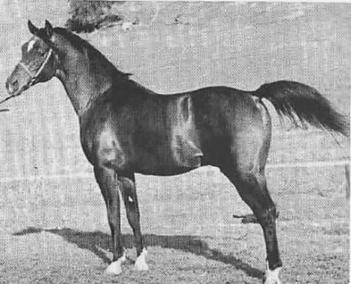
Witez II
Meanwhile, just to the west, it was the surrender of a German general to the Americans that would begin the remarkable rescue of the Hostau horses. Sensibly deciding that his chances were better in surrendering to Americans rather than to Soviets, the general began chatting amiably with an American officer, Col. Charles Reed, and the subject turned to horses. The German loved horses. Reed, the prewar commander of the famed 10th Cavalry—the “buffalo soldiers” who, in 1940, were still a mounted regiment—loved them just as much. The German officer made an emphatic plea to Reed: Might not the Americans rescue the animals before the Red Army turned them into “horseburgers?”
When word of the situation at Hostau reached Third Army’s commander, Gen. Patton, he was both sympathetic and peeved. The controversial officer, so frequently disciplined by his commander, Eisenhower, was in no position to authorize what most would see as a fool’s errand. He decided to anyway, but promised to disavow what would be called “Operation Cowboy” if anything went wrong.
“Get them,” her ordered the 2nd Cavalry’s Col Reed. “Make it fast.”
* * *
Sheila Varian’s first Arabian, the two-year-old named Farlotta, had represented a different kind of rescue. Although the pair had triumphed in 1956 at the All-Arabian show at the Cow Palace, the mare died soon after, at seven, the victim of disease and worms that had plagued her early years. Farlotta’s death—the angry and mistrustful horse had become Sheila’s friend—left her despondent. Varian’s depression began to lift only when she noticed that she wasn’t alone in her grief: standing with her head down in one of the ranch’s corrals was her second Arabian mare, Ronteza, who had been the horse closest to Farlotta. Sheila’s therapy, for both horse and rider, biographer Mary Kirkman noted, was to begin working with Witez II’s daughter.
At first, Ronteza was no replacement for Farlotta. The mare, purchased for $750 at a Porterville ranch on the basis of Wenonah Varian’s hours spent poring over pedigrees, was quiet and seemingly passive, especially when compared to the spirited Farlotta—who had even learned to enjoy games of “fetch” with the sticks Varian tossed for her—but gradually, Sheila began to realize the that the quiet little filly “was just a very serious, kind and sweet horse that didn’t beg for treats and didn’t come when called.”
Ronteza would come into her own at Sid Spencer’s ranch, when the mare began to show an instinctive feel for working cattle. Ronteza was cow-smart and she loved working. Varian began entering her, still in her hackamore bit, in competition against other Arabians, and the pair began winning. They then graduated to open shows, working cattle in an arena against competitors that were almost always Quarter horses. Ronteza was an interloper: Arabians, it was believed, were too delicate and fine-boned and lacked the toughness necessary to any cow horse. In the fall of 1961, Ronteza was finally “a finished spade bit reined cow horse,” and Varian decided to disprove the canard about Arabians in the most audacious way possible—at the reined cow horse championship, part of the Grand National Rodeo, at the Cow Palace in San Francisco.
* * *
In the spring of 1945 at the Hostau farm in Czechoslovakia, the men who cared for Witez and the Lipizzaner knew that the war was ending when the local Wehrmacht commander had a mountain of luggage piled into his chauffeur-driven Mercedes and promptly disappeared. He was followed by the teenaged soldiers of the Volkssturm, the youthful militia who were jubilant at being relieved of their ostensible duty, to stand and fight in defense of the horse farm.
When American trucks and armored vehicles began to appear on April 28 —they were the vanguard of the 2nd Cavalry, a component of Gen. George Patton’s Third Army—the stablemasters walked carefully toward the column with a large white sheet as a token of surrender. The Americans, though, had come in peace: Their mission was to secure the horse farm and protect the horses, and the man who had ordered them there was the 2nd Cavalry’s commander, Col. Hank Reed, the one-time horse soldier of the 10th Cavalry. His soldiers understood their mission.
At 71, Louis Holz, in 1945 a 2nd Cavalry lieutenant, remembered his motivation: “We thought we had a chance to save a sliver of culture for the rest of the world. We sensed the end [of the war] was in sight, and we were in a frame of mind to give credence to beauty once again.”
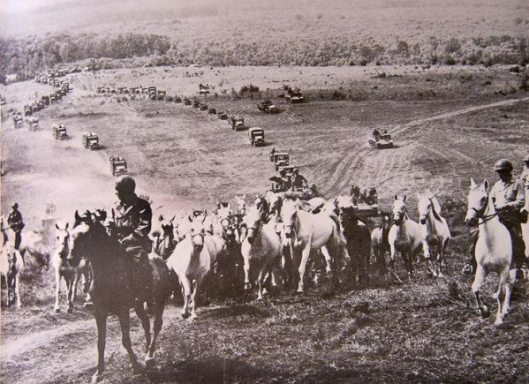
Operation Cowboy
If Hostau was secured, the beautiful horses there were not yet safe. They would have to be evacuated to German soil now under Third Army’s control; the Czech farm lay within what was to be the postwar Soviet sphere of influence and the presence of American troops would constitute an opening shot in what would become the Cold War. Col. Reed began organizing Operation Cowboy, and the improbable convoy of jeeps, trucks—the latter carried mares about to foal and colts too fragile for a long journey—began to head west, for Germany. The 2nd Cavalry soldiers, after a war spent mounted on trucks and jeeps, not horses, had become actual cavalrymen. They were jubilant. So was the Arabian stallion under their care, Witez II, happy to leave Hostau behind. Elizabeth Letts describes the leave-taking:
Witez set off eagerly, eyes bright, tail aloft. On his back, one of the cavalry riders, a cowboy who hailed from Idaho, looked like he was having the time of his life. Few of the horses stabled at Hostau, horses used for breeding, were trained to be ridden under saddle, but Witez was one. The bay had been given the important job of riding herd on the young stallions, the group that would be the most excitable.
On May 16, four days after leaving Hostau, Witez and his traveling companions were safely inside Germany. But the stallion’s travels had just begun. By then, Third Army’s commander, a veteran polo player and Olympic pentathlete, George Patton, had been graced with a performance by the Spanish Riding School’s stallions, who’d spent the last days of the war in rural Austria. It was the riding school’s master, Alois Podhasky, who asked the mercurial general to officially place both the performing horses and the animals at Hostau under American protection. Podhasky could not have known that Patton had already authorized Operation Cowboy.
The rescue of his breeding stock so pleased Podhasky that he allowed the Americans to claim some of horses for their own. Witez II was among the 150 animals the Army chose, the spoils of war, for shipment to the Quartermaster Remount Depot at the Kellogg Ranch in Pomona. This was the voyage that had nearly claimed Witez and his traveling companions in the vicious storm that overtook the Austin in the Bay of Biscay.
In 1949, when the Army Depot closed, California breeders Earle and Frances Hurlbutt bought him at action for $8,000. When the couple began to show him, he won championship blue ribbons up and down the Pacific Coast. His main business remained at the Hurbutt’s Calabasas ranch, standing at stud and so producing a new generation of Arabians with Polish bloodlines. In 1954, Ronna, a mare bred to Witez, gave birth to the filly who would mature into Sheila Varian’s cow horse
* * *
Ronteza, according to conventional wisdom, had no more business competing at the Cow Palace than the 2nd Cavalry cowboys had riding through Czechoslovakia. By now—the fall of 1961—Varian had graduated from Cal Poly and was teaching P.E. at Arroyo Grande High School. She had the equivalent of two full-time jobs, because she also was working intensively with her mare every day after school, running laps in a nearby hay field to build her endurance. In October, the pair began working with cattle on a ranch near Oakhurst. Late in the month, Varian, her mother and Ronteza arrived in San Francisco for the Grand National Rodeo and the reined-horse competition.
Ronteza and her competitors would be expected to show their skill at riding patterns—in 1961, “anything the judge thought up, and they were given to you just before you entered the arena,” Varian remembered—that demonstrated the rider’s ability to maneuver the horse in turns, spins, figure-eights and sudden stops, where the horse is virtually sitting down in a dramatic cloud of arena dirt. The second part of the competition involved cow work, in chasing, heading and turning a steer.
In the competition’s first round, against thirty horses in the lightweight class, Varian survived a near-sleepless night at her hotel and Ronteza, ready to go—she disliked warmups and practice runs—passed the test: the pair were selected for the next round, against four other lightweight finalists. Varian, by the time that first round was finished, was emotionally and physically spent; she didn’t stay to watch the thirty horses and riders who would compete in the heavyweight division. At the time, she didn’t know that because Ronteza’s number had been called first in the lightweight division’s first round, she had won.
What the pair had done so far was stunning. Ronteza was the only Arabian competing in the championship. Sheila Varian was the only woman. They weren’t done making their point.
In the lightweight finals, Varian and Ronteza rode a new pattern, seemingly without effort. But when it came to cow work, the pair faced imminent disqualification. This is what Varian remembered in their pursuit of their steer:
Ronteza drove grittily and hard, pushing between the fence and the cow. She was galloping all out with her head down, charging for the shoulder of the cow to finish the circle. Suddenly her feet hit the hard-packed dirt from the horses’ buggies [a harness competition had preceded theirs] and in one motion she was falling. I was standing over her, feet on either side, the reins still in my hands. The rules echoed through my mind in slow motion: Go off your horse and you are eliminated.
A dramatic photo captures the moment: Ronteza is nearly flattened on her left side, her head still upright and her neck arched while Varian, upright, is being propelled forward with the reins still in her widely-splayed hands. The photograph suggests exactly what happened next: the position of Ronteza’s head shows that she’s already beginning to stand up; Varian, nearly over her mount’s neck, is refusing to stand down. The pair recovered—by now they had the audience on their side—and the determined little mare showed the same seriousness and focus that her father had shown below decks on the Stephen F. Austin: she circled and turned her cow.
It was now their turn to wait for the other four horses to compete.
The judges called Ronteza’s number first
* * *
That was Friday night. On Sunday afternoon, competing against the finalists in both the lightweight and heavyweight classes, Ronteza and Varian defeated all comers and were national champions. Varian remembered a moment from the Cow Palace competition vividly: at the start of one round, she could feel distinctly Ronteza’s heartbeat through the panels of the saddle. She knew then that her mare was ready. When the signal was given, when horse and rider entered the Cow Palace arena, two hearts beat as one.
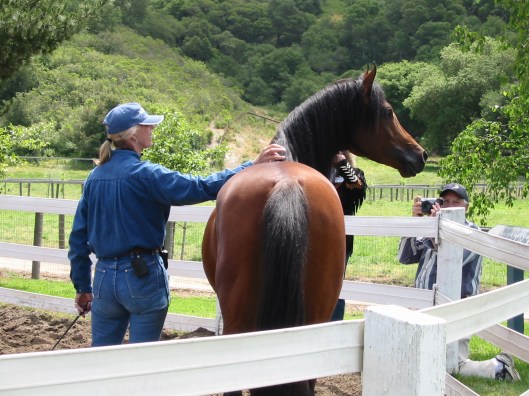
Sheila Varian, 2002. Photo by Lisa Andres
This story appeared in a slightly different version in the essay collection Will This Be on the Test?

https://www.amazon.com/Will-This-Be-Test-Reflections/dp/1795608366
10 Thursday Jan 2019
Posted in Uncategorized
Bay-Abi, Sheila Varian’s foundation stallion, was a Ronteza foal.
“When is your next book coming out?”
There’s nothing that can dry you up to turn you into a human prune as fast as that question. It doesn’t help that your writing dries up, too, as it has, for me, for several months. Self-pity is no damned good either, but it’s easy for small-potatoes writers like me: Writers don’t make a lot of money, and when the water heater or the washing machine go out, your royalties go away. Pouting uses up a lot of energy.
And then, since I’ve no talent for fiction, history writing demands that you do the research, the heavy lifting, which takes weeks and then months in places you’re not always welcome and then, when you are allowed in, it means furious note-taking in #2 pencil—the librarian strips you of everything else: no backpack, no pens, no paper, no camera—or delicate care, wearing cloth gloves, to turn the fragile pages of old newspapers or family histories that smell faintly of mildew.
It takes a lot of computer time, too, where increasing amounts of historical research are to be found, and that makes the internet a blessing. For the Aviators book, it meant everything from B-17 training manuals to MACR (Missing Air Craft Reports) filed online, from tracking down B-24 Liberator serial numbers to identifying tropical diseases suffered by American fliers in the Southwest Pacific, from 1944 fighter group yearbooks to Eighth Air Force Mission reports from Big Week, in 1944, when masses of American bombers were sent up over Berlin.
The objective of Big Week, you find out, wasn’t bombing targets. Those missions were instead intended to use the bombers as sacrificial bait to draw up German fighters so they could be shot down by American P-38s and P-51s.
The worst part of that job was finding, and reading, the Deceased Personnel Files of local fliers who didn’t survive Big Week, which include details you don’t want to know, including the way their bodies were identified after falling 25,000 feet or the list of personal effects they left behind in their footlockers in Norfolk or Cambridge.
The German fighter pilots were twenty or twenty-one years old. The average age of a B-17 pilot was twenty-two. Some of their gunners were liars and so were only sixteen or seventeen when they fell 25,000 feet to earth.
So when faced with work like this, I fall back on old tactics, honed in childhood: I hide under the pillows until whatever that scary thing is out there decides to go away.
But hiding didn’t work then and it doesn’t work much better sixty years later, no matter how much and cheerfully I admit to being a coward.
The only thing that works in these cases, with this business of writer’s block, is to guarantee a piece against deadline. Then you either do the work or you implode.
Not being willing to become pruny or to implode, I tried to begin again today. For no earthly reason, except for the inspiration of the lives of two horses and two human beings (the latter two, women, one of them a gifted popular historian), and all four marked by remarkable courage.
I managed 1200 words.
If you can’t write about horses, baseball, battle or falling in love, you need to become an engineer or a police officer, and in so doing you’ll be much more useful to society, and much less neurotic.
Finishing the piece, of course, is another mountain to be climbed. But here’s the beginning. Sheila Varian’s grandparents were from Ireland, so I hope there’s a bit of Irish here. The purpose, though, has less to do with Ireland and more to do with what I want to with my writing: To link the place I love so much—Arroyo Grande—with places and events that seem so distant yet are much closer than any of us, including me, ever realized. Here, it will be a stud farm in Poland and a ranch in Corbett Canyon.
Here’s an excerpt.
* * *
The Polish-born Arabian stallion’s name was Witez—“Chieftain” or “Hero” in translation, and he was at sea, bound for a new home in post-World War II America. But as his ship entered the Bay of Biscay, it was hit by an intense storm that produced monstrous waves. Its cargo—Witez and 150 other prized European horses—began to make noise below decks: the terrified animals screamed, kicked at the bulkheads and began struggling among each other, and wounding each other, in confusion and panic.
A U.S. Army officer, Capt. William Quinlan, was in charge of the Liberty Ship Austin’s precious cargo. Quinlan and his soldiers worked frantically to separate and calm the horses—Arabians, like Witez, Thoroughbreds and Lipizzaner bred for the Spanish Riding School in Vienna.
Quinlan lurched toward Witez and found him quiet and unafraid, focused fiercely on maintaining his balance as the ship straddled another wave. Letts describes the moment:
Quinlan stroked the horse’s nose for a moment, whispering a quiet word of thanks. Witez, the chieftain, had been bred to maintain his composure in the fury of battle—and here on the Stephen F. Austin, he had won his warrior’s stripes.
Sixteen years later, another horse would demonstrate the same composure and focus that Witez did that day in the Bay of Biscay. She, too, was an Arabian. She, too, was a warrior. The smallish, hard-muscled mare, named Ronteza, was Witez’s daughter. Her home was Corbett Canyon, near Arroyo Grande, and in 1961 she would prove herself to be her father’s daughter in front of 20,000 spectators who watched, momentarily hushed, as the little horse stumbled and fell in competition.
Her rider was Sheila Varian.
Ronteza falls at the Cow Palace, San Francisco, 1961.
 A Work in Progress