
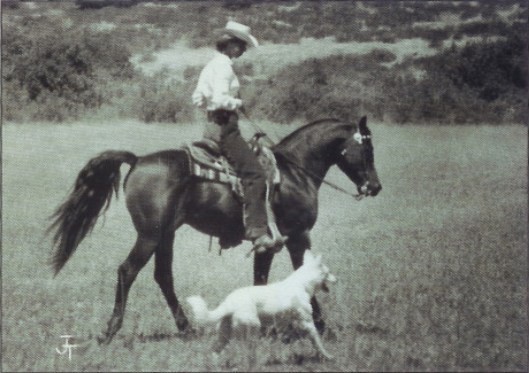
Bay-Abi, Sheila Varian’s foundation stallion, was a Ronteza foal.
“When is your next book coming out?”
There’s nothing that can dry you up to turn you into a human prune as fast as that question. It doesn’t help that your writing dries up, too, as it has, for me, for several months. Self-pity is no damned good either, but it’s easy for small-potatoes writers like me: Writers don’t make a lot of money, and when the water heater or the washing machine go out, your royalties go away. Pouting uses up a lot of energy.
And then, since I’ve no talent for fiction, history writing demands that you do the research, the heavy lifting, which takes weeks and then months in places you’re not always welcome and then, when you are allowed in, it means furious note-taking in #2 pencil—the librarian strips you of everything else: no backpack, no pens, no paper, no camera—or delicate care, wearing cloth gloves, to turn the fragile pages of old newspapers or family histories that smell faintly of mildew.
It takes a lot of computer time, too, where increasing amounts of historical research are to be found, and that makes the internet a blessing. For the Aviators book, it meant everything from B-17 training manuals to MACR (Missing Air Craft Reports) filed online, from tracking down B-24 Liberator serial numbers to identifying tropical diseases suffered by American fliers in the Southwest Pacific, from 1944 fighter group yearbooks to Eighth Air Force Mission reports from Big Week, in 1944, when masses of American bombers were sent up over Berlin.
The objective of Big Week, you find out, wasn’t bombing targets. Those missions were instead intended to use the bombers as sacrificial bait to draw up German fighters so they could be shot down by American P-38s and P-51s.
The worst part of that job was finding, and reading, the Deceased Personnel Files of local fliers who didn’t survive Big Week, which include details you don’t want to know, including the way their bodies were identified after falling 25,000 feet or the list of personal effects they left behind in their footlockers in Norfolk or Cambridge.
The German fighter pilots were twenty or twenty-one years old. The average age of a B-17 pilot was twenty-two. Some of their gunners were liars and so were only sixteen or seventeen when they fell 25,000 feet to earth.
So when faced with work like this, I fall back on old tactics, honed in childhood: I hide under the pillows until whatever that scary thing is out there decides to go away.
But hiding didn’t work then and it doesn’t work much better sixty years later, no matter how much and cheerfully I admit to being a coward.
The only thing that works in these cases, with this business of writer’s block, is to guarantee a piece against deadline. Then you either do the work or you implode.
Not being willing to become pruny or to implode, I tried to begin again today. For no earthly reason, except for the inspiration of the lives of two horses and two human beings (the latter two, women, one of them a gifted popular historian), and all four marked by remarkable courage.
I managed 1200 words.
If you can’t write about horses, baseball, battle or falling in love, you need to become an engineer or a police officer, and in so doing you’ll be much more useful to society, and much less neurotic.
Finishing the piece, of course, is another mountain to be climbed. But here’s the beginning. Sheila Varian’s grandparents were from Ireland, so I hope there’s a bit of Irish here. The purpose, though, has less to do with Ireland and more to do with what I want to with my writing: To link the place I love so much—Arroyo Grande—with places and events that seem so distant yet are much closer than any of us, including me, ever realized. Here, it will be a stud farm in Poland and a ranch in Corbett Canyon.
Here’s an excerpt.
* * *
The Polish-born Arabian stallion’s name was Witez—“Chieftain” or “Hero” in translation, and he was at sea, bound for a new home in post-World War II America. But as his ship entered the Bay of Biscay, it was hit by an intense storm that produced monstrous waves. Its cargo—Witez and 150 other prized European horses—began to make noise below decks: the terrified animals screamed, kicked at the bulkheads and began struggling among each other, and wounding each other, in confusion and panic.
A U.S. Army officer, Capt. William Quinlan, was in charge of the Liberty Ship Austin’s precious cargo. Quinlan and his soldiers worked frantically to separate and calm the horses—Arabians, like Witez, Thoroughbreds and Lipizzaner bred for the Spanish Riding School in Vienna.
Quinlan lurched toward Witez and found him quiet and unafraid, focused fiercely on maintaining his balance as the ship straddled another wave. Letts describes the moment:
Quinlan stroked the horse’s nose for a moment, whispering a quiet word of thanks. Witez, the chieftain, had been bred to maintain his composure in the fury of battle—and here on the Stephen F. Austin, he had won his warrior’s stripes.
Sixteen years later, another horse would demonstrate the same composure and focus that Witez did that day in the Bay of Biscay. She, too, was an Arabian. She, too, was a warrior. The smallish, hard-muscled mare, named Ronteza, was Witez’s daughter. Her home was Corbett Canyon, near Arroyo Grande, and in 1961 she would prove herself to be her father’s daughter in front of 20,000 spectators who watched, momentarily hushed, as the little horse stumbled and fell in competition.
Her rider was Sheila Varian.
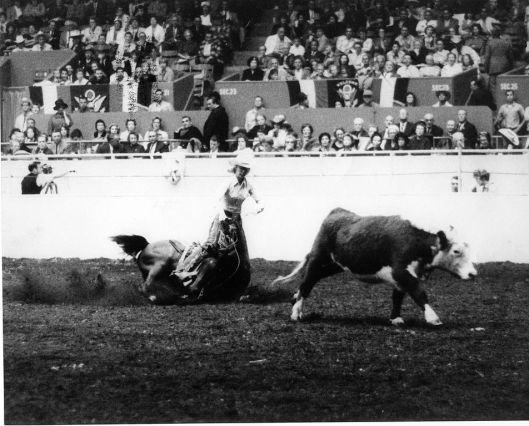
Ronteza falls at the Cow Palace, San Francisco, 1961.
 A Work in Progress