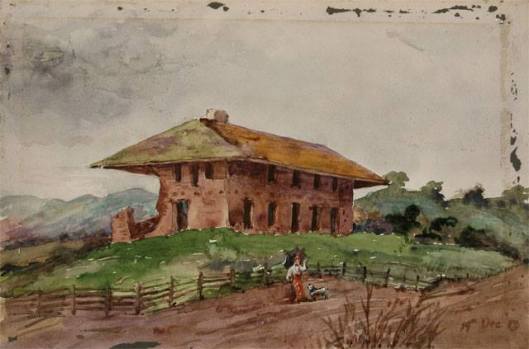
I found this beautiful watercolor online of the Branch Adobe, decaying after the damage done to it by the 1857 Fort Tejon earthquake. It was near the junction of Branch Mill and School Roads in the Upper Arroyo Grande Valley, on a little rise that still commands the valley below. A little lower are palm trees and a clearing that was the foundation of the redwood house Branch’s sons built for their mother, Manuela, after the adobe had finally melted into the ground. Manuela’s home burned to the ground when I was a little boy; we woke and could see the incredible white light of the fire as CDF trucks sped by, too late to save it. A neighbor took me there the next day and all that was left was a burned-out foundation, smoke and ashes.
But what had been there began in 1837, the same year Victoria came to the throne five thousand miles away. That’s when Branch came to the Valley. He was in his mid-thirties, a gentleman now after a career as a Great Lakes boat captain, a mountain man, a trapper, a Santa Barbara businessman. With him was with his twenty-two-year-old wife, Manuela, and their little boy, who would someday build a home that is today the Talley Farms Winery tasting room. The Valley, even for a young woman as strong and loyal as Manuela, was too wild to bear her second child. Eight months pregnant, she rode home on horseback over the San Marcos Pass to Santa Barbara to deliver her baby where her parents would be close by.
What her husband first encountered were monstrous grizzly bears that carried off the seed of his hoped-to-be-fortune, bawling calves, so he began to kill the bears. His neighbor in the Huasna, another mountain man, George Nidever, gave up cattle ranching after he’d killed his one hundredth grizzly. (His successor there, Isaac Sparks, lost an eye to a grizzly.) You have to concede something to both Branch and Nidever: They’d gotten out of the fur trade at just about the same time British machine-made velvet replaced beaver pelts for gentlemen’s hats. But only Branch survived the bears.
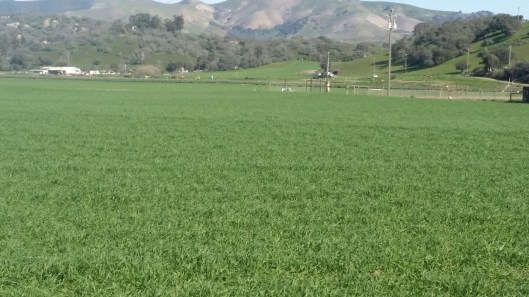
The Upper Arroyo Grande Valley, San Luis Luis Obispo County, today. Branch’s adobe would’ve stood on the hillock at the right-center of this photograph.
Grizzlies weren’t the only obstacle in 1837. The Upper Valley then was dense with willow scrub—the californio word is “monte”—so dense and so punishing that leather chaps were invented to protect vaqueros like Branch’s from having their legs slashed to ribbons when they plunged into it to rescue strays. Branch cleared the monte and planted the crops he knew from his native New York: Wheat and corn, apple and peach trees. An Eastern corn-sheller was his proudest possession, and the base of the grindstone he used to mill the Valley’s flour still sits in Arroyo Grande’s Heritage Square. Both of them were landed at Cave Landing– what is today Pirate’s Cove, near Avila Beach.
His ranch hands—many of them Chumash, others mestizo—worked hardest at roundup in June, when the cattle were slaughtered, not for beef, but for their hides. The hides were stretched on racks and soaked with seawater until they were cured and as stiff as plywood. Then they were hauled, by cart, or careta, to Cave Landing, where they’d be tossed into the surf to be fetched by fearless men, often Hawaiians, who would haul them into longboats to hoisted up into the holds of Yankee brigs bound for Cape Horn and then to Boston Harbor and Boston’s shoe factories.
It was the Gold Rush that transmuted cattle from hides into beef, meat for hungry miners from New York and Sonora and France and Chile. All it took to get the meat to market was your life: Branch and John Price found the bodies of ten people murdered at Mission San Miguel because the innkeeper there had unwisely let drop how much gold dust he’d earned for the mutton he’d sold to the gold fields. Jack Powers and Pio Linares and “Zorro’s” inspiration, Salomon Pico, waylaid cattle brokers in the Cuesta Pass and Gaviota and in Drum Canyon near Los Alamos for the gold dust they carried from beef sold to the gold fields. Pico collected their ears. To fight men like these, Branch became a member of the San Luis Obispo Vigilance Committee, which was different in two respects from San Francisco’s: Our was a little later. We hanged more men.
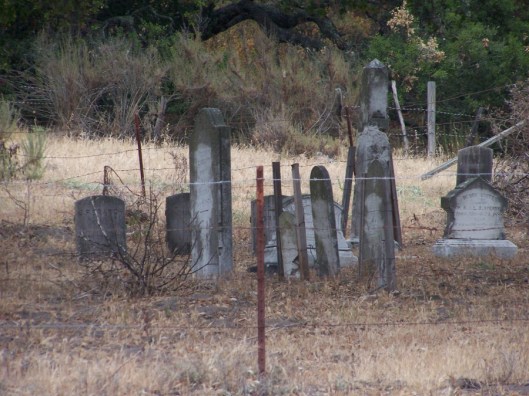
Francis Branch’s tombstone is at left-center; his three daughters’ tombstones are just to its right. The eldest was sixteen.
Branch was in San Francisco in 1862 when he got the message from Manuela. She’d given shelter to a traveler, common to ranch families then, and what he’d given the family in return was smallpox. Branch rode hard to get home again and by the time he did, exhausted and despondent, two of his little girls were dead and a third died soon after.
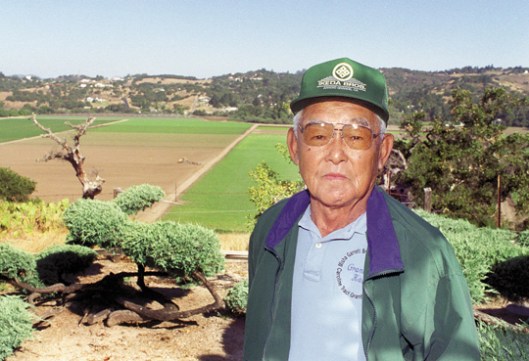
Kazuo Ikeda would come to farm the land behind him in this photograph, once owned by Branch. After Kaz and his family came home from the internment camp at Gila River, they coached Little League and Babe Ruth, inaugurated youth basketball, organized the Rotary Club fish fry, which provides scholarships to local high school students, and restored the Branch family cemetery.
They are buried next to him today, three little tombstones, broken in the years since by cattle scratching itches, next to his big tombstone. Branch died twelve years after, so he would have given instructions to have his little girls close by him. It had to have been the biggest heartbreak of his life.
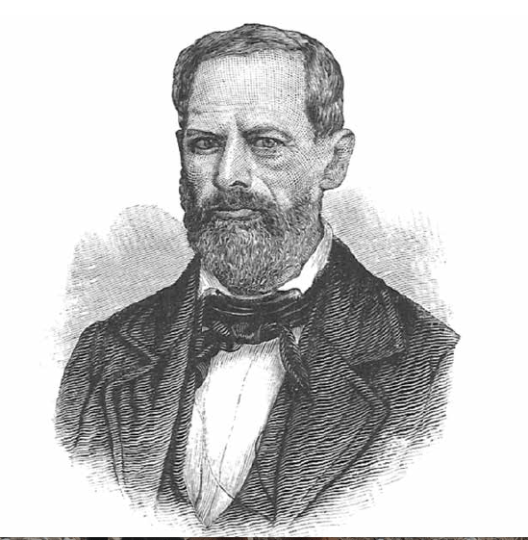
Francis Ziba Branch
Until the drought years of 1862-64. The vast herds of beef cattle he’d tended with such care for twenty-five years died on yellow, stubbled hillsides. Thirst and coyotes and ravenous mountain lions winnowed them down until they were gone. Branch lost the modern equivalent of eight million dollars.
What he hadn’t lost yet was himself, his wife, and his family. He was making the transition to row crops and tree crops and dairy farming and was dividing the Santa Manuela into sub-ranches run by ambitious sons and sons-in-law—men who were founding schools and building roads and raising churches—and then the immense energy this small, wiry, ambitious man had always taken for granted was finally taken from him, by pneumonia, in 1874.
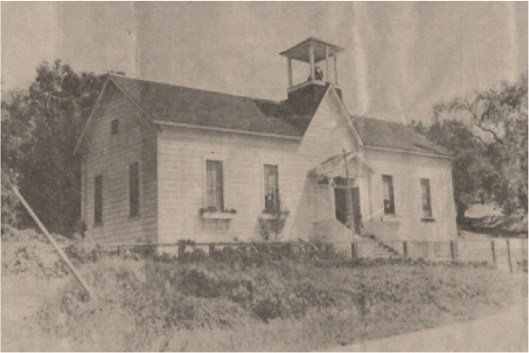
Branch Elementary School, the two-room schoolhouse where my education began in 1958.
So we have a street named for him today.
Yesterday I saw a pickup truck rear-end a sedan at the flashing crosswalk on Branch Street between Rooster Creek Tavern and the Branch Street Deli. Dozens of gawkers gathered to watch the culprit and the policeman and the fire trucks and the ambulance, thankfully, unneeded, as it turned out. Soon the gawkers dissipated and the commotion evaporated.
What was left, once the accident was cleared, was the name of the street. The folks involved, and the gawkers, too, most of them tourists, are to be forgiven, of course, given the situation, for not knowing a thing about the man for whom the street was named. Neither do the customers or the young and attractive waitresses at Rooster Creek Tavern or the sandwich-makers at Branch Street Deli.
But the street where they work is named for the man who once brought grizzly bears down with a Hawken rifle to make his cattle safe enough to the graze the land where he would build the adobe to raise the family, eleven children less three little girls, that would evolve into the beginning of a town—in 1869, one smithy, one general store, one school—that would someday name its main street for him. Yesterday, all that meant was headlight glass shattered in the crosswalk.
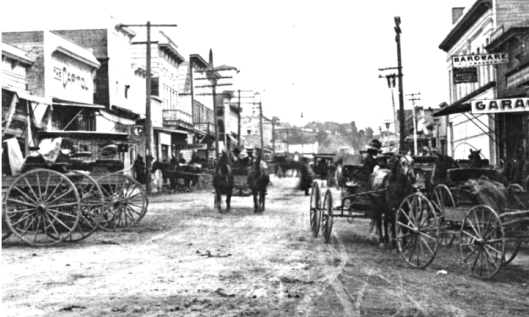
Branch Street, Arroyo Grande, about 1904.
 A Work in Progress
I remember roaming the area on horseback through these hills near branch Mill and was now and discovered the gravesite and in my 60s now could not really recall exactly where it was.
I too remember the Adobe but was not aware that it burned down.
Thank you Jim for a great article I enjoyed it immensely.
LikeLike