• About
  • The Germans

A Work in Progress

A Work in Progress

Monthly Archives: April 2019

Losing Janine

30 Tuesday Apr 2019

Posted by ag1970 in Arroyo Grande, Uncategorized

≈ 2 Comments

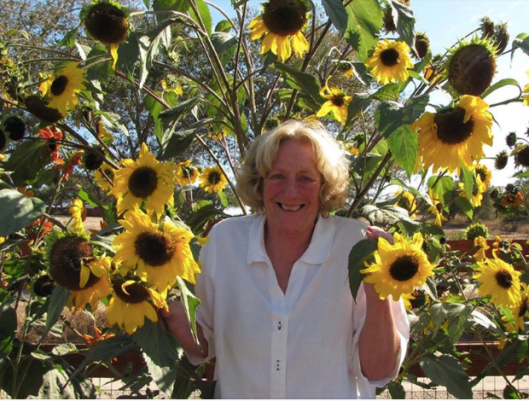
Screen Shot 2019-04-30 at 5.50.18 AM

Yes, I’m up at going on 3 a.m. after coming home from the doctor’s with good news. But whatever it is that’s still following me saps a lot of the energy out of me because it gets me out of bed at odd hours.

I almost didn’t want today’s news to be good news.

This is why. I was thinking all day of people like Janine Plassard and old friends like my teacher Jim Hayes or Jim Watson, a student Elizabeth and I just lost, and the news they got wasn’t good. Believe me, people prayed for them, too.

These are just three lives of so many that ended too early or are in such peril while my life is neither over nor in any imminent danger. It’s not fair.

So I’m angry with God now. Please allow me to be. We fight all the time; our arguments are fundamental to my faith. That’s the way He intended me to be when He gave me life.

Janine led the kind of life that gave life to others. So did my journalism professor at Poly, Jim Hayes, who made me a better writer and a better human being. It was Jim who first steered me toward teaching. When I was twenty, he made me a writing coach for other Poly journalism students. I found that I loved it, loved teaching. Jim knew that about me before I did.

Janine loved teaching, too. This was her profession, her passion, her vocation and, even though she’d hotly deny it, her ministry. Like Jim, she made better writers–there’s no better example than Kaytlyn Leslie, a superb Tribune reporter who has so much promise. Janine was her first journalism teacher at Nipomo High. She was Kaytlyn’s compass just as Jim was mine.

And just like Jim–we heard this over and over again at her celebration of life last weekend–Janine made better human beings, too.

Elizabeth and I were lucky enough to have dinner with Janine and our friends JIm and Cheryl and Mark and Evie at Rosa’s a few weeks before she died. She looked frail and was just a little subdued but every once in awhile she’d say something with a little barb to it so that it made you gasp momentarily and then laugh.

I looked down at her at the end of the table and it was obvious that she was enjoying her meal–we love Rosa’s–and her wine. She was savoring it. I think she was discerning the earth and the oak and maybe even the sunlight that had ripened the grapes.

She was eating like an Italian, who are masters of the unhurried meal. Italian food is intended to be savored like Janine’s wine. An Italian dinner is about watching your table-mate take that first bite of butternut squash ravioli, watching his eyes close momentarily with pleasure at the taste; it’s about being happy for him.

Then it’s your turn to eat.

But even the eating is secondary to Italians. Janine understood that. Good food is the pretext for bringing friends and family together, for enjoying each other, for telling stories and remembering those odd relatives that we all have; it’s about arguing over baseball. This is how you find life, at the table in other lives.

I don’t know why Janine had to give up her life and I’ve still got mine. I don’t know why I nearly died as a baby but didn’t. I was born in Taft premature and blue and strangling when the doctor, who’d been out of town, suddenly burst through the door and ordered my Dad out. He’d had a hunch. These are mysteries that both bewilder and anger me. It’s not fair.

At the end of the meal at Rosa’s, Janine and I hugged and it felt so good that I said to her: “Oh! I want to do that again!”

“You better.” she said, and she said it quickly. It was a retort, even an admonishment. She meant it. She meant, too, that she knew she didn’t have much time.

So I’m not thinking much today about my luck. I’m wishing I could watch that luck happen in other lives, filling them with life just the way that good ravioli does.

I wish I could say that then it’s my turn to eat. But, to tell you the truth, I’m not all that hungry.

I would rather rest my chin on my cupped hand, elbow on the table, and watch Janine down at the other end, watch the way she drinks wine and watch, too, her eyes close with pleasure at all the flavors she discovers in her first forkful of pasta.


Blackwell’s Corner

28 Sunday Apr 2019

Posted by ag1970 in Arroyo Grande, California history, Uncategorized

≈ 4 Comments

Screen Shot 2019-04-28 at 4.42.25 AM

Blackwell’s Corner is a gas station and little shop at the intersection of Highway 46, which will take you east to Bakersfield, and Highway 33, which will take you south to Taft, where I was born.

It is, in other words, so remote that it is nowhere.

I was a baby at home with Mom and so couldn’t see what was possibly the happiest thing that ever happened there. For some reason the bus had dropped off my Uncle George Kelly at Blackwell’s Corner. It must have been easy for my Dad, who’d come to pick him up, to see him. My uncle was and is tall and handsome and he would have been in his dress greens–this was during the Korean War–and he would’ve had his Army duffel bag slung over one shoulder and in the other hand there would’ve been grocery bag with twine handles and it would have been full of Government Issue property.

It was an official United States Army turkey. My uncle was an Army cook and it was Thanksgiving, so he’d come to spend some time in Taft with my Mom, his sister, and his parents–my Kelly grandparents.

Of course he would have called ahead both to arrange the rendezvous with Dad and to issue a good-natured warning to start the side dishes but lay off the turkey and dressing. He would bring the former–it must have been more than a little satisfying to choose a turkey when you had the time to inspect so many suspended on hooks inside a camp freezer. The Army is not necessarily kind to privates, so that would’ve made picking out the turkey even more satisfying.

As to the dressing, it would’ve been an original–my uncle cooked instinctually and decisively–and it would’ve been divine.

I’m not sure where he was based–it might have been Fort Ord–but there’s nothing better than a long bus ride for thawing a purloined turkey. It would’ve been densely wrapped, of course, and whoever sat next to Pvt. Kelly on the Greyhound and the Orange Line buses might’ve asked what was in the bag. Anybody who started a conversation with George was in for a long haul. Still, an Uncle George monologue would’ve colored the trip through severe bareness of the southern San Joaquin Valley.

He was a natural storyteller, and telling the turkey story would’ve led to another story and then George would ask a question of his seatmate who would tell a story of his own, and for every story you had, George had one to equal it.

His might’ve been about Army life or his attempt to work his way through Cal Poly by hustling pool or about the time his Dad, the cop, had won an unequal fistfight–unequal in the sense that only three oilfield roughnecks had attacked Taft police officer George Kelly Sr.  You needed to bring more guests to the table to win a fight with my grandfather.

The table in Taft, of course, at my Gramps and Grandma Kelly’s, would’ve been beautiful, dense with potatoes and  yams and string beans and gravy and Uncle George dressing and cranberry sauce. The centerpiece would have been the U.S. Army turkey and it would have been done perfectly, stuffed with apples and onions and dusted with sage and rosemary and with the breast meat still moist and tender.

In all honesty, the Army, for once, had done something precisely right because my uncle is a superb cook. And Pvt. Kelly, there at the table with his sleeves rolled up but with his Army tie tucked by regulation into his uniform blouse, would have been the handsomest man alive.

I was there and don’t remember any of this because I was in my high chair eating mashed potatoes with my hands and missing my mouth with most of them. But I’ve heard, growing up, the story of Dad finding my uncle at Blackwell’s Corner three or four times, So, oddly enough, I do remember exactly what was going on and how the table looked and, by the way, how beautiful my Mom was, and I can remember it like it was last week.
c5c0f31b-311d-408e-a5a5-20a55e4b9bc7

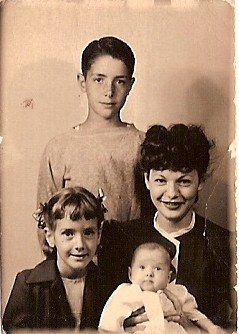
My Aunt Judy, Uncle George, Mom and my sister Roberta, about 1943

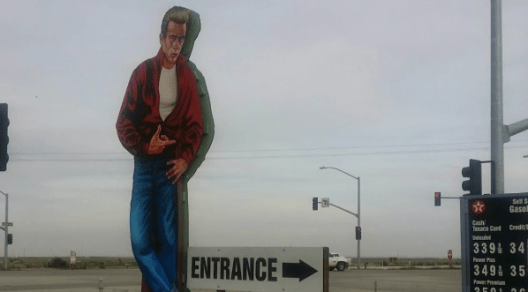
My next memory of Blackwell’s corner would have been about 1958, when we were on the road from Arroyo Grande to Bakersfield. That was three years after James Dean had made his last stop there before the Porsche Spyder’s fatal crash near Cholame. Today the Corner, then an unpretentious Atlantic Richfield gas station with a little store, is pure kitsch. There’s a figure of Dean out front, slouching slightly in his Rebel Without a Cause red jacket, and it’s obscene. I take my James Dean seriously. Neither my wife nor my U.S. History students had seen East of Eden until I showed them the film, released, of course, after his death, and the connection he made with all of them was both instant and lasting. They got him.

So Dean was three years gone and not yet a gift shop bobblehead when we stopped at Blackwell’s Corner as we did every trip to Bakersfield. This stop was at night, which was merciful, because driving at night on the 46 means you have nothing to look at out the car windows except for the scattered lights of isolated homes and metal sheds, the watchmen’s places for men who patrolled the fields with flashlights. The fields were populated otherwise only by coyotes, jackrabbits and Union Oil pumps, donkey pumps, that worked all night making Union Oil rich and powerful.

During the day you could see the pumps, most in perpetual motion and so the only signs of life in that desolate part of California where the dominant colors are a yellowish sand and purplish gray.  This is where locals, for both fun and for the rueful acknowledgement of the severity of their environment, celebrate Christmas by decorating tumbleweeds, spraying them with artificial snow and stringing them with little blinking lights. What had brought them to this severe place was oil; what had brought my Dad’s cousins here from the Ozark Plateau was oil, what had brought my mother’s father here, the son of Famine immigrants who’d worked oilfields in Pennsylvania in the 1870s, was oil.

We had gotten into the habit of stopping at Blackwell’s Corner because after an hour of staring at such a dry landscape, you  get intensely thirsty. So we would stop for a Coke for my Mom, a Pepsi for my big sister and Nehi orange sodas for my brother and me. Dad got a Coors.

By 1958 my Grandmother Gregory was sliding into dementia and increasingly fragile, so that must have been why we were driving the 46 at night. There was something wrong with Grandma Gregory.
screen-shot-2015-07-20-at-11-29-21-pm

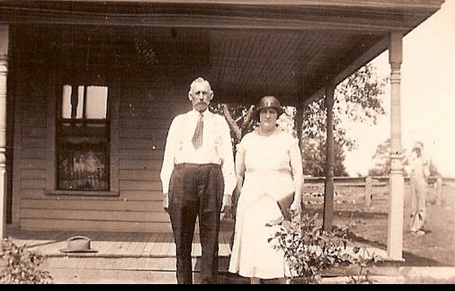
My Grandfather and Grandmother Gregory, Raymondville, MIssouri, at about at the time of his death. Grandma was a hard woman to knock down in a windstorm.

Grandma Gregory smelled like Ben-Gay and she told stories as profusely as Uncle George, but hers were all about dead people and precisely how they died and each story would end with a deep sigh and her adjusting the eyeglasses that made her eyes, now moist, so big behind the lenses. My mother called Grandma Gregory “Mother.” My father’s relationship with her was difficult, and it came from the time she’d called him back to the house when he’d been walking with my grandfather to a neighbor’s across the road. My grandfather was partly deaf and when he reached the road he never heard the Ford that killed him.

While Mom got the drinks I, being six, of course had to pee, so Dad took me into the men’s room. It was then that my epiphany happened, the beginning of my dread for this part of California. It doesn’t seem like much. But what had happened is that there’d been a sandstorm that day–the kind they describe in 1930s Oklahoma, where when you woke up there was a perfect outline of your head on the only clean part of the pillow.

The sandstorm that day at Blackwell’s Corner was so intense that the toilet bowl was filled with sand. For some reason this sight terrified me. I stood there for a long time with Dad waiting impatiently but I couldn’t make water. I told him I could hold it until we reached Bakersfield.

So we got back into our car, into the Oldsmobile, and continued east on the 46, where careless drivers forgot to dim their headlights and drunk drivers crossed into your lane and where cocky drivers miscalculated how quickly they could pass a semi truck. I don’t know that I was interested in my Nehi and I probably didn’t say much–I didn’t say much anyway–the rest of the way. I would have been thinking of sand and tumbleweeds and donkey pumps and after a few miles the irrational fear I’d felt in Blackwell’s Corner would’ve been replaced by a deep sadness.

If I was lucky, I would’ve gone to sleep. That meant, in those pre-seat belt days, asleep in the front with my feet in Dad’s lap and my head in Mom’s, with her gently stroking my hair. In my sleep, of course, I dreamed of seeing oak-studded hills and rows of crops, wet under sprinkler arcs; I would’ve dreamed most of all of seeing the ocean again.
I’ll take my mortality sweet as honey and just as slow

25 Thursday Apr 2019

Posted by ag1970 in Uncategorized

≈ Leave a comment

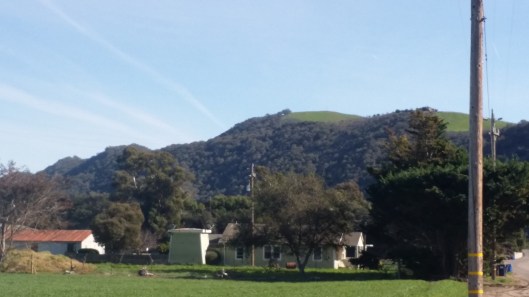
20160203_135150

Home. This was the view. alongside Huasna Road, that greeted me every morning while growing up.

It’s been a wet winter, and trees and plants and shrubs and weeds have been engaged in a kind of reproductive bacchanalia that brings on my allergies. Very occasionally, they’re so bad that I battle allergy-onset asthma.

After four weeks of coughing, I made the prompt decision to visit my doctor. It didn’t take her long to reach a diagnosis. She looked at my ankles, which resemble Popeye’s forearms. She noted my weight: I’d gained 17 pounds in two weeks and had been forced to make a WalMart run for fat jeans.

So it wasn’t allergies and it wasn’t asthma. It is, instead, congestive heart failure.

Here’s the definition I openly plagiarized:
Congestive heart failure: Inability of the heart to keep up with the demands on it, with failure of the heart to pump blood with normal efficiency. When this occurs, the heart is unable to provide adequate blood flow to other organs, such as the brain, liver, and kidneys. Abbreviated CHF. CHF may be due to failure of the right or left ventricle, or both. The symptoms can include shortness of breath (dyspnea), asthma due to the heart (cardiac asthma), pooling of blood (stasis) in the general body (systemic) circulation or in the liver’s (portal) circulation, swelling (edema), blueness or duskiness (cyanosis), and enlargement (hypertrophy) of the heart. The many causes of CHF include coronary artery disease leading to heart attacks and heart muscle (myocardium) weakness; primary heart muscle weakness from viral infections or toxins, such as prolonged alcohol exposure; heart valve disease causing heart muscle weakness due to too much leaking of blood or causing heart muscle stiffness from a blocked valve; hyperthyroidism; and high blood pressure.

I have most, if not all, of those symptoms. Of course, “prolonged alcohol exposure” is probably the most likely among a network of causes.


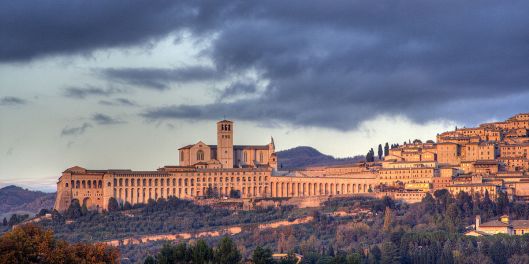
1200px-Assisi-skyline

Home #2. Italy remains the most beautiful place I’ve ever seen. This is Assisi.

After the doctor visit, I do what I always do in situations like this: I Googled. Half of the hits came up and confidently predicted that I have about five years to live. Tops.

Elizabeth did some more detailed research and found those to be a worst-case scenarios. With proper diet and medication and exercise–which, right now, I am just too tired for, but I’m going to give it shot tomorrow–I could live so long and become so obnoxious that people will actually want to take a contract out on me. They might even Crowdfund to get the job done.

I have two excellent doctors and even better, the Fisers. Randy has been my friend since high school and my fellow teacher, and his heart problems, with the help of his self-discipline and his incredible wife, have been largely neutralized. He is as vigorous now as he was in high school, when he played football and swam. So they’re going to educate us.

Hearing the diagnosis was a tough call. I was so proud of myself for beginning again with sobriety and was fighting the physical and emotional pain of withdrawal, and I was winning. It’s just that I couldn’t stop coughing, which was my body’s attempt at self-preservation, at expelling the fluids that were filling me up like a water balloon.


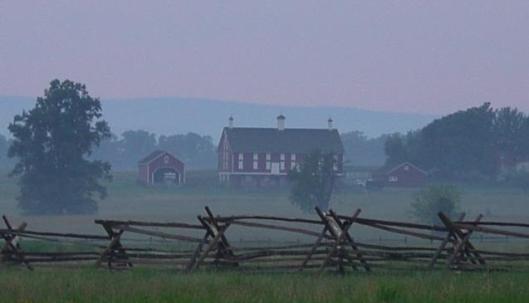
cfiles19391

Home #3: The Codori Farm, Gettysburg, a place I know almost as well as I do Arroyo Grande


It’s a tough call, too, to be so open about this. I’ve already told my family, of course, and about twenty friends, most of them AGHS colleagues or local historians. But to put this out into the open is not intended either to frighten people or to solicit pity for me. I don’t want to do either of those. And I remain, thank you very much, forcefully and stubbornly alive.

Good things have come of this. I went to church–to my cradle church, St. Barnabas–Easter Sunday and almost started crying over the words of the liturgy I’d grown up with. Also, I sat next to retired teacher Shirley Houlgate, one of the AVID pioneers and one of the loveliest persons I’ve ever met. Dan Krieger  has asked me to contribute some columns for Times Past, and despite the possibility that the copy editors were downing Margaritas and messed part of the piece up, I got in a column about my Dad. The theme, as it turned out, was about reconciliation and that’s a good one for Easter Sunday. I’ll probably contribute three or four more in the coming weeks.

What worries me is having the energy to start new stuff. My kind of writing requires interviewing, traveling, hours and hours at the computer and even more hours and hours taking notes in museums and libraries. The amount of work that goes into even a little 35,000 word book is staggering.

This also meant that I’m going to have to cancel the Adult Ed class I’d planned to teach in the fall, and that was, for me, like canceling Christmas.

For now, getting healthy again involves a lot of inactivity, something I hate. I’m happiest when I’m busy and am most myself (other than when I’m in the classroom, when what you see and hear is the most authentic Jim Gregory there is) when I am utterly and completely lost in research, like tracking down the serial number of a B-17 shot down in October 1944.


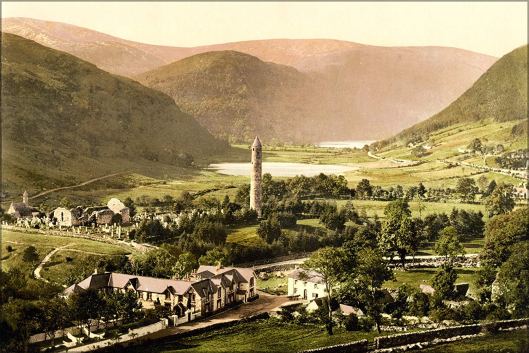
81n0s220RgL._SL1500_

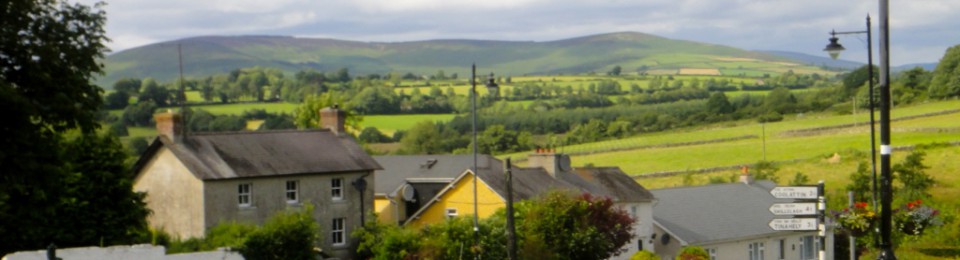
Home #4, yet to be visited: Glenadough, County Wicklow, Ireland.


So I am completely unsure about what the future holds. I am sure, increasingly, of how much I love my family and of how beautiful our dogs are (my standard greeting to Wilson: “Hello, Handsome.”) I think it’s time, too, for me to get outside more and be much less the literary hermit I’ve been the last four years. I think that was me compensating for missing my teenagers.

Most of all, I want to live a long time for them, for those teenagers who are no longer teenagers. My last bunch, from the Class of 2015, is graduating from college and going on to grad school or law school or med school or careers. Some of them have fallen in love and are going to be posting baby pictures in the next few years.

Other kids from my past, no longer kids but admirable young adults, are fighting health problems as serious or even more serious than mine, and they are doing so with such honesty and  openness that they humble me in the oddest way: I’m finding out that it’s possible to be humbled and immensely proud at the same time.

That’s not a bad way to live out my life no matter how long it may last. For now, that’s a good long time.


Arroyo Grande High School stock

Home #5, of course.


Flyboys

03 Wednesday Apr 2019

Posted by ag1970 in Uncategorized

≈ Leave a comment


This could be one of my favorite World War II movie clips, from 1990’s “Memphis Belle.” These are B-17Fs, bereft of the forward chin-mount dual machine guns, a later correction, which meant that the boys inside these planes–and some of them were boys, sixteen-year-old liars–were fodder for any Focke-Wulf 190 pilot who attacked from head-on.

That’s how Clair Abbot Tyler, a co-pilot from Morro Bay, died in 1943. An FW-190 cannon round shattered him in his seat. He left a little girl behind him at home.

What the film producers couldn’t have known is the incredble impact our soldiers and fliers had on their surrogate children, who happened to be British, not American. Here is what I found out from researching the little book I wrote:

When B-17s like these took off on their missions, they, and their Hershey bars, and their brashness and unaffected friendliness, had so earned the devotion of British children that dozens of them would line the airfield perimeter to wave goodbye to their Yanks.

I learned this, too: The same fliers were perfectly aware that the German railyards they bombed were flanked by working-class neighborhoods, and so when they missed their aim points, which happened on every mission, they were killing children 25,000 feet below.

It was this realization, and not cowardice, that led many of them to freeze in their chairs at pre-mission briefings to become so rigid that it took three of their comrades to pry them loose and walks them them to the base hospital, to the squadron psychiatrist.

The great poet Randall Jarrell, an Eighth Air Force weatherman who never flew a combat mission, could never let go of those German children. This is what led him to walk very deliberately into the path of a car on a North Carolina highway twenty years after his war had ended.

Subscribe

  • Entries (RSS)
  • Comments (RSS)

Archives

  • January 2026
  • December 2025
  • November 2025
  • October 2025
  • September 2025
  • August 2025
  • July 2025
  • June 2025
  • May 2025
  • April 2025
  • March 2025
  • February 2025
  • January 2025
  • December 2024
  • November 2024
  • October 2024
  • September 2024
  • August 2024
  • July 2024
  • June 2024
  • May 2024
  • April 2024
  • March 2024
  • February 2024
  • January 2024
  • December 2023
  • November 2023
  • October 2023
  • September 2023
  • August 2023
  • July 2023
  • June 2023
  • May 2023
  • April 2023
  • March 2023
  • February 2023
  • January 2023
  • December 2022
  • November 2022
  • October 2022
  • September 2022
  • August 2022
  • May 2022
  • April 2022
  • March 2022
  • February 2022
  • January 2022
  • December 2021
  • November 2021
  • October 2021
  • September 2021
  • August 2021
  • July 2021
  • June 2021
  • April 2021
  • March 2021
  • February 2021
  • January 2021
  • December 2020
  • November 2020
  • August 2020
  • July 2020
  • June 2020
  • May 2020
  • April 2020
  • January 2020
  • December 2019
  • November 2019
  • October 2019
  • September 2019
  • August 2019
  • May 2019
  • April 2019
  • March 2019
  • February 2019
  • January 2019
  • December 2018
  • November 2018
  • October 2018
  • September 2018
  • July 2018
  • June 2018
  • May 2018
  • April 2018
  • March 2018
  • February 2018
  • January 2018
  • December 2017
  • November 2017
  • October 2017
  • April 2017
  • March 2017
  • December 2016
  • November 2016
  • October 2016
  • September 2016
  • August 2016
  • July 2016
  • June 2016
  • April 2016
  • March 2016
  • February 2016
  • January 2016
  • December 2015
  • November 2015
  • October 2015
  • September 2015
  • August 2015
  • July 2015
  • June 2015
  • May 2015
  • April 2015
  • March 2015
  • February 2015
  • January 2015
  • December 2014
  • November 2014
  • September 2014
  • August 2014
  • July 2014

Categories

  • American History
  • Arroyo Grande
  • California history
  • Family history
  • Film and Popular Culture
  • History
  • News
  • Personal memoirs
  • Teaching
  • The Great Depression
  • trump
  • Uncategorized
  • World War II
  • Writing

Meta

  • Create account
  • Log in

Blog at WordPress.com.

  • Subscribe Subscribed
    • A Work in Progress
    • Join 68 other subscribers
    • Already have a WordPress.com account? Log in now.
    • A Work in Progress
    • Subscribe Subscribed
    • Sign up
    • Log in
    • Report this content
    • View site in Reader
    • Manage subscriptions
    • Collapse this bar
 

Loading Comments...