
Command Master Sergeant Albert Lee Findley Jr. of Los Osos died Sunday, April 28, in a San Luis Obispo hospital at age 96. Findley was a B-24 radio operator in World War II and one of the finest men I’ve ever met. These passages about Al are excerpted from the book Central Coast Aviators in World War II.

Band of Brothers
After finishing gunnery school in Yuma, Arizona, Oklahoma-born Corporal Albert Lee Findley Jr. reported to Hammer Field, just outside Fresno, and met his B-24 bomber crew:
I met my pilot, Byron Johnson, from Oklahoma; my copilot, James Gill, from California; my navigator, Robert Cramer, from California; my bombardier, Nolan Willis, from California; my engineer, Morgan Fowler, from South Dakota; my nose gunner, Homer Smith, from Texas; my left gunner, Theodore Mabee, from Illinois; my right waist gunner was James Walter…and he was from some eastern state that I don’t recall, and my tail gunner was Johnny Gates—he was from some eastern state, also. That was the crew. Plus me.

Findley next to his bomber, 1944.
It’s hard to fault Findley for not remembering every one of his crew members’ home states. The Los Osos retiree was speaking from memory in 2013, nearly seventy years after he’d met the men who became “very dear.” The feeling must have been reciprocated, because Findley, in an oral history interview that has become part of a Library of Congress collection, emerges as engaging, well spoken and warm—traits that may have failed him only once, when, two-thirds of the way through his combat tour, he was shot down over Germany.
The first thing a downed airman would do, if he was able, was seek out his surviving comrades. It was an obligation that had begun in the very last stage of training. Finally, the component parts of what would become an aircrew would meet one another and, as Findley did, their aircraft at about the same time. Findley remembered, with a sense of relief, that their brand-new B-24 Liberator came with a ball turret on its underside. Air force commanders in the South Pacific had ordered the turret removed to improve the big bomber’s maneuverability. What Findley and his new crew realized was that they were headed for Europe—a relief because of the oppressive climate and primitive conditions servicemen had to endure in the Pacific.
For most of the war, San Luis Obispo County airmen flew in two types of heavy bombers—the B-17 Flying Fortress or the B-24 Liberator. (By 1944, some would fly the B-29 Superfortress over Japan.) While crews devoted to their B-17s derided the more ungainly B-24 as “the box the B-17 came in,” Liberator crews were just as dedicated to their ships. More B-24s were manufactured—nineteen thousand, with eight thousand built by the retooled Ford Motor Company at its Willow Run plant alone—than any heavy bomber in history. If the B-17 has a more glamorous image, it’s largely due to both its sleek looks and to Hollywood: newly-minted Major William Wyler, who had directed Jezebel, Wuthering Heights and the stirring wartime drama Mrs. Miniver, immortalized the crew of the “Memphis Belle” in the 1943 documentary of the same name. Belle’s crew was the first said to have completed the required twenty-five missions over Europe (a milestone more likely attributed to a B-17, “Hell’s Angels,” part of Morro Bay’s Clair Abbott Tyler’s 303rd Bomb Group, but “Angels” had no Hollywood directors aboard), and so the B-17 became immediately and intimately familiar to Americans. Despite Wyler’s documentary, it was, in the final analysis, the Liberator that may have won the most famous Hollywood advocate: James Stewart, who’d already made films like Mr. Smith Goes to Washington and The Philadelphia Story, became the commanding officer of a B-24 squadron and flew twenty combat missions over Europe. “He was a hell of a good pilot,” one of his bombardiers remembered.
Perhaps the best way to deal with the debate between B-17 and B-24 enthusiasts is to simply leave it alone. Each plane had it advantages: the B-17 could take substantial punishment and was far easier to fly in formation—B-24s demanded considerable muscular strength from their pilots—but the Liberator was faster and carried a heavier payload. The B-17 was more numerous in the European theater while the B-24 was the more common heavy bomber, until the advent of the B-29 Superfortress, in the Pacific.
* * *
Flak
Enemy antiaircraft fire may have been even more dangerous [than German fighters]. Radioman/gunner Albert Lee Findley flew his first mission in his B-24 on September 5, 1944. As he and his crew approached the target, Findley was suddenly enchanted:
I saw a lot of silver things floating out of the air, and I thought “if that’s flak, it’s very lovely.” Shortly after that, I saw the flak, big black bursts, and it shook the airplane. The silver things I saw were chaff that some of the airplanes dropped to foul up their radar. It didn’t work that day, because a lot of the aircraft were hit over the target, including us.
In fact, Findley’s bomber was so badly damaged by flak—radar-directed ground fire from German batteries (the chaff he’d seen was made up of slivers of aluminum foil)—that the pilot had to crash-land the plane in France and, fortunately for Findley and his aircrew, on French soil that had just been liberated by American ground forces. “If this was the first mission,” a smiling Findley remembered decades later, “I wasn’t sure I could make thirty.”

A B-24 doomed by a direct hit.
Flak, from the German word Fliegerabwehrkanone, or “antiaircraft cannon,” was psychologically devastating to World War II fliers, because, unlike their encounters with fighter planes, there was simply nothing they could do to fight back. The twenty-pound enemy shells, fired from ground batteries that were dense around key targets, exploded in angry black puffs that sent steel fragments slicing through wings, fuselage and crewmen. Flight engineer Al Spierling of Arroyo Grande counted over one hundred holes in his B-17 after one mission; on another, shards of flak sliced the oxygen lines necessary to survival at twenty-five thousand feet; the waist gunners and tail gunner in Spierling’s ship kept passing out—symptomatic of anoxia—until he could repair the system. Bomber crews could hear the flak fragments hit as the shell exploded close by, like gravel scattered on a tin roof. They would watch in amazement, as Spierling did on several missions, as gaping holes appeared in the airframe or, in Albert Findley’s case, as an engine caught fire from a flak hit.
* * *
Forty below
As if enemy fighters and flak weren’t enough to worry about, bomber crews also had to deal with the elements: the oxygen supply, of course, was critical at missions flown in unpressurized cabins at twenty-five thousand feet. Masks were donned once the aircraft reached ten thousand feet, and it was the bombardier’s responsibility to do “oxygen checks”—to check in, via intercom, with each crew member every five minutes. But the cold—Radioman Findley remembered temperatures at forty below zero—impinged on breathing, as well; any moisture inside the oxygen mask froze, blocking the air supply, something a crew member might not notice until one of his comrades lost consciousness. (Urine froze as well, so the “relief tube” provided each bomber crew frequently proved useless; veterans used buckets or just relieved themselves inside their clothing..
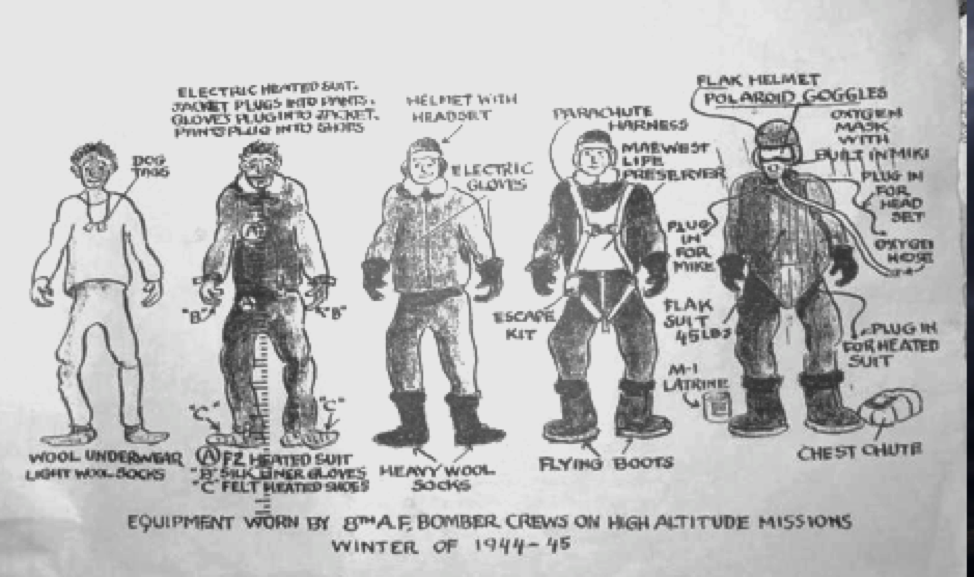
An airmen demonstrates the kind of layering required for survival at 25,000 feet.
* * *
Powdered Eggs and Creamed Chipped Beef on Toast
Army food wasn’t country club fare. Bill Mauldin, the great cartoonist who created the imaginary Willie and Joe, his comrades in the Italian campaign, once remarked, without malice, that his mother was the worst cook in the world. Then he encountered army food, which was infinitely worse. At least airmen understood that they were fed better than men like Mauldin, dogfaces, who commonly used GI powdered lemonade to wash their socks. Still, even in the AAF, the green-hued powdered eggs, along with the ubiquitous Spam, were breakfast standards, and creamed chipped beef on toast—referred to as “shit on a shingle”—followed airmen across the Atlantic from the air bases stateside where they’d first encountered what seemed to be, to the military, a perverse culinary masterpiece. Radioman/gunner Albert Lee Findley Jr. found little relief off base. “English food took some getting used to,” he admittted tactfully. (Many years after the war, Findley and his wife would live in England as the proprietors of an antique shop.) One vegetable, brussels sprouts, was as common to English fare as Spam was to American mess halls, and at war’s end, many English-based GIs swore they would never eat them again.
* * *
Vive les Américains !
Al Findley was the B-24 Liberator radioman who had the distinction of being shot down on his first combat mission. Luckily for him, his pilot, fellow Oklahoman Byron Johnson, was [a talented pilot] and he brought the bomber down near a French town in Champagne, Epernay, that had just been liberated by the Allies. The good people of Epernay were delighted with their unexpected guests, and…they insisted on wining and dining the young Americans—one of the villagers, Jean-Louis, became pen pals with Findley’s mother back in Oklahoma. The good times lasted for a week, when their squadron commander buzzed Epernay and dropped a testy message: Lieutenant Johnson and his crew were to report to Reims immediately and hitch a ride on an Army C-47 back to base in Attlebridge. The second shootdown, over Germany, would lack the first one’s charms.

Epernay
* * *
“For You, the War Is Over”
The second time B-24 radioman Al Findley was shot down, in February 1945, was on his twenty-sixth mission. The target was Magdeburg, a city once famed for Martin Luther’s preaching but now important to the German war effort for its production of synthetic fuel from lignite coal and so integral to Spaatz’s “oil campaign.” Findley’s bomber had released its payload and was on its way home, over the Ruhr Valley, when it was hit by flak bursts on the tail and on the left wing. Three gunners were injured. Control cables were severed. The pilot ordered Findley and the uninjured aircrew to throw out everything that was loose to lighten the load, but the radioman realized how serious the situation was when he saw the copilot putting on his parachute. “Bail out!” he yelled at Findley. Findley obeyed and, on his way down, saw two more parachutes. He landed hard, was knocked unconscious and woke up to see three German farmers—two with pitchforks, one with a shotgun—standing over him
* * *
Both Findley and [San Luis Obispo] B-17 copilot 2nd Lt Robert Potter] Dwight were captured as the war entered its final months. Findley would later learn that he’d lost four crewmates; five others, besides Findley, became prisoners of war—it was two weeks before his pilot, Byron Johnson, was captured. The twenty-year-old radioman was put on a train to an interrogation center in Oberursel, north of Frankfurt, where he spent eleven days in solitary confinement, living on a diet of coffee, brown bread and “some kind of soup.” He was finally interrogated by a Luftwaffe major who asked him about the impact of the new ballistic missile, the V-2, that was the last of Hitler’s “miracle weapons” to be unleashed on Britain. Findley responded with his name, rank and serial number. He was a little rattled, as most captured airmen were, when his interrogator, in a little show, started talking about Findley’s bomb group, the 466th—“he probably knew more about my outfit than I did,” the American remembered.
* * *
Once downed fliers had been interrogated, their usefulness was at an end, and they then became part of the Luftwaffe-administered prison camp system. Al Findley was part of a prisoner-of-war shipment bound for an overcrowded camp, Stalag XIII-D, near Nuremberg, Bavaria, sited on a parade ground that was once the scene, in Hitler’s heyday, for Nazi Party rallies. Findley remembered a camp that was overcrowded—Allied airmen in other camps had been brought to this one as the Red Army began to overrun eastern Germany—and rife with dysentery, bedbugs and fleas. “I think I spent half my time in the chow line,” he remembered ruefully, where standard fare was soup with bugs in the beans, which he and his comrades decided were their meat supply. (In reality, the diet for German civilians wasn’t much better.) The poor conditions were relieved by a reunion with his B-24 crew, with the pilot the last man to come into the prison camp. Pilot Byron Johnson cried when Findley and the other survivors told him about the four lost crewmen, including the lost flight engineer, the only married man with a child among the crew, who had gone back to get the gunners out and wound up dying with them.
* * *
Findley’s confinement ended on April 4, 1945, when the prisoners of Stalag XIII-D were ordered out and into the countryside as George Patton’s Third Army closed in. While on the march, Findley and his fellow prisoners had to endure friendly fire: they were strafed by American fighters who mistook them for German troops. (Findley’s boxcar, on its way to Nuremberg, had likewise been strafed by Allied fighters.) At their stopping point the next day, the prisoners garnered enough toilet paper to spell out “POW” in the field where they were to sleep. Fighters passed over them, but this time the planes waggled their wings and departed. The bedraggled column finally stopped at Moosburg, ninety miles south of Nuremberg, where they were united with prisoners of war herded from Stalag VII. A week later, Findley and the mass of prisoners realized one morning that the Germans were gone. Third Army arrived at Moosburg at about noon, and Al Findley was free. Both Findley and Dwight would be flown to a recuperation center near Le Havre, Camp Lucky Strike, where their injuries would be tended to (Dwight’s shoulder would eventually require surgery) and where, as Findley noted, “they fattened us up again.” They were then put on ships and sent home.
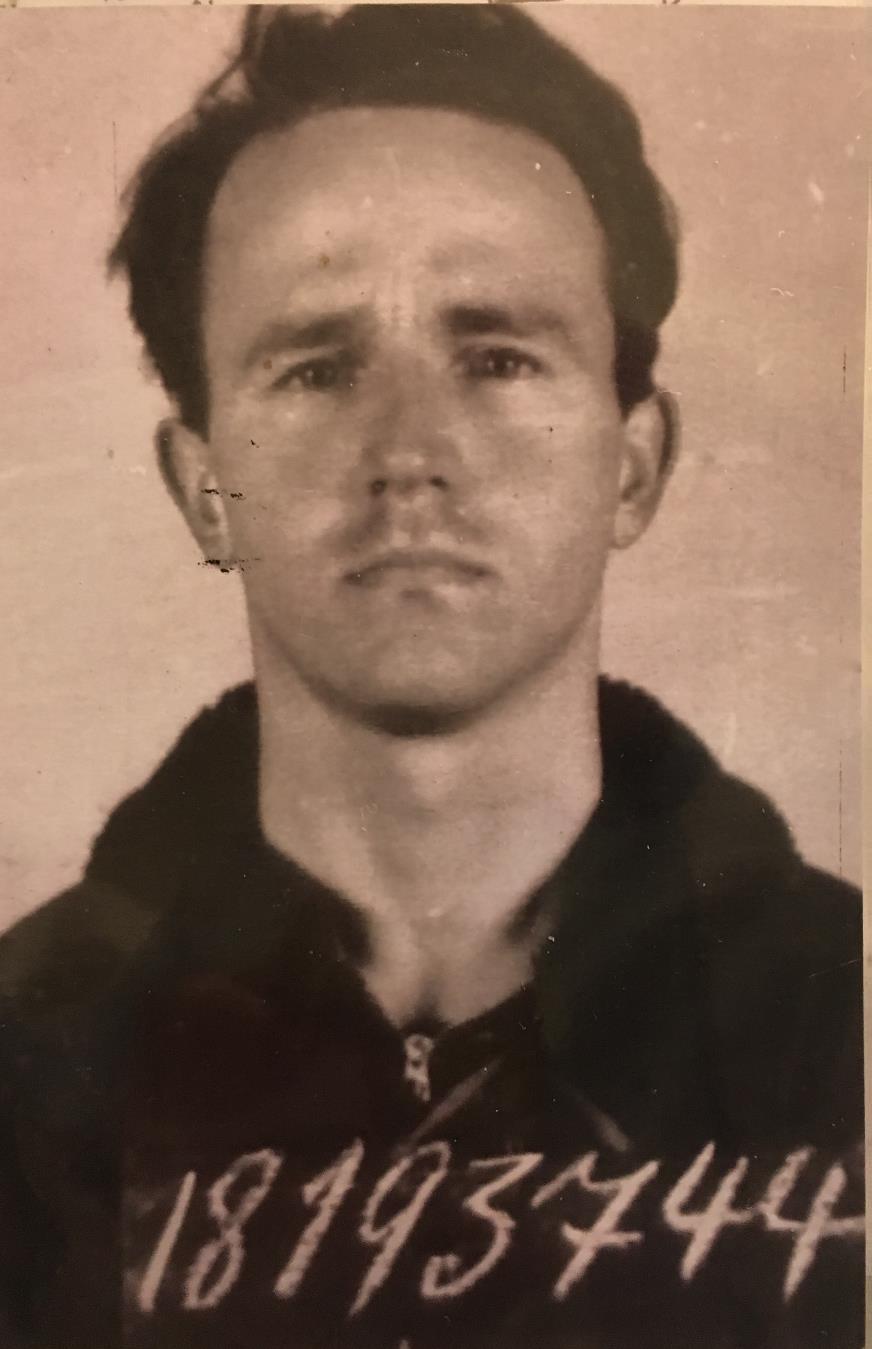
Al Findley’s POW photograph.
 A Work in Progress