
The statistics are as somber as Memorial Day itself: for every American infantryman killed in World War II, three were wounded; for every American airman wounded, three were killed.
Twenty-six thousand Marines died in the Pacific; the same number of Eighth Air Force airmen died over Europe.
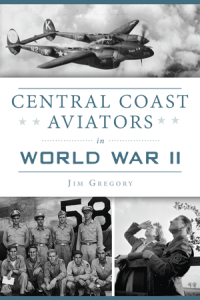
Other fliers died here. P-38 fighters would have been a common wartime sight over San Luis Obispo County; today’s Santa Maria Airport was an Army Air Forces base that specialized in advanced training of pilots about to head overseas. There were eight fighter crashes near that base in January 1945 alone.
One pilot died when his plane went down in the Oceano dunes. Two fighters collided over Corbett Canyon, but only one pilot survived. Three died—a pilot and two civilians– when another P-38 fell into a Santa Maria café.
Meanwhile, accidents claimed about half the eighteen county airmen killed in World War II. Those deaths seem especially capricious and cruel.
In 1943, Clarence Ballagh, a B-17 co-pilot, was merely hitching a ride north on another bomber for a few days’ leave in Edinburgh. That B-17 flew into the side of an English mountain. Fragments of the plane remain on Mt. Skiddaw today, 5,000 miles away from Ballagh’s Arroyo Grande grave.
Templeton’s Norman Hoover died, ironically, when his bombing mission was scrubbed in January 1945. His B-24 crashed returning to its Yorkshire base. It was the only plane lost that day.
Sgt. Charles Eddy of Templeton died in Idaho. Eddy’s B-24 was on a practice bomb run when it suddenly fell from 20,000 feet. The pilot and co-pilot fought desperately to regain control of the plane. They did, at one hundred feet. When they banked gently to return to base, the bomber plummeted into the ground and exploded.
Three county airmen, combat casualties, remain missing.
In 1943, a German fighter’s cannon round killed Clair Abbott Tyler of Morro Bay in his co-pilot’s seat. His B-17, returning from a mission to Lorient, France, went into the sea and took Tyler’s body with it.
French civilians reported seeing Cholame’s Jack Langston bail out when German anti-aircraft guns set his P-38 afire over Cherbourg in July 1944. His body was never found.
In Germany, near the war’s end, famed San Luis Obispo P-51 pilot Elwyn Righetti was never seen again after he’d crash-landed his crippled fighter and radioed that he was all right.
In a tragic coincidence, Righetti, Tyler and Ballagh all left behind little girls who were just beginning to walk when they lost their fathers.
Details like those are haunting.
Clair Tyler’s mother made wonderful enchiladas and Alex Madonna was the best man at his wedding.
Clarence Ballagh’s wedding band was returned to his wife in 1949. Lost B-17 gunner Donal Laird’s wristwatch was returned to his San Luis Obispo nieces in 2015.
Jack Langston played the saxophone; Lt. Ted Lee, shot down near New Guinea, was a trombonist.
As a little boy, lost B-29 pilot Jack Nilsson had been invited to Patsy Berkemeyer’s sixth birthday. Since Patsy’s parents owned a San Luis Obispo bakery, the cake must have been spectacular.
So is the life of P-47 pilot John Sim Stuart, a retired Cal Poly professor still married to Mary, the girl he met in 1944.
Despite being shot down twice, Los Osos retiree Al Findley, a B-24 radioman, was a joyful man who filled his life with friends. He died, at 96, April 28.
Another retiree, Morro Bay’s Jack Gibson—the father of County Supervisor Bruce Gibson–died in 2016 at 95.
Gibson was a B-29 crewman who got a letter from his mother, a knitter, about socks. Did Jack want argyle, striped, or plain? He wrote back that he didn’t care as long as she was the one who knitted them.
Soon after, the Japanese shot his bomber down. POW Gibson endured beatings, starvation and dysentery, but he survived. When he finally came home, he opened a dresser drawer in his bedroom.
Inside were six new pairs of socks.
 A Work in Progress