• About
  • The Germans

A Work in Progress

A Work in Progress

Monthly Archives: October 2019

The Great Northern Railway and Great Uncle Willie

28 Monday Oct 2019

Posted by ag1970 in Uncategorized

≈ Leave a comment

From a kind of round-robin email to family:

Hello, all!

The SLO Railroad Museum just emailed me to let me know of the upcoming funeral of a local man, 93, who was one of the last steam engine engineers. (Elizabeth and I took a ride on one to the Isle of Skye, and it was just like a Harry Potter movie.)

That set me a-pondering. Wasn’t there an ancestor who was a train engineer?

Yup. Our Great Uncle William “Willie” Keefe, born in the Pennsylvania oilfields to Thomas and Margaret Keefe. He was #1 in the batch of ten that would include our grandfather, at #9.

I found his photo, not a good one:

Screen Shot 2019-10-28 at 2.44.10 PM.png

And I discovered that he was an engineer on the Great Northern Railway, whose route(s) ran thusly (it went out of business about 1970):

GNMap1.jpg

So there’s a chance some of Elizabeth’s Washington ancestors might’ve been passengers on Great Uncle Willie’s train.

There was no date of death for him on ancestry.com, so I did some hunting. After about 25 minutes, from the Minneapolis Star-Tribune:*

Screen Shot 2019-10-28 at 3.23.42 PM.png

So, sadly, he died on the job. He died on Monday, May 10, 1948–only three days before Bruce Keefe Gregory was born.

Then I looked up his train. It wasn’t diesel, not steam, but it was gorgeous.

Great_Northern_Empire_Builder_WP_1024x1024.jpg

*More Minnesota trivia: The 1862 Sioux uprising began in Meeker County, where Thomas and Margaret would later homestead and where most of the bunch o’ Keefes were born. I bring that up because John Rice, an Arroyo Grande settler whose house still stands in an old, old part of AG [photo below], was part of a regiment charged with ensuring order and witnessing the execution of 38 Sioux warriors in Mankato, Minnesota in December 1862.

Screen Shot 2019-10-28 at 3.45.20 PM.png

So it goes.  That is today’s report from The History Desk.

Screen Shot 2019-10-28 at 3.56.15 PM.png

Great Uncle Willie’s home in Minneapolis–the little fellow with the  yellow door.

Where history is close: Branch Street, Arroyo Grande, California

04 Friday Oct 2019

Posted by ag1970 in Uncategorized

≈ Leave a comment

94c0e37a165ceb75d4ffc8e3d4fcde1f


Video link:

https://drive.google.com/file/d/1ydE-jzczpi8KSpe_d9RDIj1zQDwjcBfJ/view?usp=sharing

Losing the B-17 Nine O Nine

04 Friday Oct 2019

Posted by ag1970 in Uncategorized

≈ Leave a comment

920x920

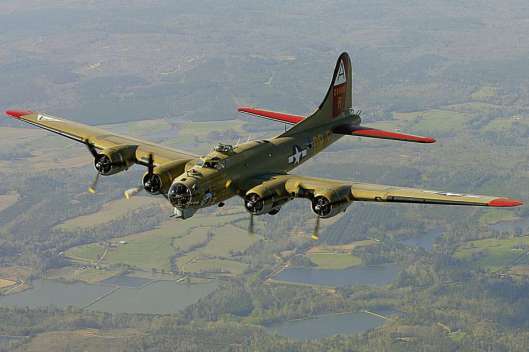
Nine O Nine

There was a tragic accident in Connecticut this morning when a vintage B-17G, “Nine O Nine,” crashed. The plane was a frequent visitor to our area, to San Luis Obispo County. My son and I saw this beautiful airplane, restored to resemble the 1943 original, which flew 140 combat missions with the 91st Bomb Group without a fatality. The chief of the B-17’s ground crew won a Bronze Star because his airplane flew 126 consecutive missions without aborting for a mechanical failure.

That streak ran out this morning, when this ship, built in 1944, lost an engine and went down just short of the runway.
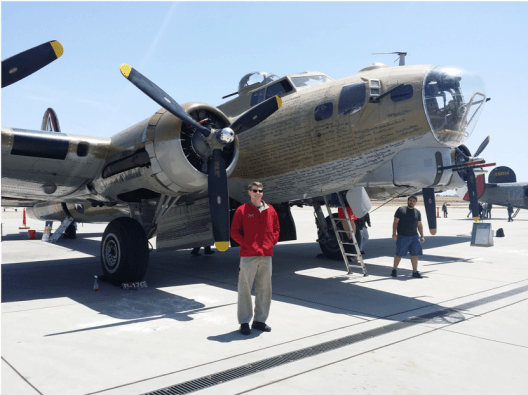
Picture1

My son John with Nine O Nine, San Luis Obispo, 2012.

I wrote a book about aviators from my area— San Luis Obispo and northern Santa Barbara Counties.

I learned that a bomber squadron was usually made up of twenty B-17s like “Nine O Nine.” On maximum effort days—in the spring of 1944—there would be eight hundred to a thousand of these airplanes, both B-17s and B-24s, going into the air in shifts all over East Anglia. They would rattle dishes and wedding crystal in the modest homes below as they assembled and headed east.

Typically, B-17 pilots were twenty-two years old. Gunners were teenagers. There were liars among them as young as fifteen. San Luis Obispo County lost eighteen of these young fliers during World War II, both in combat and in horrific training accidents from Texas to Montana to South Carolina.

Among the young men who made it overseas, one, from Arroyo Grande, died when his B-17 flew into the side of Mount Skiddaw in England’s Lake District. Another, from Morro Bay, was shattered in his co-pilot’s seat by a cannon round from a Focke-Wulf 190. A San Luis Obispo navigator died when a Messerschmitt 109 collided with his B-17. A Templeton B-24 gunner took off on a mission that was scrubbed because of weather; when his bomber crashed returning to base, his aircrew were the only Eighth Air Force casualties that day.

At least two local men served in “Nine O Nine’s” 91st Bomb Group.

Robert Abbey Dickson’s B-17, “Wheel and Deal,” was brought down by antiaircraft fire over the Ruhr Valley in 1943. Dickson bailed out and when he hit the ground, the first German he met was an angry farmer armed with a vintage World War I Mauser. The young American was rescued by two Luftwaffe soldiers who rode up on a motorcycle and sidecar and fetched him back to their 88-mm gun emplacement. It suddenly occurred to Dickson that this might be the gun that had brought his bomber down.

But it was lunchtime. The first thing Dickson’s captors did was to offer him a bowl of potato soup.
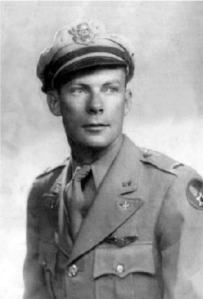
Picture2

91st Bomb Group co-pilot Robert Abbey Dickson retired to Morro Bay.

Henry Hall of Cayucos was a twenty-year-old gunner on “Black Monday,” in March 1944, when Eighth Air Force undertook a “maximum” effort mission, with nearly a thousand heavies sent into the air. At this point in the war, the B-17s and B-24s weren’t just strategic weapons. They were bait, intended to bring up German fighters so state-of-the-art American fighters, like the P-51, could begin to winnow the young Germans down. But the winnowing that Hall saw involved Americans. Hall watched, horrified, as an Me-109’s attack on a nearby B-17 took effect. The plane’s right-wing landing gear dropped lazily. Then it began to go in, and on its way down, it clipped two more B-17s and sent them in, as well. That mission turned out to be fruitless: the target was obscured and Hall’s ship dropped its bombload on a “target of opportunity,” a German village—one, Hall thought, that had done little harm to any Americans— on its way home. It was a terrible day for Hall’s aircrew.

What kept them together, I learned, and kept them flying in unpressurized cabins where hypoxia and frostbite were common, when they endured sudden, terrifying attacks from German fighters so fast that no gunner could track them—those fighters, too, were flown by twenty-two year-olds—and when flak sliced through wings, fuselage, air hoses and human beings, was their devotion to each other.
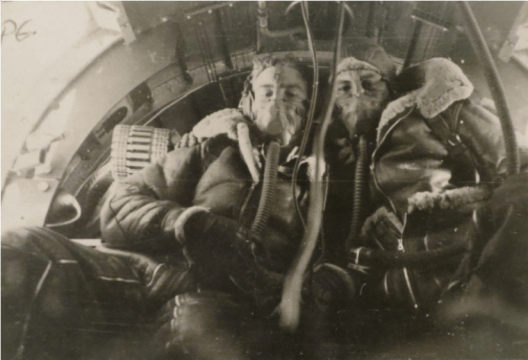
Picture3

Waist gunners, friends.

You could not let your friends down.

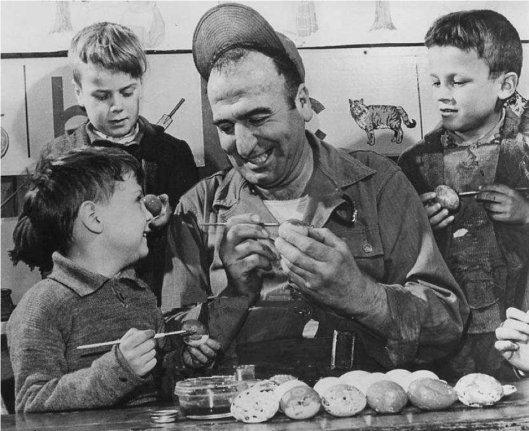
I learned, too, that among their best friends were the British schoolchildren who lined airfield fences along the tarmac at the start of every mission.

They were there to wave goodbye to their Americans, who were loud and boisterous, friendly and incredibly generous, with endless supplies of Hershey bars, because these young men had grown up in the Depression, and they knew what the British children, after their six years of war, knew. They knew what deprivation was like.

So those children were there for their Yanks.
Picture4

The 96th Bomb Group’s Sgt. George Crist of San Diego colors Easter Eggs with British children, 1945.


Subscribe

  • Entries (RSS)
  • Comments (RSS)

Archives

  • January 2026
  • December 2025
  • November 2025
  • October 2025
  • September 2025
  • August 2025
  • July 2025
  • June 2025
  • May 2025
  • April 2025
  • March 2025
  • February 2025
  • January 2025
  • December 2024
  • November 2024
  • October 2024
  • September 2024
  • August 2024
  • July 2024
  • June 2024
  • May 2024
  • April 2024
  • March 2024
  • February 2024
  • January 2024
  • December 2023
  • November 2023
  • October 2023
  • September 2023
  • August 2023
  • July 2023
  • June 2023
  • May 2023
  • April 2023
  • March 2023
  • February 2023
  • January 2023
  • December 2022
  • November 2022
  • October 2022
  • September 2022
  • August 2022
  • May 2022
  • April 2022
  • March 2022
  • February 2022
  • January 2022
  • December 2021
  • November 2021
  • October 2021
  • September 2021
  • August 2021
  • July 2021
  • June 2021
  • April 2021
  • March 2021
  • February 2021
  • January 2021
  • December 2020
  • November 2020
  • August 2020
  • July 2020
  • June 2020
  • May 2020
  • April 2020
  • January 2020
  • December 2019
  • November 2019
  • October 2019
  • September 2019
  • August 2019
  • May 2019
  • April 2019
  • March 2019
  • February 2019
  • January 2019
  • December 2018
  • November 2018
  • October 2018
  • September 2018
  • July 2018
  • June 2018
  • May 2018
  • April 2018
  • March 2018
  • February 2018
  • January 2018
  • December 2017
  • November 2017
  • October 2017
  • April 2017
  • March 2017
  • December 2016
  • November 2016
  • October 2016
  • September 2016
  • August 2016
  • July 2016
  • June 2016
  • April 2016
  • March 2016
  • February 2016
  • January 2016
  • December 2015
  • November 2015
  • October 2015
  • September 2015
  • August 2015
  • July 2015
  • June 2015
  • May 2015
  • April 2015
  • March 2015
  • February 2015
  • January 2015
  • December 2014
  • November 2014
  • September 2014
  • August 2014
  • July 2014

Categories

  • American History
  • Arroyo Grande
  • California history
  • Family history
  • Film and Popular Culture
  • History
  • News
  • Personal memoirs
  • Teaching
  • The Great Depression
  • trump
  • Uncategorized
  • World War II
  • Writing

Meta

  • Create account
  • Log in

Blog at WordPress.com.

  • Subscribe Subscribed
    • A Work in Progress
    • Join 68 other subscribers
    • Already have a WordPress.com account? Log in now.
    • A Work in Progress
    • Subscribe Subscribed
    • Sign up
    • Log in
    • Report this content
    • View site in Reader
    • Manage subscriptions
    • Collapse this bar
 

Loading Comments...