I taught AP European History for nineteen years, and I quickly discovered a passion for social history, including women’s history. We learned about skimmingtons, Tudor marriage patterns, women’s work on farms and in factories. Then we got to La Belle Epoque–-Victorian Europe—which should have been my favorite chapter. It was Marion Cotillard’s favorite era, too, in Midnight in Paris, and I would’ve been hard-pressed to choose between Cotillard’s Paris and Owen Wilson’s Lost Generation version of the great city.
I have my romantic reveries about the film interrupted by the reality of its director, whose victim—much later, his wife— was his stepchild, and that unpleasant juxtaposition reminds me of the way I taught this chapter.

I didn’t lead with Julie Andrews’ Mary Poppins or Nicole Kidman’s Satine from Moulin Rouge–although I did touch on Montmartre and on Hausmann’s re-imagining of Paris.
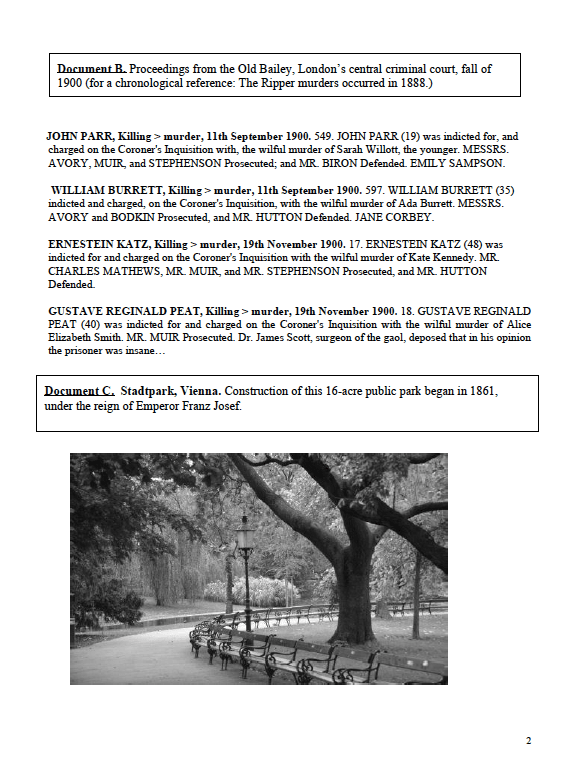
No. I started the chapter with Jack the Ripper. The Ripper murders, in 1888, were so revelatory of the larger society’s misogyny. The students were reminded of Nancy in Oliver Twist and they learned about Victorian widow’s reeds—for which Her Majesty, in her pining for Albert, deserves so much blame–when it was discovered that black taffeta, required for a year, when combined with gaslights, led to British and American middle-class sati, the tradition where, once upon a time, Hindu women threw themselves onto their husbands’ funeral pyres.
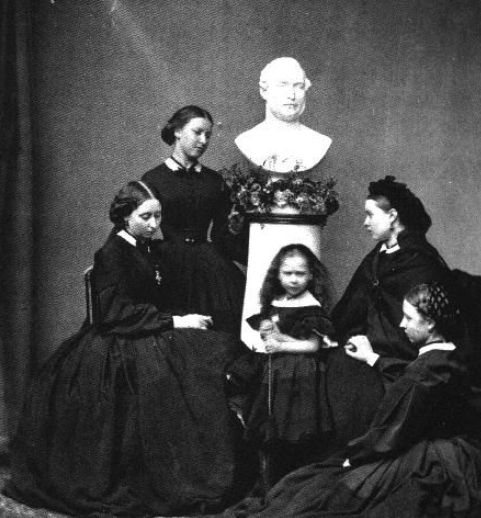
The Rippers’ victims funerals were attended only by detectives. These women, some but not all of them prostitutes, were desperately poor, frequently drunk and utterly alone. (This was when the Industrial Revolution had advanced to the point where women, thanks to cooperation between male workers and male capitalists, had been forced out of factory work, where they’d always been integral. World War I would call them back, when munitions work would kill women workers in bushel-loads; shell-filling turned their skin bright yellow. So most of them died slow deaths, from chemical poisoning, rather than the instant deliverance conferred on other women by accidental explosions.)
The Ripper’s escapes were made possible by the rabbit-warren of alleyways and the density of London fog–T.S. Elliot described its greenish cast—that were so evocative of the density and the filth of the East End. Sunlight rarely penetrated the lives of these women; their deaths were captured in photographers’ flashes—theirs were among the first autopsy photos ever taken for police work. I could not show some of them to sixteen-year-olds.
So we began a chapter that was ostensibly my favorite (they learned how to speak Cockney, learned rhyming slang, learned about department stores and the demarcation lines between social classes within Parisian apartment buildings and in the process of lifeboat-filling on Titanic, learned, most of all, about Paris) with some of the most brutal material I’ve ever taught.
I wanted it that way. I taught, whenever I could, to my students’ emotions, because that’s the way I experience history—these people are very much alive and so very human to me—and I wanted them, as we began this chapter, to be outraged.
Most of all, I wanted my male students to understand the Ripper’s brutality, so reflective of the society’s brutality, to understand what it might have been like to be a woman then—and now, because we would visit this topic again before the year had ended–and if outrage wouldn’t take with them, with my young men, then discomfort would do.
I hope their discomfort hasn’t ended. The misogyny, revealed in so many presidential tweets, certainly hasn’t.
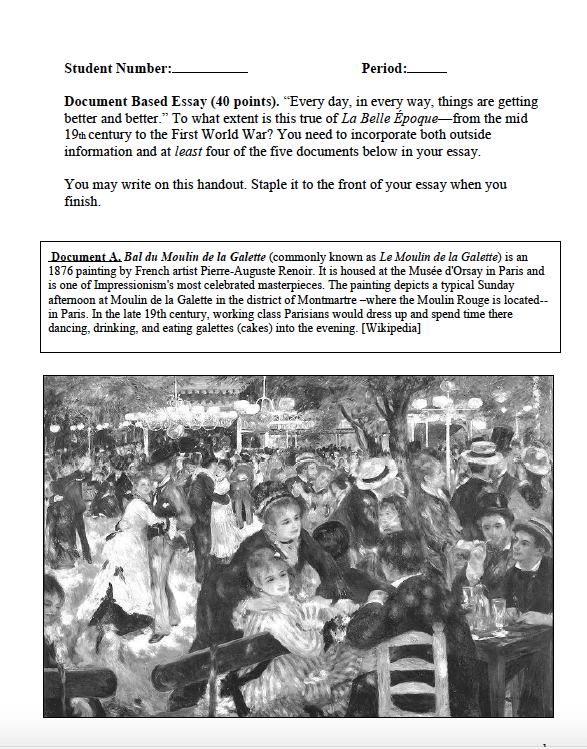
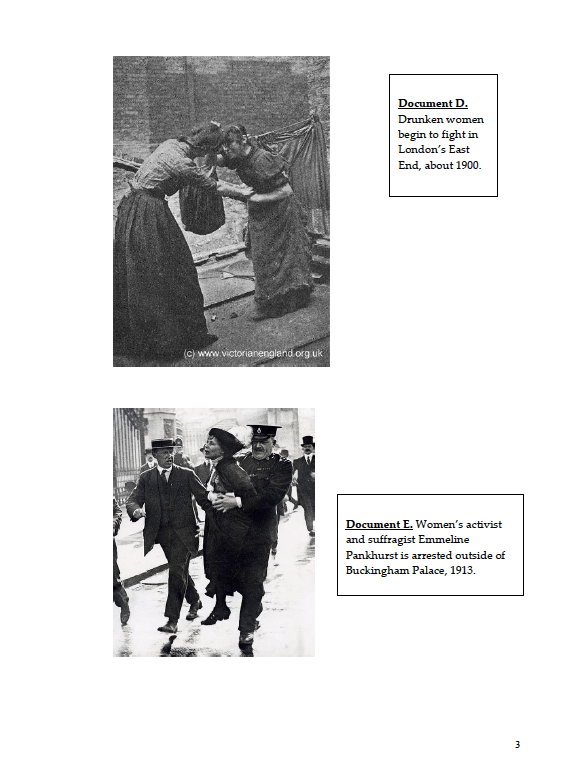
This was the Document-Based Essay that ended the chapter–a truncated version of the much more lengthy essays they’d encounter on the AP exam. I was a little proud of this one.
I always reasoned that I needed to retire once my own anger over World War I had passed. I think that sentiment extends logically to the status of Victorian/Edwardian women, as well.
I am retired. The anger isn’t.
 A Work in Progress