On the morning of Friday, April 12, 1895, the proprietor of the Fashion Stables in San Luis Obispo discovered a body. It lay in a pool of blood—the back of the victim’s skull had been crushed—in a vacant lot behind The Palace, a “house of ill fame,” near the intersection of Monterey and Morro Streets.
An Arroyo Grande man, Frank Feliz, was nearby, inside Sinsheimer’s store—today’s Giuseppe’s—and after he’d followed the gathering crowd to the vacant lot he identified the victim as Ygnacio Villa, a neighbor of his. Villa’s family was prominent but had fallen on hard times. Ygnacio’s father had been the master of the 30,000-acre Corral de Piedra rancho between Pismo Beach and the Edna Valley. Ygnacio, by contrast, homesteaded 160 acres in Lopez Canyon.
The sheriff’s deputy on the scene, Joseph Eubanks, would have had bad memories of Lopez Canyon. Eubanks had assisted Constable Thomas Whitely in the arrest of Peter and P.J. Hemmi for the 1886 murder of Eugene Walker. The Hemmis and Walker had been involved in a land dispute in the canyon; Hemmi had reportedly broken down fences and poisoned livestock to force Walker off land he believed to be his. On March 31, fifteen-year-old P.J. shot Walker and his young wife, Nancy, who died several months later.
On the night of the Hemmis’ arrest, Eubanks had to share Whitely’s humiliation when a mob, their faces covered by handkerchiefs, locked the two inside a Branch Street restaurant’s storeroom. The mob then stormed the little town jail and lynched the Hemmis from the PCRR trestle over Arroyo Grande Creek. It was schoolchildren who first discovered the hanging bodies the next day—April Fool’s Day.
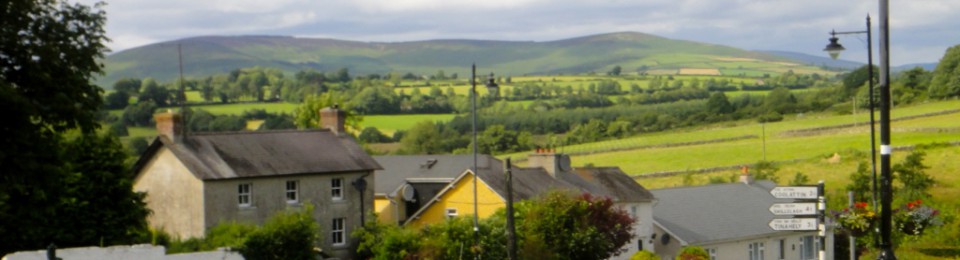
After 1886, Arroyo Grandeans remembered Lopez Canyon for its bounty, rather than its violence.
A 1909 San Luis Obispo Morning Tribune portrait of the canyon was titled “Where Nature Has Been Lavish With Her Charms.” Local papers were frequently filled with little stories about Arroyo Grandeans taking extended hiking and camping trips or those who came back to town to brag about a big catch of trout, to show off trophy mule deer bucks or, in one case, four bird hunters who returned with “a wagon load” of pigeons.
But Deputy Sheriff Eubanks wasn’t done with Lopez Canyon. Within days of Ygnacio Villa’s murder, he would place Frank Feliz and two others under arrest. The killing was the apparent culmination of a year-long feud between two factions in the canyon—one led by Feliz and the other by a neighbor named Gerard Jasper.
There are repeated stories about the feud throughout local newspapers in 1894-95. It began, as the Hemmi-Walker dispute had, because of conflicting claims over land. Neither side comes off looking innocent.
Gerard Jasper was a contrary man. In 1869, when he’d lived in Cambria, a deputation of local citizens was organized to warn him not do bring his cattle into town during an outbreak of what was called “Texas Fever.” He appears frequently in county civil suits in subsequent years, but his contrariness took a new direction in Lopez Canyon: Jasper was accused, in the fall of 1894, of setting a string of arson fires. Pasturage, a neighbor’s wagon and twenty-five cords of wood went up in flames, and one of those fires burned land claimed by Frank Feliz.
At his San Luis Obispo trial, Jasper, according to one account, “offered a very vigorous defense, and at times branched out into philosophical utterances, which His Honor [Judge V.A. Gregg] was finally compelled to check.” Jasper’s character witnesses, which included prominent local men like Fred Branch and David Newsom, were more effective in his eventual acquittal.
After the trial, the Jasper-Feliz feud escalated in late 1894 and early 1895. Feliz was arrested and charged with assault with a deadly weapon. A comrade of Jasper’s, identified only as P. Morales, broke down a neighbor’s fence and smashed the windows and door of his little Lopez Canyon cabin. Morales had to be subdued by two deputies when he resisted arrest. Another friend of Jasper’s was a victim: he returned from town to find seven bullet holes in his front door and seven .44-caliber slugs embedded in the opposite wall.
It seemed that Frank Feliz was itching to make Ygnacio Villa a victim, too. Villa had testified against Feliz in the Jasper arson trial and, according to news accounts, Feliz accused Villa of stealing one of his cows. “I will kill him the first time I see him,” Feliz reportedly told Villa’s niece, Rafaela.
There was evidence that Feliz had done just that, according to trial accounts that dominated the news in August 1895.
Two prostitutes from the Morro Street houses saw Feliz and some companions verbally confront Villa the night he died (one of them was the first to find the body the next morning, but she didn’t report it). Evidently all of the men, Villa included, had spent much of Thursday night, April 11, drinking heavily in a nexus of saloons—one of them, ironically, was called the Olive Branch–along Monterey Street. There was physical evidence, as well: blood on Feliz’s overalls. On the witness stand, Feliz maintained the blood had come from slaughtering a steer several days before Villa’s murder.
The evidence wasn’t enough to convince the jury. On August 11, 1895, they acquitted Feliz. A few years later, Gerard Jasper died a natural death and the feud seemed to end with him.
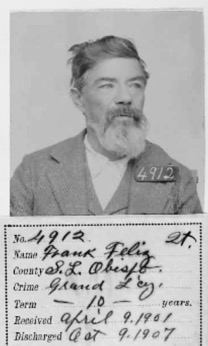
Ironically, the crime that would finally doom Frank Feliz, in 1901, was the one he’d accused Ygnacio Villa of committing: cattle theft. On April 7, 1901, the Morning Tribune exulted in Feliz’s conviction and subsequent ten-year sentence to Folsom prison: time enough, the article opined, for Feliz to reflect on a brutal murder “in an alley back of a darkened street where evil flourished.”
 A Work in Progress
I wonder what my grandfather Patrick J. Hughes thought? He was a 26 year old Belfast tailor who was recruited by a Mr. Quinn (who lived at 480 Pismo) who sailed back to Belfast in 1885 to convince young Hughes to come to San Luis to work for Kaufman Green as business was booming and the town needed another tailor. He arrived in early 1886.
LikeLike
Wow!!!! Thank you for sharing this, Patrick! Was that Kaufman Green as in the Green Brothers?
LikeLike