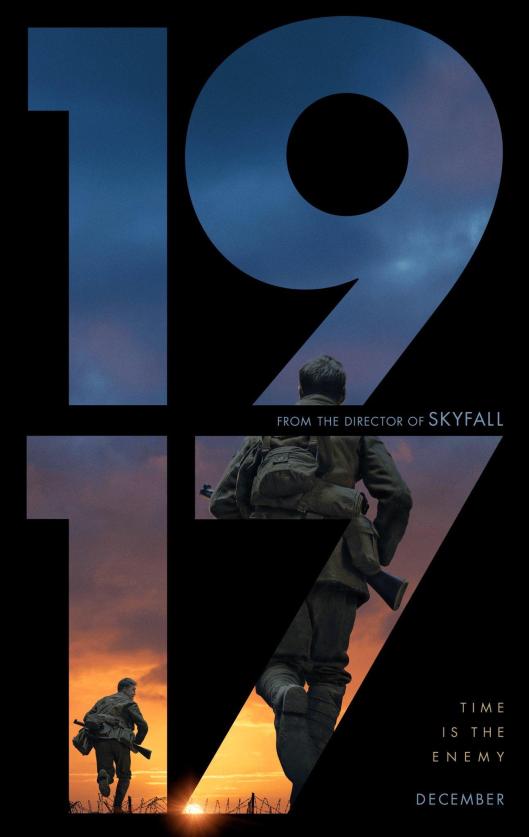
Sam Mendes, a director whose credits include spectacular Bond films, is about to release  something different: 1917.
It was a JRR Tolkein’s (right) experiences in the trenchland of northern France that would lead to The Lord of the Rings in the attempt, I think, to confront the demonic forces that surrounded him when he was twenty-four years old.
Erich Maria Remarque’s All Quiet on the Western Front was the same kind of response. Writers like these two—and like Siegfried Sassoon, Robert Graves and Wilfred Owen—showed us how quickly and completely centuries of civilization could unravel.
The advance word is positive and I hope the critics are right. Gettysburg, based on a far worthier novel, The Killer Angels, lasted longer than the battle itself and I was rooting against both sides by the end; Midway made me care not a damn about human beings. Private Ryan, on the other hand, did.
So I am hopeful for this film.

1917: Benedict Cumberbatch as Colonel Mackenzie
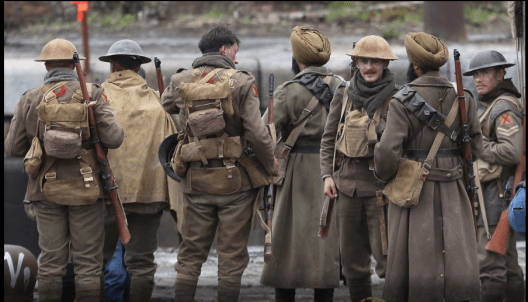
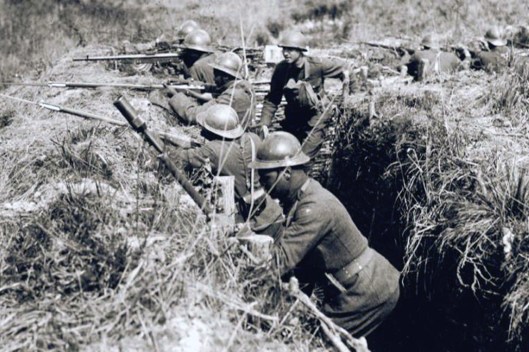
I wrote a a book about World War II which would have been impossible to write unless I’d had twenty years’ experience teaching World War I to European history students. It truly was a world war: The film still below shows actors portraying both Tommies and Sikhs fighting as comrades. Those are African-American troops from the 369th Infantry Regiment, but they’re wearing French helmets because the French begged for fighting men–we used African-Americans as manual laborers– and they responded by fighting like tigers. 170 members of this regiment received the Croix de Guerre.
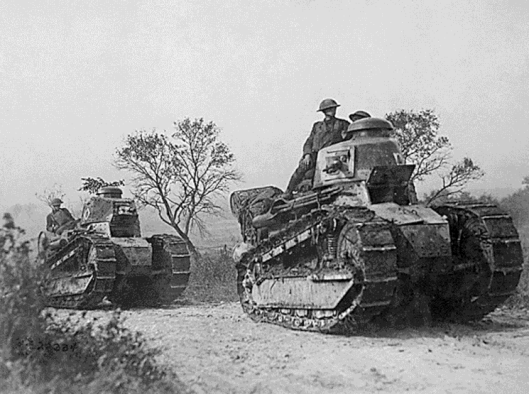
And these are American doughboys riding atop French Renault tanks; our Marines advanced on the machine gun nests in Belleau Wood carrying French Chaucat light machine guns. They fired from the hip, the Germans remembered, while smoking cigarettes. Our troops went into action in the Meuse-Argonne Offensive convoyed in French trucks driven by French colonials from a country that would someday be called Vietnam.
At the end of the year, my students and I decided that there had been no turning points in Western history quite like these three: Luther’s posting of the Ninety-Five Theses; the storming of the Bastille in 1789; the assassination of Franz Ferdinand and Sophie in 1914. The last event, which tumbled us into World War I within a month, hasn’t played itself out yet.
The Americans serving in Syria and Iraq are a product of this war and the ineptitude of the peace treaty never really ended it.
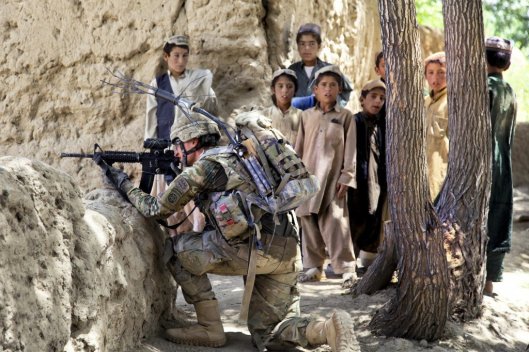
I tried to explain, in this passage from the World War II book, why we need to confront World War I. I have the feeling that this film will take us there.
* * *
I taught history for thirty years, and I never, never ceased to get angry every spring when I taught the First World War. It was this war and its peace treaty that did so much to make World War II possible. In 2010, I took some of my students to Western Europe’s World War II battlefields but also to Verdun, site of a horrific 1916 battle that lasted over ten months. The stacked bones in the ossuary there once belonged to boys like my two sons, whose parents had applauded at their first steps or cheered when they scored their first football goal.
I made it my business to help all of my students understand that idea— that war cheats us all so cruelly—and so I led them, every year in my classroom, into dark places, like Fort Douaumont at Verdun, so dark that it swallowed the light of five hundred years of Western culture. To go inside Douaumont, where 100,000 young men were killed or wounded, to study war doesn’t mean we glorify it. A few years ago, a student told me the First World War was her favorite unit. (Not mine—I much prefer La Belle Èpoque) I asked her why, and she replied, “Now I understand how precious human life is.”
She understood precisely why I became a history teacher.
She would have understood, as well, how in the process of writing this book, something extraordinary has happened within my heart: the more I research these young men of my father’s generation, the inheritors of the legacy of places like Douaumont, the more they become my sons.
Through no one’s fault, they’ve been mostly forgotten. This book seeks to name them and so reclaim them for a new generation. When we come to know these young men, we come to love them, and maybe that is the force that will carry us a small step farther along a path that will lead us to a world of peace. The great Jesuit theologian and anthropologist Pierre Teilhard de Chardin believed that we have a divine gift. We evolve physically and intellectually, but, he argued, we can evolve spiritually, as well. I believe Teilhard is exactly right. But I believe also that we cannot advance if we leave behind the boys and men I’ve met, the casualties of war. Their lives were, and are, precious, and if they could somehow save other young lives, I think they’d do it in an instant.
A North Vietnamese soldier-poet wrote many years ago that “the bullet that kills a soldier passes first through his mother’s heart.” If the young men I now know could somehow spare other mothers the pain theirs went through, then I think they would do that in an instant, too.
It is our responsibility to confront and understand the horrific violence that took their lives. The young men I now know who died in a Norman village like Le Bot or in the sky over the English Channel or deep in the waters of Ironbotttom Sound off Guadalcanal lit a path, in dying, for the living to follow. If we ignore them, we will lose the path, and the dark will have won after all.

Arroyo Grande High School students at Fort Douaumont, 2010.
 A Work in Progress