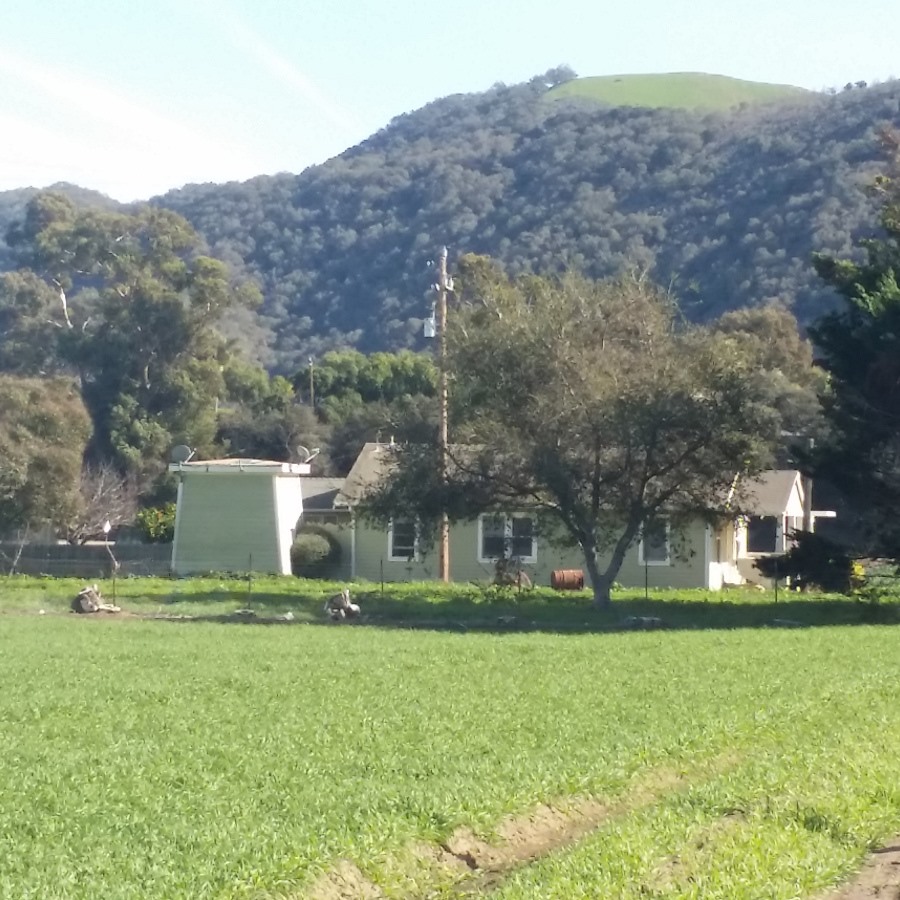
This photo was taken near the intersection of Huasna Road and Lopez Drive, where I grew up. Here is the story of the mountain in the photo.
This view is what would we could see very morning from one of our living room picture windows, but, for the sake of accuracy, in this order:
- Mom’s roses. Sutter Golds were among her favorites.
- Pasture, with Morgans, whose discharge made the roses grow. Cars would stop to watch the foal, a little stallion made up of 78% legs.
- Row crops, with the occasional crop duster dipping saucily beyond the power lines. Sometimes they were peppers, sometimes pole beans. A little up the Valley, Mr, Ikeda favored cabbages, which are blue. Just a tad to the left of the cabbages was the beaver dam into which I fell while fishing. Ineptly.
- The Coehlo place (Kathy). Her Dad carved a model of the old St. Patrick’s Church that was astonishing.
- The McNeil place.
- The Shannon place.
- Various pumphouses and barns.
- The man who had an airplane in his yard. Just in case.
- By the early 1960s, just a tad to the left and atop another hill, the Ikeda place.
- In the late 1950s, Dona Manuela Branch’s redwood home–she’d come to the Arroyo Grande Valley, pregnant, in 1837–had been just a tad more to the left. When I was very little, the home burned in the night. It gave off a spark as bright as Venus. Only the palm trees that had shaded the home, its gardens and had once shaded the family at barbecue remain today. The Ikedas take respectful care of Manuela and her family, maintaining the graveyard up a little canyon five hundred yards away from the home her devoted children had built for her.
So I grew up with this mountain, sort of. It always looked to me like the top of a head with a receding oak tree hairline.
Once there was a brushfire that came up behind it and framed the top, like the sun’s aureola at full eclipse, and that became a passage, fifty years later, in a chapter about the Battle of Petersburg. It went like this:
The Third Battle of Petersburg began in the pitch-black pre-dawn of April 2, 1865. A Union army surgeon, watching the assault from a federal fort, could see nothing until the combined muzzle flashes of thousands of Confederate rifles lit the horizon the way a brush fire will when it crowns a hilltop. When a line of flashes went black again, the doctor knew that the Union assault had carried the Confederate entrenchments.
One day, when I was in my early teens, I decided to climb it. You could access it from behind the Cherry Apple Farm. I was by myself, which was stupid, and forgot about the poison oak, which was stupider.
It took me two hours.
When I reached the top of the mountain I considered to be very close to my own personal property–emotionally, if not legally–I found out I hadn’t reached the top at all.
What neither the photo nor my many morning views as a little boy revealed was that this was actually two mountains: There’s a razorback ridge in front and, behind it and beyond it, the bald man with his receding hairline of oak trees.
I was kind of angry. It took me until almost dark to get back down, by which time my family assumed I’d been eaten by cannibals, which meant that the Eskimo Pies brought us by Frank the Foremost Dairy delivery driver–a consistently cheerful man– would last a little longer.
So it turned out that I climbed mountains just as ineptly as I fished. I would live to climb a few more. I’d help the Mission Prep kids whitewash the “M” on San Luis Mountain and fell off it twice more, spraining an ankle both times. I am not going back.
Now people live on that mountain. This kind of audacity would never have occurred to me when I was thirteen. It may seem pretentious to call it a “mountain.” Visit the Midwest. It’d be a veritable Matterhorn to folks north of the Ozark Plateau.
You can still see the backside of this mountain, but from the Nipomo Valley, to the right off the 101, as you drive north from Santa Maria. The hairline is flipped as if it were a reversed photograph.
I hold it no hard feelings. Seen from Nipomo, it’s a little bare and humbled without the oak-studded proscenium seen from its Arroyo Grande side. This gave the mountain a little romance to a little boy looking sleepily out the window on a cold morning.
Climbing it–and then finding out that I hadn’t climbed it at all–taught me a lesson in humility that I need to re-learn every day of my life.
 A Work in Progress