
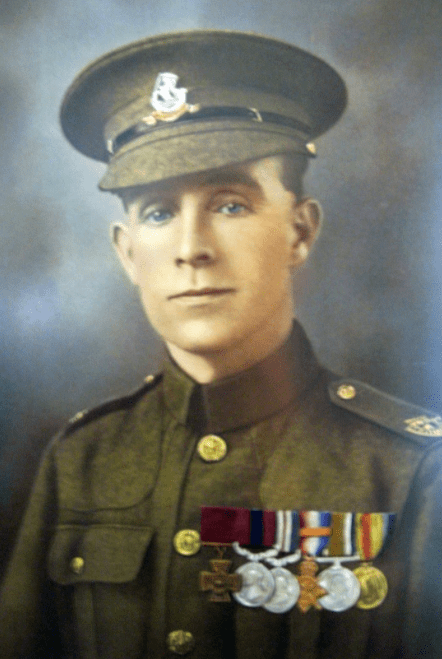
There are some stories that are so true that cynics cannot abide them and will spend countless needless hours—when they could be doing better things, like planting squash or building model battleships—trying to debunk them. Henry Tandey’s story is one of those.
Even if it’s not quite true—it does have factual underpinnings, but not the kind of deeply sunk concrete foundation that its doubters require— it has become a kind of parable, which is a story that tells a higher truth without getting bogged down in footnotes. That may make it even more important.
It’s a simple story. Henry Tandey was an immensely courageous British soldier (The VC, or Victoria Cross, is equivalent to the American Medal of Honor) fighting in the last year of the Great War, in September 1918, near Cambrai, where, only days later, an American engineer battalion would join the Brits in carrying the fight to their German enemy.
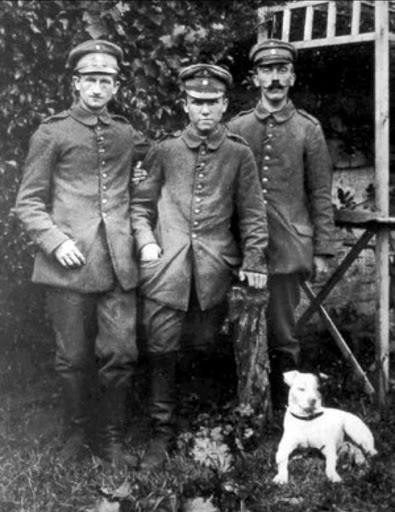
It was a German who entered young Tandey’s life that day. Tandey saw him pretty clearly through the gunsight of his Lee-Enfield .303. The fellow was staggering and disoriented and it would have been easy for the young Briton put the young German out of his misery–it looked as if he’d been gassed, after all.
Tandey started to squeeze the trigger and then something interposed. Was it a hymn he’d learned as a little boy? Was it something his grandmother had taught him? It was certainly something he couldn’t articulate at the time. Battlefields don’t lend themselves to thinking in ordered companies of sentences arranged in battalions of persuasive paragraphs.
Tandey let his finger relax and so let the helpless man go.
The German soldier survived the war, as did Tandey, but their paths would cross again, twenty years later, oddly enough and quite indirectly, in Munich, a beautiful city. That’s where the German saw this painting and instantly recognized the soldier in the foreground, in what must have been a customary moment of compassion, carrying a wounded comrade.
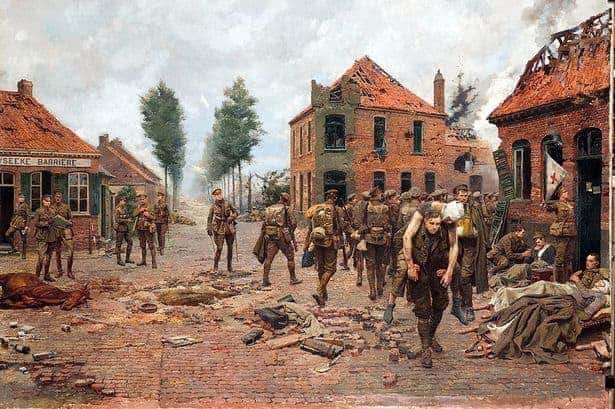
“I know that man!” the German veteran exclaimed to his guest, a visitor from Britain. “That’s the man who spared my life!” The veteran asked his British guest, a man of some power, if there was any way he could discover the British soldier’s name.
There was. The guest was, after all, Neville Chamberlain, the Prime Minister. After finding the artist and interviewing him, a young man working for Chamberlain identified the soldier in the painting as Pvt. Henry Tandey.
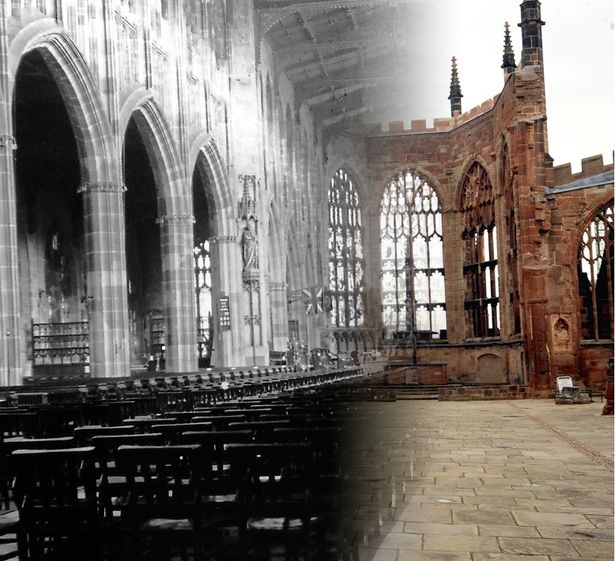
He was no longer “Pvt. Henry Tandey,” of course. He was a factory policeman working in the Triumph plant in Coventry, a beautiful city noted for its beautiful cathedral.
The delighted German sent a message of thanks to Tandey in Coventry.
Two years later, he bombed Coventry.
Pvt. Henry Tandey, VC, had Adolph Hitler in his gunsights that day in 1918. “I couldn’t shoot a wounded man,” he said in the years after.
“I’m sorry to God I let him go.”
 A Work in Progress