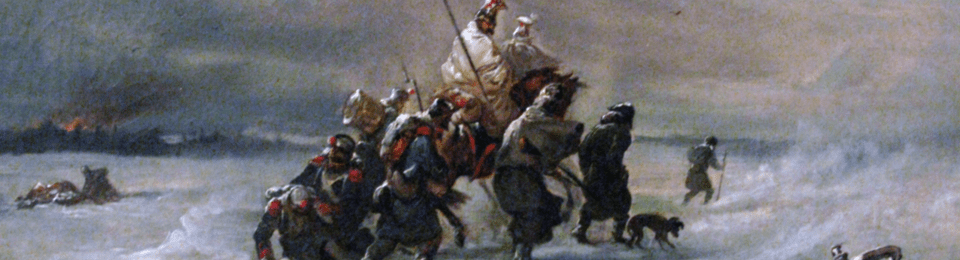
In the early 2000s in Vilnius, in Lithuania, when construction workers began unearthing skeletons, they called in the anthropologists. The work these scientists do is familiar in this part of the world. Thanks to Stalin’s NKVD and Hitler’s einsatzgruppen, mass graves that would be a horror anywhere else are common in Eastern Europe.
The only place remotely familiar is Spain, where everyone knows about the mass graves, legacies of the Civil War, but no one speaks about them.
In Vilnius, the skeletons were even older than the ones left behind by Stalin and Hitler and Franco. These were Napoleon’s soldiers.
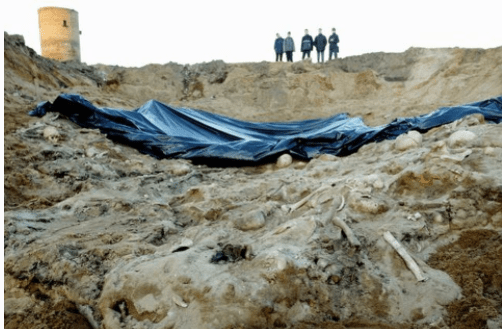
Nearly four thousand individuals were isolated, only part of the estimated 20,000 soldiers who died here. The numbers are staggering: Napoleon had taken a multinational army of 675,000 men into Russia in 1812. Near the end of his retreat, at Russia’s western frontier, only 40,000 remained. Half of them staggered into Vilnius.

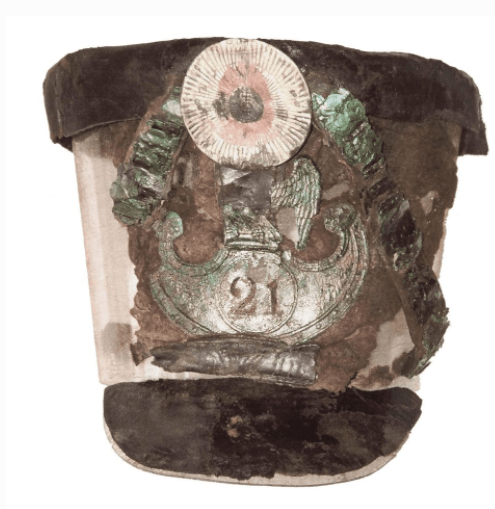
Some of the finds were fascinating. Many individuals had a notch in the front teeth of their lower jaws. This is where the stems of their clay pipes had fit. Bits of uniform cloth and infantry helmets, like this one, allowed archaeologists to match some soldiers with their units in what Napoleon called the Grand Armee.
Chemical analysis of the Vilnius bones hinted, from fragmentary nutritional evidence, at those soldiers who were more likely French and ate a diet based on wheat and those where millet was detected. These were the Italians.
By the end of the retreat, none of the Vilnius survivors was eating much at all. They’d slaughtered the horses that had drawn their baggage and then they’d begged the bewildered townsmen bare. Some starving soldiers broke into a medical office to steal the doctor’s anatomical specimens, suspended in formaldehyde.
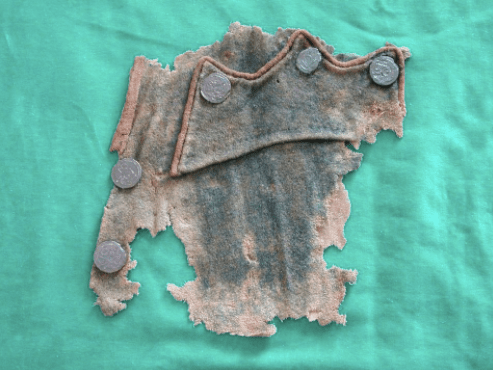
Uniform fragments like this one revealed the final killer: The scat left behind that was evidence of typhus, the same opportunistic disease that would kill so many in Ireland’s famine thirty-five years later.
Some of the skeletons would’ve belonged to the military doctors who remained behind in Vilnius. Napoleon didn’t. He abandoned his dying army—just as he had in Egypt fourteen years before—and, wrapped in furs, safe inside a fast sled, he raced in relays of horses, killed in their harnesses, to get back to Paris, where he could minimize the news of this epic disaster, reshape it in the imperial press.
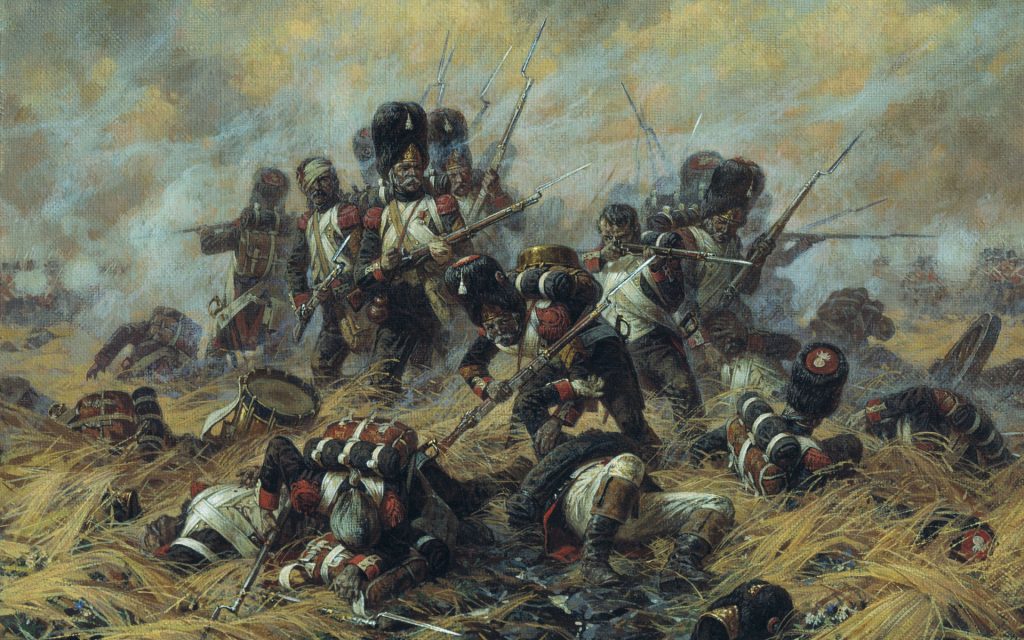
In this, he was spectacularly successful. He would make a comeback and lead let another army to spectacular failure at Waterloo two years later. This army included the troops esteemed more than any others, the Old Guard, his personal bodyguard. Many of them, tall men made taller by their bearskin helmets, were grey-mustached veterans who had been with him since the beginning. By the end, they were ironically the safest soldiers in his army. They were so venerated that they would always make up the emperor’s strategic reserve, to be used only as a last resort.
At Waterloo, that last resort came when the Guard was called on to cover the flight of the Emperor as his carriage sped, again at a horse-killing pace, toward Paris. The Old Guard would die, abandoned on the field in the moment that their emperor realized that the weight of late-arriving Prussian troops was more than his empire could bear. He realized, too, in the same moment and with perfect clarity, that his life was far more valuable than the lives of the veteran warriors who loved him the most.
This week the president announced that “we are all warriors.” Here are warriors in New York City in a grave different only from the grave in Vilnius for the decency of its caskets and the symmetry of its trench.

But this grave, like the Vilnius grave, demonstrates some of the similarities between the emperor and the president. Like Napoleon, Trump has demonstrated a perverse genius for altering reality.
The president and his people are preparing to magically reduce the casualties of the last two months. They will claim that hospitals, eager for the Medicare money that comes with treating coronavirus patients, are inflating the numbers of admissions and, of course, the numbers of dead—the ones who lie unburied in a fleet of refrigerated trucks in Brooklyn, the trucks organized in neat rows where, in the distance, you can see the Statue of Liberty.
The president has blamed one of his more vivid leadership failures on hospitals, too. He obliquely and darkly implied that the lack of personal protective equipment was traceable to doctors, nurses and respiratory therapists who were selling the gear on some kind of coronavirus black market.
Yesterday, in the Oval Office, he quickly and sharply contradicted a nurse he was supposed to honoring when she revealed that the supplies of PPE were still sporadic and unreliable.
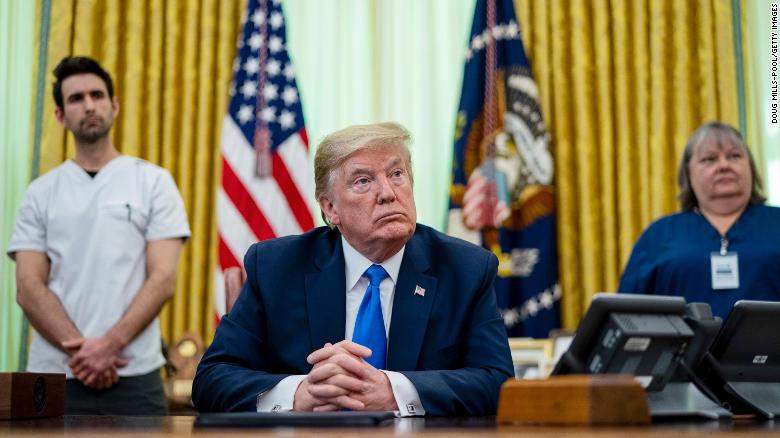
“That’s not what I hear,” he said, without revealing, as he never does, where he’d heard it. “Many people tell me” is the closest we get to attribution from a president who constantly excoriates the background sources from the reportage of the New York Times or the Washington Post.
He was far more obvious in his repeated references to “The China Virus,” the one he claimed to have quashed at American ports of entry. But the tragic numbers in New York City came from Europe, from Heathrow and Orly and da Vinci-Fiumicino, as passengers made their transit through JFK and Newark.
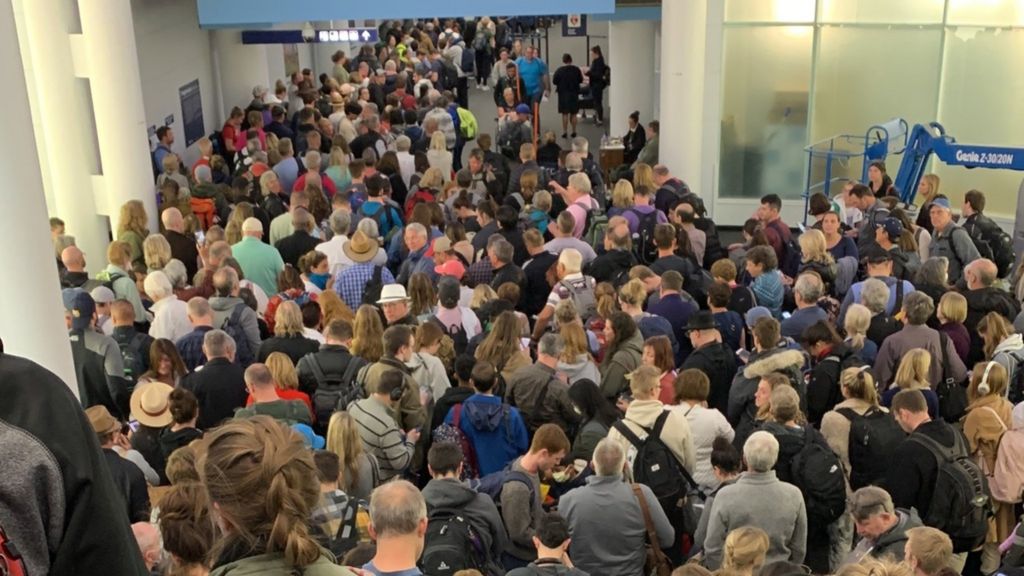
When he did respond to the East Coast threat, he did so with his customary incompetence, announcing “enhanced screenings” that left hundreds funneled into Customs hallways where they had far less freedom to move than the virus did.
But these were warriors, weren’t they?
Trump’s ignorance of history remains his greatest and most enduring personal virtue. He knows nothing about Napoleon and Russia and does not care. He refers repeatedly to “the 1917” flu. You could see his restlessness on a visit to Gettysburg, early on in what he called, early on, his “reign.” (Someone in the West Wing got him stop using this term, one he used for previous presidents, as well.) Later he passed on a visit to Belleau Wood because it was raining. He did speak, to his credit, at Normandy on the same trip, but it was transparently empty because he spoke in the same uncomprehending monotone that he reserves especially for the dead. The words written for him meant nothing to him. He was, as someone so aptly pointed out, like a sixth-grader delivering a book report about a book he hadn’t read.
And he did speak, to be fair, in the rain. In a July 4 speech, he praised the Continental Army for seizing airports from the British during the American Revolution.
And so the ignorance he so carefully cultivates—the coronavirus deaths are fake news, after all—will shield him until, God willing, he leaves office. The man who has called himself “a wartime president” will be whisked away from the battlefield.
He’ll be flown home to Mar-a-Lago where he will finally be alone with the thing he loves the most: A New York steak, very well-done, with a a side of fries and plenty of ketchup. And then there will be a thick slice of chocolate cake with two scoops of ice cream.
All he will have left behind are trenches filled with warriors. But the country will be opened again. We will have that much. And, in truth, when the trenches are covered over, the scars they leave behind will grow over and so fade away.
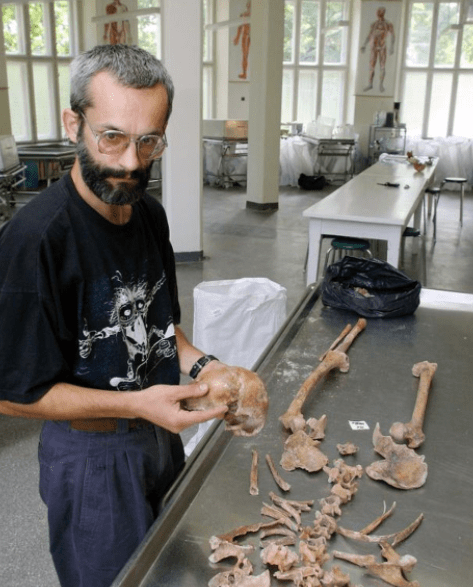
When the Vilnius warriors were finally unearthed, the scars there reopened. You can see it in the scowling face of the Lithuanian anthropologist. You can see it in the compassionate face of the young woman field technician as she reveals a young man who’d died nearly two centuries before she was born. What you see in both images, in both expressions, are human beings registering their humanity.

A little humanity is not too much to ask for. Unless you ask for it from the misshapen man who claims to leads us.
 A Work in Progress