

29 Monday Jun 2020
Posted in Uncategorized
24 Wednesday Jun 2020
Posted in Arroyo Grande, Uncategorized
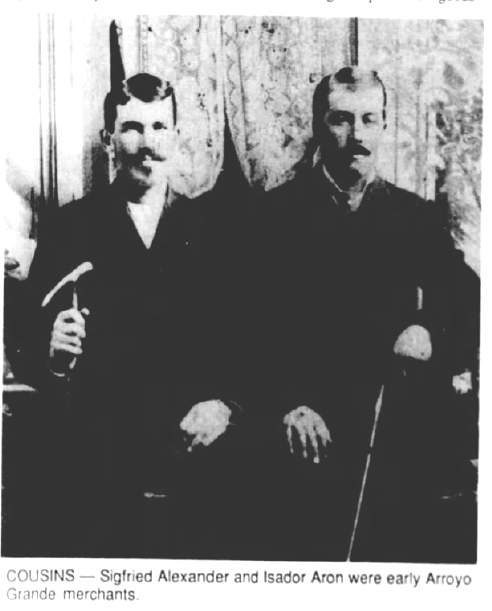
There are times in any amateur historian’s research when you’re led in a direction you didn’t expect. If you’re lucky, that new direction will reward you with a lesson in our shared humanity–which, to me, is what history is all about, anyway.
The facts seem basic. Isidor Aron (1853-1909) and Siegfried Alexander (1856-1923), were cousins, from Posen, a province of Prussia until Bismarck completed Germany’s unification in The Hall of Mirrors at Versailles in 1871. This was the final act of a victory over Napoleon III’s France that would poison Europe. This moment made Verdun possible—the place where, beneath plexiglas panels in the floor of the battlefield ossuary, the unidentified bones of tens of thousands of French and German boys are stacked, orderly and ghastly.
The two cousins had emigrated to America two years before the Bismarck’s moment in the Hall of Mirrors—that’s good news— but not long after their adoptive nation’s near-annihilation in the Civil War. That’s bad news. German immigrants were not viewed kindly—my grandmother’s people came here from Baden-Wurttemberg—and the war had made them tragicomic. The Army of the Potomac’s XI Corps, after all, made up mostly of German immigrants (“We Fight Mits Sigel,” a popular song was titled, in honor of their commander, Franz Sigel), had collapsed under the weight of Stonewall Jackson’s stunning surprise attack at Chancellorsville in May 1863, in Lee’s greatest victory.
The Confederates had come bursting out of dense woods thought impassable, trilling their Rebel Yell and preceded by panic-stricken jackrabbits, foxes and deer who galloped through the Union soldiers at their suppers. The Germans trailed the animals in their flight, but not by much.
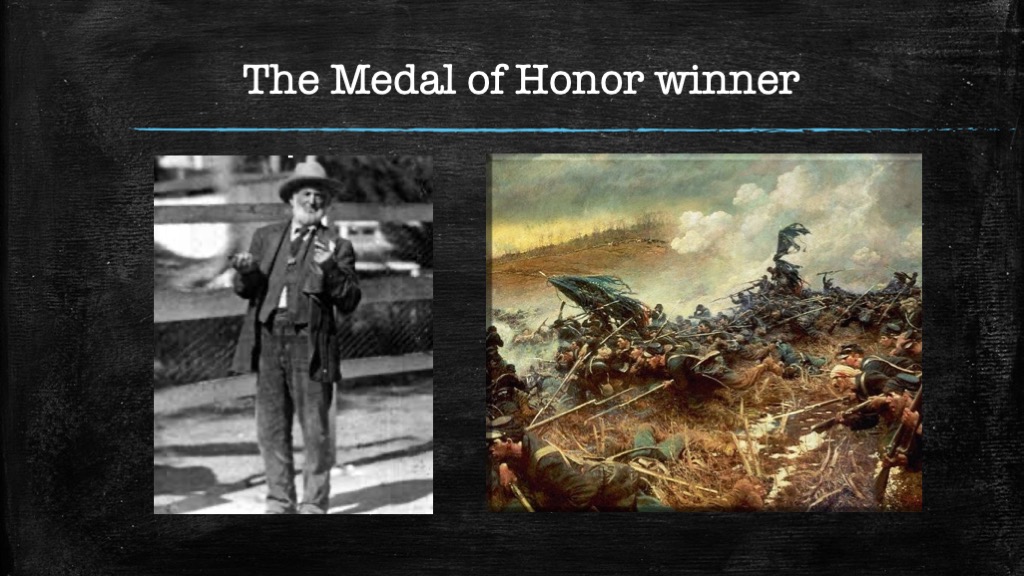
For a time, the only resistance on Hooker’s right seemed to be coming from a single cannon, also in retreat, but manned by a crew that would pause periodically to load and fire a canister charge, essentially, the artillery version of a shotgun shell, loaded with deadly steel balls, into their pursuers. The defiant artillery crew was directed by a German immigrant, Captain Hubert Dilger. A Southern artillerist described Dilger’s actions that day as “superhuman,” and the young Union officer would win the Medal of Honor.
It appears that Dilger was overshadowed by bad generalship and the resultant flight of XI Corps. It would take generations for their descendants—Eisenhower, Eichelberger, Spaatz, Nimitz—to redeem Chancellorsville.
For the rest of the war, XI Corps would be derisively referred to as “The Flying Dutchmen.” Ironically, it was a Confederate state—Texas, of all places—that would welcome German immigrants with open arms. Texas German is still spoken there.
German immigrant Isidor Aron came to California. Here’s a 1905 passport application, preparatory to the great adventure of his life, which includes the record of his immigration and citizenship.
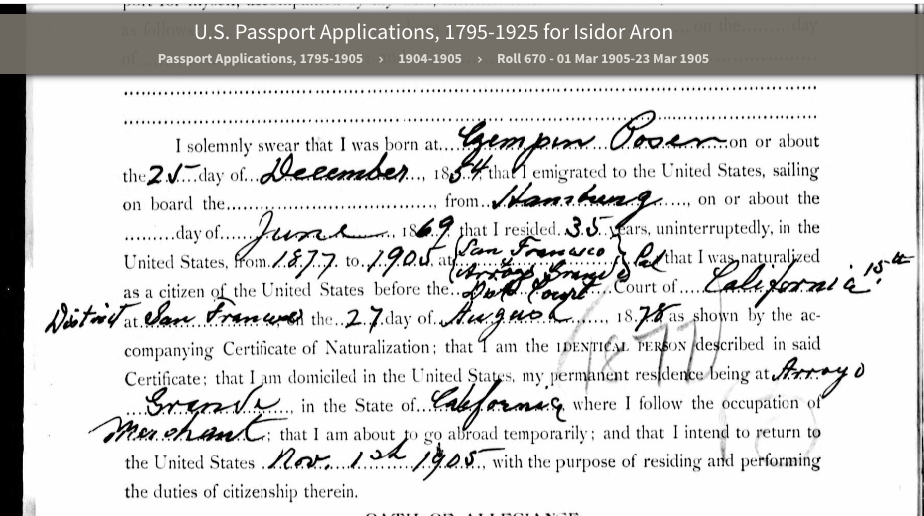
Luckily, Isidor and his cousin Siegfried were far too young for Chancellorsville. They took up clerking in San Francisco, possibly attracted by the reputation of another successful German—another German Jew—the Bavarian-born Levi Strauss.
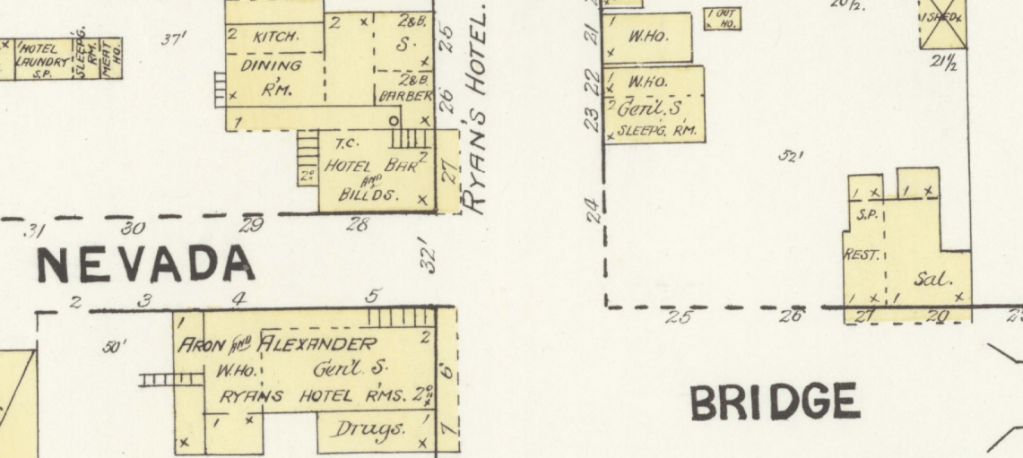
The cousins came to Arroyo Grande as merchants in the 1880s, setting up a haberdashery and dry-goods store on the corner of Branch and Bridge Streets, on the site of today’s “Something Different” store, which was once the Bank of America.
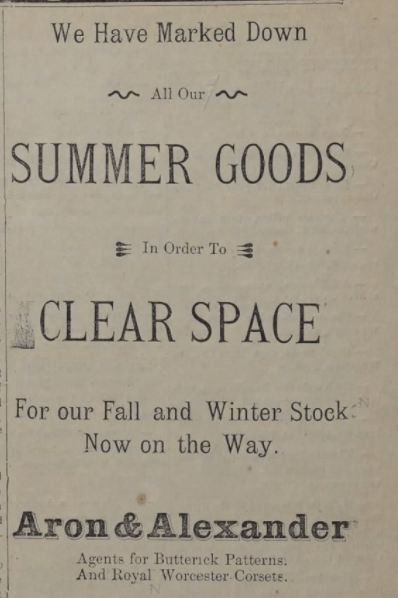
In August 1897, the cousins took out a rare display ad—they were given to more modest two-line blurbs that typified the advertising columns of small-town Victorian weeklies— in the Arroyo Grande Valley Herald-Recorder.
What is clear from the historical record is the popularity of Aron and Alexander—as men and fellow citizens, and not just as merchants. The venerable local historian Madge Ditmas wrote in one of her 1941 Herald-Recorder columns, just before veering off into one of her typical anti-FDR screeds, that these Germans weren’t seen as foreigners at all.
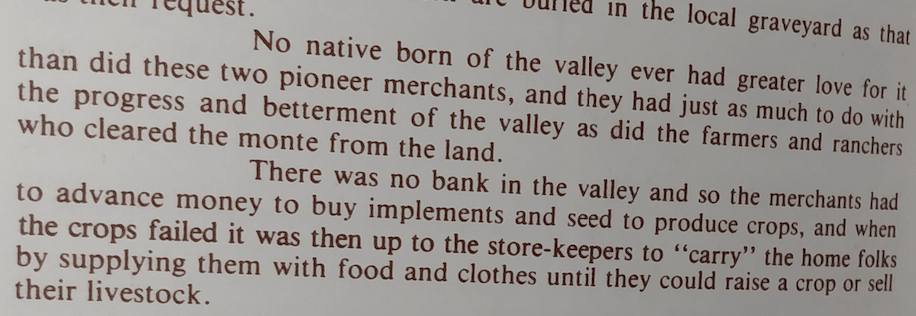
So the seemingly effortless generosity of the two—which had to have come, in reality, with tremendous effort—endeared them to Arroyo Grande.
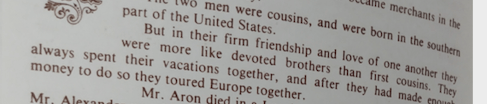
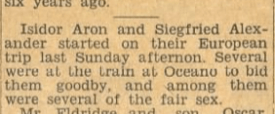
Sadly, the cousins would die far from their American home. A stroke killed Aron in 1909 Los Angeles; a heart attack ended Alexander’s life in 1922 San Francisco. But, as Ditmas notes, they loved to travel, and luckily, they managed to take what was called the Grand Tour together in 1905, four years before Aron’s death. Here’s a note from the Herald-Recorder that clearly indicates the presence of an Aron and Alexander Fan Club:
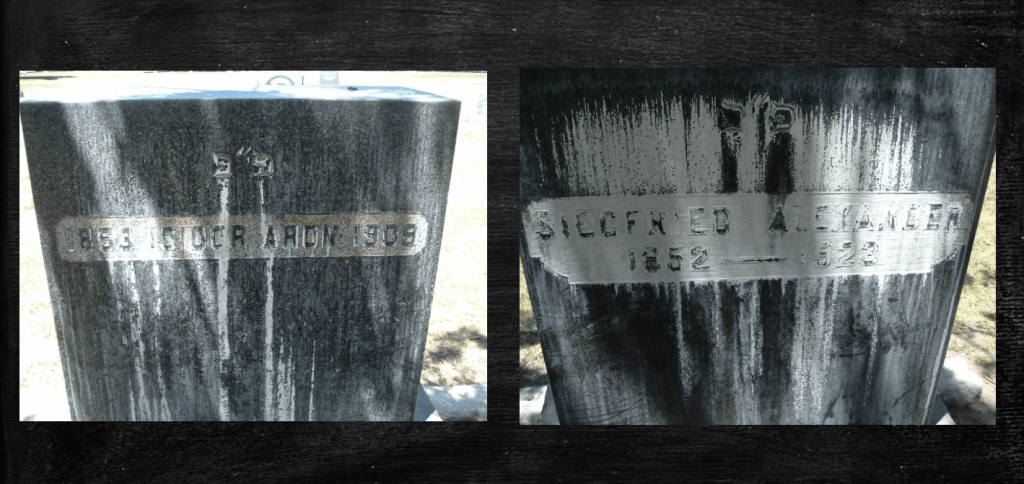
The cousins were eventually buried together. Aron is buried in Plot C8 in the Arroyo Grande District Cemetery; Alexander lies alongside, in C10. Atop their tombstones are the Hebrew letters that tell you
Here lies a son of God.
Of that, I am sure. To have made your way as a foreigner in a place as foreign as Arroyo Grande, on the continent’s edge, to have generated so much good will, speaks unwritten volumes beyond the simple profundity of their tombstones. They were certainly devoted to their business and to each other, but they were devoted—perhaps even more— to my home town. Their lives shaped ours in ways we may never fully understand or appreciate.
16 Tuesday Jun 2020
Posted in Uncategorized
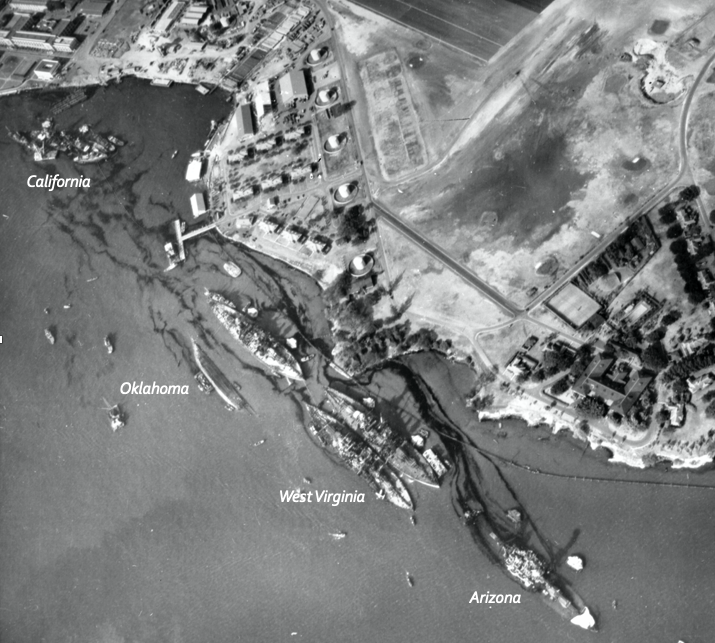
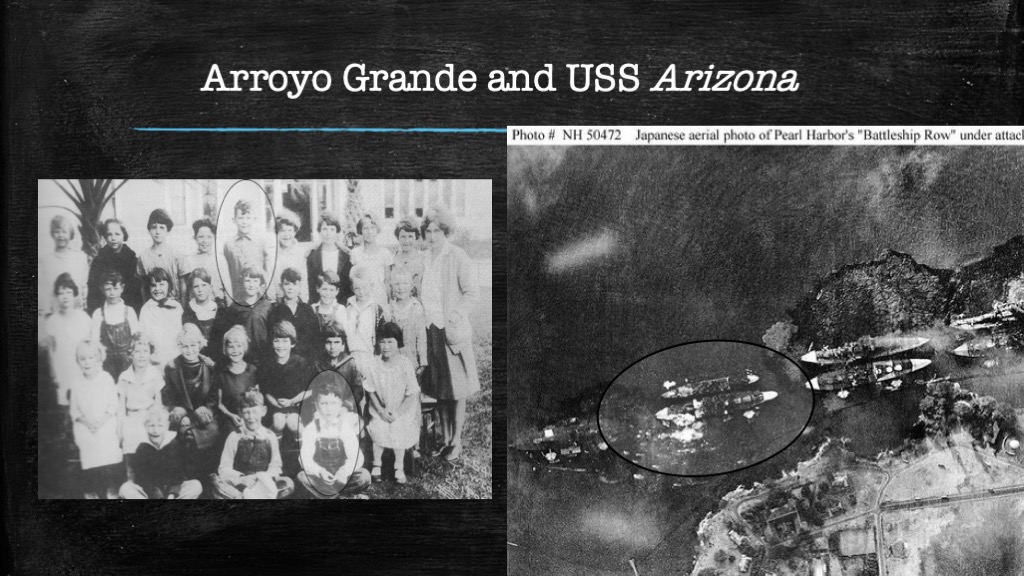
Watching From Here to Eternity yesterday reminded me of how miraculous Americans can be when they work together. One example of this would be the battleship California, sunk at her berth at the head of Battleship Row. These photos show her position a few days after, surrounded by repair vessels, trying desperately to keep California afloat, but she would finally sink and settle on December 10 You can see also the capsized Oklahoma and the sunken Arizona, with her bow blown away.
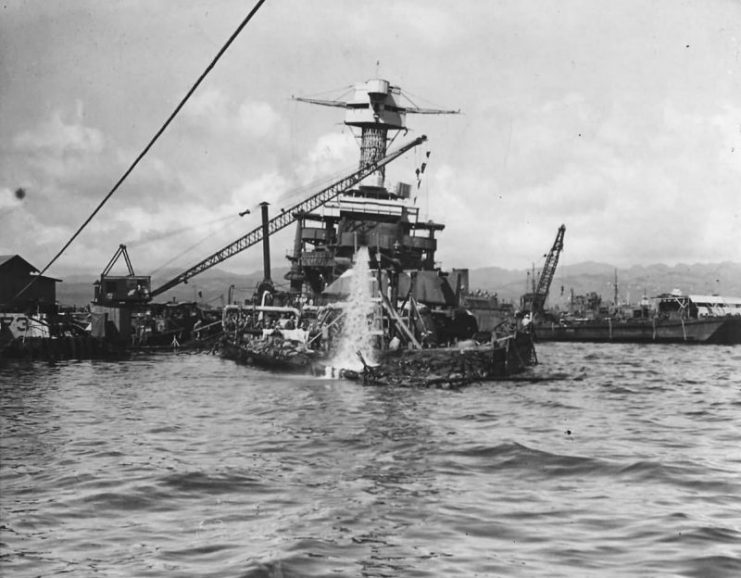
And here is California being raised from the mud at Pearl. She would not only be raised, but she’d be re-designed, repaired and put back into action by early 1944. Her lines (seen below) were far more beautiful than they’d ever been.
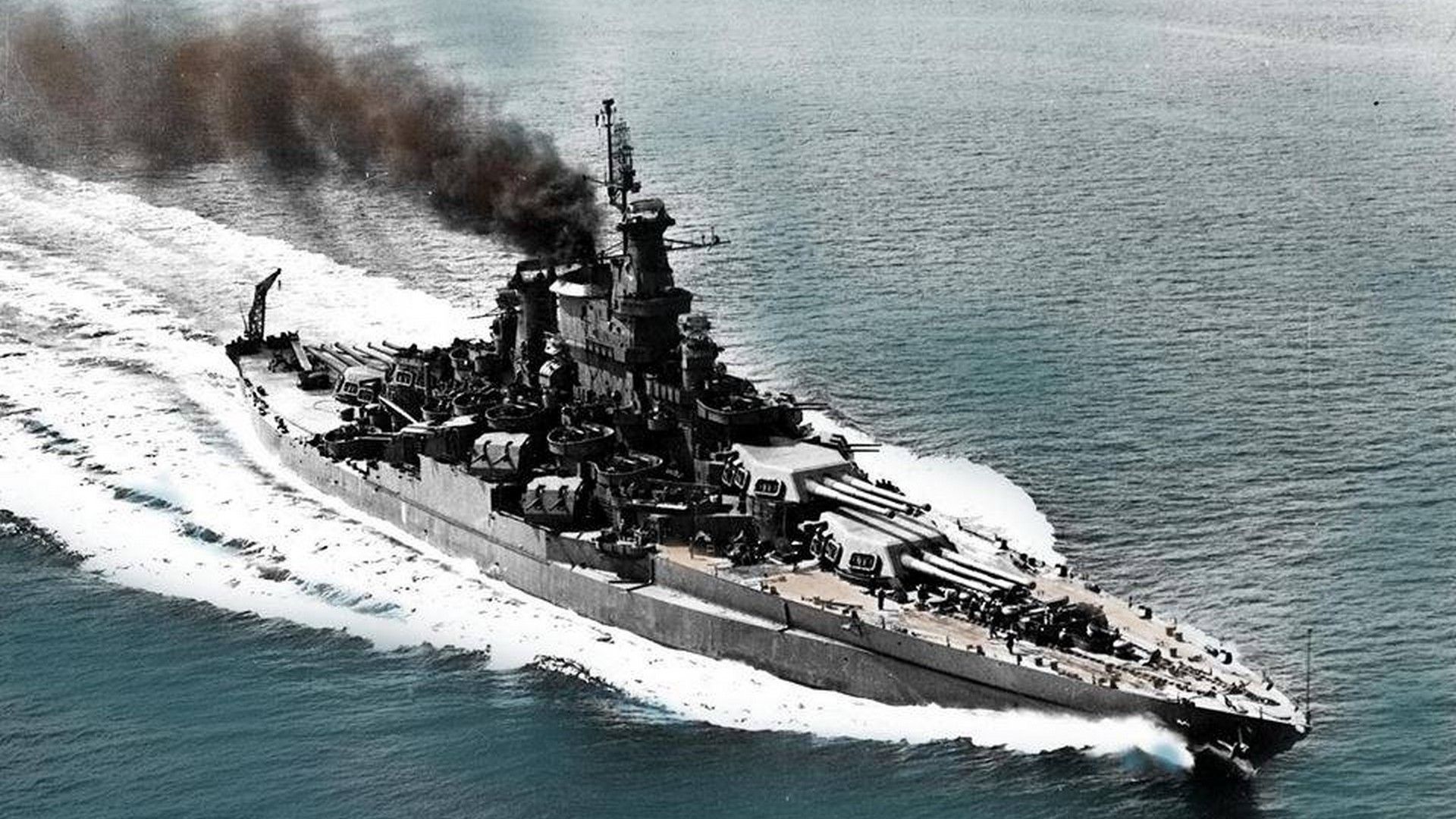
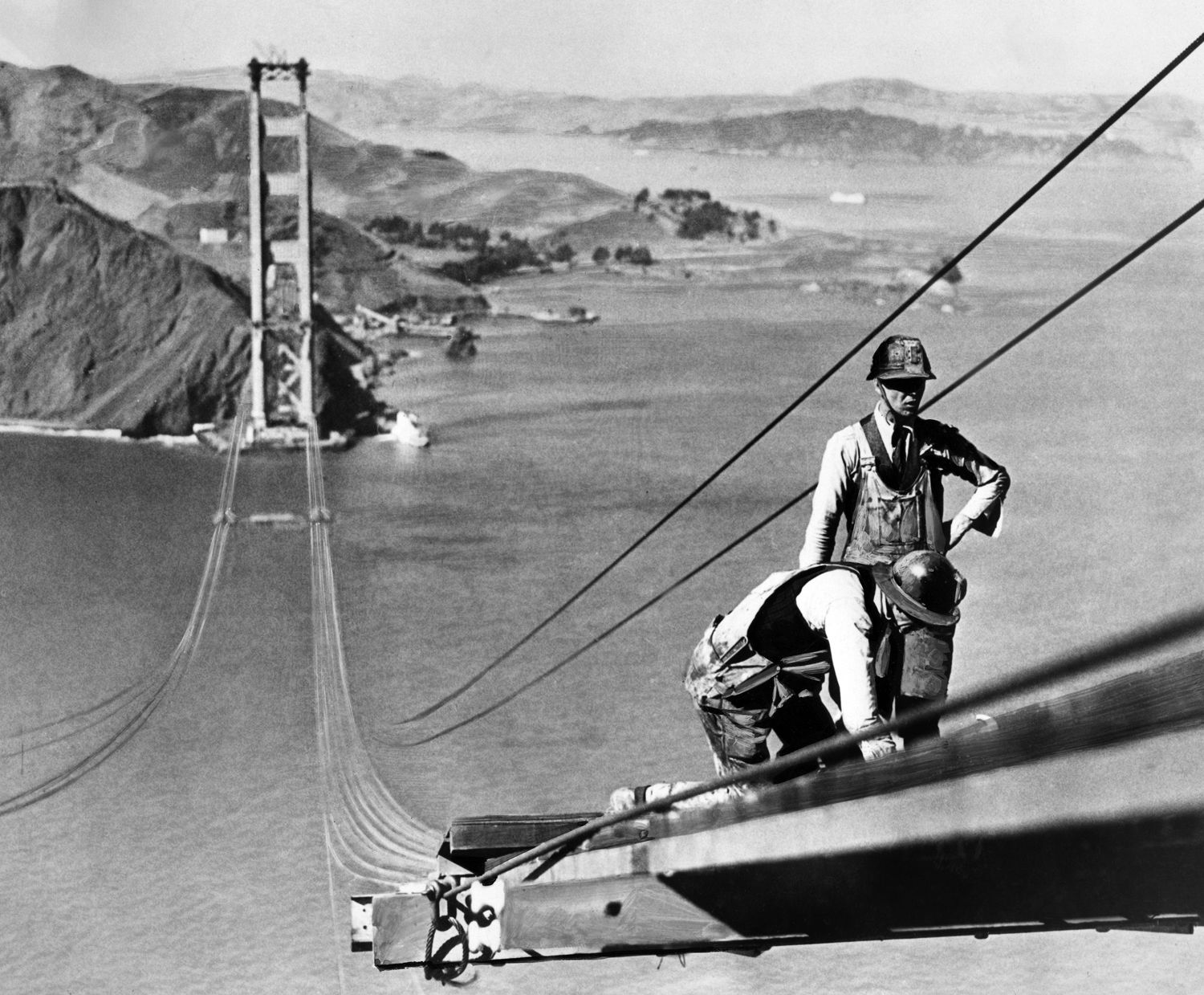
California had been launched in 1921; but even in her more ungainly interwar version, I found this photograph enchanting. Here she is passing beneath another American engineering miracle, still under construction: The Golden Gate Bridge.
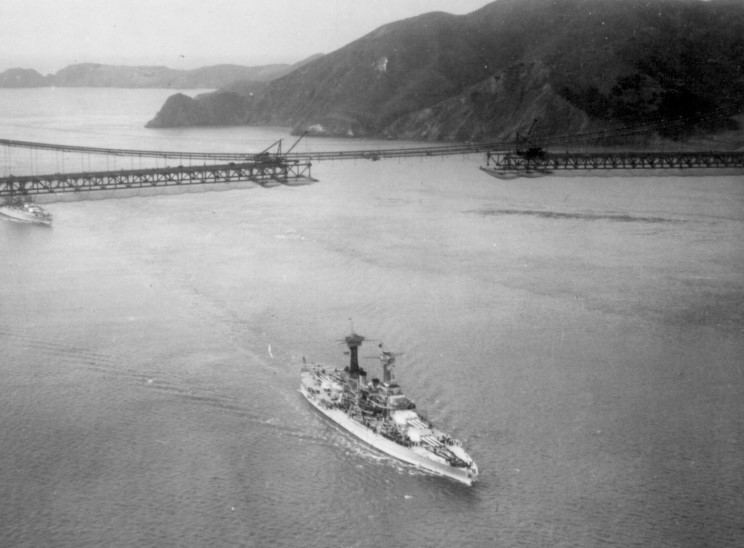
It struck me how incredibly productive Americans can be—I looked forward every year to teaching my U.S. History students about 1930s bridge-building. But nothing demonstrated our productivity and ingenuity more than the civilian response to World War II, including the fabled “Rosie the Riveter” (women made up a third of the labor force).
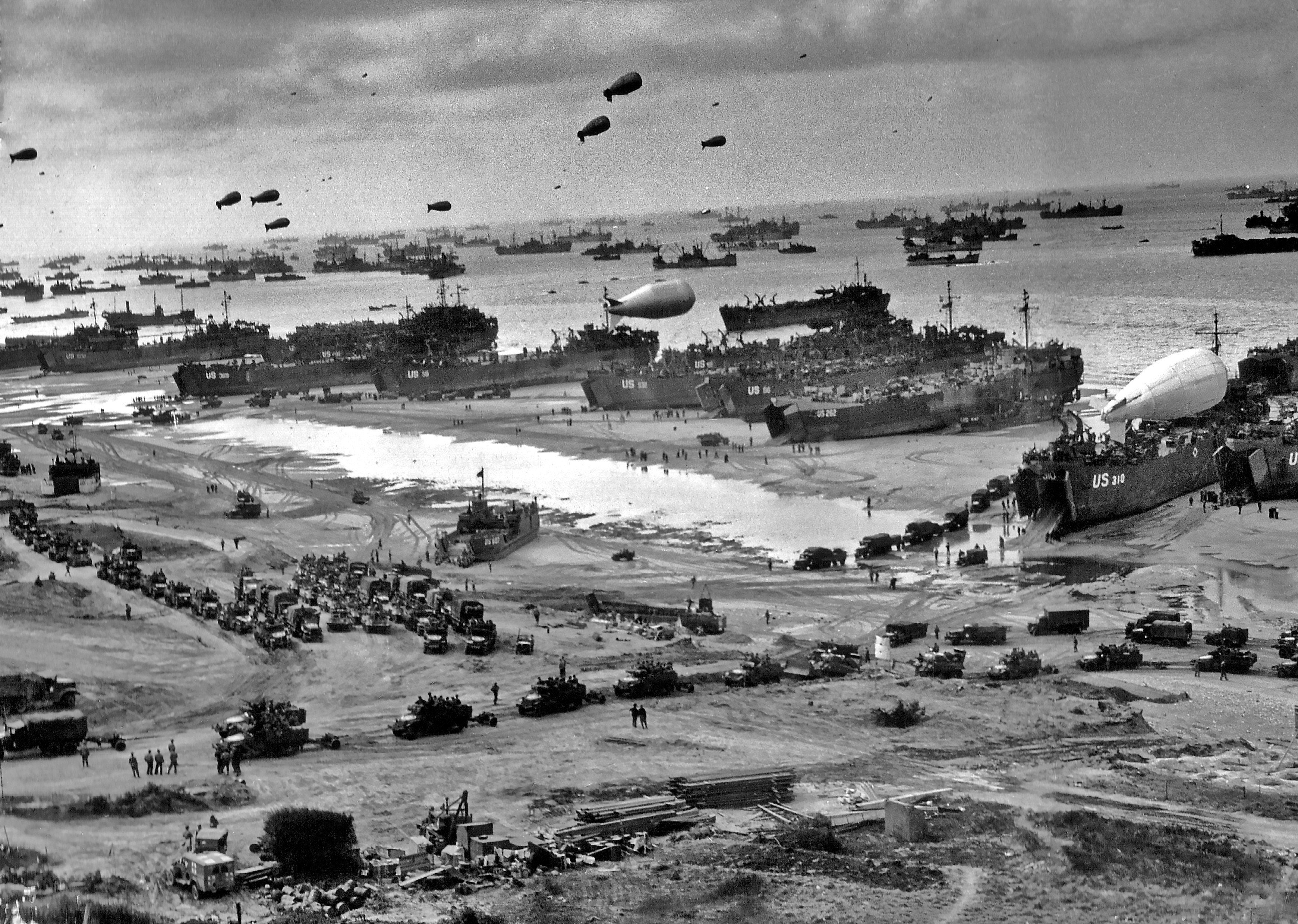
The image that so vividly demonstrates this part of our national character is this photograph of masses of supplies being offloaded onto Omaha Beach shortly after D-Day. I think this is one of the most inspirational photographs in our history.
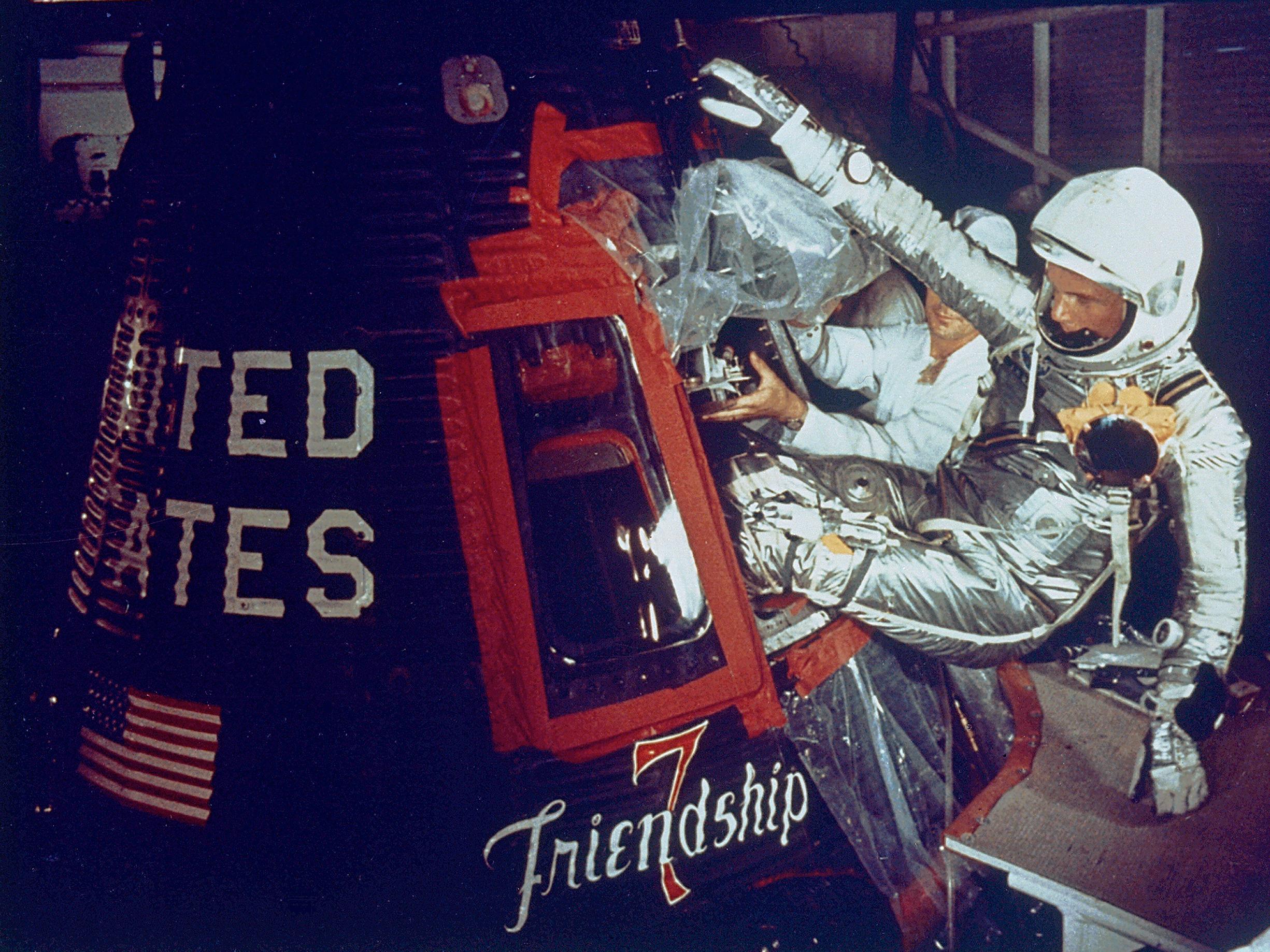
There is something else that reclaimed ships, bridges and wartime factories suggest, and that’s the capability of our national imagination, something I took for granted growing up when I would pad out into our living room, wrapped in a blanket against the cold, to watch a Mercury Program launch from Cape Canaveral. This is John Glenn, one of my Mercury heroes.
But the best example of this element of our national character–our imagination–didn’t come in wartime or in the New Deal years–and not even in the heady days of the seven Mercury astronauts. I think it came in 1956.
The largest work project in American history came in Ike’s time: The National Highway Act led to the construction of 41,000 miles of roads and generated hundreds of thousands of jobs. We proved once again that we could think big and build big.
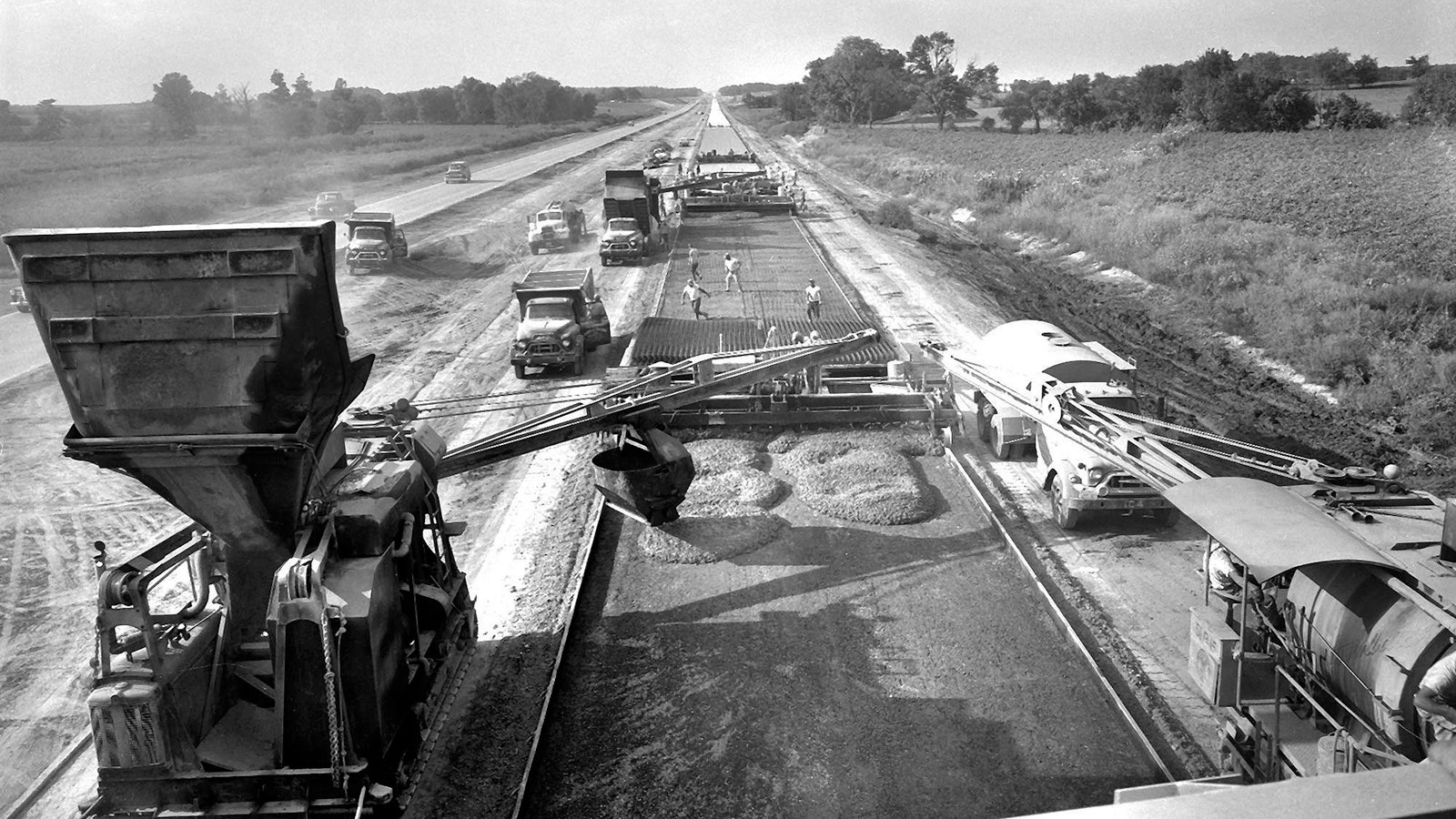
And of course the Highway Act led to my life the way it’s turned out; when my father became the comptroller of Madonna Construction–he bid jobs up and down the state–that led to the family’s move from Taft to Arroyo Grande, my hometown.
I am sick of those who proclaim us a “failed country,” because they know nothing about our history. We don’t need them anymore than we needed Copperhead Clement Vallandigham or snake-oil salesman like Huey Long or Joseph McCarthy.
What we need to do is to remember who we are.
01 Monday Jun 2020
Posted in Uncategorized
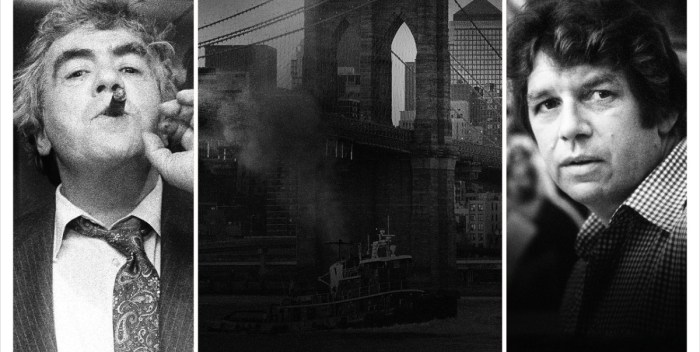
Watched a fascinating HBO documentary last night on what used to be called “New Journalists.” It focused on two New Yorkers, Jimmy Breslin and Pete Hamill. I was particularly struck by Breslin–not necessarily an admirable person, he was a brilliant writer and, even better, a brilliant reporter.
Two examples from JFK’s assassination: While the pack of print journalists hunkered down in front of Malcolm Kilduff for the announcement and followup details of the president’s death, Breslin tracked down the ER doctor who’d tried to keep Kennedy alive. The story even included the sandwich the doctor was eating when he was called to Examination Room 1, and Breslin’s description of Jacqueline Kennedy and her stoicism there is some of the most brilliant writing I’ve ever read.
Example #2: On the day of the funeral, Breslin looked around and realized he was one of 3,000 reporters covering the funeral procession. He broke away, sped to the cemetery, and found the man who was digging the president’s grave. It was, the man said, an honor, for which he was paid $3 an hour. Breslin’s story about the gravedigger somehow crystalized the entire nation’s grief.
The two journalists were a study in contrasts. Breslin agonized over every word. Hamill, like me, wrote rapidly and his New York “Times” pieces–on politics, on social justice, on the civil rights movement–still have a kind of shimmer to them today.
While Breslin was fond of the companions he’d immortalize in “The Gang Who Couldn’t Shoot Straight”–button men, professional arsonists (!), mob lawyers, gamblers–Hamill was dating Shirley McLaine and Jacqueline Kennedy Onassis. His best work–on his own alcoholism–was yet to come then, in the early 1970s.
He’d almost quit writing in 1968, when Robert Kennedy was assassinated. He’d made a mistake, he said. He’d gotten too close to his subject. Bobby’s death nearly killed him, too.
 A Work in Progress