
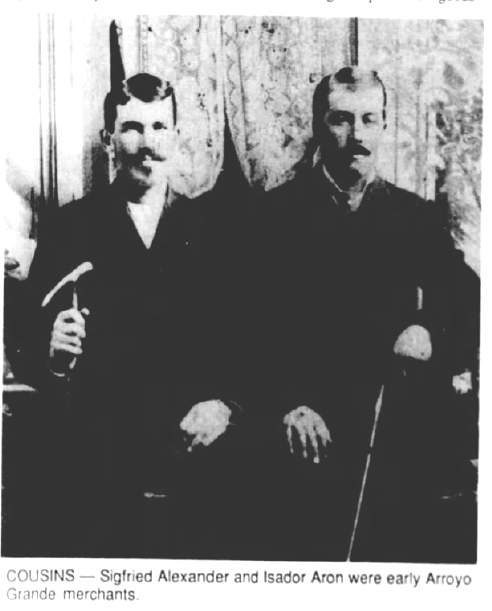
There are times in any amateur historian’s research when you’re led in a direction you didn’t expect. If you’re lucky, that new direction will reward you with a lesson in our shared humanity–which, to me, is what history is all about, anyway.
The facts seem basic. Isidor Aron (1853-1909) and Siegfried Alexander (1856-1923), were cousins, from Posen, a province of Prussia until Bismarck completed Germany’s unification in The Hall of Mirrors at Versailles in 1871. This was the final act of a victory over Napoleon III’s France that would poison Europe. This moment made Verdun possible—the place where, beneath plexiglas panels in the floor of the battlefield ossuary, the unidentified bones of tens of thousands of French and German boys are stacked, orderly and ghastly.
The two cousins had emigrated to America two years before the Bismarck’s moment in the Hall of Mirrors—that’s good news— but not long after their adoptive nation’s near-annihilation in the Civil War. That’s bad news. German immigrants were not viewed kindly—my grandmother’s people came here from Baden-Wurttemberg—and the war had made them tragicomic. The Army of the Potomac’s XI Corps, after all, made up mostly of German immigrants (“We Fight Mits Sigel,” a popular song was titled, in honor of their commander, Franz Sigel), had collapsed under the weight of Stonewall Jackson’s stunning surprise attack at Chancellorsville in May 1863, in Lee’s greatest victory.
The Confederates had come bursting out of dense woods thought impassable, trilling their Rebel Yell and preceded by panic-stricken jackrabbits, foxes and deer who galloped through the Union soldiers at their suppers. The Germans trailed the animals in their flight, but not by much.
For a time, the only resistance on Hooker’s right seemed to be coming from a single cannon, also in retreat, but manned by a crew that would pause periodically to load and fire a canister charge, essentially, the artillery version of a shotgun shell, loaded with deadly steel balls, into their pursuers. The defiant artillery crew was directed by a German immigrant, Captain Hubert Dilger. A Southern artillerist described Dilger’s actions that day as “superhuman,” and the young Union officer would win the Medal of Honor.
It appears that Dilger was overshadowed by bad generalship and the resultant flight of XI Corps. It would take generations for their descendants—Eisenhower, Eichelberger, Spaatz, Nimitz—to redeem Chancellorsville.
For the rest of the war, XI Corps would be derisively referred to as “The Flying Dutchmen.” Ironically, it was a Confederate state—Texas, of all places—that would welcome German immigrants with open arms. Texas German is still spoken there.
German immigrant Isidor Aron came to California. Here’s a 1905 passport application, preparatory to the great adventure of his life, which includes the record of his immigration and citizenship.
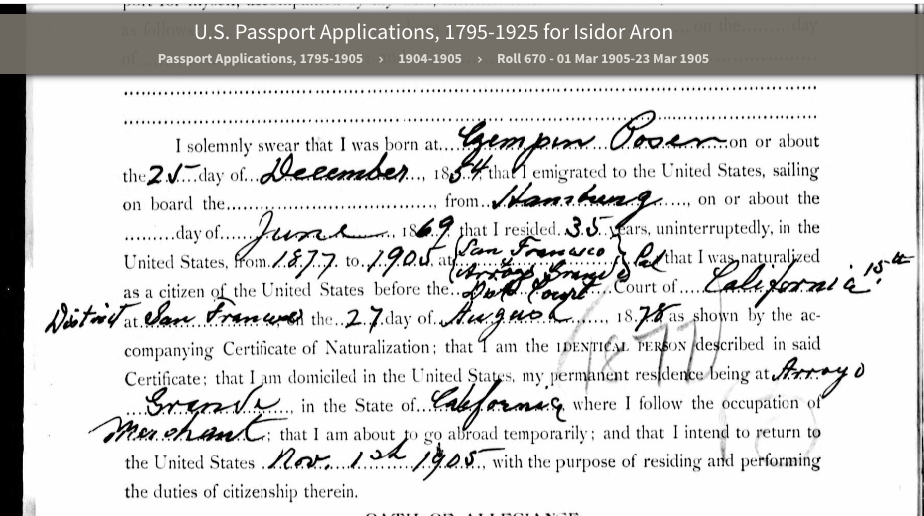
Luckily, Isidor and his cousin Siegfried were far too young for Chancellorsville. They took up clerking in San Francisco, possibly attracted by the reputation of another successful German—another German Jew—the Bavarian-born Levi Strauss.
The cousins came to Arroyo Grande as merchants in the 1880s, setting up a haberdashery and dry-goods store on the corner of Branch and Bridge Streets, on the site of today’s “Something Different” store, which was once the Bank of America.
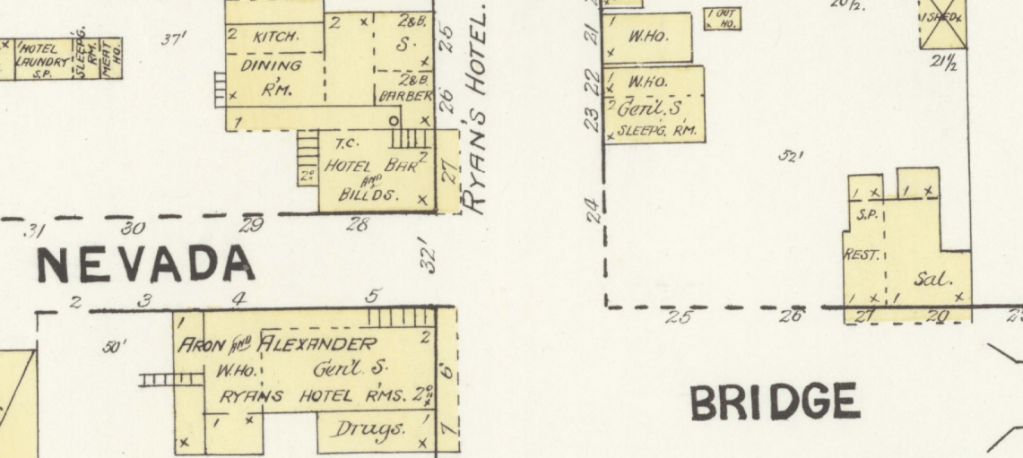
In August 1897, the cousins took out a rare display ad—they were given to more modest two-line blurbs that typified the advertising columns of small-town Victorian weeklies— in the Arroyo Grande Valley Herald-Recorder.

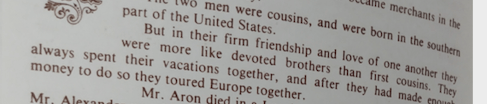
What is clear from the historical record is the popularity of Aron and Alexander—as men and fellow citizens, and not just as merchants. The venerable local historian Madge Ditmas wrote in one of her 1941 Herald-Recorder columns, just before veering off into one of her typical anti-FDR screeds, that these Germans weren’t seen as foreigners at all.
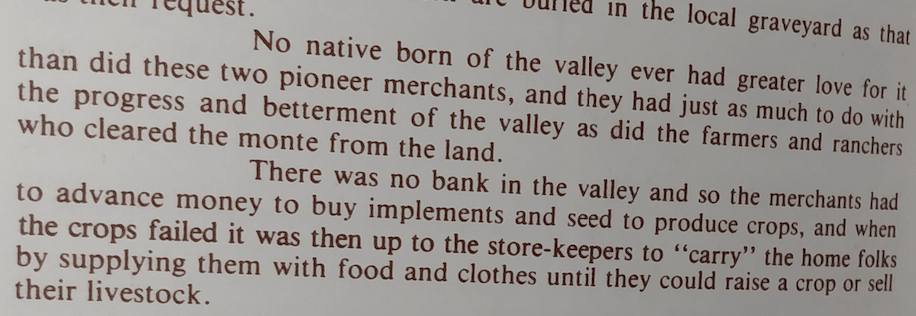
So the seemingly effortless generosity of the two—which had to have come, in reality, with tremendous effort—endeared them to Arroyo Grande.
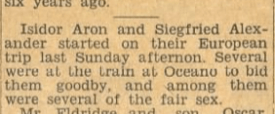
Sadly, the cousins would die far from their American home. A stroke killed Aron in 1909 Los Angeles; a heart attack ended Alexander’s life in 1922 San Francisco. But, as Ditmas notes, they loved to travel, and luckily, they managed to take what was called the Grand Tour together in 1905, four years before Aron’s death. Here’s a note from the Herald-Recorder that clearly indicates the presence of an Aron and Alexander Fan Club:
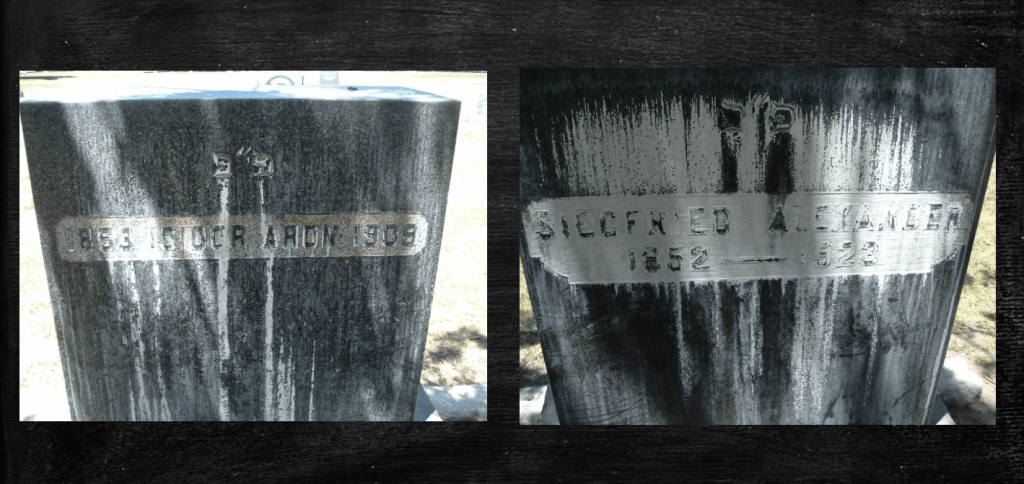
The cousins were eventually buried together. Aron is buried in Plot C8 in the Arroyo Grande District Cemetery; Alexander lies alongside, in C10. Atop their tombstones are the Hebrew letters that tell you
Here lies a son of God.
Of that, I am sure. To have made your way as a foreigner in a place as foreign as Arroyo Grande, on the continent’s edge, to have generated so much good will, speaks unwritten volumes beyond the simple profundity of their tombstones. They were certainly devoted to their business and to each other, but they were devoted—perhaps even more— to my home town. Their lives shaped ours in ways we may never fully understand or appreciate.
 A Work in Progress