
Adapted from the book World War II Arroyo Grande
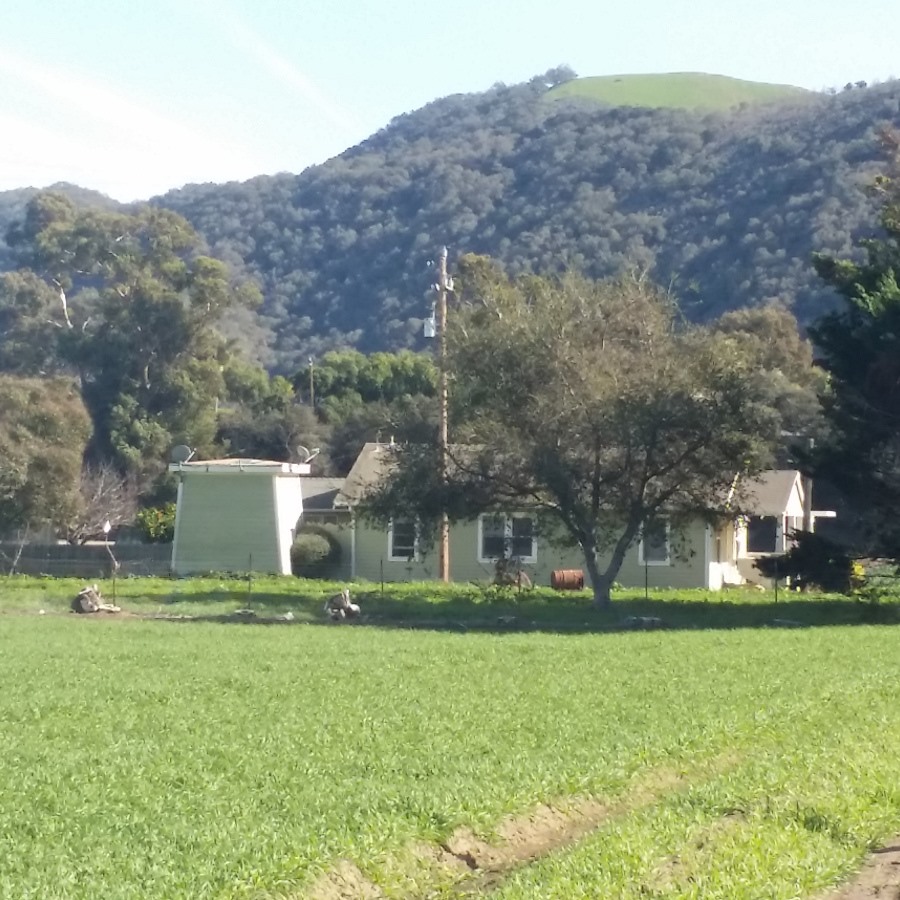
…Just east of Old Arroyo, farm fields also bordered the house where I grew up during the 1950s and 1960s. With my big brother, I walked through them on my way to school, past men cultivating crops with el cortito, the “short hoe”—backbreaking work with a tool that would be outlawed in 1974. The soil of these fields is rich and loamy, alluvial deposits that are the gift of the Arroyo Grande Creek, which flows into the Pacific Ocean seven miles from its origins in the Santa Lucia Mountains.
During my childhood, the creek was my playground. My friends and I fished for rainbow trout in little eddies and in a beaver pond adjacent to farmer Kazuo Ikeda’s cabbages. In fact, steelhead trout still swam upstream to spawn; they are now gone this far south in California. I hooked one once when I was eleven, and the shock of the big fish hitting and then fighting made me nearly drop my pole. I had never seen anything quite so beautiful and so violent—so determined to escape and to live. She did both.
It was earning a living that absorbed my father; a brilliant man with a gift for numbers, he became an accountant who was determined that his children would not suffer anything like the poverty he’d seen among his neighbors in the Ozark foothills during the Great Depression. Beyond that, he was determined that they would all get a college education. His mother, our grandmother Gregory, had been a rural schoolmarm. My education began with two severe but gifted women at the two-room Branch Elementary School, another rural school, with some seventy-odd students in grades one through eight.
Though our teachers dressed like the women in Grant Woods’s Daughters of the American Revolution, they had none of the insipid smugness of Wood’s subjects. These women were teachers because they had the calling; their lives had purpose. Each had to choreograph teaching six subjects to four grades—first through fourth in one room, fifth through eighth in the other— and so they ran a tight ship. We would learn their way, a requirement for which, many years later, I would be deeply grateful.
My first teacher, however, was my mother, and she was remarkable. Her childhood had been a hard one. She grew up poor. Her ne’er-do-well Irish father deserted the family when she was a toddler in an oil boomtown, Taft, just over the county line. When I was very little, we played school. She even rang a hand bell—it had been Grandmother Gregory’s—when “recess” was over. On my first day of formal education, I remember realizing, with a little shock of pleasure, that I could read the names of my classmates as our teacher, Mrs. Brown, wrote them on the blackboard.
One lesson appeared to my mother in the form of a Mexican fieldworker, a bracero, who one day walked into our front yard and up to her. She kept her garden shears at port arms and shoved me behind her skirts. The man signaled that he wanted to fill an empty wine gallon jug with water for himself and his friends, who were working the pepper field adjacent to our pasture. His face, with a tiny Cantínflas mustache, radiated good humor. My mother relaxed and filled the jug from her garden hose. The water was cold. I knew that because of what she said next.
“Now, help him carry it back.”
So I did. And I stayed awhile. These men worked for George Shannon, a man of immense warmth, and on later visits to their barracks at Shannon’s farm—it smelled of earth and Aqua Velva and laundry soap—I learned a little Spanish from the braceros. They spread snapshots across their bunks of wives and girlfriends and children, and they laughed when I tried out my new words in their language. That encounter would lead to my college studies’ focus, the history of Mexico and Latin America.
Year later, a Spanish professor—I am ashamed at how much of the language I’ve forgotten– at my Midwestern college took me aside after class and told me this:
“Mr. Gregory, you have a pronounced Mexican accent.”
It was one of the finest compliments I’ve ever received.
In the early summer of 1944—when Gen. Dwight Eisenhower receives his weather officer’s report for June 6 and says simply, “OK, we’ll go,” when Rome falls to Mark Clark’s armies and when horrified marines watch Japanese civilians leap to their deaths from the cliffs of Saipan—the war, for Americans at home, was both distant and, for grieving families, painfully intimate, but even the war could not touch the work to be done.
That month, in the upper Arroyo Grande Valley of coastal California, this is what you would see, possibly through the dense, cold morning fog: labor contractors drop off pickup loads of fieldworkers at the Harris Bridge, which spans the creek that nourishes and gives the valley its name.
The workers cross the bridge whistling, an incredibly beautiful, almost baroque whistling of Mexican folk tunes from the time of the revolution or love songs, as they walk down to the fields to their work with their lunches— wine jugs filled with drinking water and perhaps chorizo-and-egg burritos wrapped in wax paper, fuel for the kind of physical work that would make most men sit in the freshly turned field gasping within fifteen minutes and woefully regarding their quickly blistered hands.
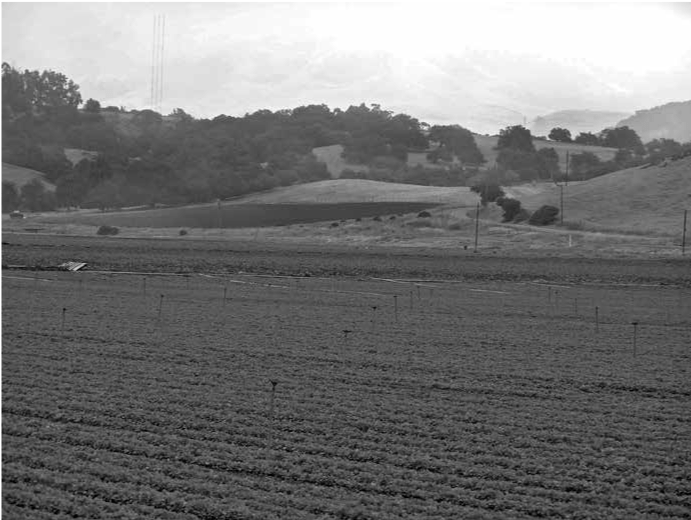
Their summer work might be in a new bean field, where the whistling would eventually stop because it is such a tax on men who work hard, whose breathing soon becomes laborious and therefore precious. To begin a newly planted field of beans, the fieldworkers have to drive wooden stakes into precise parade-ground lines along the furrows, so that the bean vines can use the stakes to climb and twist—they will eventually bear delicate, bell-shaped flowers that stretch toward the sun. The sun invariably appears in late morning, when it burns the sea fog away, and the colors of the valley— wheaten hills and verdant bottomland where the crop is in—are reborn, vivid and sharply focused.
To drive the wooden stakes, the fieldworkers use a heavy metal tube, a driver, with a handle attached that resembles that of an old-time pump primer that nineteenth-century settlers used to draw water from the ground. So the whistling stops and is replaced by the rhythmic ring of the stake drivers as the workers pound hundreds of stakes into the field.
It is a musical sound. But of course, what you cannot hear are the grunts of the men at each stroke of the stake driver; what you cannot feel is the enormous weight that exhausted arms and shoulders soon take on; and what you cannot avoid, if you think about it sensibly, is admiration for the men who feed you.
Since World War II, agriculture here has changed—pole beans and the seemingly limitless groves of walnut trees that once competed with row crops are gone, the latter victims of a malevolent infestation of insect larvae. Today, farmers grow more exotic crops, like bok choy and kale, and along the hillsides given over to beef cattle as far back as the beginning of the nineteenth century, there are new farmers and new rows of wine grapes, profitable, lovely and greedy for water—a commodity that isn’t plentiful in California—multiplying every year. The beef cattle haven’t dominated the coastal hills since the 1860s, when the drought that periodically afflicts the state hit as hard as it ever has. The cattle, either killed outright by ravenous coyotes or mountain lions come down from distant folds in the hills or dead of thirst and hunger, would have covered the hills with their bones.
It was that kind of drought that may have brought a fieldworker, whose family had lived for generations in New Mexico, to these coastal valleys in 1940. Much of his native state in the years before had been swept away by the Dust Bowl. Winds had carried the copper-red soil as far east as the Mid- Atlantic to drop it, like gritty rain from a place that had none, onto ships still sailing freely between continents.
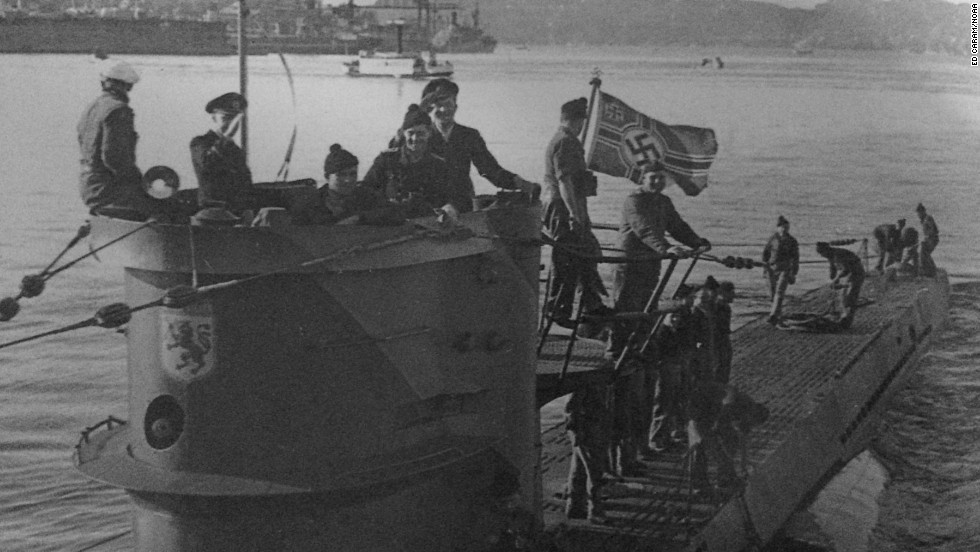
Those ships would lose their freedom in the years immediately after, and the coyotes that hunted them without fear were U-boats come out of their lairs in Kiel and later in Lorient. U-boat captains called this the “Happy Time.” The U-boats would someday kill that young fieldworker, if indirectly, as part of an inexorable chain of events that would lead him to Normandy, so far away from the fields that border Arroyo Grande Creek, and to pastures bound by hedges and grazed by fat dairy cows, cows that lowed piteously to be milked in what had become killing zones. One of them, dead in the crossfire, may have provided scant cover from the German machine guns that harvested crops of young men for fieldworker, now rifleman, Private Domingo Martinez.

 A Work in Progress