
• About
  • The Germans

A Work in Progress

A Work in Progress

Monthly Archives: December 2020

Talent

11 Friday Dec 2020

Posted by ag1970 in Arroyo Grande, Uncategorized

≈ Leave a comment


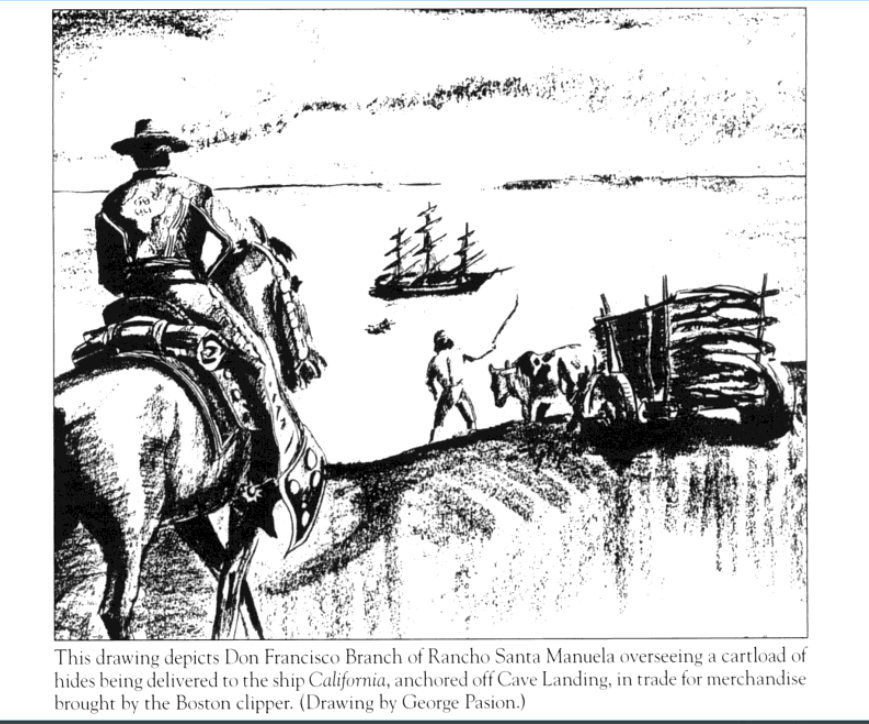
This drawing appears in Jean Hubbard and Gary Hoving’s outstanding book, from Arcadia Publishing, about Arroyo Grande’s history.

It moves me every time I see it. This is why.

The artist was my best friend in first grade at the two-room Branch School. George’s original hangs on a wall of the South County Historical Society’s research library, so every time I go inside I feel an instant of intense pain. George Pasion died two years ago.

George introduced me to empathy. He wore heavy leg braces—the film Forrest Gump replicated them— and running, for him, was awkward and painful. I remember distinctly one day when he could not keep up with the rest of us boys, and his eyes filled with tears. He was frustrated and enraged.

That moment broke my six-year-old heart, which is as good a way as any to begin a friendship.

George’s heart carried immense weight that belied the weakness of his legs. He was strong in ways we couldn’t understand. He was intensely focused but sometimes far, far away; his art, at which we always marveled, took him to places we couldn’t begin to imagine. This piece indicates he found the ability to time-travel while the rest of us were stuck in the Cold War and Mouseketeers.

There was immense wisdom in George, even then, when he was just a second-grade boy.

It was, of course, a wisdom he must’ve inherited from his parents. His father was Filipino, a member of the manong—Elder Brother—generation, bachelor men who came to Arroyo Grande to help support their parents back home. They fought, like tigers, in World War II and, at war’s end, they brought war brides home from the Islands, thanks to newfound liberality on the part of the federal government. Before the war, almost no Filipinas were allowed to immigrate; in California, male immigrants outnumbered them a hundred to one.

This was thanks to some of the most virulent racism, including in Arroyo Grande, that I’ve ever encountered in my research.

So it was World War II, and the families that soldiers started, that made my friend from sixty-two years ago possible. I last saw him fifty years ago. In learning of his passing, and in seeing this drawing, I’m reminded of the Whitman line.

Time avails not, the old fellow wrote in one of my favorite poems, “Crossing Brooklyn Ferry.” Time, according to the poet, doesn’t matter. There are some moments, when we keep them, that can never escape us. And there are some people, like the audacious poet, the old silky-bearded rascal, who inserts himself into his poem, who are looking at us fondly just beyond the reach of our vision.

And so George remains as vivid a presence in my life today as he was in that moment, in 1958, when I saw his eyes fill with tears. That was the moment that made him my first best friend.

Teaching history through film

06 Sunday Dec 2020

Posted by ag1970 in Uncategorized

≈ Leave a comment

From Swing Kids

Forgive me, but I once got the chance, thanks to an immensely talented student, to design a course on Film History for the high school where I taught Advanced Placement European History. I’ve never worked quite so hard on a project and never loved working that hard quite so much.

The course was approved and adopted by the panel that resembles, I suppose, the faculty at Hogwarts, by which I mean UC Berkeley, but it was a great sadness that there was no room in my schedule to teach it. Film history is a passion of mine.

But when I taught my students AP European History. I would sometimes use film excerpts to make a point that was beyond me to teach. There is no shame in that. Even if the film--Amadeus is an example—wasn’t 100% historically accurate, if it gave them a sense of the times we were learning—an emotional connection–then that was enough and more than enough.

I was reminiscing about  a few of their favorites. And mine.

Dali’s cameo in Midnight in Paris. This is when they “caught” my love for the Lost Generation.

In Amadeus, the “improvement” on Salieri’s march. I adore this scene because someday nearly all my students would meet someone far more gifted than they thought they were. Thanks to them, I’d already made acquaintance with people far more gifted than I thought I was.


2003’s Luther relieves us of the idea that he was so constantly dour. He was a brilliant teacher.


The absurdity of the Cold War was something students instantly grasped, thanks to Dr. Strangelove:

Where did nationalism come from? Shakespeare put these words into Henry V’s mouth at Agincourt, but they explain the idea exactly:


The horror of World War I? Australia’s Gallipoli remains one of the finest war/anti-war films ever made. Peter Weir, director. Here’s, Mel Gibson’s runner is trying to stop a costly Australian attack against the Turks.


And this battle scene from Weir’s Master and Commander teaches us that Napoleonic warfare could be just just as terrible:


What kind of leader was Elizabeth I? The Tilbury speech—an this is verbatim, not the work of screenwriters—is from the mini-series The Virgin Queen. This is extraordinary political leadership. We could use an Elizabeth.


For a sense of what it was like young in a fascist dictatorship, this thrilling dance sequence—just before the police raid—from Swing Kids:


And belonging to fascism was never better captured—until perhaps Jojo Rabbit– than in this scene form Bob Fosse’s Cabaret:


How terrifying was Stalin? The Boss loved movies, so this film is about his movie projectionist. From The Inner Circle.


How terrifying was Henry VIII? I guess no powerful man’s temper tantrums can be shrugged off. This one couldn’t. From the classic A Man for All Seasons.

And, as to royalty, there can’t be a better way to demonstrate the disconnect between the Bourbons and their people than in this scene–thanks to music by Bow Wow Wow–from Marie Antoinette.


What scenes like these—-and there are many more—teach both teachers and students is that history isn’t the province of textbooks reduced to chaff by center-right selection committees. It’s about the people we recognize, if only for an instant, in a few feet of film. This is the medium, after all, that so often gives us the chance to recognize ourselves, even if the selves we see shock us suddenly with shame. Film can lead us, too, toward the people would like to be. That’s when the learning comes, in that moment of recognition when we see ourselves, when we become actors in the past that belongs to all of us.

Subscribe

  • Entries (RSS)
  • Comments (RSS)

Archives

  • January 2026
  • December 2025
  • November 2025
  • October 2025
  • September 2025
  • August 2025
  • July 2025
  • June 2025
  • May 2025
  • April 2025
  • March 2025
  • February 2025
  • January 2025
  • December 2024
  • November 2024
  • October 2024
  • September 2024
  • August 2024
  • July 2024
  • June 2024
  • May 2024
  • April 2024
  • March 2024
  • February 2024
  • January 2024
  • December 2023
  • November 2023
  • October 2023
  • September 2023
  • August 2023
  • July 2023
  • June 2023
  • May 2023
  • April 2023
  • March 2023
  • February 2023
  • January 2023
  • December 2022
  • November 2022
  • October 2022
  • September 2022
  • August 2022
  • May 2022
  • April 2022
  • March 2022
  • February 2022
  • January 2022
  • December 2021
  • November 2021
  • October 2021
  • September 2021
  • August 2021
  • July 2021
  • June 2021
  • April 2021
  • March 2021
  • February 2021
  • January 2021
  • December 2020
  • November 2020
  • August 2020
  • July 2020
  • June 2020
  • May 2020
  • April 2020
  • January 2020
  • December 2019
  • November 2019
  • October 2019
  • September 2019
  • August 2019
  • May 2019
  • April 2019
  • March 2019
  • February 2019
  • January 2019
  • December 2018
  • November 2018
  • October 2018
  • September 2018
  • July 2018
  • June 2018
  • May 2018
  • April 2018
  • March 2018
  • February 2018
  • January 2018
  • December 2017
  • November 2017
  • October 2017
  • April 2017
  • March 2017
  • December 2016
  • November 2016
  • October 2016
  • September 2016
  • August 2016
  • July 2016
  • June 2016
  • April 2016
  • March 2016
  • February 2016
  • January 2016
  • December 2015
  • November 2015
  • October 2015
  • September 2015
  • August 2015
  • July 2015
  • June 2015
  • May 2015
  • April 2015
  • March 2015
  • February 2015
  • January 2015
  • December 2014
  • November 2014
  • September 2014
  • August 2014
  • July 2014

Categories

  • American History
  • Arroyo Grande
  • California history
  • Family history
  • Film and Popular Culture
  • History
  • News
  • Personal memoirs
  • Teaching
  • The Great Depression
  • trump
  • Uncategorized
  • World War II
  • Writing

Meta

  • Create account
  • Log in

Blog at WordPress.com.

  • Subscribe Subscribed
    • A Work in Progress
    • Join 68 other subscribers
    • Already have a WordPress.com account? Log in now.
    • A Work in Progress
    • Subscribe Subscribed
    • Sign up
    • Log in
    • Report this content
    • View site in Reader
    • Manage subscriptions
    • Collapse this bar
 

Loading Comments...