
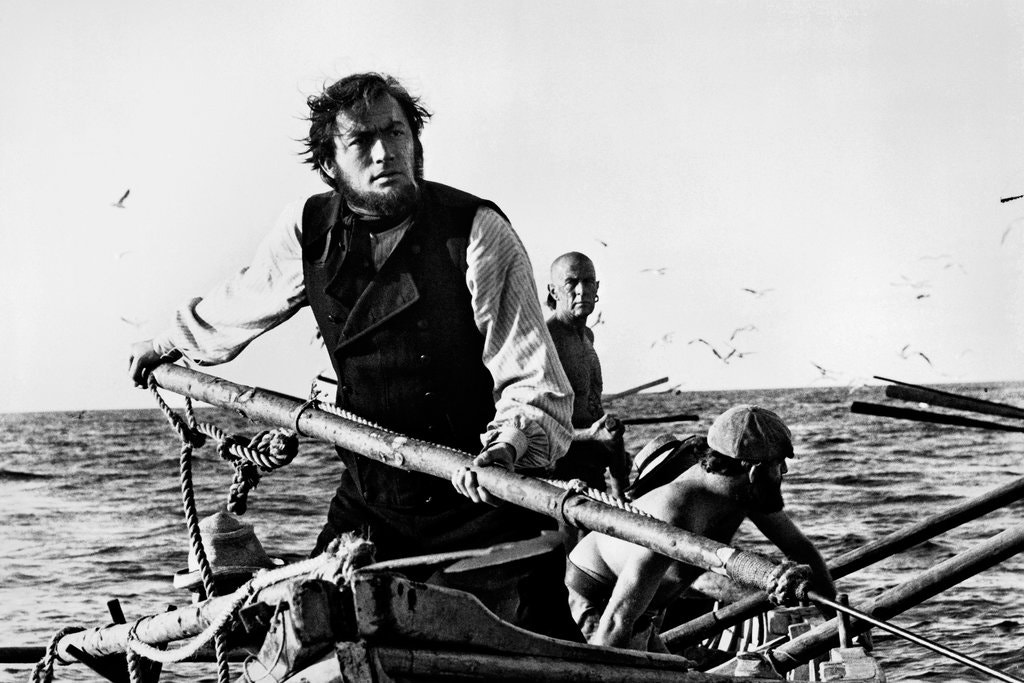
I finally got my appointment for my first Covid shot, which, of course, given the size of the needles I’ve seen on television, reminded me of Ahab and Melville’s Moby-Dick.
This was a novel I read in its entirety when I was a sophomore at Arroyo Grande High School. Two factors drove me to do this: 1) I had mono, was out of school for ten days, and the status of daytime television in 1968 was odious. You only had Herman Melville to fall back on, and he was one of our Assigned Novels. 2) While I read, our West Highland White Terrier, Winnie, napped under the comforter at my feet. Having a Westie as your best reading buddy was a marvelous experience.
And, as it turned out, so was the novel. I learned everything about cetaceans except their bowel movements, which I prefer to ignore, and Ahab was one of the most delicious fictional characters, in terms of self-destructive leadership and excepting our 45th President, whom I’ve ever encountered. (An aside: Patrick Stewart’s Ahab is fine, but Gregory Peck’s remains the standard.)
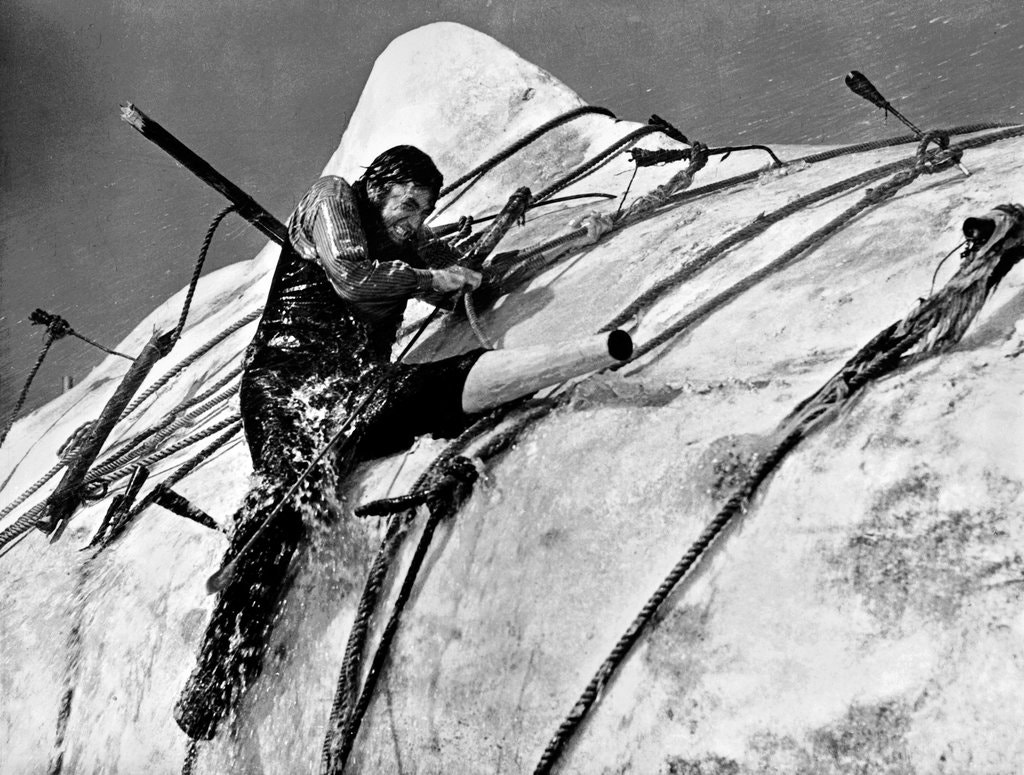
Here is what happened because I had Mono and Winnie: I discovered a latent New England fetish. Never mind Robert Frost, whom I’d loved since I was a little boy. Years and years later, when I taught American Lit at Mission Prep, I discovered, after two years of struggling with the material, how much fun teaching Hawthorne’s Scarlet Letter was. Hawthorne’s gift was never in writing, which quickly became apparent to my students; it was instead in human psychology. So I became, the third time around, a member of the Hester Prynne Marching and Chowder Society, a devotee of the short story “The Minister’s Black Veil”—Puritan guilt isn’t that far removed from my ancestral Irish guilt—and even began to like, from a distance, the frequently-infuriating Melville short story “Bartleby the Scrivener.”
All of this, of course, came a whole unit before I got to teach New Englander Emily Dickinson, whom I never much wanted to leave behind, and her Brooklyn contemporary Walt Whitman, for the more dubious pleasures of Hamlin Garland or even Huckleberry Finn. There’s not much more fun to be found in teaching American Lit than to teach these two side-by-side and to marvel at the contrast—Whitman’s obnoxious but endearingly jubilant expansiveness, Dickinson’s eccentrically-hyphenated economy—and to try to teach your students the one quality they shared, which was their audacity.
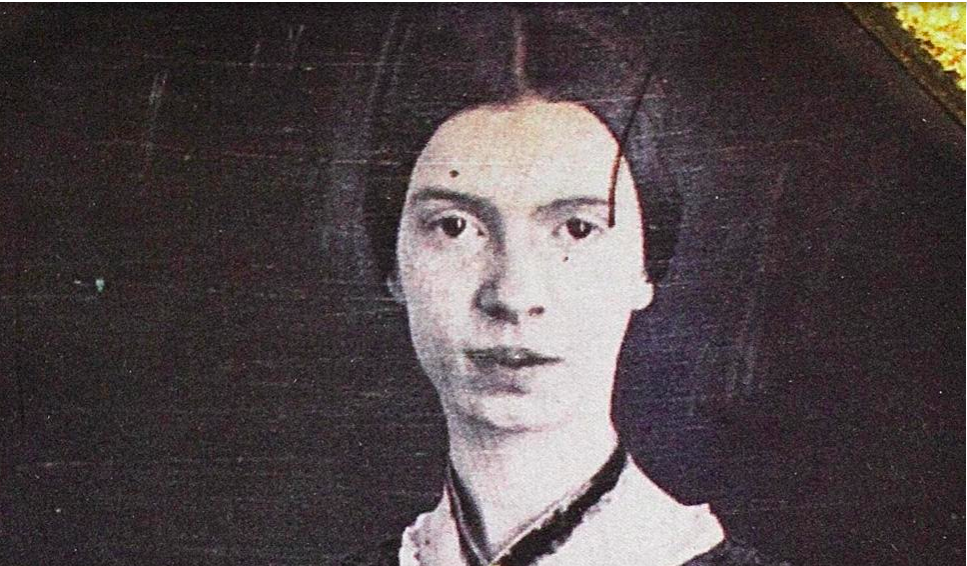
But Emily never held a harpoon in her hand. Melville did, and, given my impending vaccination, I was reminded, too, of nonfiction, which I read much more nowadays. Nathaniel Philbrick is one of our finest nautical writers, and his book In the Heart of the Sea is a marvelous re-telling of the actual event on which Melville based Moby-Dick.
In 1820, the Nantucket whaler Essex had her hull crushed by an enraged bull whale in the South Pacific. Essex was engaged in the work of whalers, harvesting calves and cows and young bulls in the important business of lighting American homes and around-the-clock New England textile mills, where thirteen-year-old girls at their power looms were frequently beaten.
Whale oil smelled sweet, but the whaling ships were brutal, too, with their crews at the mercy of a ship’s master who might prove as merciless, as prone to a “starter”—a short knotted rope— as a Mississippi Delta overseer was to his whip. A whaler’s voyage frequently took three years or more, and from them we derived a feature of late Georgian and early Victorian American architecture, the “Widow’s Walk.” From their heights, women whose hearts would break as surely as Emily Dickinson’s did could watch for ships that would never return. Even for husbands who did return, Philbrick writes of polished whalebone dildos–they were called “he’s at homes”—that served as transitory relief for young wives condemned to the celibacy that whaling imposed on their lives.

Essex didn’t return, of course. These marvelous stills from the film version, directed by Ron Howard, of In the Heart of the Sea suggests why. The things that men make don’t stand a chance against the whales that God makes:
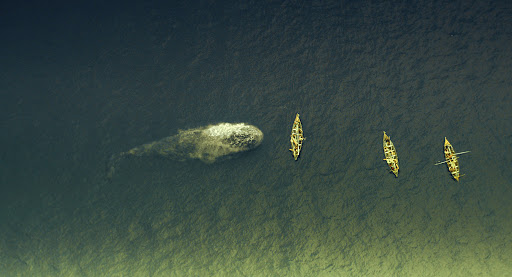
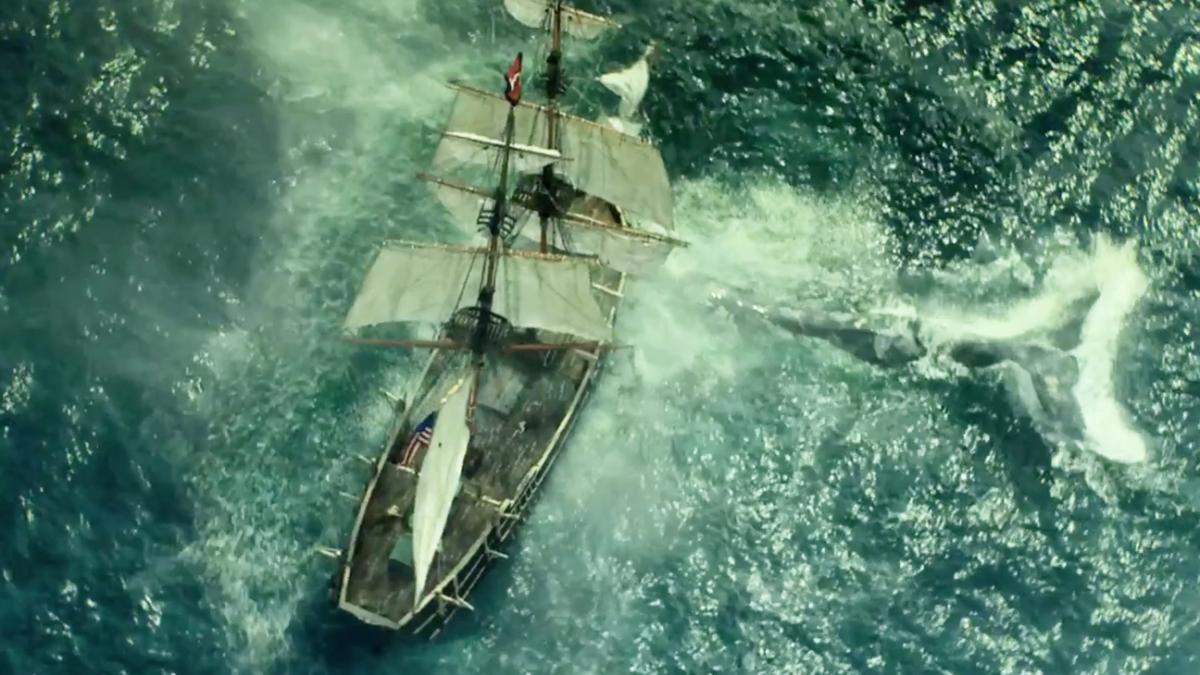
One of the ironies of Essex’s wreck is that the crew, in three tiny whaleboats, made for the shore of Chile, 3,000 miles away. The Hawaiian, or Sandwich, Islands were much closer, but the Americans heard that the natives there were cannibals. On the day Essex left Nantucket, a Boston newspaper might’ve hit the docks, bundled in twine, and one of its articles remarked on the kindness of the people who lived in the Sandwich Islands.
Of course, during the ninety days that it took Essex’s crew—what was left of it—to get themselves rescued, they had to eat each other to survive.
Hence the value of local journalism, something rapidly disappearing in 21st century America.
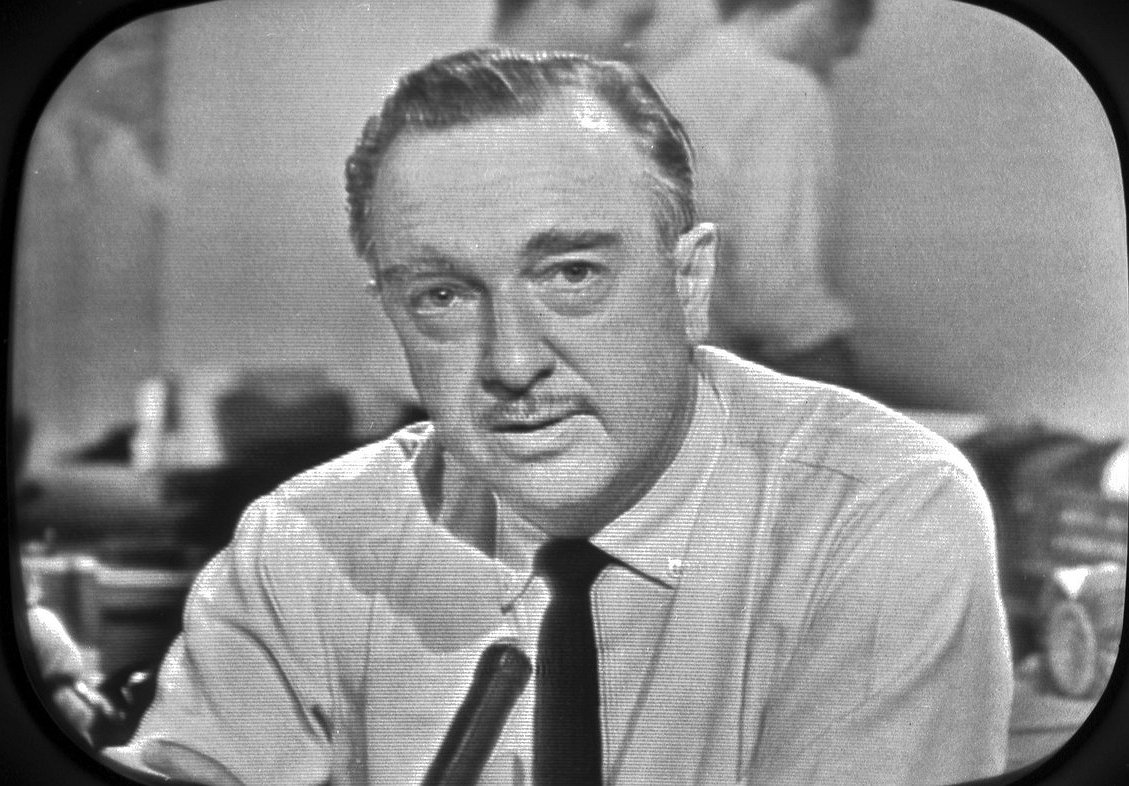
I was a journalist. I was frequently complimented for my accuracy, which made me immensely uncomfortable. That meant I was telling a story that someone wanted to hear. That’s not the same as reporting objective reality, or its closest approximation, which is the best that any reporter an hope to do. The reporters I knew and worked with were young men and women of immense integrity. They agonized, as I did, over misstated facts or misquoted quotes. A misspelled name would keep me awake for two nights running.
Years and years after, Murdochian journalism appeared—with its antecedents in the 1860 Charleston Mercury, in Hearst’s Journal, in Father Coughlin’s broadcasts from the National Shrine of the Little Flower–but this was seven nights running, loud and shrill and strikingly blond, skilled in telling stories that Americans wanted to hear, skilled in the kind of seduction that Ahab used to lure Pequod’s crew to its doom.
The Americans who tuned in, in their Nielsen millions, lacked my father’s editorial snort.
Now it’s come to this: We are in the same sea that Essex sailed in 1820. Our hull has been stove in and we are taking on water. We call out to each other across the sea that separates us in our isolated whaleboats, but the loudest voices, the ones that carry above the wavetops and against the current, belong to men and women fully as mad as Pequod’s Ahab was. In the aftershock of January 6, we watch our ship in her agony, but we remain shocked and silent, listening to boat-captains urging us to steer east, toward a landing we will never make.
As meek as they might seem—and all of these truly are–wearing a mask, displaying the flag on Inauguration Day, questioning the wisdom, given Exodus, of the golden statue of Donald Trump at CPAC and even getting a vaccination are all now politically fraught. I hate shots, so I will get my shot. It’s my only oar in the water, but even a gentle pull might help us come home again.
Call me Ishmael.
 A Work in Progress