
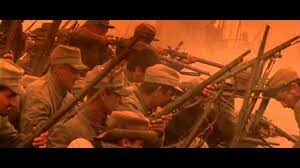
In the summer of 1864, Lee had his men dig a network of trenches around the Petersburg, the city that guarded Richmond. Among the soldier opposing Lee was Corporal Adam Bair, 60th Ohio Infantry, who would settle in the Huasna Valley in the years after the war. From Patriot Graves: Discovering A California Town’s Civil War Heritage.
…Meanwhile, Grant had ordered his men to dig their own trenches. So what followed for Bair and his comrades was nine months of trench warfare, of the scuttling of rats, of infestations of lice called “graybacks,” of mud, which permeated even what soldiers ate, of disease caused by vermin and foul water, of intermittent and lethal sniper fire that claimed any tired solider who lapsed into even a moment of inattention, of intense discomfort felt by soldiers who could never get completely dry in the winter and who baked in the heat and choked in the dust of summer, and all of this amid the treeless moonscape they’d created from constant digging and constant heavy artillery bombardment—all a foretelling of the horrors of the First World War.
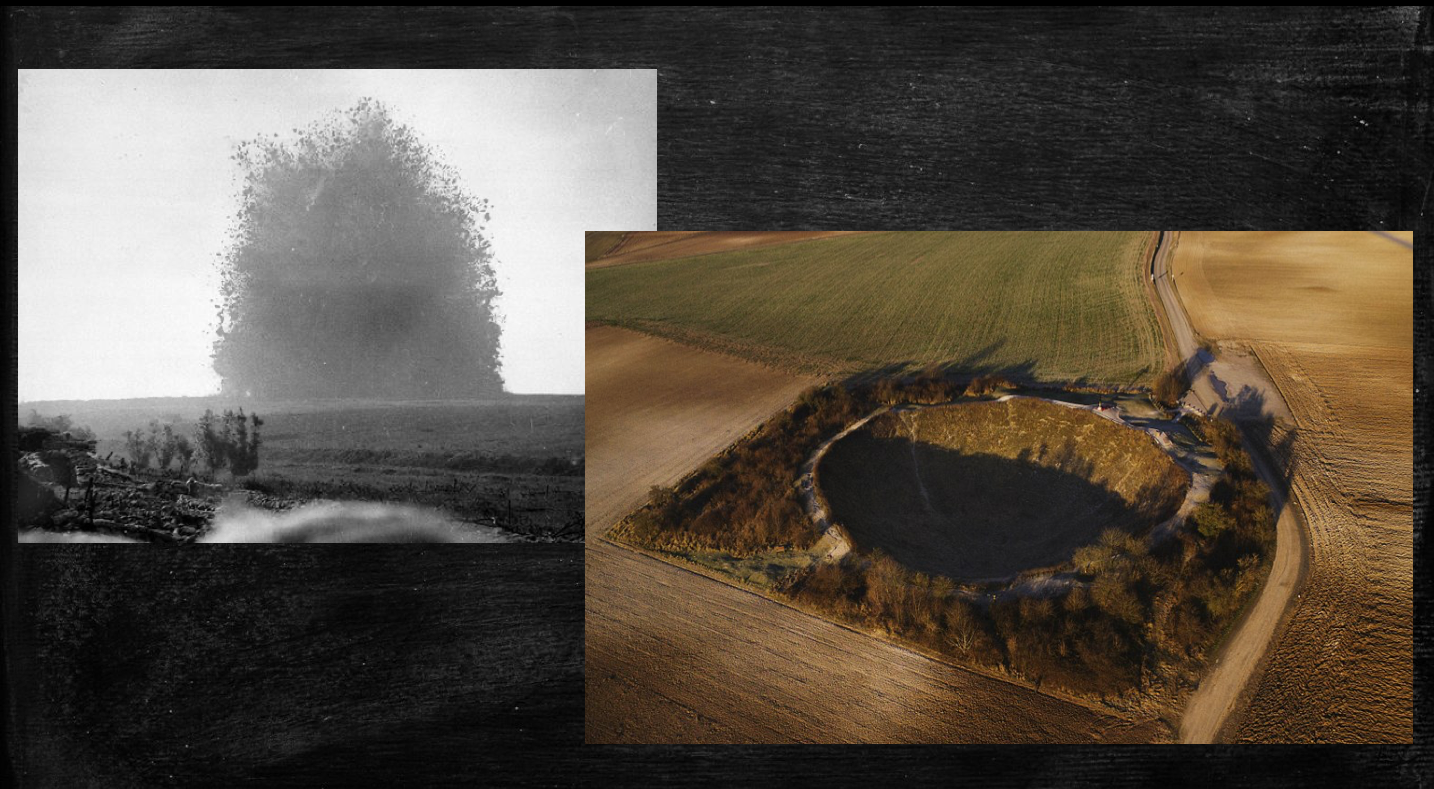
That war’s catastrophic 1916 Battle of the Somme would begin with the detonation of a massive mine under German lines—the crater it created remains today, looking like a massive sinkhole amid a patchwork of farm fields. A mine explosion also would mark a surrealistic and shocking moment in the trenches of Petersburg. The crater that explosion left behind was, of course, The Crater, and Adam Bair and the 60th Ohio were eyewitnesses to the tragedy that followed.
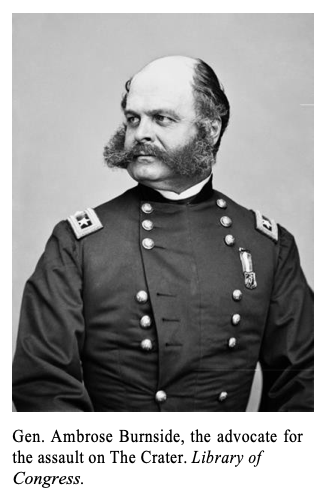
Unlike the debacle at Cold Harbor, the assault on Confederate lines in the Battle of the Crater had logic, foresight, and planning. It was the execution of the plan that verged on criminality, and it would finally cost the genial, consistently incompetent Ambrose Burnside, Bair’s IX Corps commander, his job.
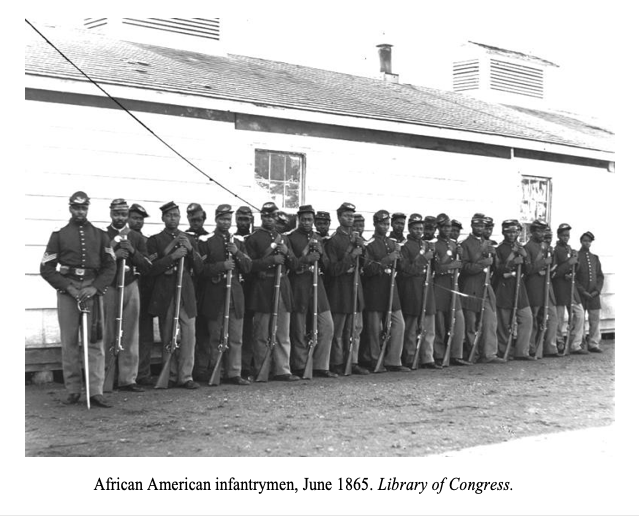
In July, Union soldiers who had been peacetime coal miners began digging a tunnel over 500 feet long to a point underneath trenchworks held by soldiers from South Carolina. Meanwhile, Burnside decided to use inexperienced troops, but troops that were highly motivated and would be specially trained to move through the tunnel and into the Confederate trenches, once four tons of powder were detonated beneath the South Carolinians. The troops that began training for the assault were African Americans—the nine regiments of U.S. Colored Troops that made up Burnside’s Fourth Division. These were men who understood completely what would happen to them in battle—there would be no quarter for black troops, a precedent that had already been set at Fort Pillow in April, when Nathan Bedford Forrest’s cavalry had attacked and overwhelmed a detachment of black troops in Tennessee and murdered soldiers trying to surrender. The Fourth Division chose “Fort Pillow!” as its battle cry for the day they would go into the coal miners’ tunnel and emerge on the other side. In a letter to his mother two days after the Battle of the Crater, a Union soldier wrote admiringly of the black troops: “they would charge into the city [Petersburg] if the order had been given…They don’t know when to stop.”
The orders seemed clear-cut:
At 3.30 in the morning of the 30th Major-General Burnside will spring his mine and his assaulting columns will immediately move rapidly upon the breach, seize the crest in the rear, and effect a lodgment there. He will be followed by Major-General Ord, who will support him on the right, directing his movement to the crest indicated, and by Major-General Warren, who will support him on the left. Upon the explosion of the mine the artillery of all kinds in battery will open upon those points of the enemy’s works whose fire covers the ground over which our columns must move, care being taken to avoid impeding the progress of our troops. Special instructions respecting the direction of fire will be issued through the chief of artillery.
The detonation of the mine was spectacular. Adam Bair and the 60th Ohio, held in reserve to the left of the planned assault, would have watched in awe when the explosion went off at 5 a.m. on July 30, 1864, and scores of unfortunate South Carolinians were vaporized or blown high into the sky. Eighty-five Union artillery pieces then opened fire on the Confederate lines. It was at that moment that the Union troops charged into the tunnel to follow the shock of the explosion with the shock of a concentrated infantry assault.
The problem for Grant is that they were the wrong troops. George Gordon Meade, Grant’s subordinate and commander of the Army of the Potomac— a command he held uneasily, sharing his ill-defined role with the general-in- chief—at the last moment changed Burnside’s plans. Meade didn’t trust Black troops—unlike the soldier who’d written his mother, Gen. Meade didn’t understand, or didn’t care to understand, their motivation and discipline, and he ordered Burnside to replace them. The assault would be led by White troops.
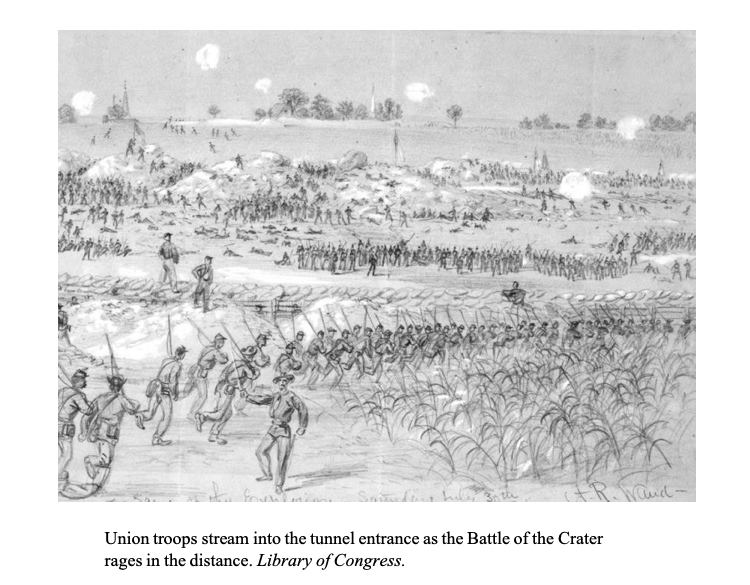
Burnside became petulant and had his divisional commanders draw straws for the dubious privilege of leading the attack. The winner was Brig. Gen. James H. Ledlie, who was both safe and drunk in his bombproof shelter when his men entered the tunnel. Once they emerged in the crater, they stayed. The black troops had been trained to skirt around the edges of the not to go into it, where they would Subsequent attackers, including the black soldiers, ran into what essentially was a human traffic jam inside the tunnel and in the crater on the other side. The Confederates brought up and began firing into the masses of soldiers below. When they closed with the U.S. Colored regiments, they showed no mercy: wounded soldiers were bayoneted, and soldiers trying to surrender—or soldiers who had surrendered, and were being led to the rear— were shot. A Virginia officer watched, sickened, as two soldiers tormented their Black prisoner, whipping him with a ramrod, shooting him in the hip, and finally killing him with a second shot to the stomach.
Over 400 African American soldiers would be killed and 750 wounded in the four hours of fighting after the mine’s detonation. Generals Burnside and Ledlie were relieved of command and sent home. Other soldiers, like Adam Bair, were condemned to seven more months in the trenches around Petersburg.
 A Work in Progress