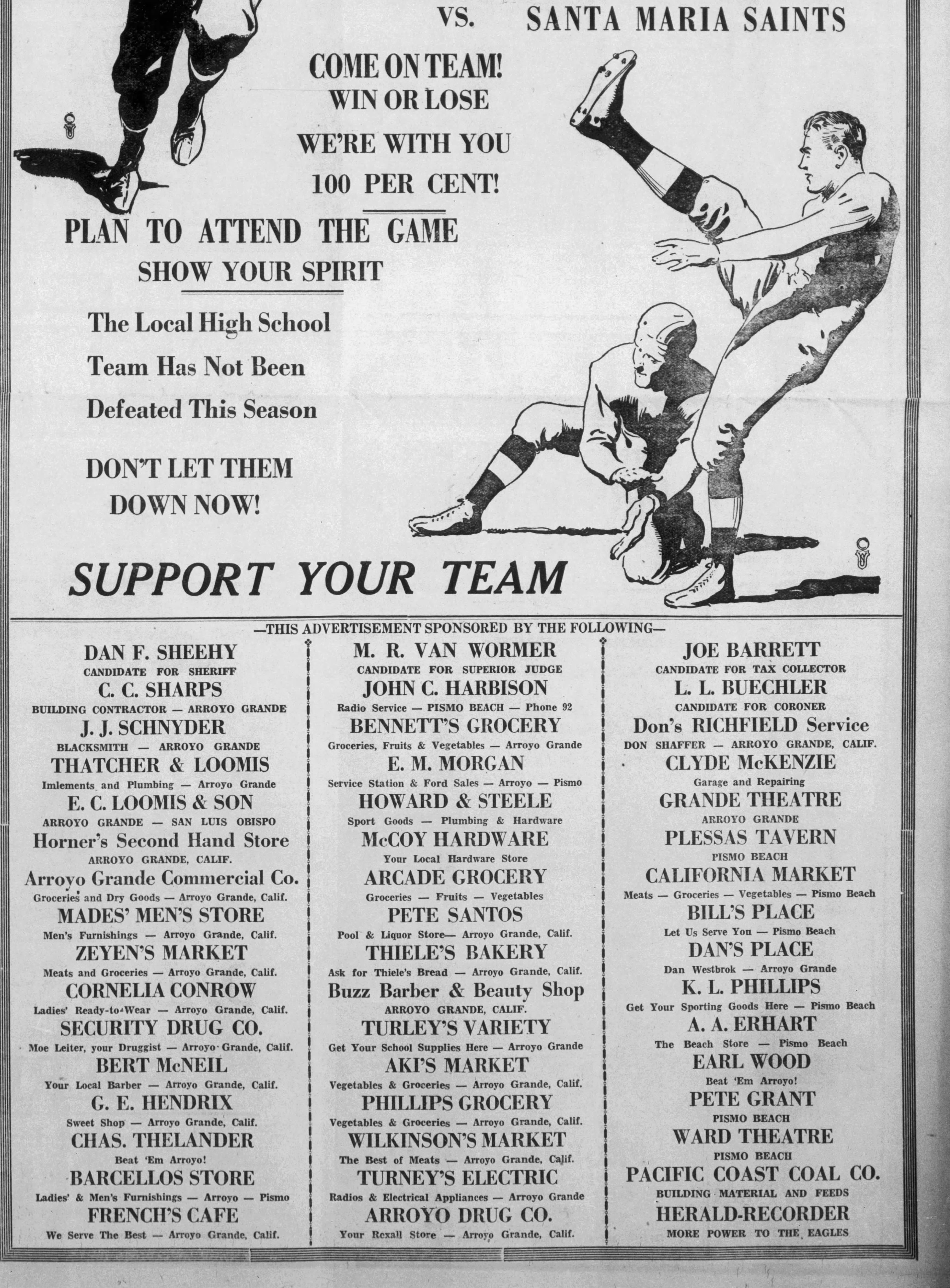
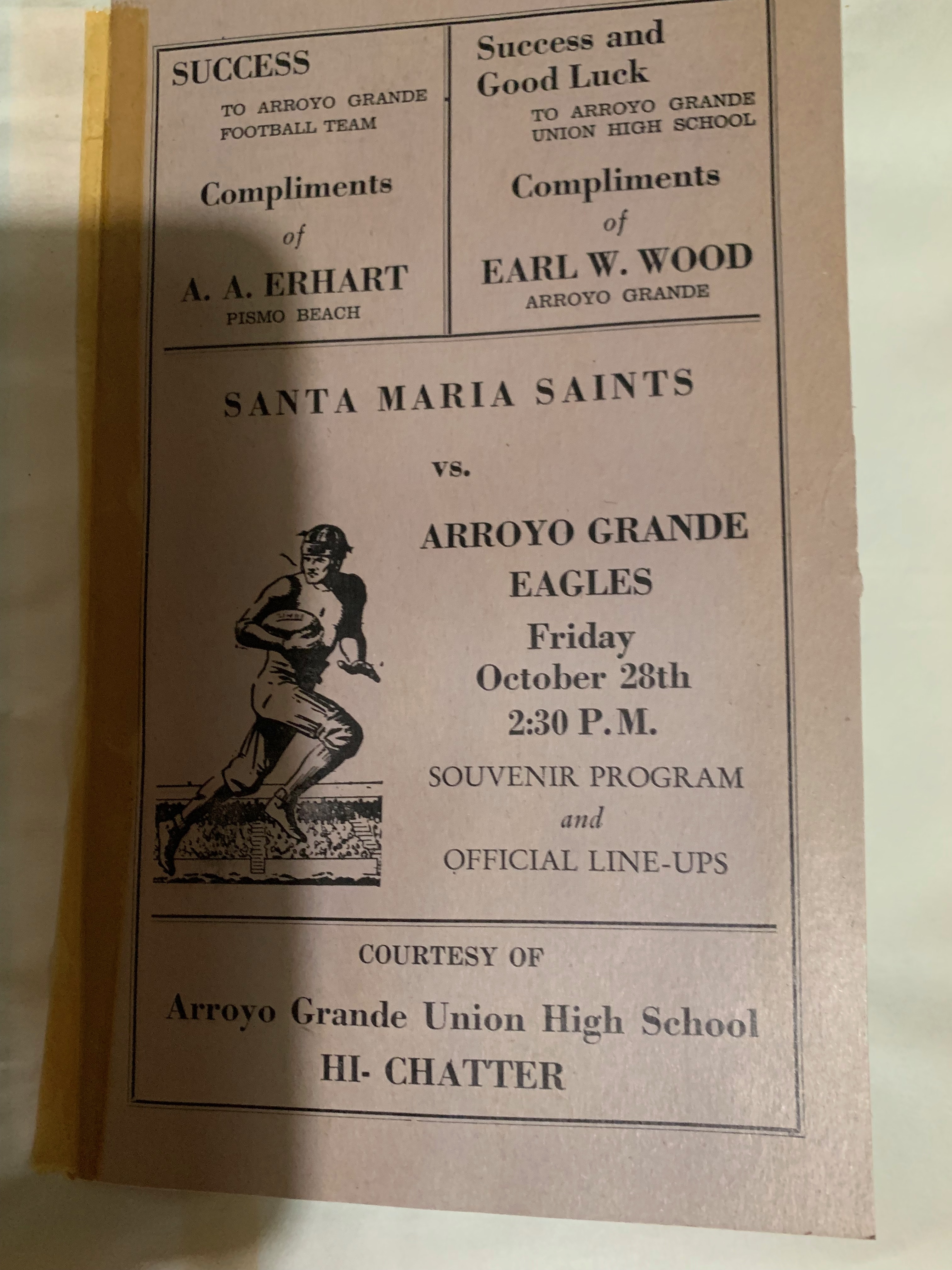
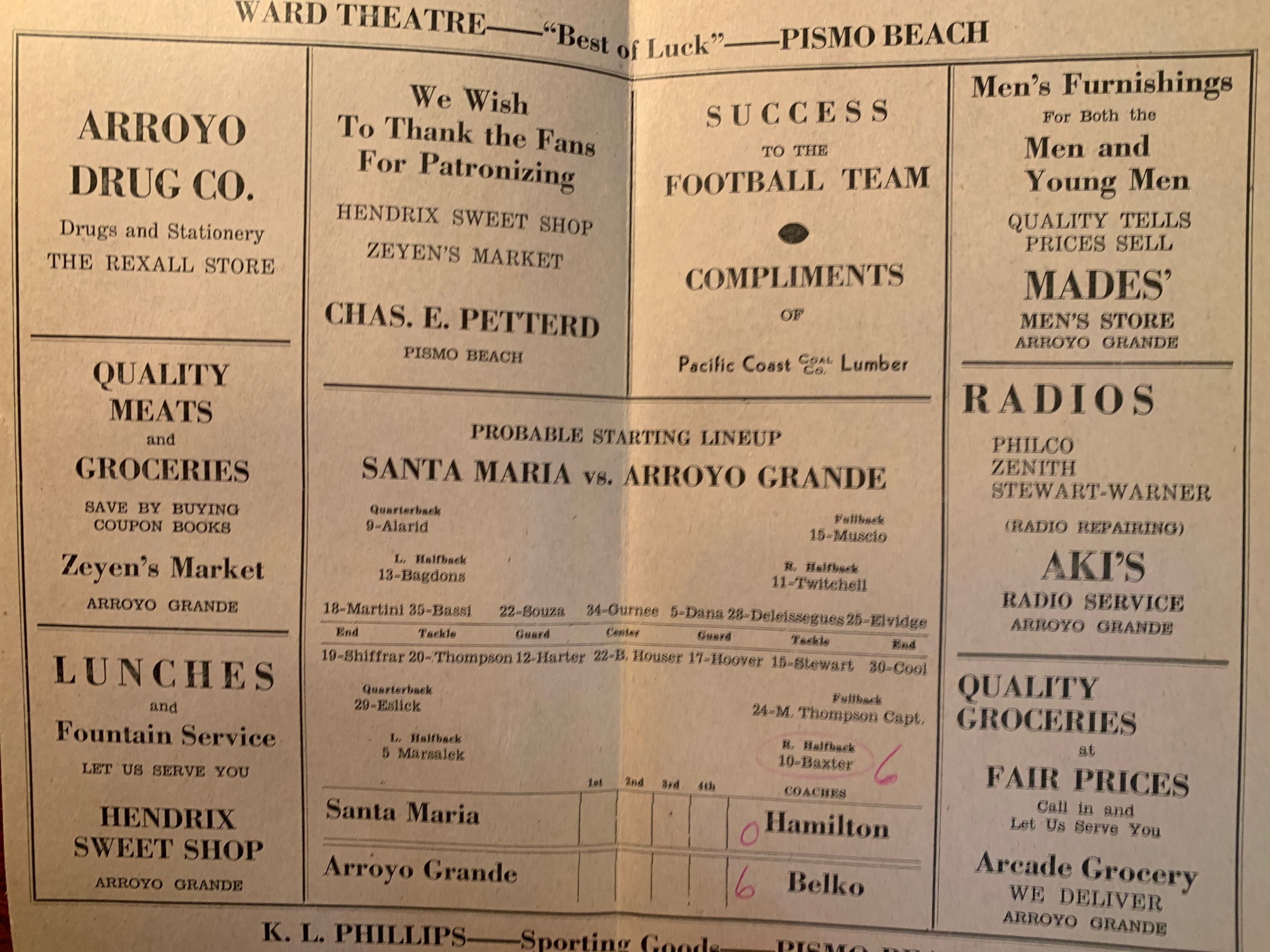
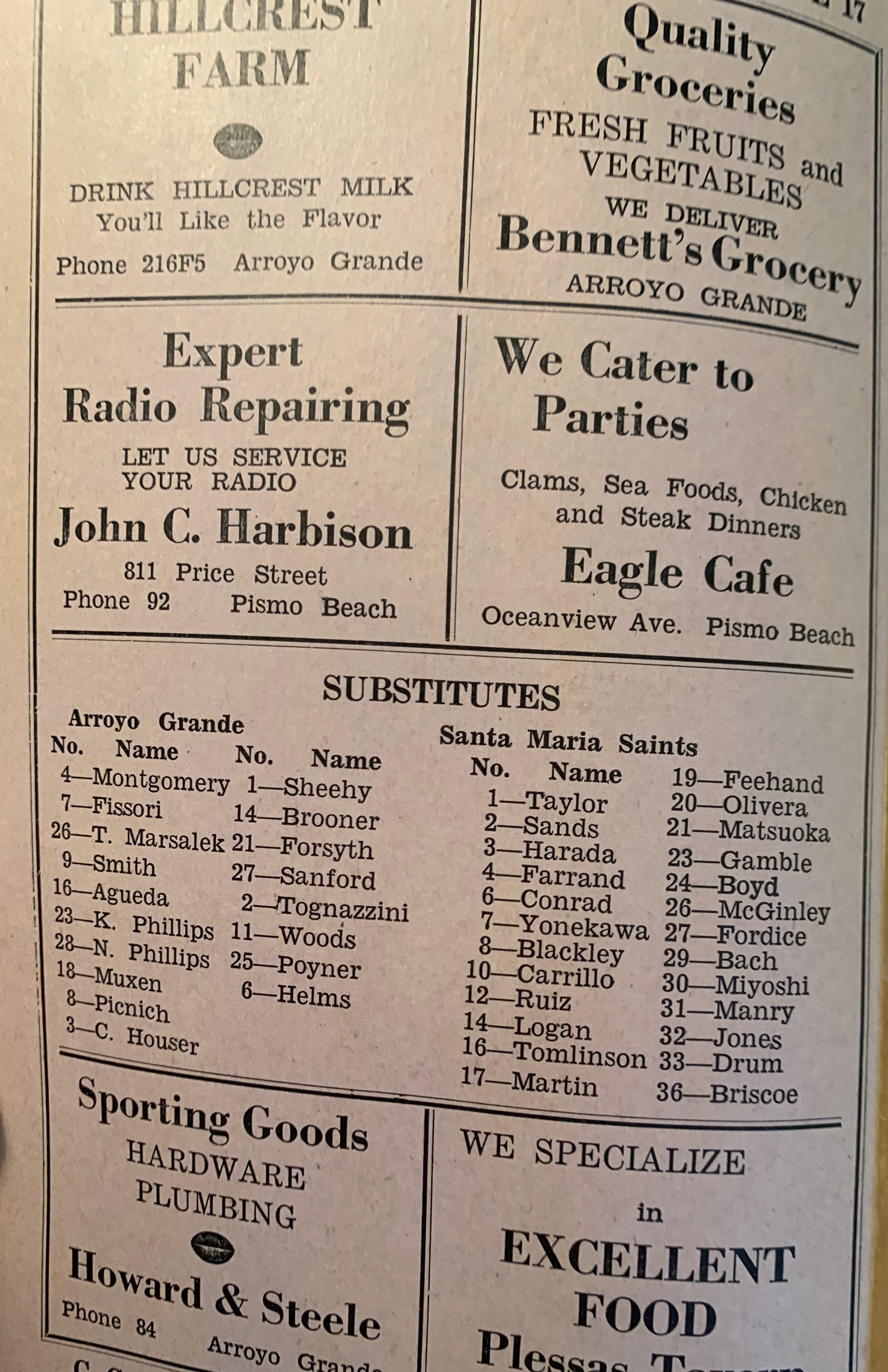
This is like a Rosetta Stone for local historians. To put this in context, 1938 was the year of the first Harvest Festival, indicative that the area was beginning to recover from the hit it had taken during the Great Depression, when San Luis Obispo County crop prices were halved between 1929 and 1933. And it’s in a kind of place of innocence, three years away from World War II, which will sweep up the little town, population 1,090 in the 1940 census.
A few examples among the advertisers in the newspaper ad, and this is just scratching the surface:
“J.J. Schnyder” was the kindly blacksmith who’d interrupt almost any paying job to fix a kid’s soapbox racer; he was responsible for funding the first swimming pool at Arroyo Grande High School because he wanted kids to have a place to play. When the Kobara family’s irrigation pump broke down in 1945, after their return from internment, Schyder insisted on fixing it immediately. It was Christmas Day.
“E.C. Loomis and Son:” The family would safeguard the land and equipment of their Japanese-American neighbors during the war; one son, Vard, had coached the Nisei Arroyo Grande Growers, a powerhouse baseball team, before the war. His catcher was Kaz Ikeda, whose image is included in the mural on the Mason Bar wall, and Kaz named one son “Vard.” E.C.’s grandson, John, was a Marine who fought at Pelileu and Okinawa who maintained a lifelong friendship with the other three of a kind of “Four Musketeers:” Don Gullickson, Gordon Bennett, and Haruo Hayashi.
“Horner’s Second Hand Store:” Ed Horner, an Eighth Air Force officer, had his B-17 shot down in 1944 and would be a POW until war’s end.
“Commercial Company:” This general-goods store stood on the site of today’s Mason Bar; it was later a grocery in the same building Mason Bar occupies. One of the owner’s sons, Elliott Whitlock, AGUHS ’40, won a Distinguished Flying Cross for bringing his B-17 safely home after it’d been set afire by flak over Berlin in March 1944.
“French’s Cafe:” On April 30, 1942, French’s prepared over 200 box lunches for local Japanese-Americans on the day buses took them to the Tulare Assembly Center. Only about half of our prewar neighbors would come back after the war.
“Bennett’s Grocery” (today, the Chic Salon): Two of Rusty and Muriel Bennett’s sons would serve–Jerry in the Army Air Forces, Gordon in the Navy.
“E.M. Morgan:” His Ford agency occupied today’s Doc Burnstein’s. Morgan’s son, Wayne, was killed December 7 on USS Arizona, along with his second-grade classmate, Navy bandsman Jack Scruggs.
“Aki’s Market,” next to the meat market, was owned by Akira Saruwatari, a member of perhaps the first Japanese immigrant family to settle in the Arroyo Grande Valley; they farmed land across from the Halcyon Store. He was interned at Gila River and would live his postwar life in Santa Barbara.
“Wilkinson’s Market:” Today’s meat market. When his Japanese customers came in to pay their bills just before internment, Leo Wilkinson would’t take their money. “You keep it; you’re going to need it,” he told them. This act of generosity was repaid, in full, after the war.
“Grande Theater,” in the building that today houses Posies in the Village, would’ve been where many local people, through newsreels, kept up with the war news. (A short distance up Branch was the Security Drug Company, today’s Village Grill, where moviegoers could order a milkshake or ice cream sundae after the movies.)
Earl Wood was the funeral director who would supervise the homecomings of many South County servicemen killed in Europe or the Pacific in the years after the war had ended; Louis Brown, for example, killed on Iwo Jima, came home in 1948.
In the program, the Arroyo Grande coach, Max Belko, was once a USC All-American. He kicked a field goal against Montana in 1935, a feat that wouldn’t be repeated for fifteen years, when Frank Gifford kicked the next Southern Cal field goal. Belko, a Marine lieutenant, was killed on Guam in 1944, but we still have a connection to him: He was Haruo Hayashi’s P.E. teacher. (There are many familiar surnames in the football program, but two, both Navy men during the war, offer a glimpse into postwar Arroyo Grande: Tony Marsalek was our longtime fire chief; Chuck Brooner was the pharmacist/owner of the Fair Oaka Pharmacy.)
The sports editor of the high school newspaper, the “Hi-Chatter,” was George Nakamura. As a twenty-year-old intelligence officer in China, he was awarded a Bronze Star for going behind Japanese lines to rescue a downed American flier and, after the war, a Congressional Gold Medal in recognition for his efforts, as an international businessman, to nurture the relationship between Japan and the United States.
 A Work in Progress