
It’s sad–but no recriminations on my part–that the Harvest Festival was canceled this year. (There were cancellations during World War II, as well; the first Harvest Festival was in 1937). The Harvest Festival was an especially big deal when I was little, when my parents dropped me off and turned me loose for the day. The parade was the best part. My sisters, in matching mint-green outfits, appeared in at least one, in the pony cart with Obispo Telstar, one of Anne Westerman’s Welsh ponies, doing the work.
That’s my big sister in the center of the Jeanne Thwaites photograph, taken at Sid Spencer’s cattle ranch, now underneath Lopez Lake. Sid, on her Morgan–Roberta’s riding a Spencer Morgan mare–is on the left and her sister, Anne, on her pony, is on the right.
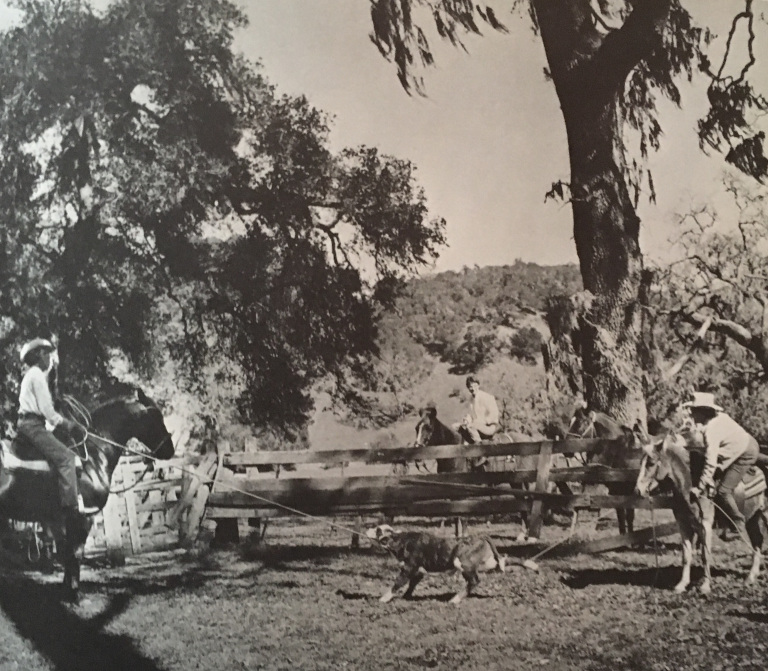
It was Sid Spencer who taught Sheila Varian how to work cattle. She was a good teacher. Sheila won the National Cow Horse Championship at the Cow Palace in 1961. She was the only woman competitor and her mare, Ronteza, was the only Arabian in a field of Quarter horses.Ronteza’s sire, Witez II, was a champion Polish Arab who plays a central role in a superb book, “The Perfect Horse,” about the American rescue of the Spanish Riding School’s Lipizzaner near the end of World War II.
My favorite Harvest Festival equestrian unit was the one that veered off the parade route and entered Ralph and Duane’s. The horses were thirsty.My most vivid memory was the Harvest Festival of 1966, I think. I was a ninth-grader at the big old Paulding campus, having just graduated from Branch in a class of ten boys and three girls. I went to a dance in Tanner Hall, where City Hall now stands.Tanner Hall had been a dance hall since it was built by Beder Wood in 1894.
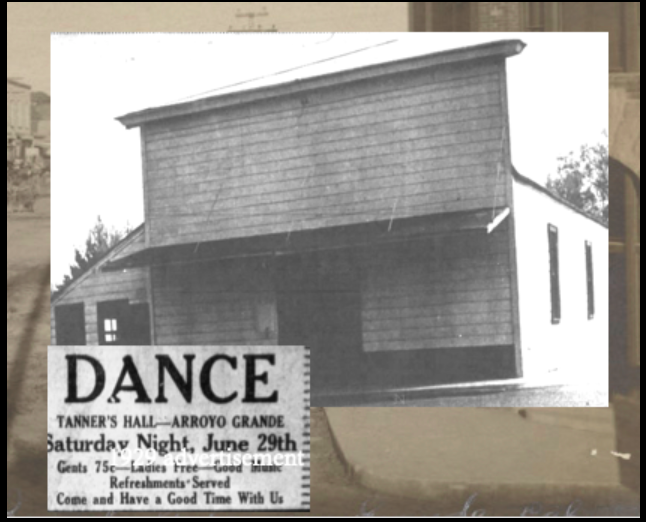
But in 1966, at that particular Harvest Festival Dance, I saw the second-most epic girl fight of my life. It was terrifying when you come from a graduating class of ten boys and three girls.
These city girls are lethal, I thought.
The most-epic Young Woman fight–note the change in word choice, reflective of the times– I ever saw was one I broke up as a student teacher at Righetti. I barely survived. Boy fights end when they get tired. If I hadn’t intervened at Righetti, those two Young Women would STILL be fighting.I was lucky to survive.
Tanner, or Tanner’s, Hall was also where locals went to watch silent movies, enormously popular by 1912, when the ad appeared in the Herald-Recorder. And Young Women in 1918–we know this from contemporary teenager letters– couldn’t wait for the flu pandemic to end because they missed the movies. High school, not so much.
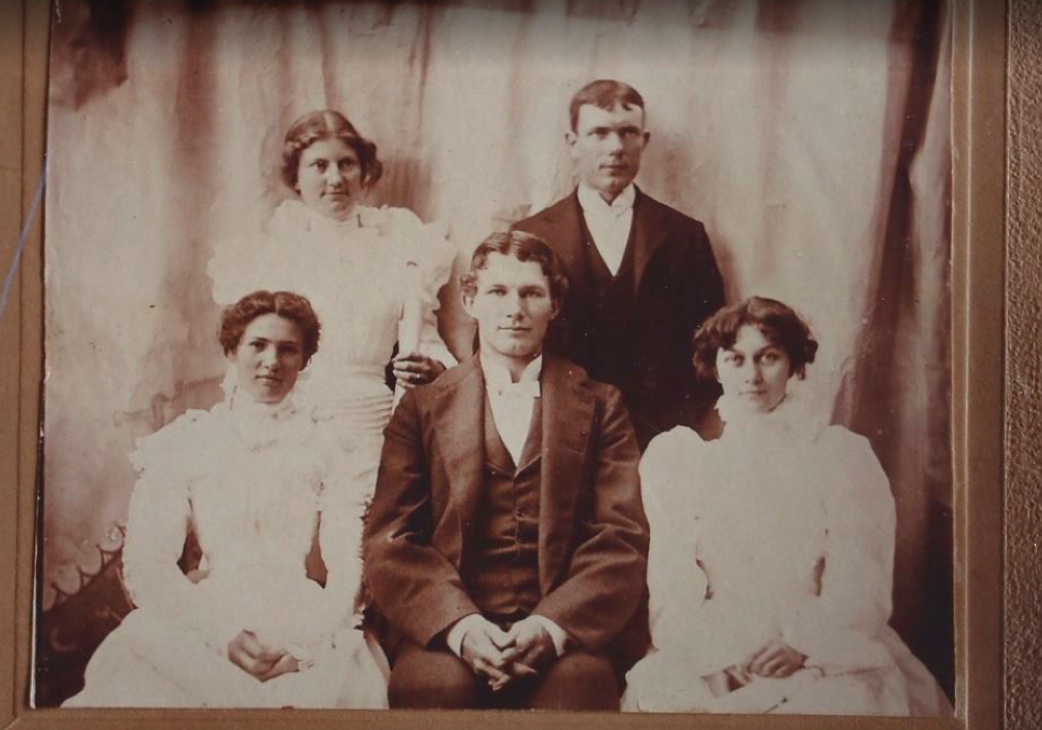
The Hall was also used for high-school graduations. The Hall, according to the Arroyo Grande Herald, “was filled to the point of suffocation” for the graduating class of 1898.All five of them. That’s the Class of ’98 in the photo.
Young Women wore white dresses to their graduations in those days. Fifty years after her graduation from Arroyo Grande Union High School, Ruth Paulding STILL fit into hers.
At the 1898 commencement, graduate Albert Ore delivered what the newspaper characterized as a stirring speech, “Spain and America!” about the then-current war still being played out in Cuba and the Philippines.
Ore gave that speech on June 30, 1898.The next day, Theodore Roosevelt’s Rough Riders, one of them from San Luis Obispo, followed the Buffalo Soldiers in to take the Spanish trenches atop Kettleman Hill in Cuba–misnamed “San Juan Hill.”
Albert Ore must have been thrilled. Look at what his speech did.
 A Work in Progress