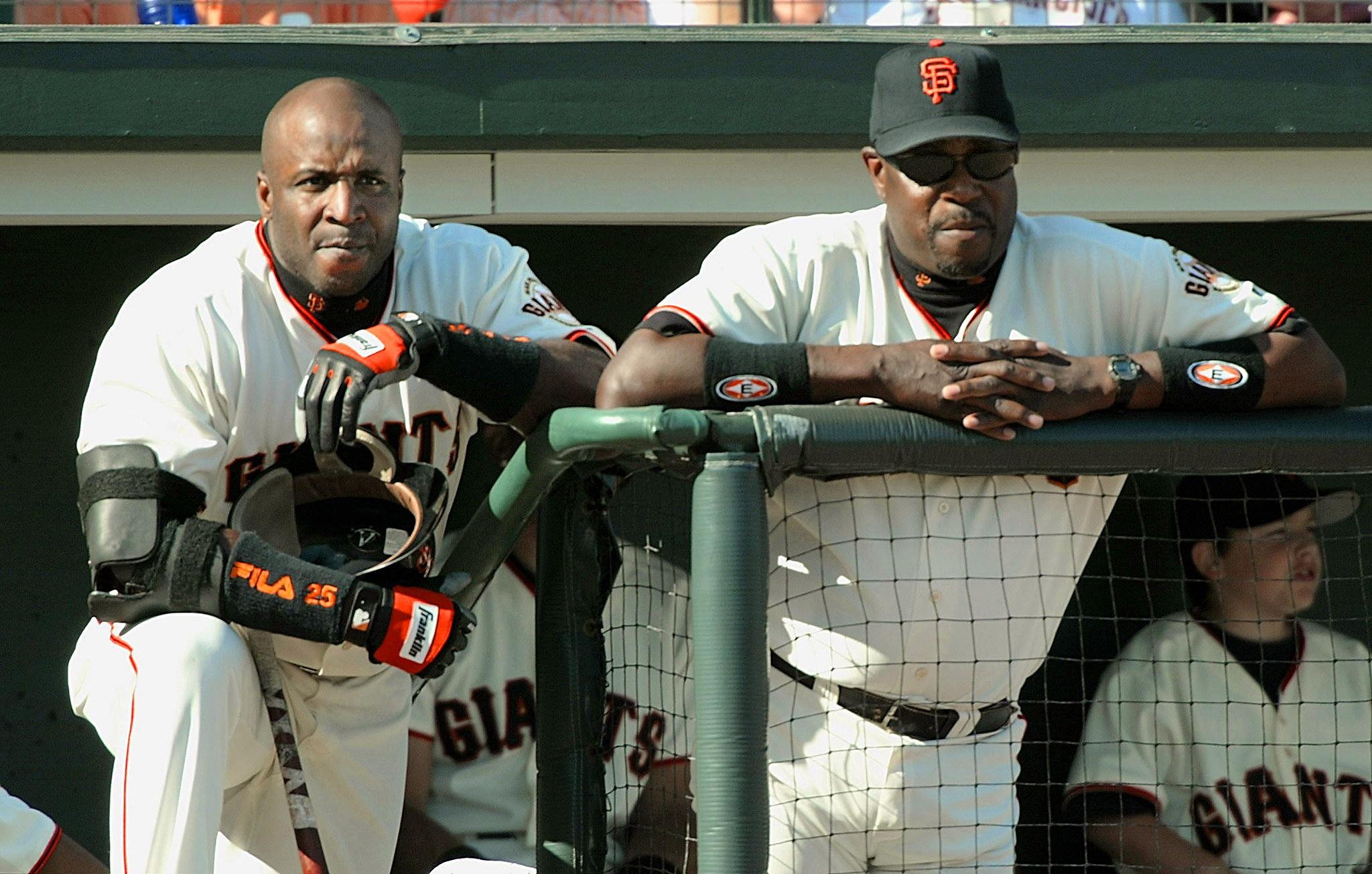
Doesn’t matter what uniform this guy wears. There are some people whose integrity is so transparent that you can’t help but admire them. Dusty Baker’s like that.
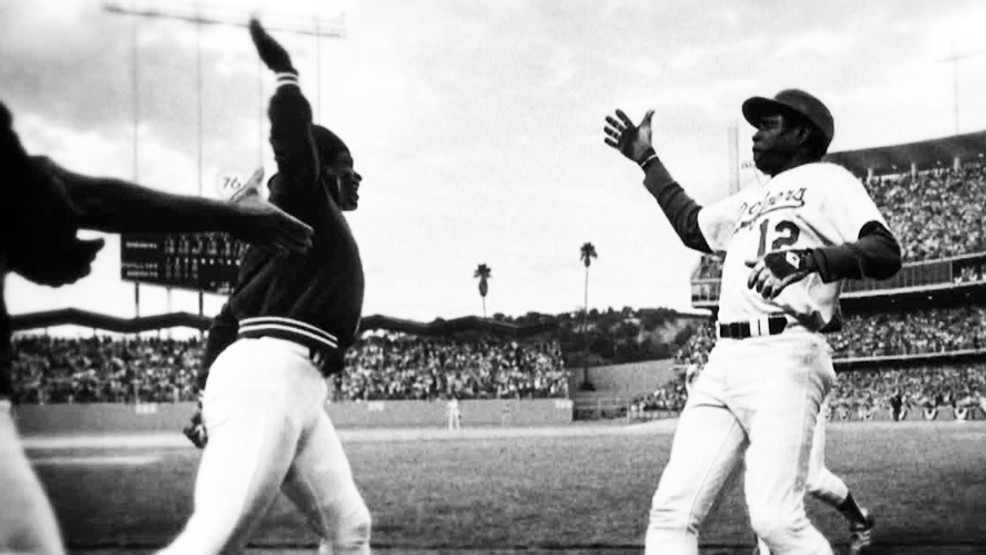
I just read an article that asserted that the high five was invented when Dusty, as a Dodger, homered off the Astros’ J.R. Richard. But Dusty didn’t exactly invent it–he responded to the raised hand of his teammate and friend, Glenn Burke.
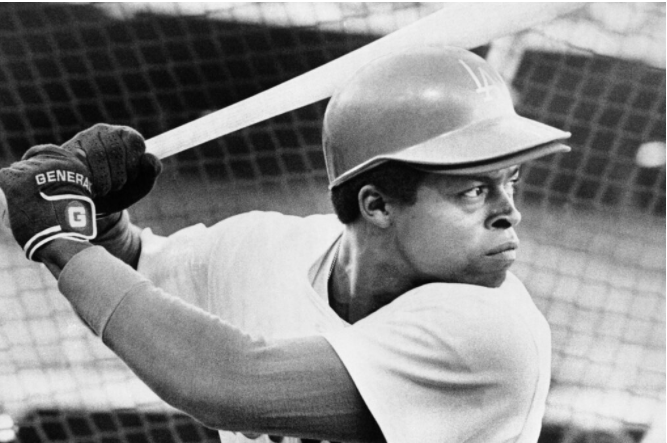
Burke was to be the Dodgers’ next big star. He was compared to Willie Mays.
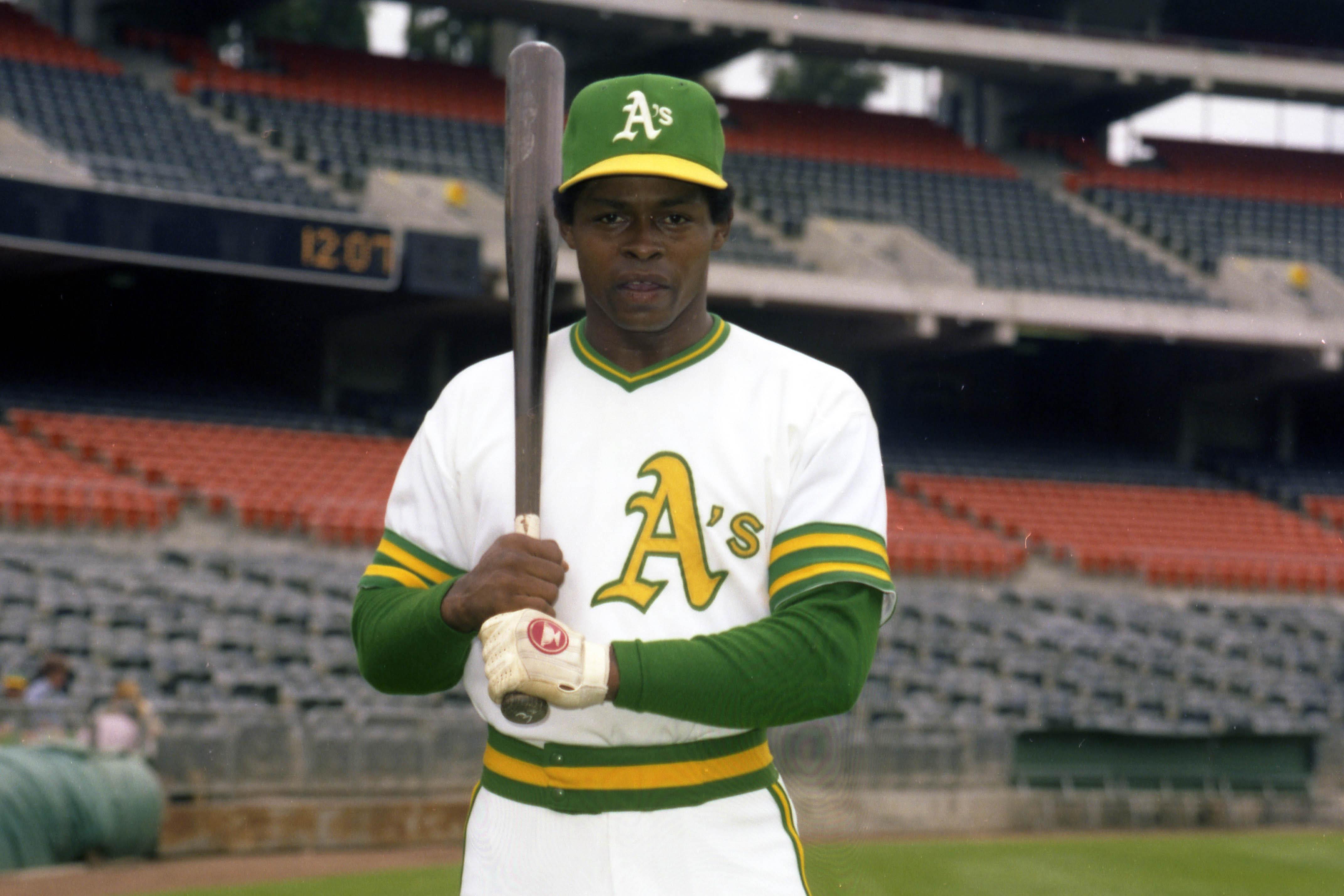
In 1978, he was traded to the Oakland A’s.
Baker later said that “we knew the reason he was traded was because he was gay. You couldn’t be more blunt than that.”
Glenn Burke
Burke had come out to his teammates and, in part because Baker was so open to Burke’s announcement—he was a leader even then; he set the tone— the rest of the team accepted Burke for who he was.
That’s the other reason they accepted him: because of who he was. Former Dodger outfielder Rick Monday said that Burke “could take any moment in time and make it fun. There was no better guy in the clubhouse, I’ll tell you that. There was no one who didn’t love having Glenn around.”
Some of his teammates cried when the trade was announced.
Burke’s trade was tied to the fact that manager Tommy Lasorda’s son was gay. Lasorda essentially disowned Tommy Jr., whose circle of friends included Burke.
And A’s manager Billy Martin loathed Glenn Burke, openly called him a “faggot.”
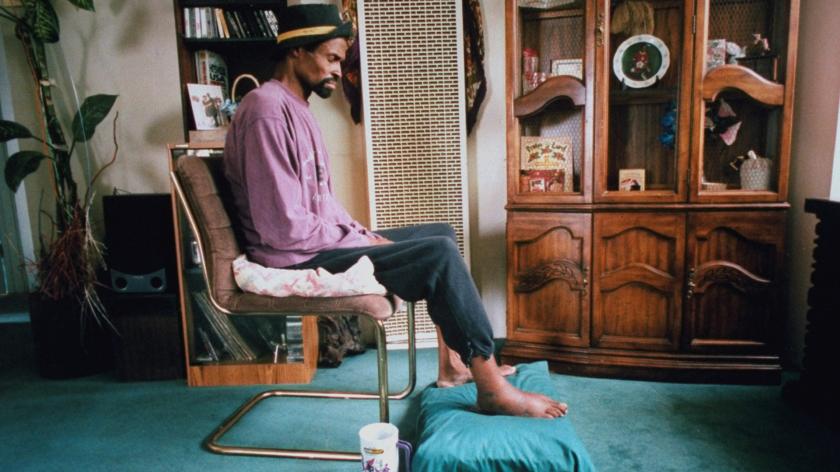
Burke’s career languished and he left baseball. He died of complications from AIDS in 1995.
Tommy Lasorda Jr. had died from the same complications in 1991. His father, one of the most famous Dodger managers, insisted then and for the rest of his life that his son had died of cancer.
Burke near the end of his life.
So now Dusty Baker is a manager, too. After stints with the Giants, the Cubs, the the Reds and the Nationals, he was hired, at age seventy, by the Astros. He took over a team justifiably ostracized for cheating. The Houston franchise was at its nadir. There was no tougher job in baseball. Now Baker is taking the Astros to the World Series.
“He’s a leader and he’s a friend, so we can go into his office whenever we feel like it and talk about it,” shortstop Carlos Correa [told the New York Times]. “He’s such a wise man and he’s been through it all in baseball.”
“He’s such a wise man.” That resonates. That makes sense.
Okay, the big pumpkin eating the little pumpkin is brilliant.
I might try to make a pumpkin pie from scratch this year for Thanksgiving, by the way. I’ve already done it once.
I was in college and visiting my second cousin Frances Sally, a powerful figure in Missouri politics. She was the head of the Missouri State Cosmetologists’ Association.
My college friend Wayne from Oklahoma happened to be in the area and his car broke down, so he stayed with us for a few days. He was dead broke, estranged from his Dad, and needed the comfort of a Cousin Frances Sally bed.
She was a sweet lady, but she cut my hair once. Many years later, I realized that the same style had been adopted by Princess Diana. I don’t think Frances Sally had much experience with cutting men’s hair.
This was in Licking, Missouri. There hasn’t been a lot to do in Licking, Missouri, since they closed down the Rawlings baseball factory. Licking used to make all the baseballs for the MLB.
By the way, I had a grand Thanksgiving there once. We were watching Notre Dame slaughter USC and the gang was making fun of me, the California boy. Then, some of you may recall, Anthony Davis scored six touchdowns and SC won going away, 45-23.
Many years later, my Dad called me to the phone. “Somebody wants to talk to you,” he said.
It was Anthony Davis. I pretty much melted into the floor.
Anyway, back to Wayne and me. Since there’s not a lot to do in Licking, Missouri, we bought some pumpkins. And we made a pumpkin pie.
Ladies and gentlemen, there has not been a process this labor-intensive since the construction of The Great Pyramid of Giza. It took us ALL DAY. Scraping and rendering and mixing and beating and spicing and crusting and then, finally, actually baking the damn thing.
Wayne from Oklahoma and I gained a whole new appreciation for what frontier wives had to go through when they baked. And we had an electric oven.
The pie was incredible. Other than getting the Sor Juana de la Cruz Award for being the top student in my Mexican History class, that was the crowning achievement of my time at the University of Missouri.
So I think it’s time to recapture the glory. I sure wish Wayne from Oklahoma was nearby to help. He was a good guy.
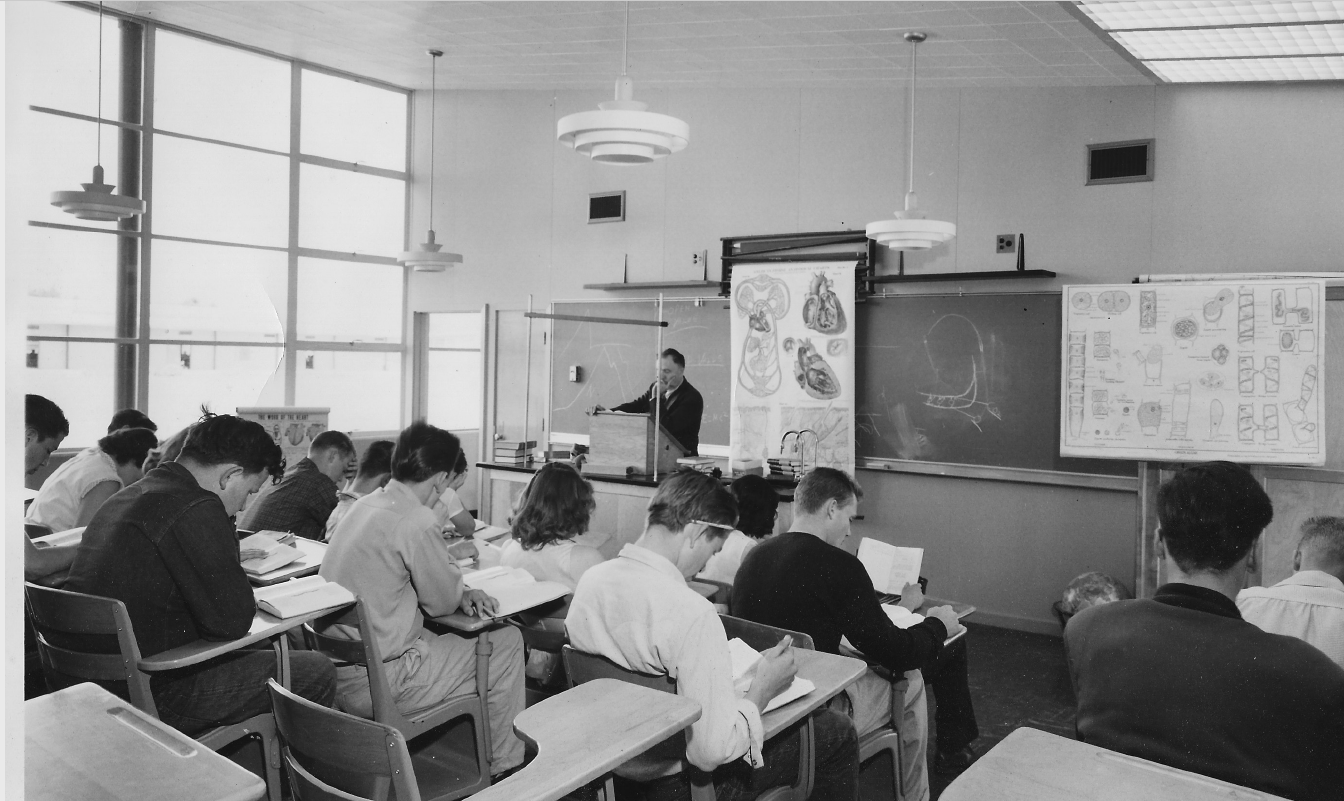
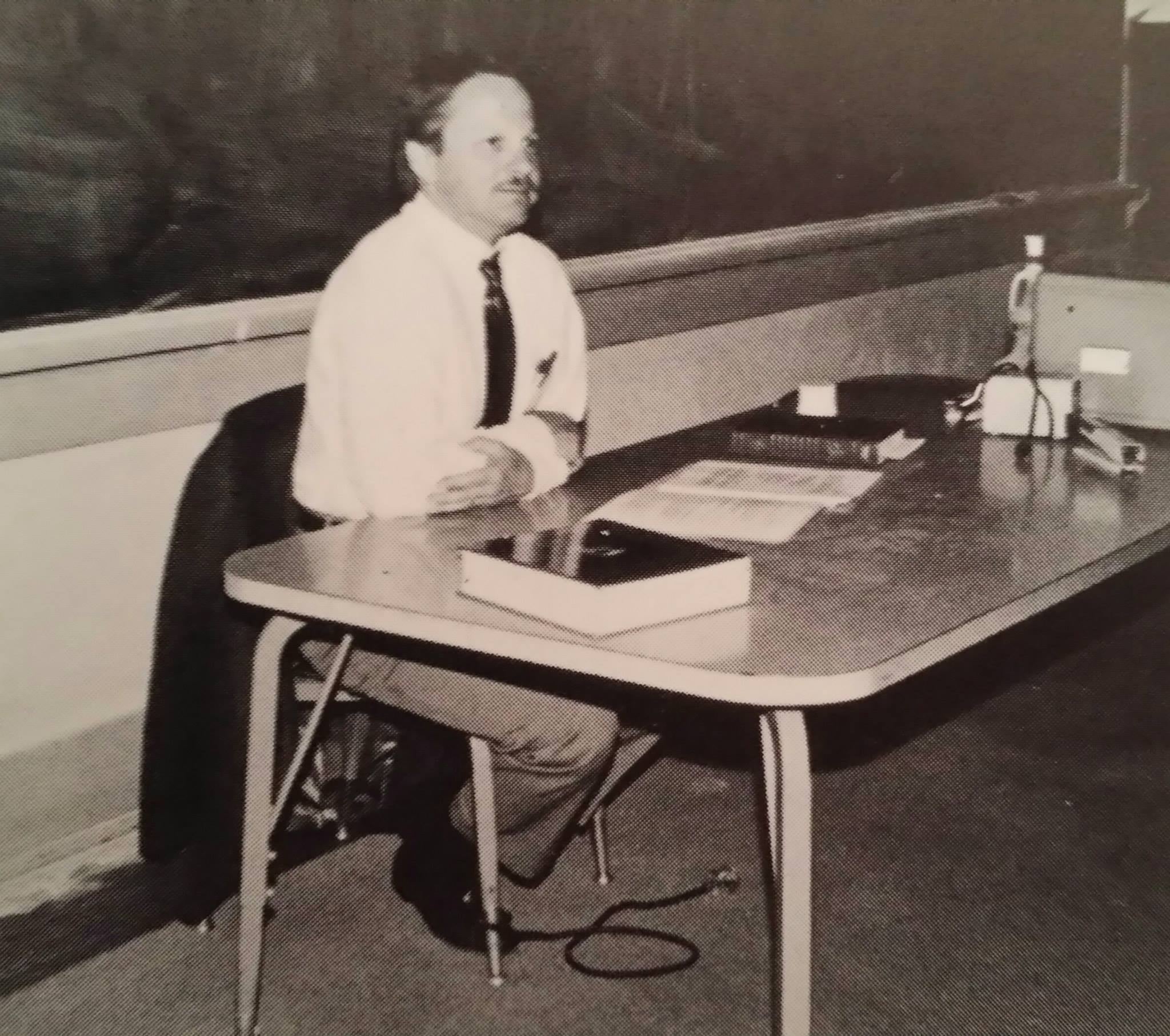
This is a science classroom at AGHS, about 1956, courtesy of Mr. Spin, who donated some vintage photos to me.
No STEM yet. Notice the overwhelming number of males. My sister, Roberta, a proud graduate of Arroyo Grande (Union) High School, was a math major at Poly, and sometimes she was the only female in her class section. Maybe two more, but not more than that. And Poly hadn’t caught up with coeducation, even in 1960. It was about a three-day horseback ride to the nearest women’s restroom.
And in 1960, math was a serious business. All those fellows with the flattops and Madras shirts were someday going to be rapidly but noiselessly sliding their slide rules, calculating exactly how long it would take an Atlas missile with a 1.44 megaton nuclear warhead to land in the swimming pool of Nikita Khrushchev’s dacha on the Black Sea.
(Khrushchev was the Russian leader who said ”We will bury you!” Vice President Nixon countered by informing Khrushchev that we made better color TVs than the Soviets did. Touché!)
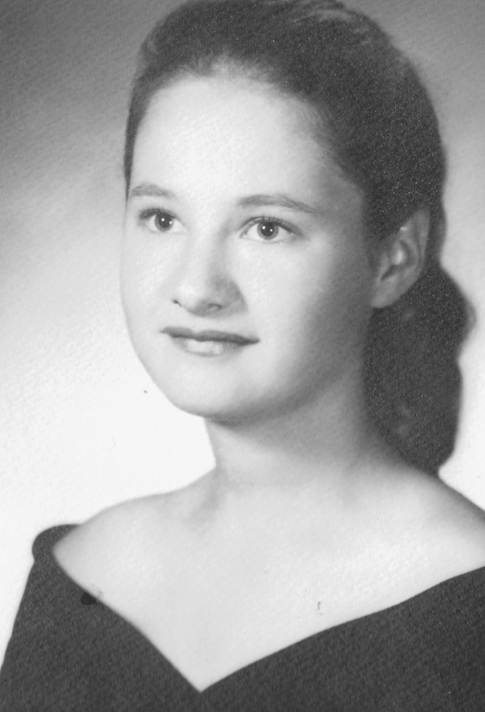
So I don’t think women were particularly welcome in Cal Poly math classes in 1960. Especially really bright ones. Roberta’s the fat puppy in the litter when it comes to smarts, and maybe that was resented by her classmates.
Roberta as a senior at AG(U)HS. Yeah, she’s kinda stunning.
Roberta decided that she wanted to be a teacher anyway. So she became an education major, then a third-grade teacher, and a no-nonsense one. You can ask Miss Sandy. Her classes at Poly made for over thirty years of very lucky third-graders, busy little sailors on the ship my sister sailed.
I love my big sister.
The other, less serious observation: See those lights? Those light bulbs are BIG, somewhere between a grapefruit and a basketball. I had lights just like those in my Mission Prep classroom–the one with only one electrical outlet, because the Immaculate Heart Sisters thought electricity was a modern convenience, a crutch for softies, like socialists or Presbyterians.
And of course, at least one of the deceased Sisters is supposed to un-decease herself upstairs, where my classroom was, and where my former and much-admired and beloved student Julie Newton now teaches English (that makes me feel real happy, that she’s in that classroom). The late sister is, of course, a ghost. Or one of them.
I told the Mission kids that an I-beam fell on her while they were building their school and flattened her like a tortilla. That was both irreverent and made up.
(I’ll bet she’s looking for knuckles to rap with her steel protractor ruler. The sister, not Julie. English teachers don’t have much use for protractor rulers.)
But Elizabeth, my wife, did hear loud construction noises as she came back from coaching a basketball game late one night. Bang bang. Drill drill. As soon as she opened the double doors that lead to the school’s main hallway, there was complete silence. Complete and dark dark silence, all the lights being turned off. She did a u-turn and went home.
The next day, She asked Mike, the maintenance man, if he’d been working that night. Nope.
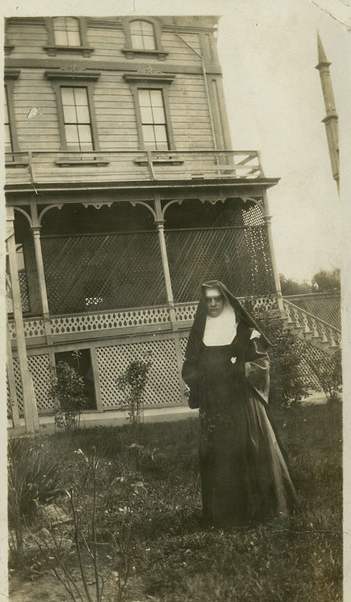
An Immaculate Heart Sister on the hunt for knuckles, early 1900s. SLO County Photograph Collection.
Anyway, there have been repeated Sister Sightings–some of ’em in flocks, if not quite whole convents–up there on the second floor over the years. A SLOHS girl, a guest at a school dance in the 1950s, took a look around between songs up on the second floor and came back to her friend, downstairs in the gym. She was thrilled, charmed by the cozy gathering around a warm stove that she’d seen upstairs.
“I didn’t know that the nuns lived here!” she told her friend.
They didn’t.
At another dance in the 1980s a teacher saw a shadowy figure dart around a corner, headed toward my classroom. He thought it might be a student up there messing around. When the teacher turned the corner, there was nothing but empty hallway..
In the 1990s, a French couple, tourists, were traveling through San Luis Obispo and they did what the French will do. They spread their sleeping bags on the Mission Prep front lawn, broke out a bottle of Bordeaux and some Camembert, and began talking about Proust. They were sleeping when the temperature suddenly dropped about thirty degrees. They woke up and it was pitch-black. Black black, and whatever the black was, it was hovering just above them. Then the black lifted, and then the black drifted, into the gym behind the lawn.
They found another place to sleep.
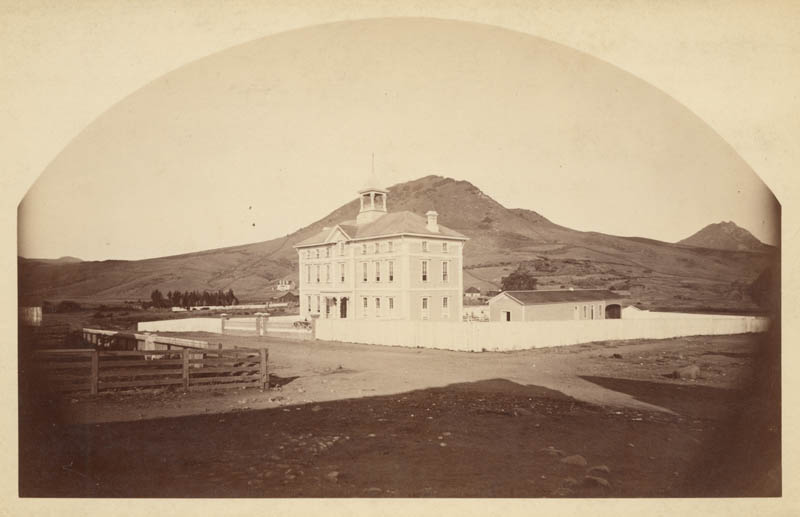
The school was built in 1926–it was sixty years old when I started, just as AGHS was sixty years old when I retired– over the site of the of Immaculate Heart of Mary Academy.
That earlier school was built in 1876. The sisters lived in a convent house behind the present Mission Prep, in what is now a parking lot.
There was a fire at Mission in the 1980s and it burned through the gym floor. There, underneath, was the foundation for the Academy. And a dead cat.
The Immaculate Heart Academy, Palm Street, San Luis Obispo, soon after it was built.
That was downstairs. I was upstairs.
So I was up there painting my room. At night. The biology teacher was around the corner and down the hall just a little ways, happy amid his labware and a year’s supply of dissectable frogs.
I finished up and decided my room looked pretty good. As I prepared to lock up, I called down to the biology teacher: “Barry, I don’t think this place is haunted at all.”
When I closed the door, one of those light bulbs exploded.
*BOOM!*
It was a good one. It was a detonation. It was a good emphatic detonation. My heart wasn’t the only thing that jumped.
I peeked back inside and decided it would wiser to sweep up all that broken glass the next day, in broad daylight. I bid the biology teacher farewell. It was a quick one.
I taught at Mission for eleven years. I never went upstairs at night by myself again.
Me, looking confident in that classroom. That’s because it was daytime.
So I just rowed for 40 minutes on this thing thanks to a 60s playlist on my iPod Nano (yes, I still have a Nano. I once had a FOUR-track tape player, too). Now that I’ve crawled back to the computer–I don’t look quite as pleasant as this young woman– I was connecting old groups/songs with old friends.
Neil Young and Crazy Horse: Joe Loomis (Joe and I also loved “Tusk,” Joe because of the song “Sara,” and that’s because of his little sister.) Oh, and “Crosby, Stills and Nash,” with them on the porch. I later took a photo of Crosby with his arm around Elizabeth’s shoulders only to find out later that I’d run out of film.
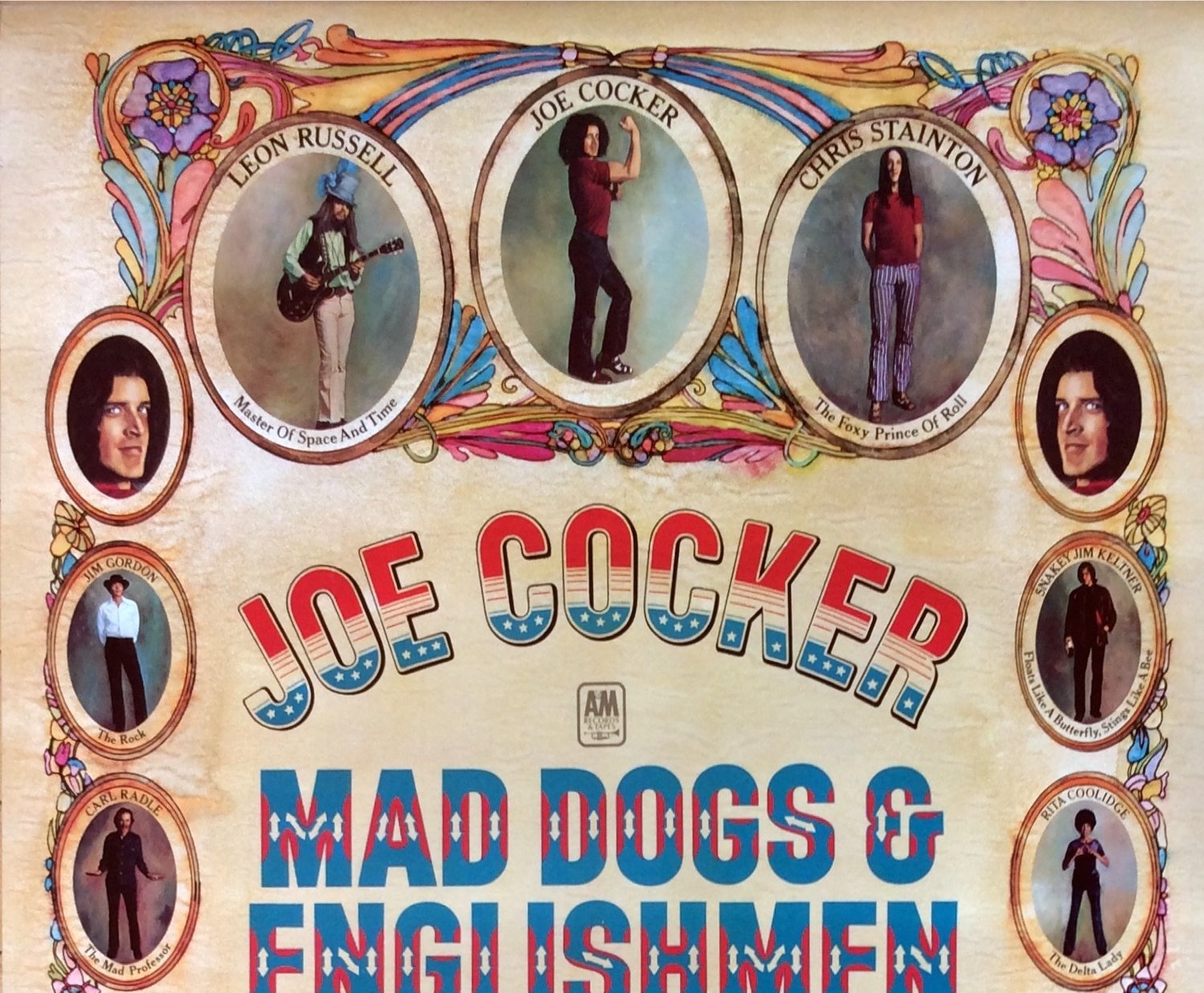
Joe Cocker: David Cherry. We listened to “Mad Dogs and Englishmen,” with Leon Russell (and Rita Coolidge) until you could see through it. I also owe David thanks for another album we played without mercy: Big Brother and the Holding Company, “Cheap Thrills.” Janis’s “Ball and Chain” is a kind of musical Chrysler Building or maybe Half Dome at Yosemite. Or, since she drove one, a Porsche 911.
The Beatles: “She Loves You.” Melvin Milton (I think I have the name right). He was an eighth-grade transfer to Branch and it took us awhile to get over the culture shock: He wore all black: Beatle boots, tight slacks, turtleneck under and a striped oxford shirt over. He took a lot of flak for that, but he was a kind and thoughtful young man.Totally Committed to the Fab Four. But you can’t run base-paths very well in Beatle boots.
Joni Mitchell: Oh, a girl I once knew.
Blood, Sweat and Tears: Robert Garza. He was crazy about “Spinning Wheel.” Robert was one of my best friends–still is–and we were fellow veterans of Kinney’s Shoes and the somewhat addled lady who was the store manager. Elbows flew when a girl in a miniskirt came in shoe-shopping. It could get ugly.
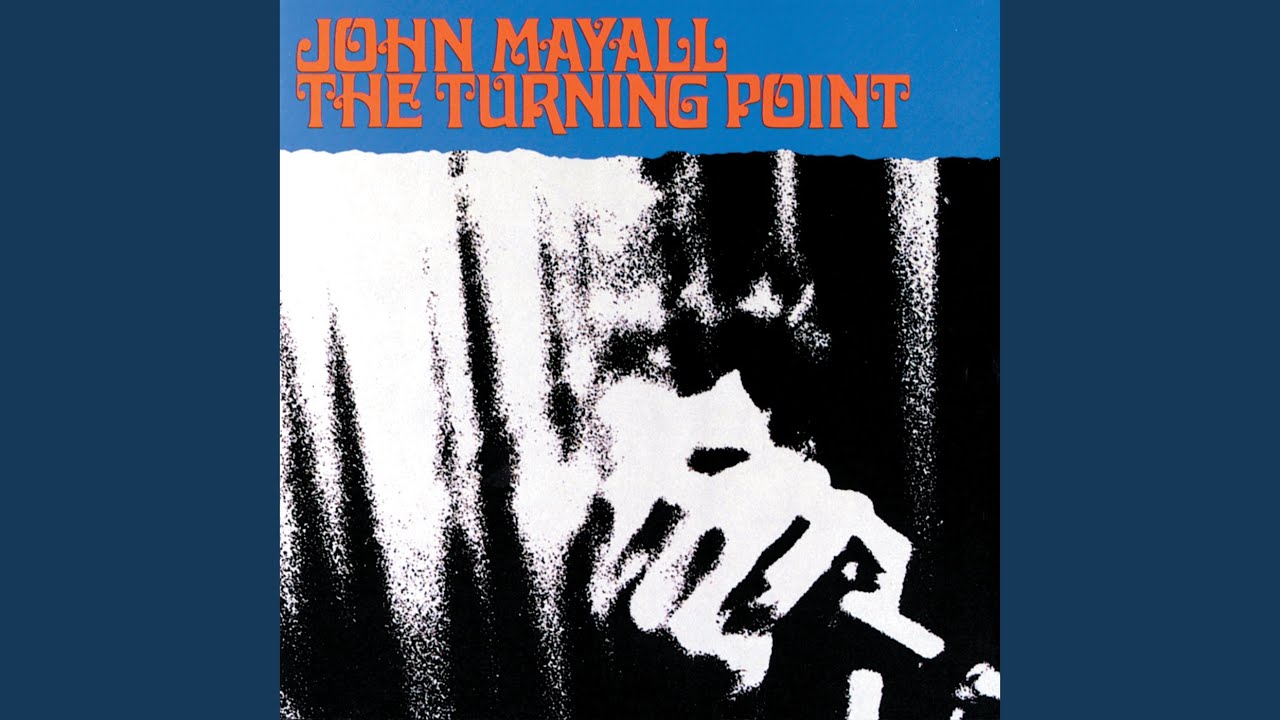
Cream (“Crossroads”) and Jon Mayall (“Room to Move”). No contest here. My old Sambo’s endless cuppa coffee buddy, Paul Hibbard.
Neil Diamond (Yes, I have Neil Diamond songs on my playlist–“Cherry, Cherry” is awesome): Linda DeVaurs. She was very bright, very funny and a total Neil Diamond freak. We dated, but just for a short time because there was no way I could measure up to Neil Diamond.
Simon and Garfunkel: Didn’t play any today, but Debbie Wizemann and Bonnie Silva (she’s no longer with us and I thought the world of Bonnie. I always will.) did a stellar speech presentation on The Poetry of Simon and Garfunkel for Miss Steigerwalt’s speech class. And we were all fans, of course, of “The Graduate.”
Eric Burdon and the Animals: Nobody in particular, but because EVERY LAST SCHOOL DANCE BETWEEN 1969 AND 1970 ended with “San Franciscan Nights.” Also, my ninth-grade art class collage (see below) was “We Gotta Get Out of This Place.” I still like The Animals. YouTube “House of the Rising Sun.”
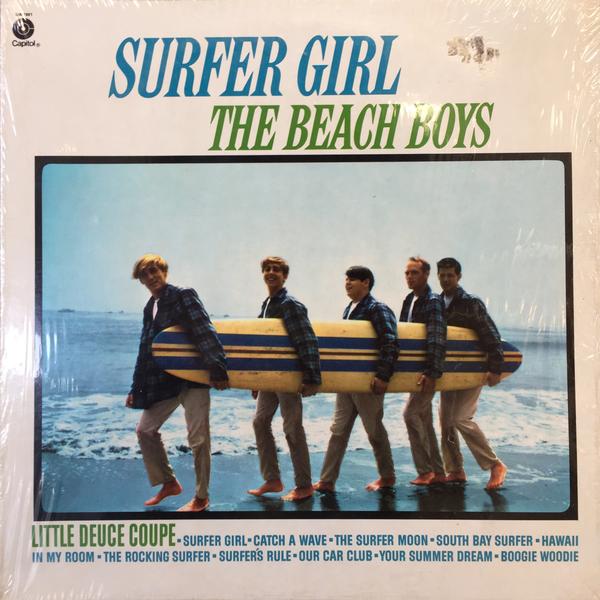
The Beach Boys: Patsy Silva, Marilyn Machado and Carolyn Coehlo. These three were a year ahead of me at Branch and they’d have little dance parties at lunch in Mr. Lane’s room. And they KNEW HOW TO DANCE. They were so cool, and I think they are still cool. We were a little in awe of them–they were eighth-graders, after all. Okay, okay. Also, all us seventh-grade boys–all ten of us– had crushes on them.
The Rolling Stones: My big brother.
Linda Ronstadt: My big brother.
The Turtles: Liz Miller. Our ninth-grade art teacher asked us to make a collage representing a current popular song, and Liz’s was of two pairs of feet close together–a boy and girl sitting on a park bench–representing the Turtles’ “Happy Together.” Both the collage and the song were utterly charming.
I have pretty much decided that I have ADHD—my psychology doctorate is speeding its way here from Trump University– so I offer this as a public service for other folks who might be, too. It’s a condition that can get you into all sorts of trouble. It’s sometimes great fun.
Here are some of my symptoms.
Telephone phobia: An incoming telephone call makes me panic. I’m sure that when I pick it up, the voice on the other line will say something like: “I’m so sorry. Everyone you love has died.” And calling someone on the phone is extremely difficult. It can take me several hours to work up the courage to use the telephone, and my hands are shaking when I hit the buttons on the phone’s keyboard. This was not a helpful trait when I was a newspaper reporter. I have mentally consigned Alexander Graham Bell to the Nether Regions.
Hyperfocus: Working on a task—like writing a book—means that I can stay in the same position for hours, oblivious to everything around me. I think I’m in trouble with Elizabeth because I was working on History Society stuff this morning when I realized I hadn’t heard her for awhile. I looked out the window and her car was gone. Without me saying goodbye. Uh-oh. It’s also extremely difficult to switch from one task—working on something for the Historical Society—to another, like making the bed.
Time Blindness: Due to problems with “executive function,” ADHD individuals sometimes forget anniversaries and birthdays, have trouble placing events in their past on a rough timeline, are habitually late and have trouble with placing upcoming dates or days of the week correctly.
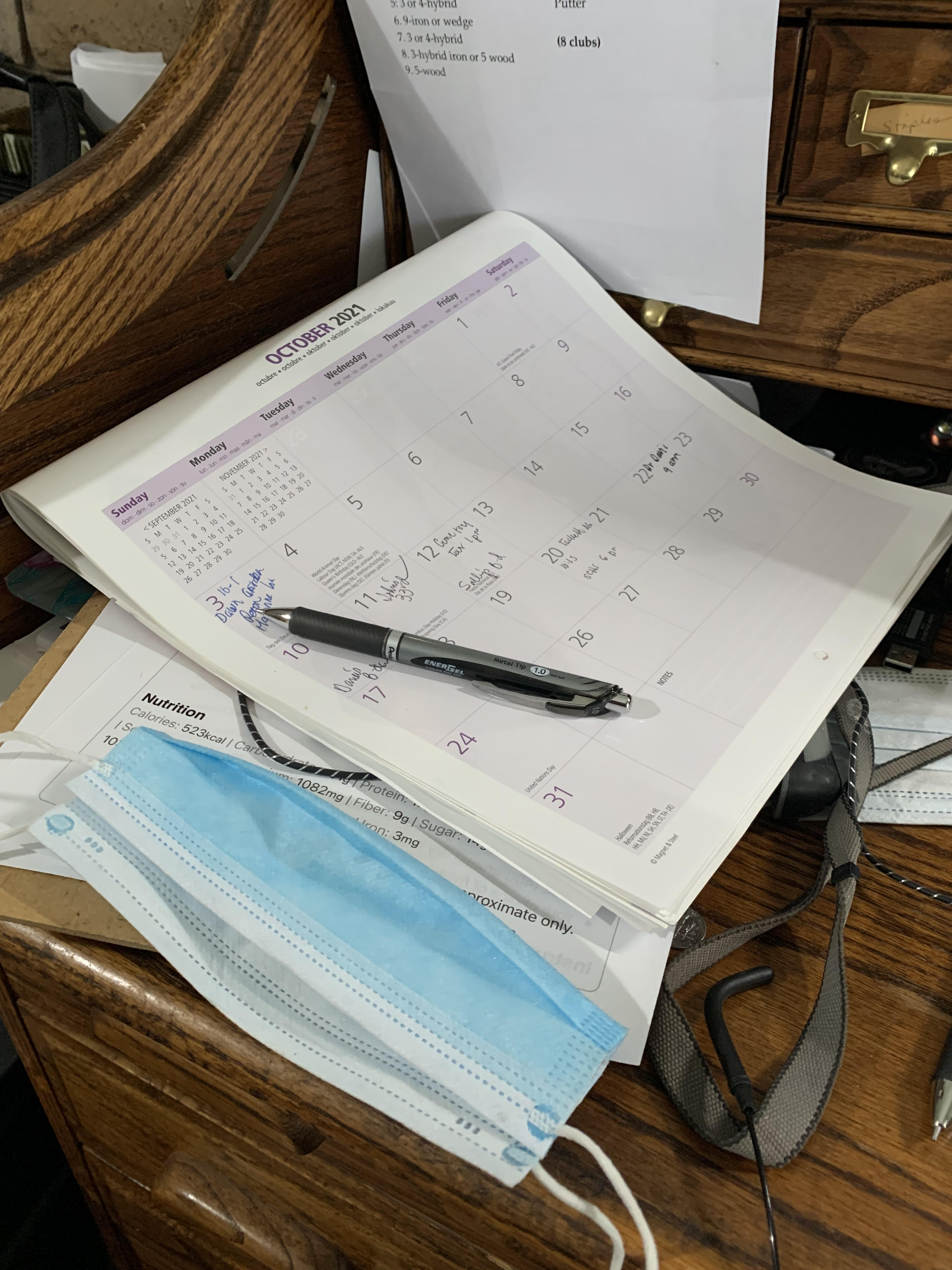
Organizational chaos: Oddly, I could plan a classroom unit easily, almost down to the minute of a daily lesson plan, because it’s creative and oddly fun. But my teacher desk was a disaster except when Matt Stamey was my TA. I actually needed Matt to follow me around the rest of my life. The photo shows my filing system today. And I lose things. A lot. Once I get started, I’m easily distracted, so instead of getting two jobs done efficiently, I o for twelve done half-assedly. Mornings are agony, because I look around and there’s so much to do that I don’t know where to start. So I just go back to bed.
Lateral thinking: I have never gone from “A” to “B.” If you’ve ever read anything on my blog, you can see that. I recently wrote about two friends on a road trip. It started with the two friends, went to my first cigarette, moseyed on over to Kerouac and “On the Road,” made a beeline for my friend Erin who works at the City Lights Bookshop in San Francisco, then flew across the Atlantic to Les Deux Magots café, opposite Notre Dame, and finally wound up with a delicacy of hamburger stands in rural Missouri, French-fried mushrooms.
Elvis has left the building: Sometimes when people are speaking to me, it seems to them as if I’m not listening. That’s because I’m not. I am more or less a thousand miles away. Maybe at Les Deux Magots, and that’s five thousand miles away. A related problem, seemingly one of inattention, is that I can’t remember names. Our neighbors across the street are the nicest people. Her name is Mary. I can’t remember his name, even though I’ve been reminded a hundred times. I do know that it’s a latino name, so I just call him “Fidel.”
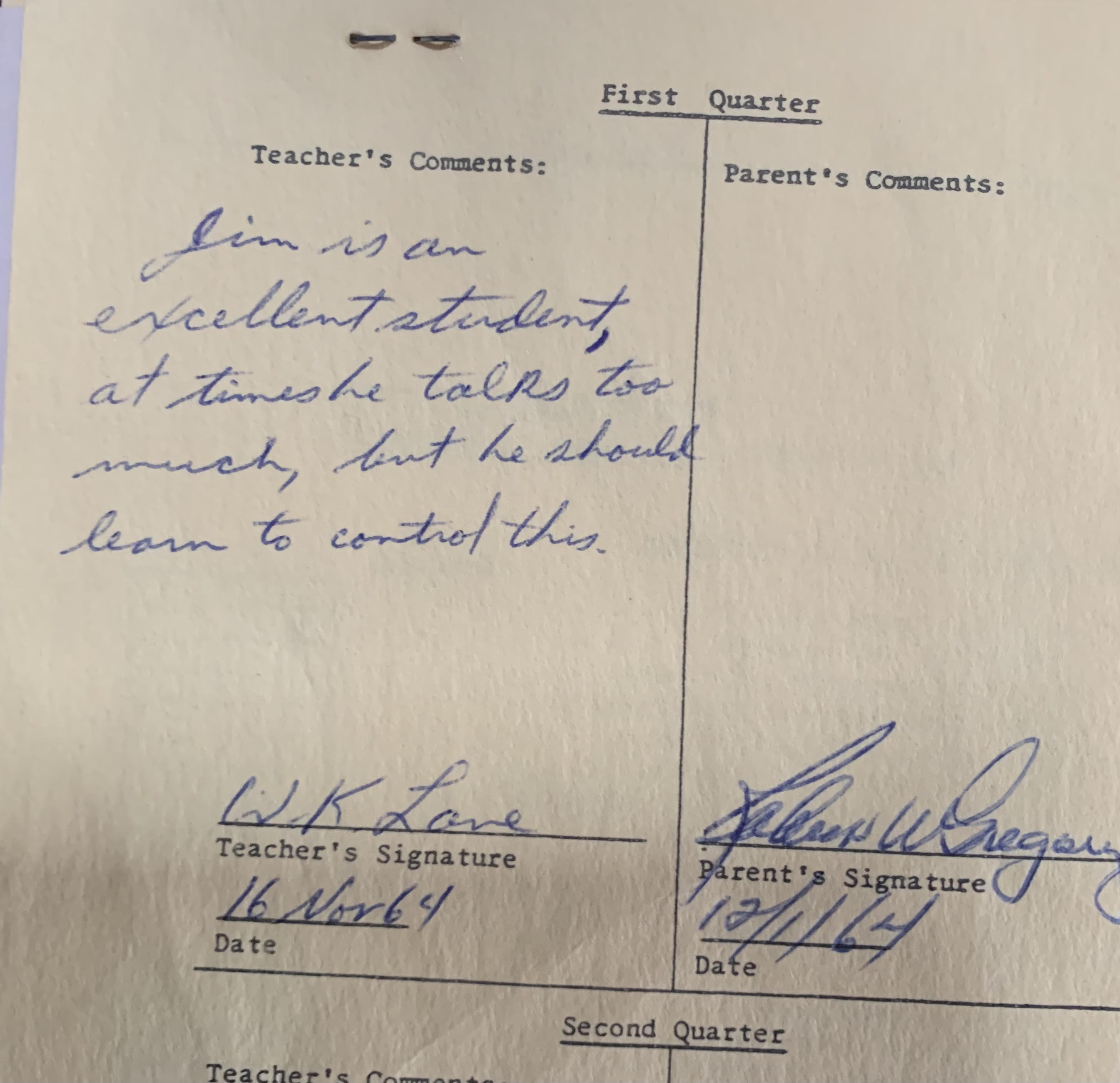
Talkative or Interrupts Frequently: Got me in trouble from first through twelfth grades. “Jimmy talks excessively in class” was a constant on my report cards. And when someone else is the important announcer, doing the play-by-play of a baseball game, I’m the color guy who interrupts with pithy remarks about Yogi Berra’s socks. If you’re old enough to remember the Smothers Brothers, I’m Tommy.
Creativity. “Many people with ADHD tend to be enthusiastic, inquisitive, witty, lively and spontaneous – and each of these characteristics can contribute to being more creative than others who don’t deal with ADHD.
“Generally speaking, creativity is the ability to create something that is both unprecedented and original. Creative ideas must be relevant, new, useful and surprising. Creativity often comes through intense knowledge and significant motivation for innovation in a certain field. These fields can vary, ranging from mathematics to painting, science, or music.” (https://neurogrow.com/creativity-as-a-positive-feature-of-adhd/)
It’s pretty obvious that I love writing. I have this blog. I’m a Facebook addict. I’ve written five books and I write for small magazines, the occasional newspaper and the local historical society.. I even loved writing lesson plans. How do I get their attention? What steps do I need to take to lead them to what they need to learn? How do I make transitions so that it’s not me going blah blah blah for 52 minutes? How do I engage them emotionally? I’d spend hours at it but find it oddly enjoyable.
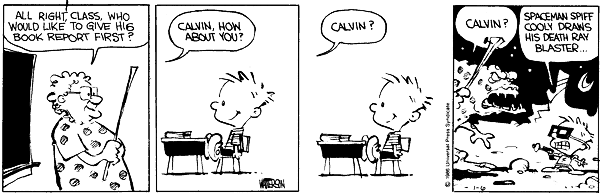
But if I’d been teaching me, I would’ve been the kid surreptitiously reading Cannery Row hidden just under my student desk.
So, at least in some ways, I’m Calvin.
Time, boredom on your part and self-absorption on my part means I need to finish this. So we’ll just go with a laundry list of symptoms–some of them discussed in more detail above. (Deep breath) Here we go:
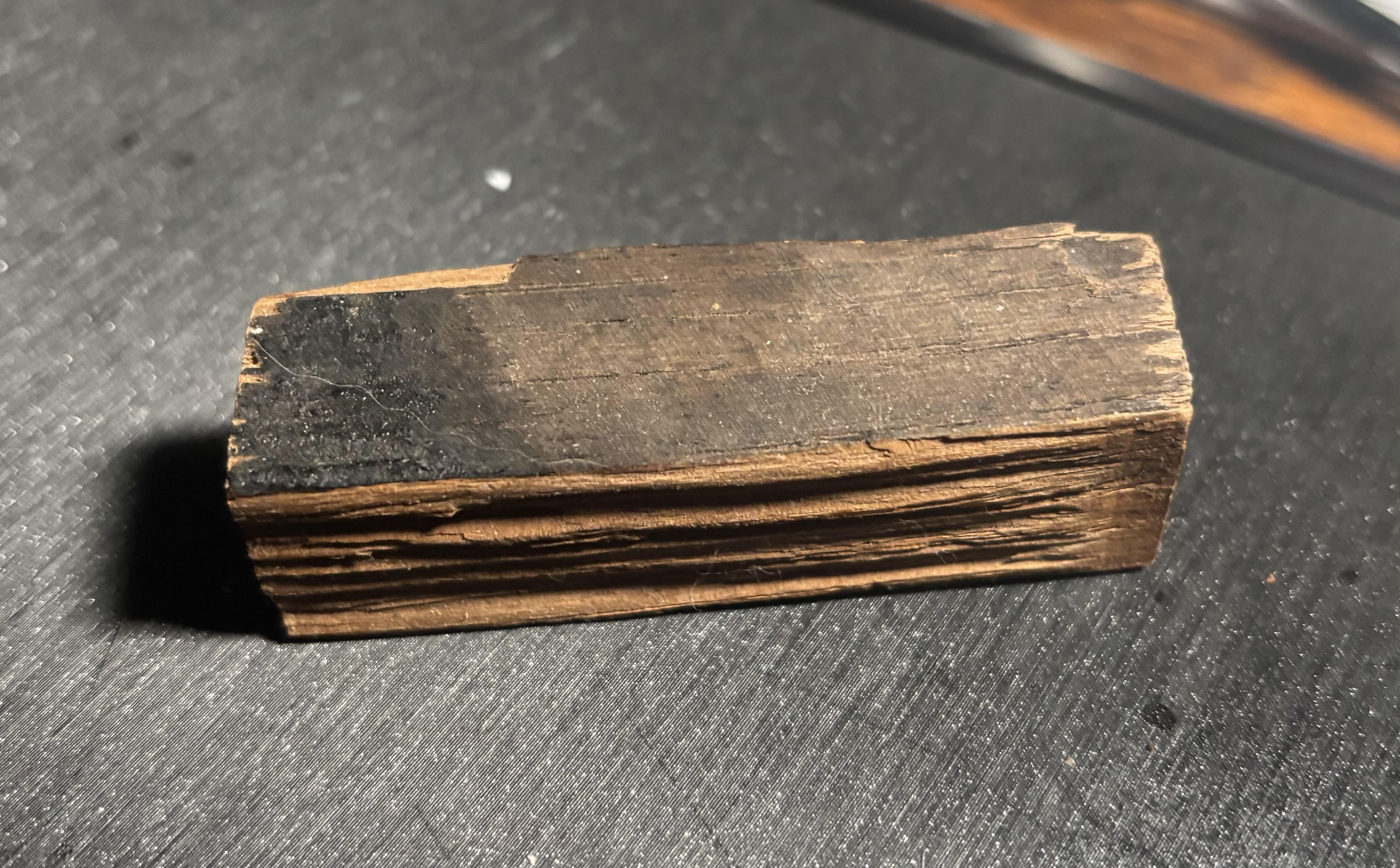
My little piece of HMS Victory, brougt home to California in 1987.
Thursday, October 21, is a big day in history.
–USS Constitution was launched on this day in 1797. A 44-gun heavy frigate so well-designed that, during a ship-to-ship duel with the British frigate Guerriere, cannonballs bounced off her hull, earning her the nickname “Old Ironsides.”
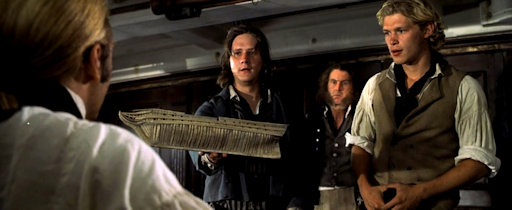
Aubrey is presented with the model of Acheron.
There’s a moment in the film Master and Commander when Russell Crowe, as Captain Jack Aubrey, studies a model of his nemesis, the Yankee-built frigate Acheron, a stand-in, I think, for Constitution. Aubrey is impressed with the ship’s construction.
“What a fascinating modern age we live in,” he remarks.
Life aboard in Aubrey’s time was, of course, terrible. In addition to the corporal punishment, casks of water soon became befouled, the salt pork that was the standard meat issue became so hardened the sailors carved ship models out of hunks of pork, and ship’s biscuits became home to weevils–it was standard practice to rap your biscuit on the tabletop to serve notice to the weevils that they were about to be evicted.
Which reminds me of another scene from Master and Commander, where Aubrey victimizes his dear friend, Dr. Maturin, with the worst pun of all time.
Beyond the flying splinters and boarding parties, the books and film are fascinating for the unlikely friendship between Aubrey and Dr. Maturin. When teaching the Romantic movement, I used Kirk (the Romantic, driven by hunches, passionate loyalty and the pursuit of Space Dates) to demonstrate Romanticism and Spock, the epitome of rationality, the earlier Enlightenment. The passionate Aubrey and Maturin, the scientist, demonstrate the same dichotomy. What unites them, even when they quarrel, is the power of their friendship.
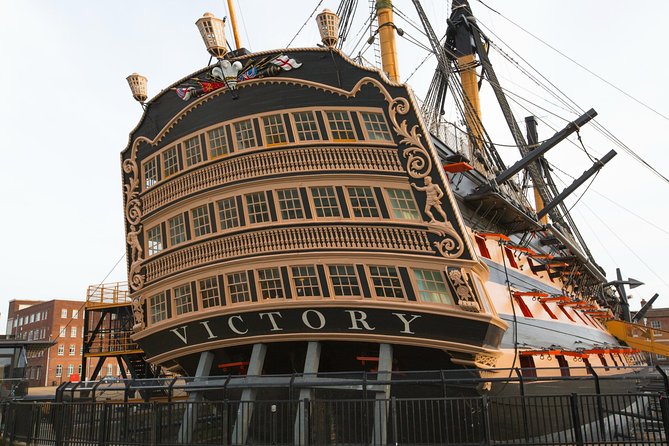
HMS Victory’s stern gallery
–On this day in 1805, Lord Admiral Horatio Nelson won his greatest victory–and his last, for he was fatally shot by a French sniper–at Trafalgar, off the Spanish coast. Nelson’s flagship that day, HMS Victory, a 104-gun ship of the line, is in dry-dock as a museum in Portsmouth, and I got to visit it.
It was kind of a big deal.
When Nelson was killed, they put his little body (he was about 5′ 4″) in a cask of spirits to preserve it on the voyage back to England. Rum on Royal Navy ships was known grimly thereafter as “Nelson’s Blood.” His coffin, carved from the mast of a French ship he’d defeated in battle, was immense–as is his tomb in St. Paul’s–both indicative of his ego, not his stature. He insisted on wearing his array of medals—only North Korean generals have more—which is what made the sniper pick him out. Shot in the spine, he died belowdecks on Victory, where the spot commemorated with a simple brass plaque.
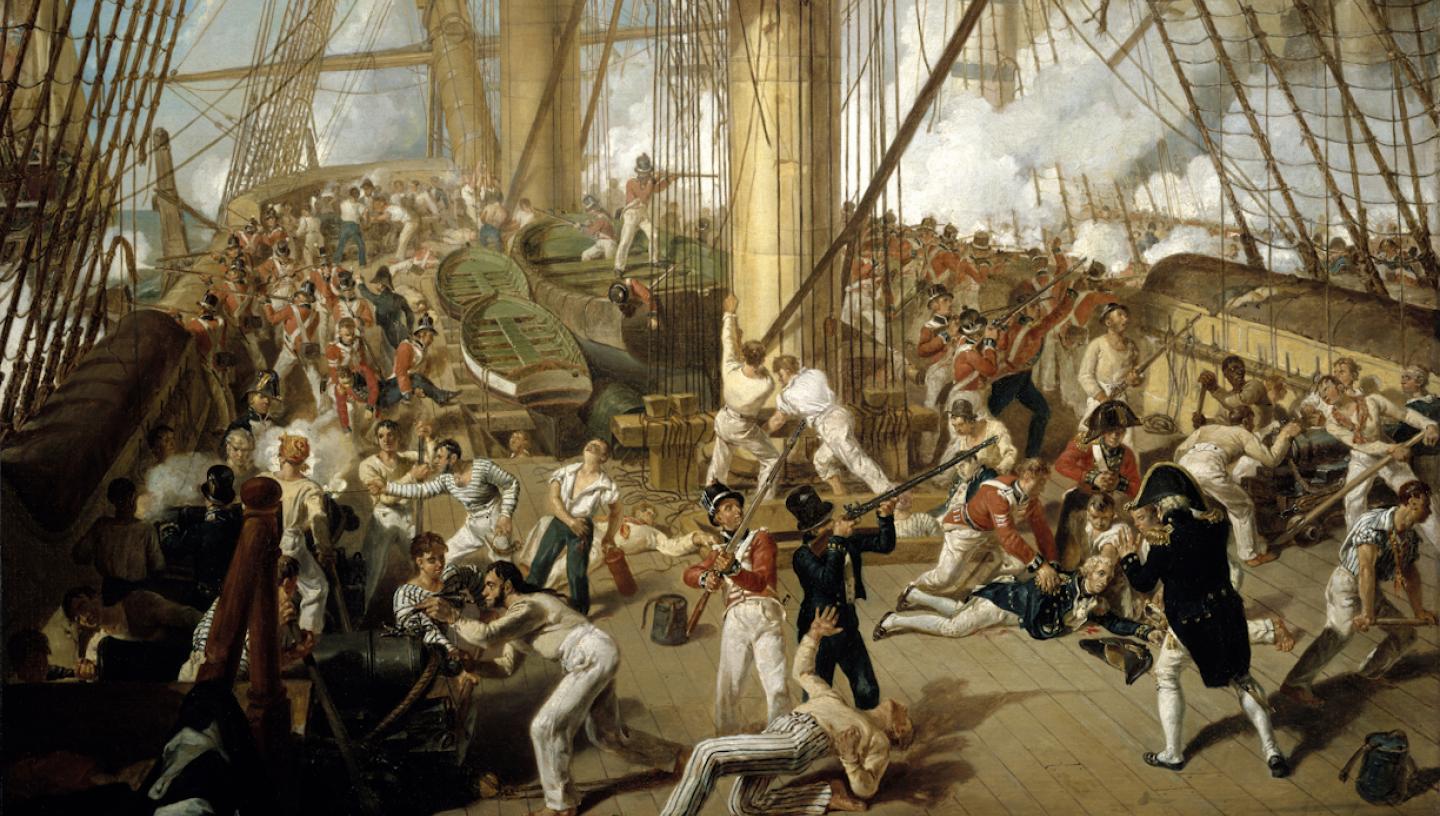
Nelson is shot at Trafalgar–he’s fallen to the deck at center-right. A young midshipman, depicted here just below the mast, aiming his musket, took credit for killing the sniper.
In his years of service, he’d lost an arm and an eye. At the Battle of Copenhagen, the admiral commanding signaled the British fleet to withdraw. Nelson aimed his telescope at the flagship, but he was looking through it with his blind eye. “I see no such signal,” he remarked. And proceeded to win the battle.
Nelson’s attack at The Nile; the British ships are in red.
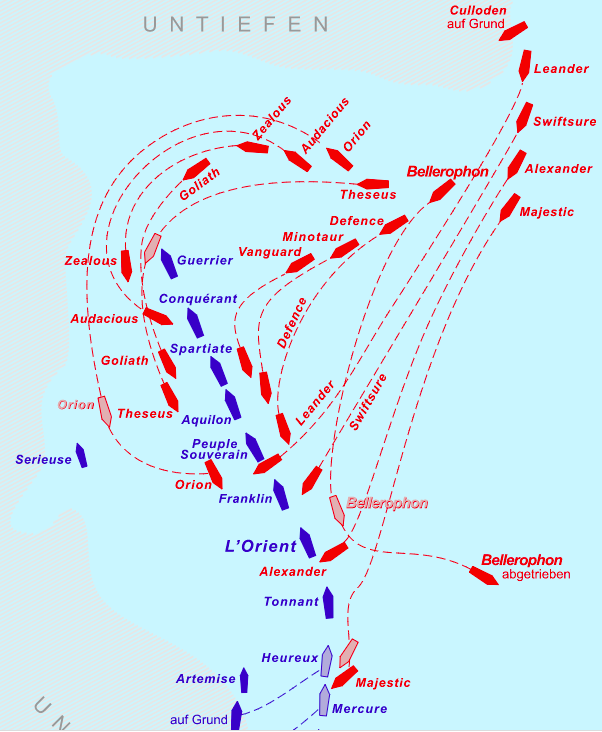
And, earlier, at the Battle of the Nile, the combined French/Spanish fleet anchored their battle line in shoal water, close to the Egyptian shore. No ship, they thought, could outflank them to engage their larboard guns. That’s exactly what Nelson did, risking grounding his ships and having them blown to splinters as a result. The British lost no ships that day; they sank four enemy ships and captured nine more.
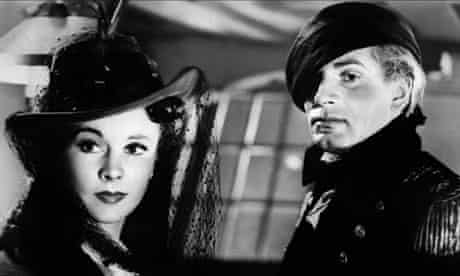
The little admiral’s life ashore was scandalous. He began a torrid affair with Emma Hamilton, the wife of a British diplomat. Eventually the two lived as man and wife, doing their daughter the great disfavor of naming her “Horatia.” When, during World War II, the film That Hamilton Woman was made—Olivier as Nelson, Vivien Leigh as Emma, it’s said that the PM, Churchill, wept copiously at its conclusion.
Leigh–not long after her role as Scarlett O’Hara–and Olivier, That Hamilton Woman.
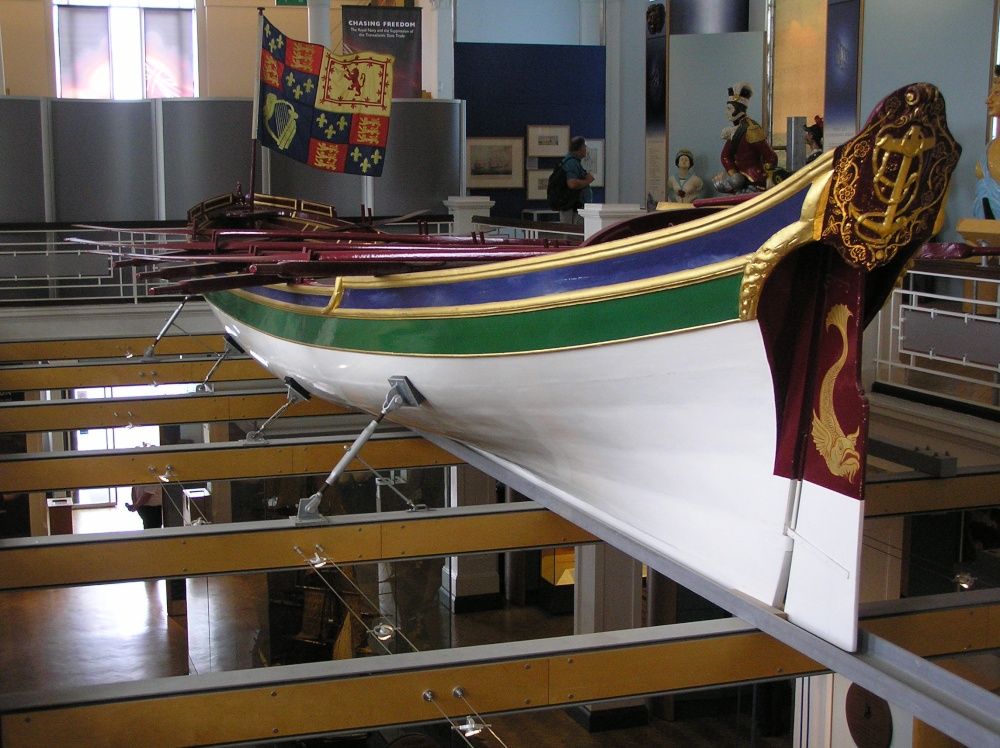
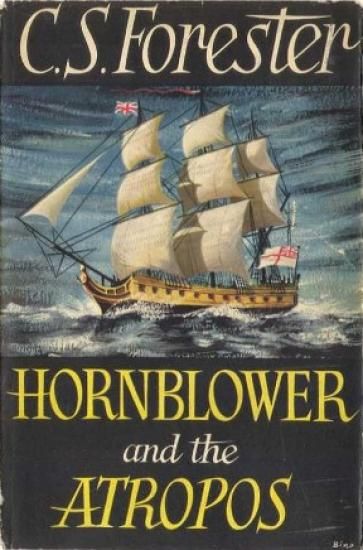
The Royal Naval Museum even has Nelson’s funeral barge on display–it processed up the Thames to St. Paul’s–and one of my favorite Horatio Hornblower moments, in Hornblower and the Atropos, has him, as a young officer, commanding the barge crew. It springs a leak and the crew has to bail desperately to prevent Nelson’s coffin from sinking into the Thames and so into the deep mud of the riverbed.
The barge that gave Hornblower so much trouble.
Hornblower had hard luck with leaks.(Like Nelson, he was also prone to violent seasickness.) As a young lieutenant, his first command was a French merchant ship taken as a prize; he was to bring it into port. Unfortunately, the ship’s hull was holed, and it began to flood. Even more unfortunate, the ship’s cargo was rice, which, of course, expands when wet. Goodbye, first command.
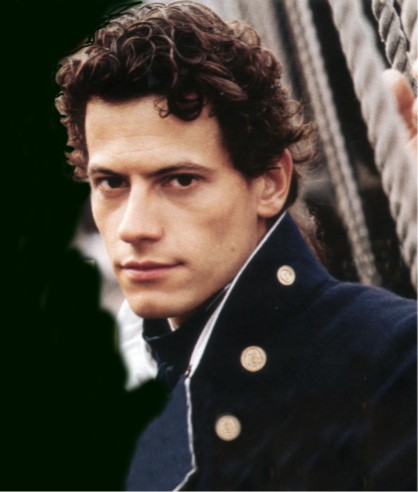
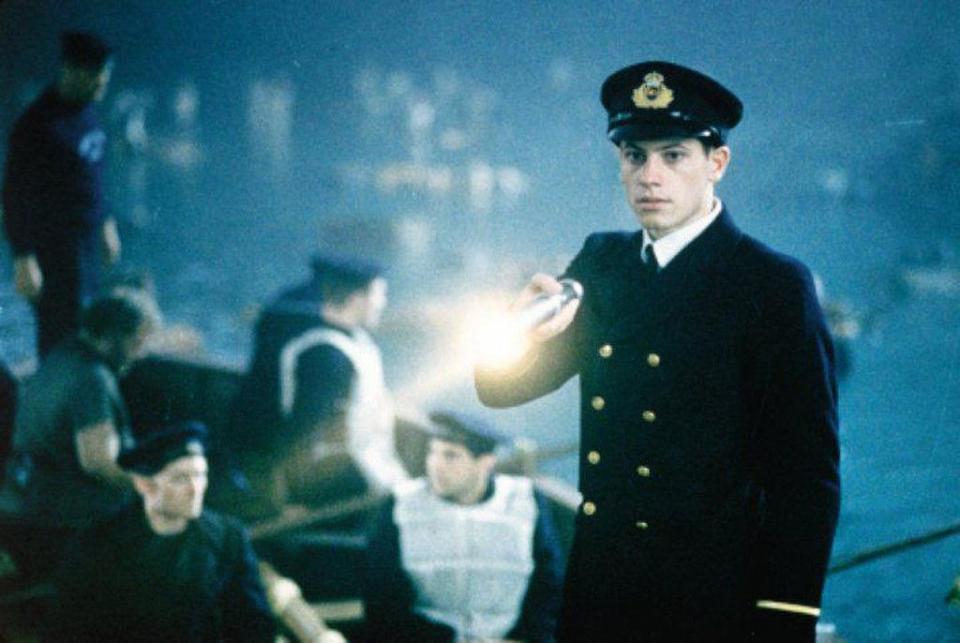
Ioan Gruffudd was the young Welsh actor who did a fine job as Hornblower in a television miniseries. Gruffudd has a nautical background–the commanded the lifeboat that rescued Rose in Titanic.
The Hornblower novels were my first “adult” reading. Dad brought a set home from the war, published by Little, Brown. Dad got to see “Victory,” too, when he was a soldier, and we had a tin, once home to a nest of hard candies. Mom used for her sewing kit; on its lid was a beautiful painting of the ship. I wish we still had it.
Victory fired cannonballs weighing 12, 24 or 32 pounds, any one of which could ruin your whole day. Gun crews worked belowdecks where the interior hull was painted red to soften the shock of casualties. Here she is delivering a rolling broadside, from bow to stern.
In a way, the Nelson-era navy lives on. Some expressions we get from the times:
Turn a blind eye: At the 1801 Battle of Copenhagen, Nelson’s superior hoisted signal flags ordering a withdrawl. When this was pointed out to Nelson, he raised his spyglass to his blind eye and announced that he saw no such signal. He continued fighting. The British won the battle.
Three squares a day: Royal Navy sailor were served their meals on square plates.
Groggy: The effect of having a bit too much “grog,” or rum. The standard issue was one-eighth of an imperial pint per day. The stuff was 95 proof (!), so it was diluted with water.
Three sheets to the wind: Another way of indicating a grog overdose.
Over a barrel: Not a good place to be. Sailors were wrapped around a cannon carriage for corporal punishment
Let the cat out of the bag: The “cat” was the cat o’ nine tails, a whip with nine knotted rope ends that could inflict terrible wounds. It was kept in a canvas bag only to be drawn out, for dramatic effect, when a ship’s company witnessed the whipping of a miscreant shipmate.
Freeze the balls off a brass monkey: A “monkey” was the receptacle–shaped a little like the holder for billiard balls–on which cannonballs were stacked. Iron contracts in cold weather, and sometimes the cannonballs would come tumbling off their stack.
Pipe down! The bosun’s mates blew a shrill whistle at 8 p.m. That was signal to glow belowdecks and rig your hammock.
Clean slate: The officer of the watch would note conditions–ship’s speed, wind direction course corrections–on a black slate. When a new officer assumed watch, the slate was wiped clean.
And, finally, two reminders of what these incredible men endured.
Flying splinters: In Master and Commander, the French superfrigate Acheron emerges from dense fog to ambush Aubrey’s HMS Surprise.
What lifts this film above your typical escapist fare is the friendship between Aubrey and his dearest friend, the ships’ doctor, Maturin. The two are replicas of Kirk and Spock: Aubrey’s passionate Romantic is pushing aside Maturin’s Enlightenment scientist. Only two things bind the two: their love for each other and their love for music. This just might be my favorite scene. Aubrey has just captured his nemesis, Acheron, only to discover that he’s been hoodwinked. So, since they have plenty of time, given this Age of Sail, Aubrey and Maturin turn to Boccherini.
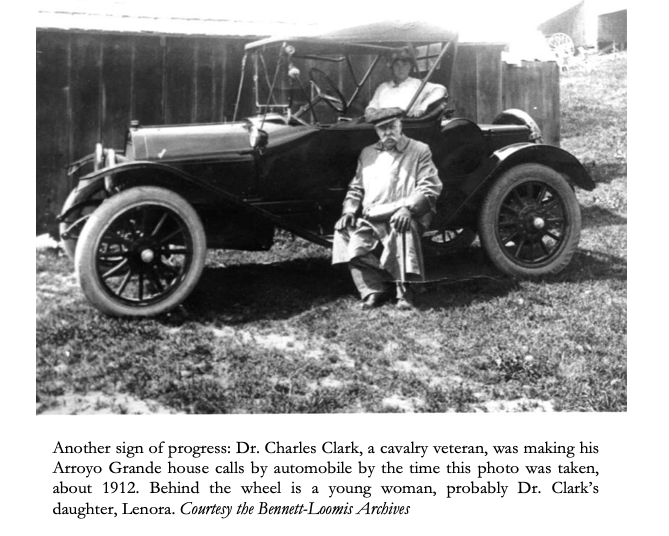
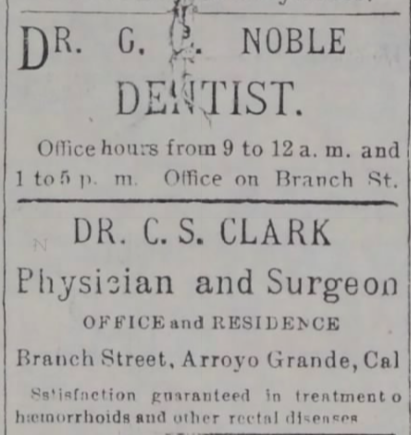
Dr. Charles Clark was Arroyo Grande’s “baby doctor” for many years until his death in 1916.
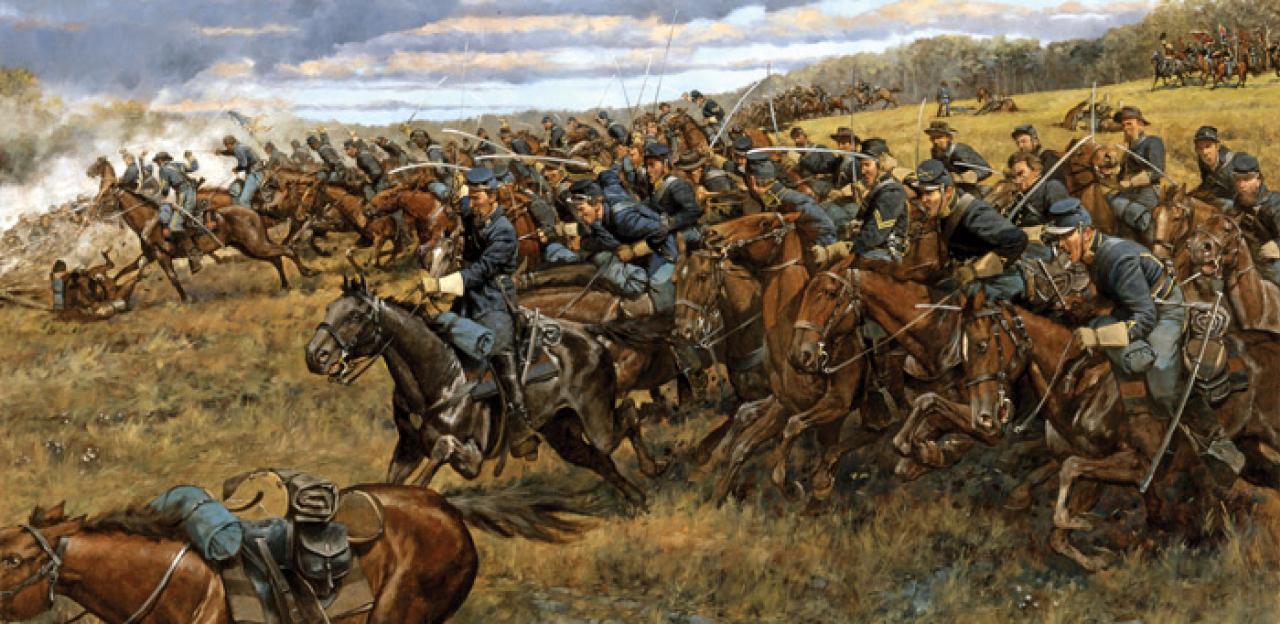
During the Civil War, he was a seventeen-year-old member of the 1st New Jersey Cavalry under George Custer–and he fought at Sailor’s Creek in 1865, the battle depicted in the painting.
Even after the war, Clark’s attention was turned toward the…er…south.
I’m seeing how much I can find about his practice–his office was on Branch Street, I think near today’s Branch Street Deli–and it’s kind of shocking. Doc Paulding seems to have been the town’s primary doctor–he was a superb orthopedist–but even pediatrician Clark had to sew up the occasional adult who had an extra smile added to his cheek, the result of a knife fight. (This one was the result of an argument between farm laborers in the Upper Arroyo Grande Valley.)
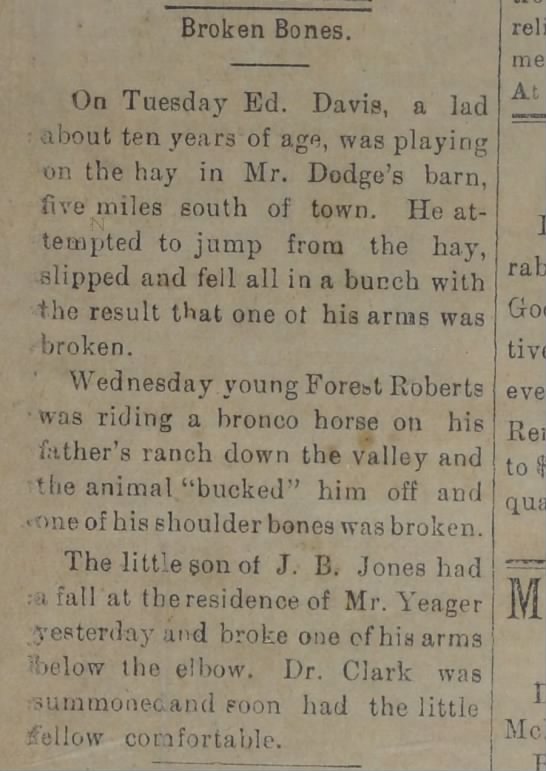
Being a child in the early 1900s wasn’t all that safe, either. I’m finding injuries caused to children by a mower (a bean-cutter killed one of our Civil War veterans in the Huasna Valley. He fell into it and his horses dutifully kept pulling), accidental shootings, runaway horses, burns caused by “manufacture of a steam engine out of a carbide can” by some future scientist (maybe not); he tended to his own son, Ed, a printer at the Arroyo Grande “Herald” whose fingers were caught in a press.
From 1894
The most tragic incident, because it could’ve happened to any of us, came when a young mother, tending to her kitchen, left her toddler alone in the parlor for a moment. The little girl fell into the fireplace. Clark was unable to save her life.
[Fire was a terrible hazard for Victorian and Edwardian widows. A year of mourning called for widow’s reeds of black taffeta, easily set alight by the open flame of a gas jet used to illuminate homes. All that was expected of widowers was a thick black silk armband around the sleeve of a suitcoat.]
Cars are dangerous, (Dr. Paulding never mastered his–it was dangerous when he was out and about on house calls) but so was travel by wagon. Clark tended to the victims of two wagon accidents. In one, a woman and daughter in a funeral cortege were thrown to the pavement and knocked unconscious when the wagon started suddenly and the rear seat tipped.
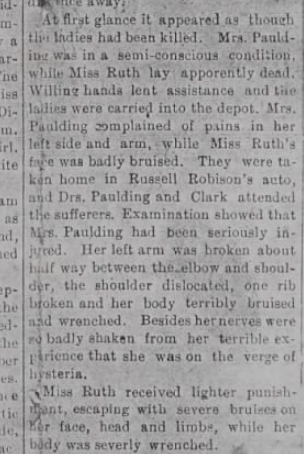
And in 1912, a PCRR electric utility car T-boned the carriage containing schoolteacher Clara Paulding and her daughter, future schoolteacher Ruth Paulding, for whom the middle school is named. The carriage was reduced to splinters–the horse, an admirable one, stayed in its traces–and Clark helped attend to the Pauldings. The family got a nice settlement from the railroad.
His death was an untimely one; he died at 70 on September 27, 1916. Two tears later, the Spanish Flu would arrive in Arroyo. The Paulding home became a temporary hospital, housing up to sixteen patients at a time, so my guess is that Dr. Clark was sorely missed.
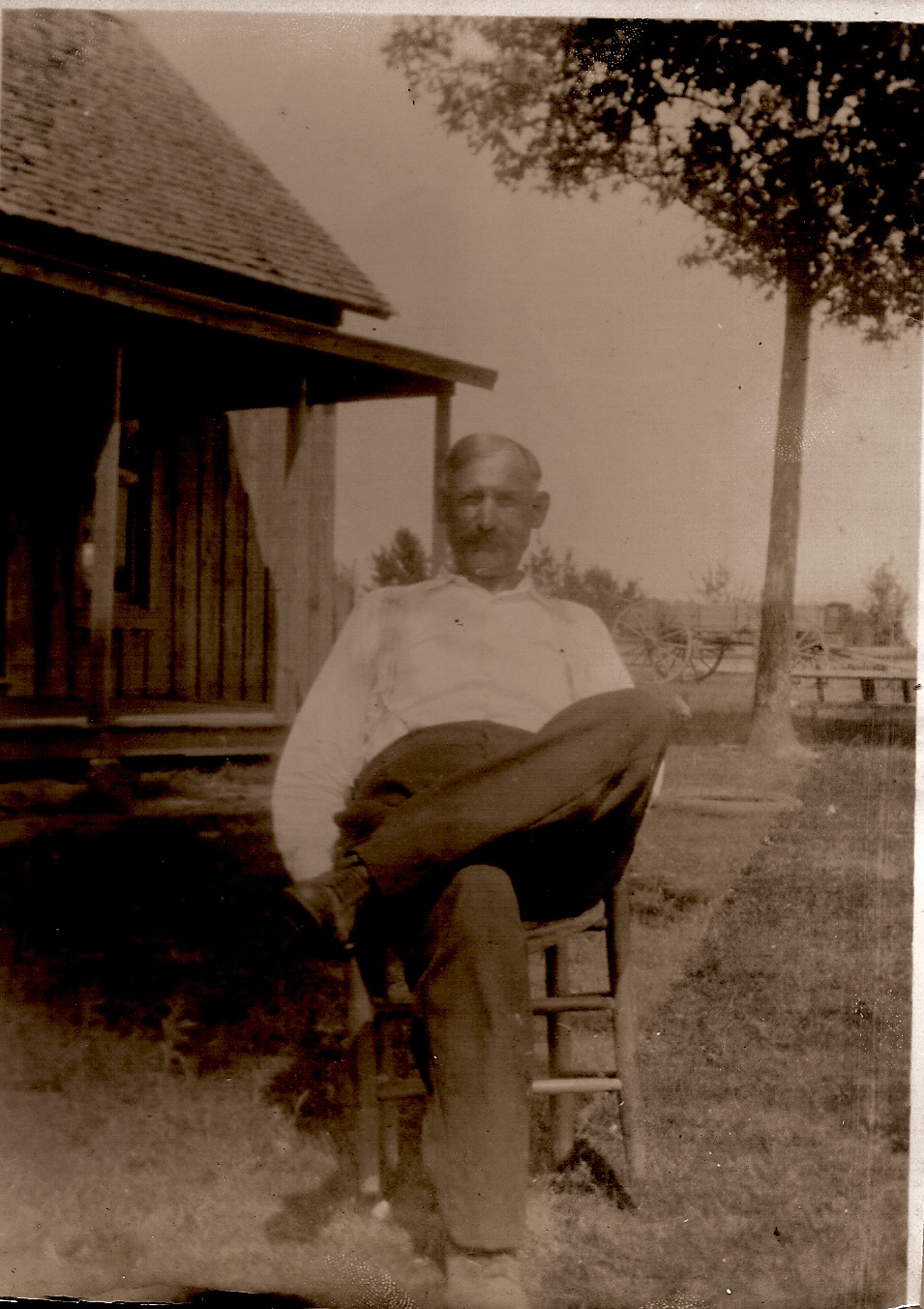
This is my grandfather John, in a photograph taken some time before his death in 1933, in front of his farmhouse in Texas County, Missouri, on the Ozark Plateau. I’ve written about him at length; he was, among other things, a graceful dancer; my grandmother was not amused by the queue of teenaged girls who waited their turn to dance with Mr. Gregory, who transformed the sawdust-strewn floors beneath their feet into polished glass.
This is the farmhouse today. The Ozark Plateau today is vastly different from my grandfather’s time.
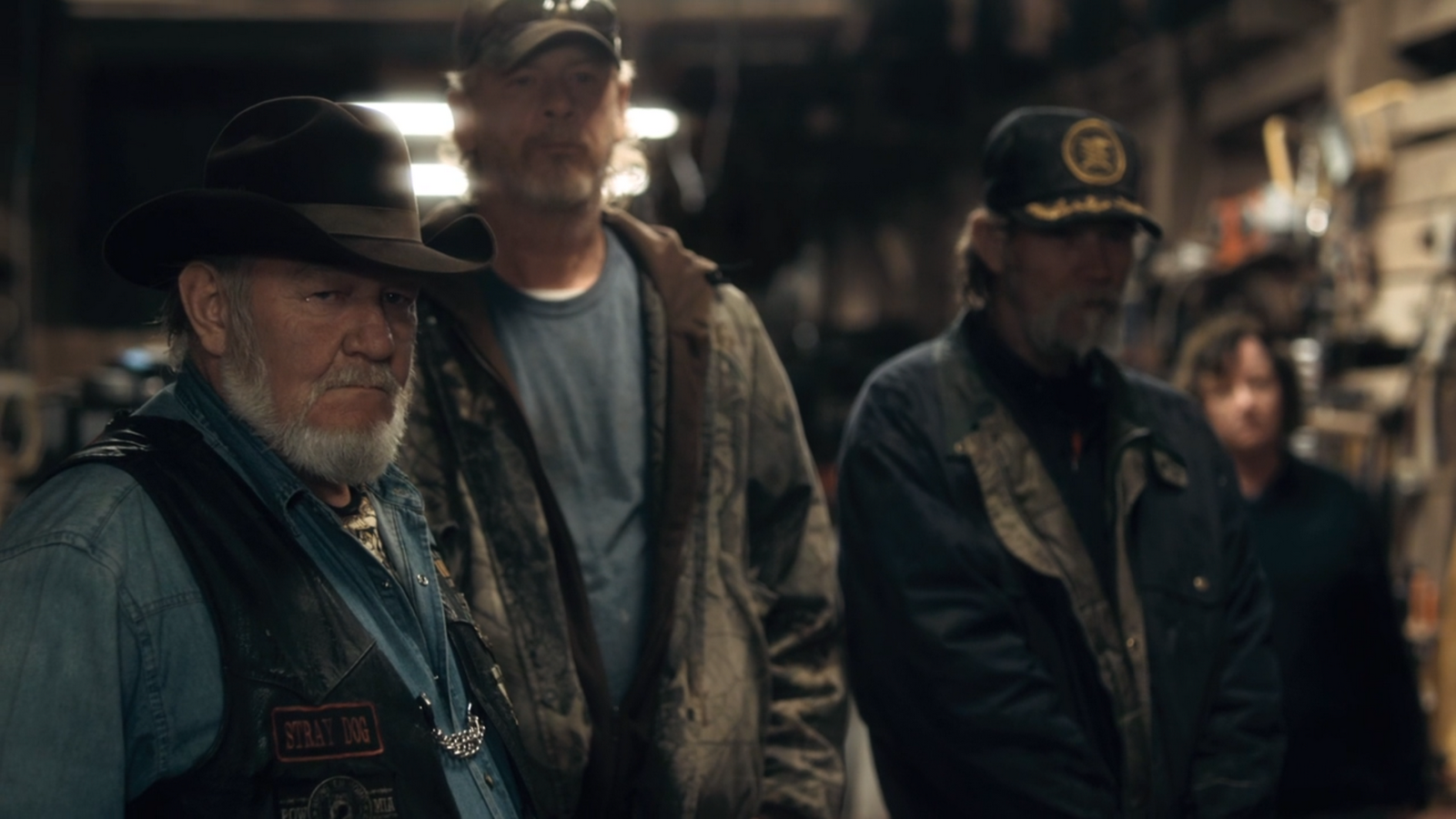
And John Gregory came to mind again because I watched again Winter’s Bone, the Daniel Woodrell novel that was committed to film in 2010 by a remarkable director, Debra Granik, marking the debut of a remarkable actress, Jennifer Lawrence.
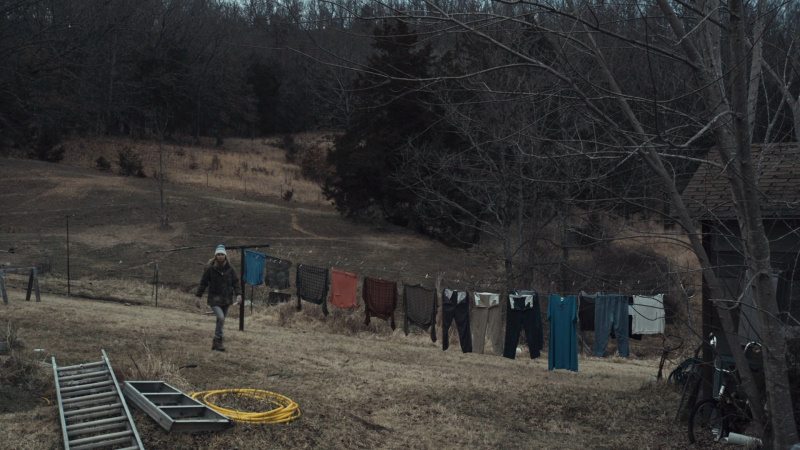
The film was shot two counties down from Texas County, hard on the Arkansas border, in Christian and Taney Counties (the latter named for the Chief Justice who rejected Dred Scott’s petition for freedom), and the story focuses on teenager Ree Dolly’s search for Jessup, her missing father, a bail-skipping meth cook who has seemingly left his wife and children to fend for themselves.
Ree must contend with dangerous people who suggest that her Daddy doesn’t want to be found.And maybe she doesn’t want to go looking for him.
The stolidity, the loyalty and the immense courage of Ree is humbling. What’s sobering is the desperation of this part of the Ozark Plateau, marked by yardfuls of wrecked cars that will never be salvaged and yard dogs, their ribs prominent, tied to stakes, that will never be let go. Always, in the background, there’s the bareness of Missouri trees in wintertime. Even they speak of hopelessness. It’s no accident that they’re the St. Louis Cardinals: one of the most beautiful sights of my life, when I was a student at the University of Missouri, was the sight of a bright-red cardinal, vivid among skeletal tree limbs, on a March day. Seeing him was a sudden and joyful shock. His presence marked the end of a winter of unrelenting grayness.
Those trees are important to Ree’s family. The hardwood on them is their only investment in the future; my grandfather, who possessed uncanny arithmetical gifts, was a part-time estimator for lumber companies. He could look into stand of hardwood and tell the company foreman, with precision, how many board-feet of lumber he and his crew would bring out.
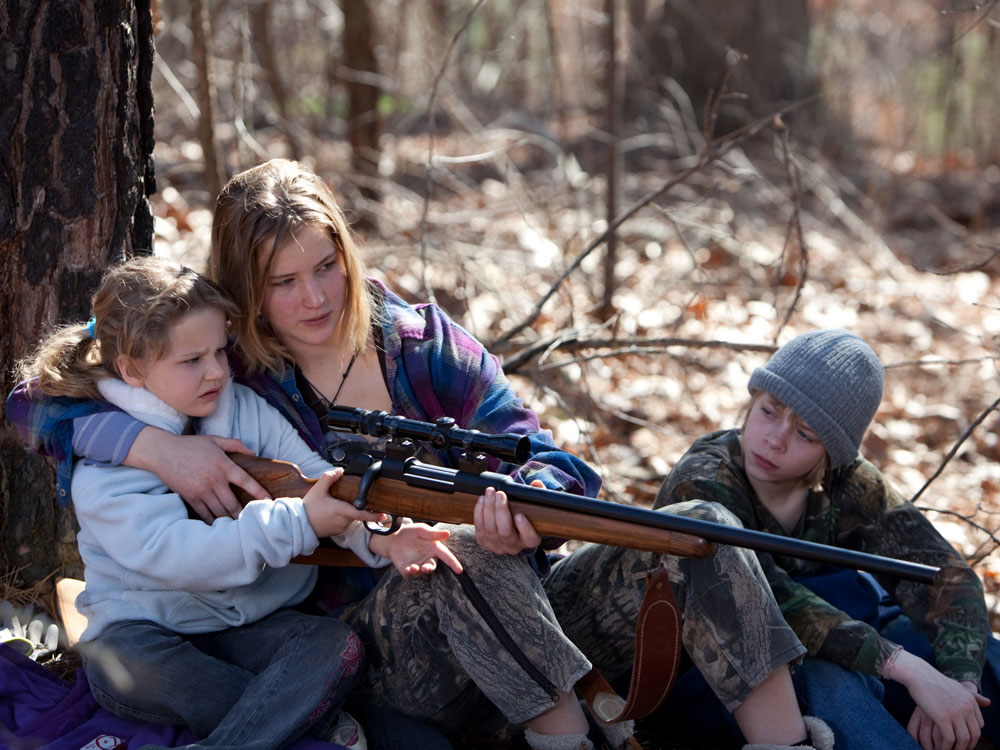
Lawrence, as Ree, keeps the family fed by hunting. She skins a squirrel in one scene; I’ve had squirrel stew but I couldn’t do what she did. (I’ve always admired Lawrence’s authenticity. A New Yorker writer met her for an interview in a Los Angeles Mexican restaurant and wrote admiringly that the actress “ate a burrito the size of a mailbox.”)
Squirrel hunting.
Throughout the film, there are constant echoes of Tudor England, in the grave formality with which people speak to each other—there is nothing so wicked in the Ozarks nor in Appalachia as offending another person’s honor—and in the music, fiddle and mandolin and guitar and banjo—that’s so evocative of Elizabethan times in the Midlands or Lowland Scotland.
Here’s an example. The singer is named Marideth Sisco.
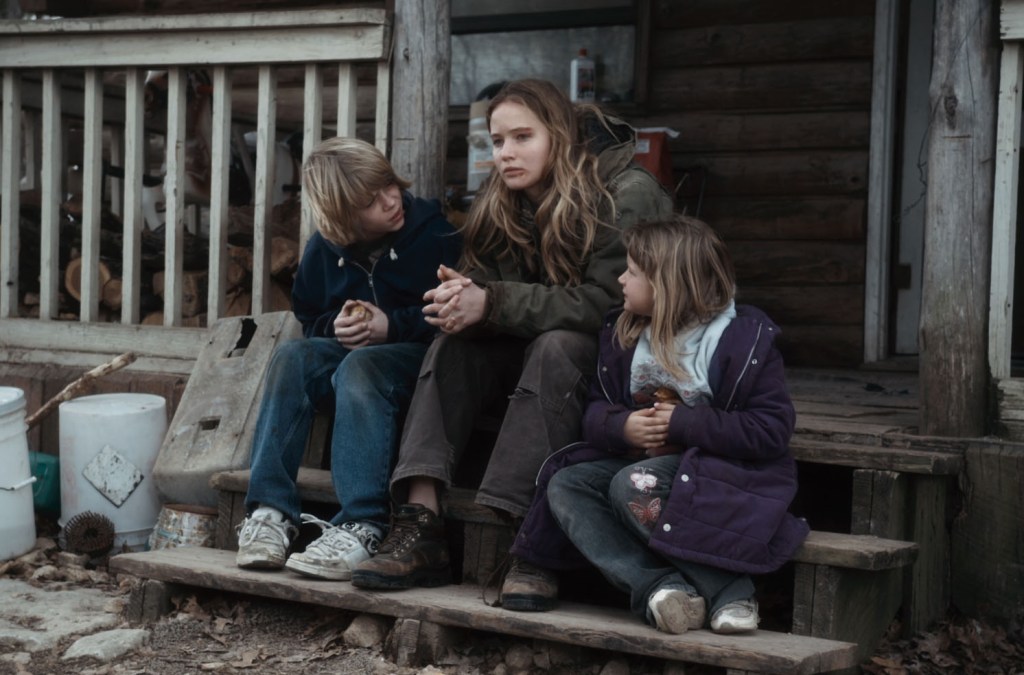
My favorite line in the film bespeaks the dignity of speech that so marks hill people. Ree’s father is missing and her mother is addled, so she is the surrogate mother to her little brother and sister. They are desperately afraid that Ree will give up on them and go away to join the Army.
“I’d be lost without the weight of you two on my back.” she tells them.
In the end, Ree finds her father. It’s a quest —she’s helped in a backhanded way by her uncle, Teardrop, played by another remarkable actor, John Hawkes, whose name is evocative of Tudor England—that she has to complete, even though you don’t want her to have to do it. You don’t want her to have to skin that squirrel, either.
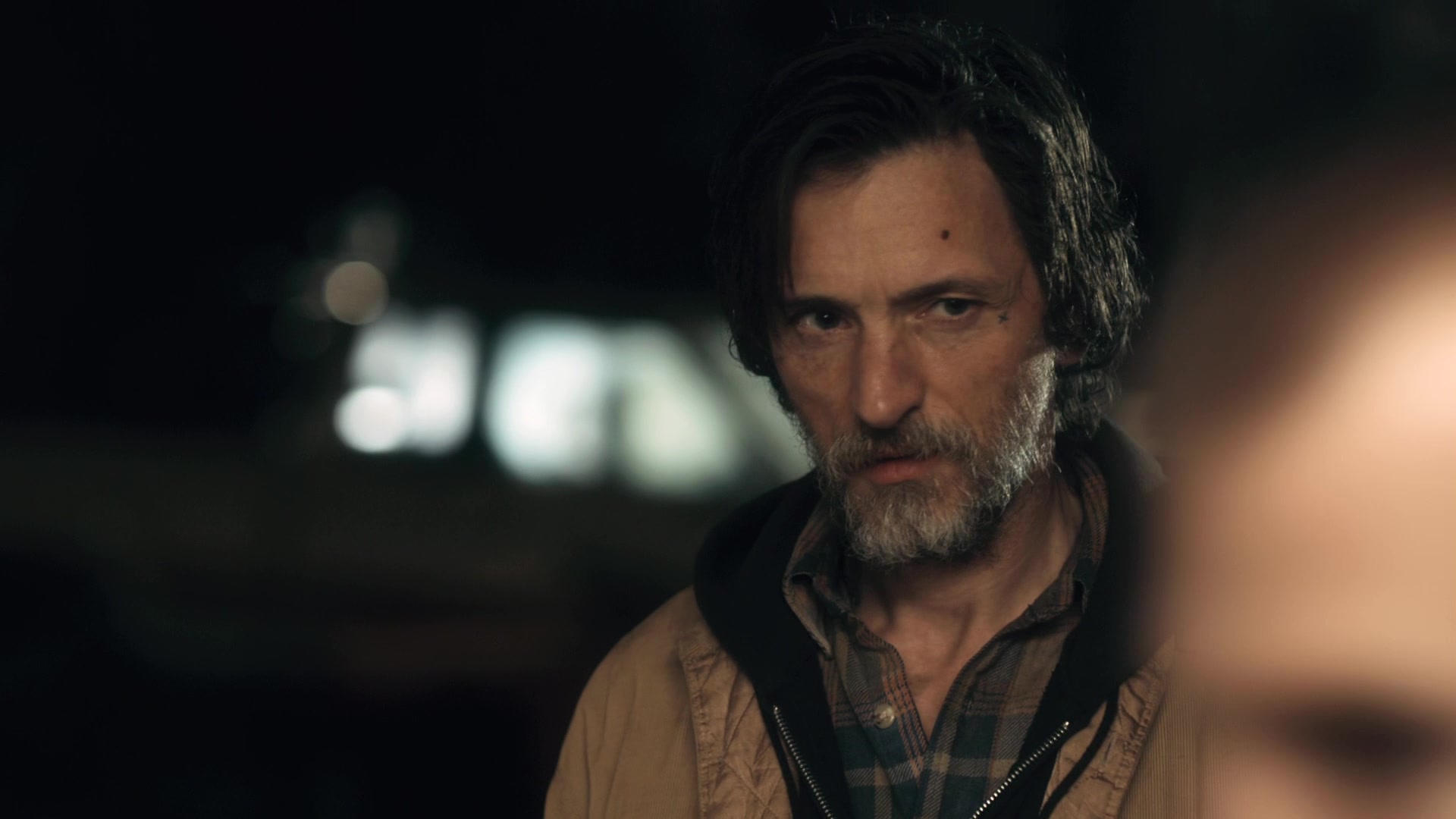
John Hawkes
But watching the film again reminded me of the desperation in that beautiful part of our country. I wrote about it a little in a little essay called “Ozark Death Wish.”
* * *
Texas County today is marked by the suffocation of Pentecostal and fundamentalist churches who keep vigilant watch over the ungodly, which probably includes a smattering of Episcopalians and Catholics. They’ve bought up nearly all the local liquor licenses to keep the area dry, in an Ozark variation on Sharia Law.
Life there is also marked by chronic and deep-rooted joblessness, by a thriving trade in meth and by meth addiction, and by violence. Sometimes, folks just vanish.
* * *
Just like Ree’s father.
In the end, it’s the most frightening of Ree’s antagonists—the women—who will help her complete her quest. The language emerges again when Ree first confronts one of them, a woman named Merab.
Merab: One of my nephews is Buster Leroy. Didn’t he shoot your daddy one time?
Ree: Yes, but that’s got nothin’ to do with me. They settle that stuff themselves, don’t they?
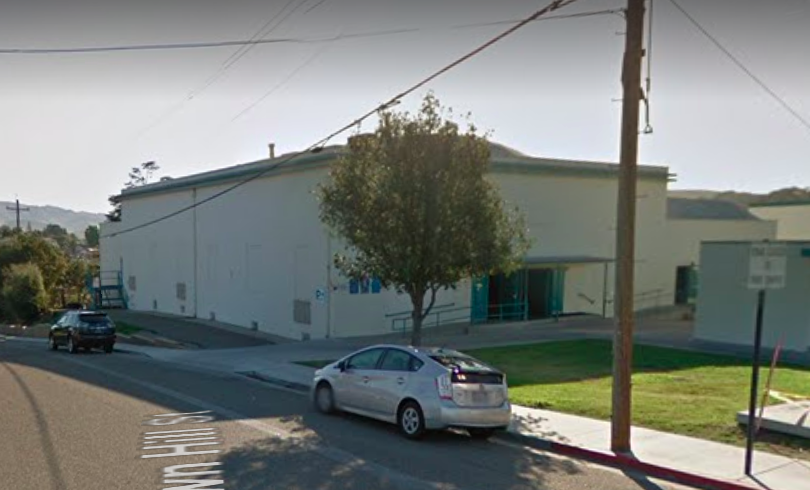
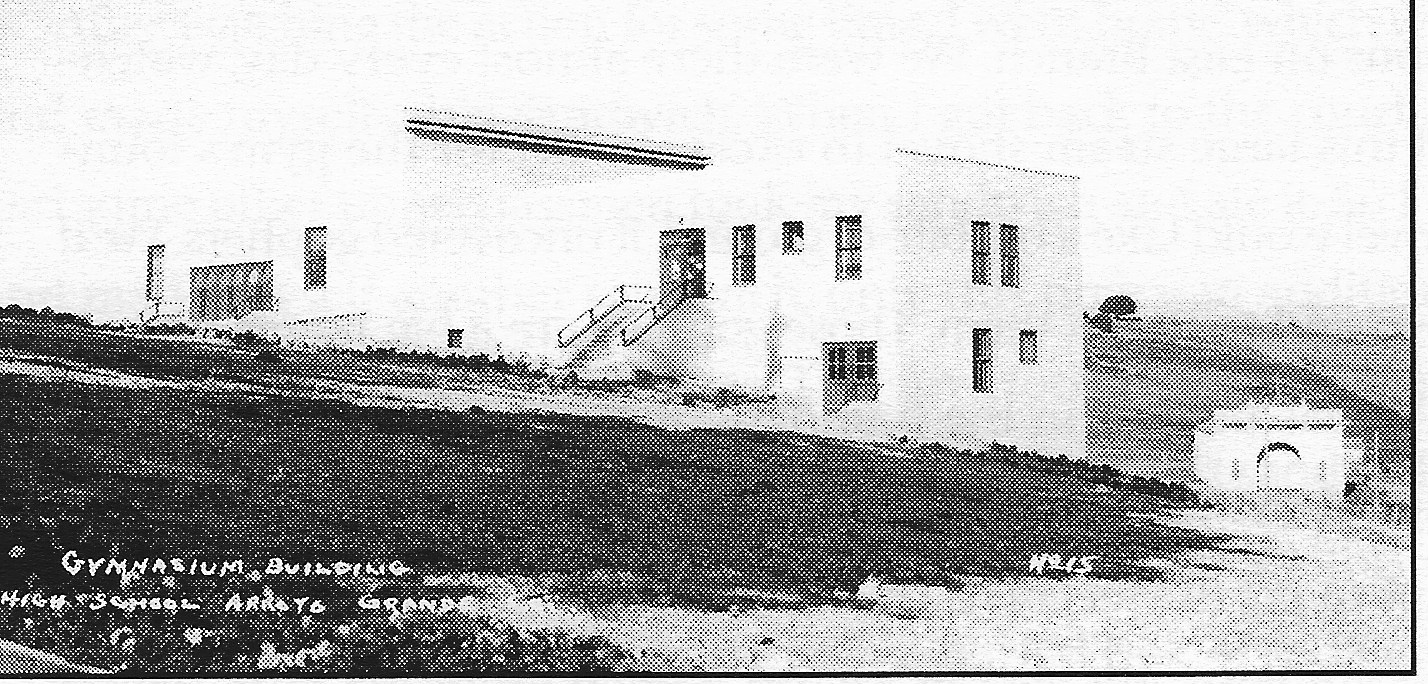
You wouldn’t think a structure as homely as this one—the Paulding Gym, taken from the Google Earth image—would be all that important. There was thought given to demolishing it at one time. That would be a mistake.
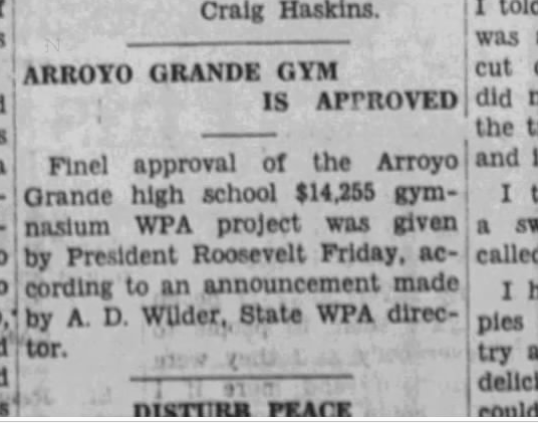
October 2, 1937, Arroyo Grande Valley Herald-Recorder
For one thing, Arroyo Grande sports fans had been wanting a high school gym—this would’ve been for the 1916 high school, atop Crown Hill—for many years. For another, it’s a legacy of American history, a small part (for a town of about 1,000 people in 1937, a big part) of American history. Along with the retaining wall below Paulding, the WPA stamps on Mason Street sidewalks and the stone fence around the town cemetery, it’s one of the last legacies of the New Deal.
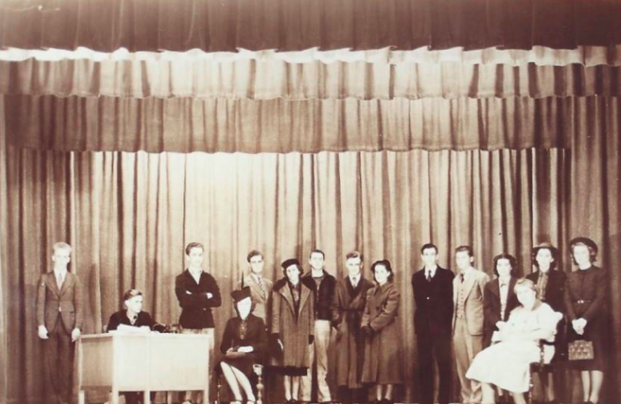
And in many ways, it hasn’t changed all that much. My son Thomas, then a Paulding student, acted in Mr. Liebo’s plays on the same stage these students are using in 1939.
And even the buildings nearby, at the base of Crown Hill, have some historical significance. Here’s another Google Earth image of the IDES Hall, built in 1948;
I don’t know that most people realize that this is the second IDES Hall, still a testament to the importance that Azorean immigration has had in Arroyo Grande’s past. Here’s another photo of the gym, from the 1930s, and at the right, you can see the first IDES Hall.
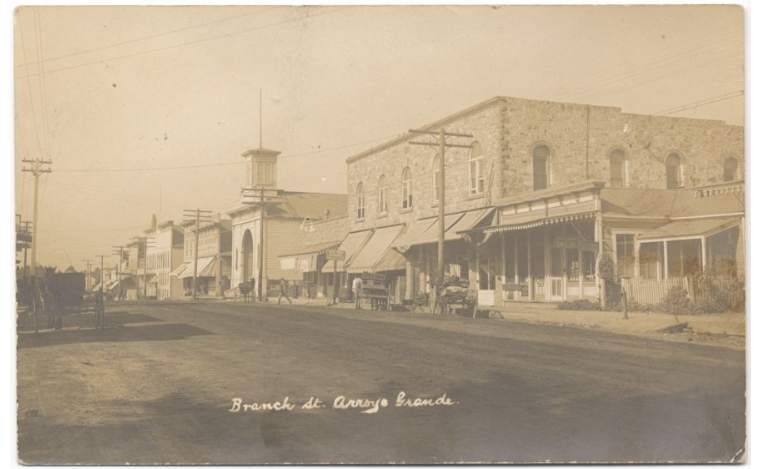
And that structure dates from the 1880s, built by the Phillips brothers, who owned a furniture store—one of their places is today’s Bill’s Place on Branch Street. But what you see in this photo is a sad remnant of a much grander, complete with steeple, Columbian Hall. Here it is, when it was still on Branch Street, in a photo taken about 1908.
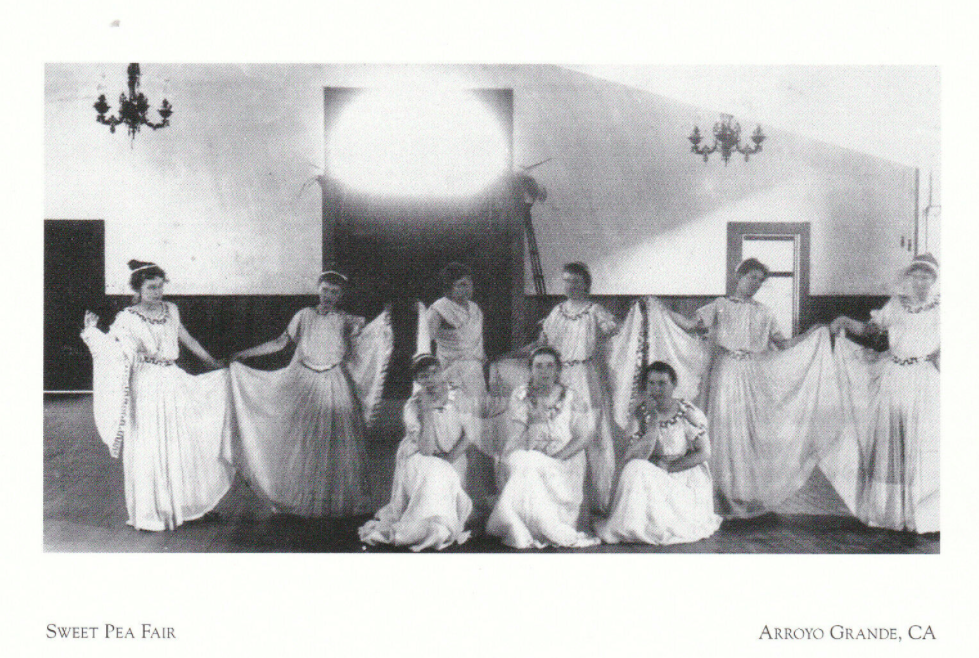
And the Columbia Hall was important—kind of an early 20th Century version of today’s Clark Center—that was the scene for everything from political meetings to Temperance lectures to recitals and plays. And dances: These young women, for all intents and purposes, are dancing in tribute to the local cash crop, the sweet pea, in the Columbian Hall.
By the 1930s, overcultivation of crops like sweet peas had just about done in the topsoil on the hillside around the Arroyo Grande Valley. 230 Civilian Conservation Crops youths from New York City, New Jersey and Delaware—their headquarters stood where today’s Woman’s Club stands–would begin to reverse the damage.
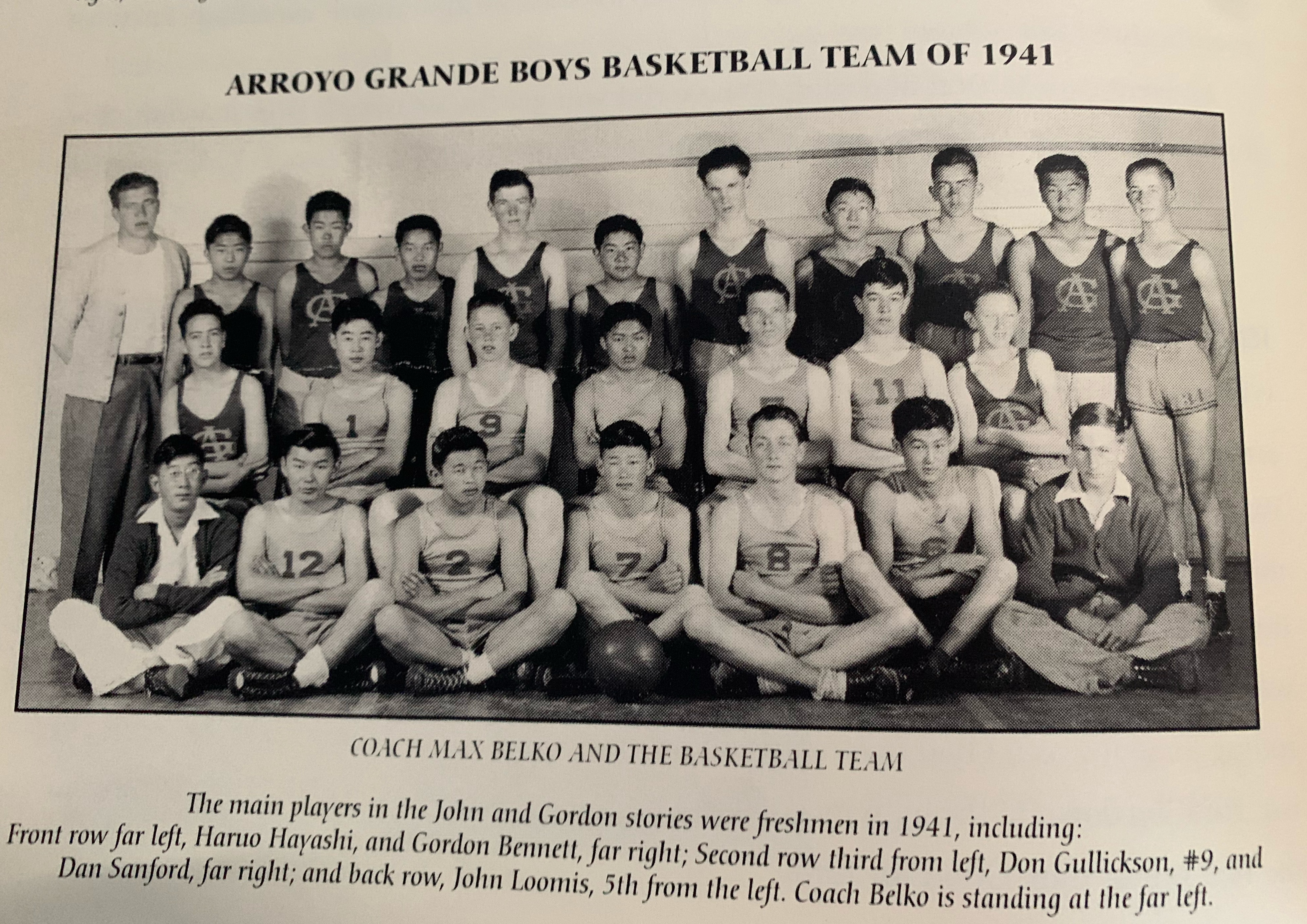
And by the 1930s, the new gym had a new coach. USC Trojan football star also coached basketball in that gym, and he brought a formidable reputation with him. Somehow, Belko, from a tough immigrant family, steelworkers, in Gary Indiana, had somehow escaped the attention of Notre Dame. USC was fine with that. His coach there, Howard Jones, called him “the finest example of a man I’ve ever coached,” and Belko, among other things, kicked a field goal against Montana in 1935. Inexplicably, USC wouldn’t kick another field goal for fifteen years. Frank Gifford kicked that one.
Here’s Belko and his basketball team, from Gordon Bennett and John Loomis’s book, The Old Days.
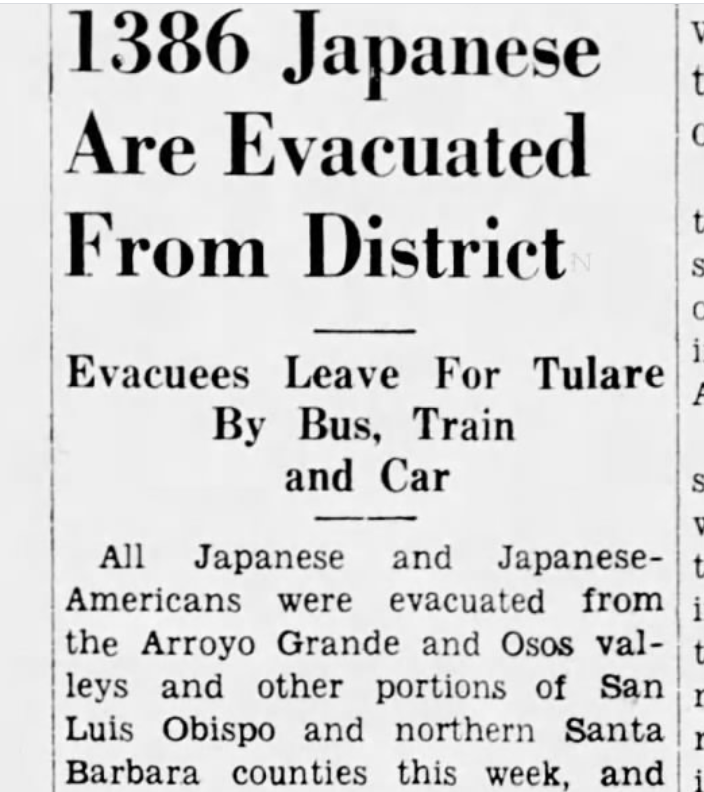
It’s not your imagination. There were a lot of Japanese-Americans who went out for basketball. That’s the next, tragic connection that the Paulding Gym has with history. On April 30, 1942, buses would assemble in the high school parking lot just outside to take local Japanese-Americans into internment. Among them were the Nisei seniors of the Arroyo Grande Union High School Class of 1942. There were fifty-eight seniors that year. Twenty-five were Japanese-Americans.
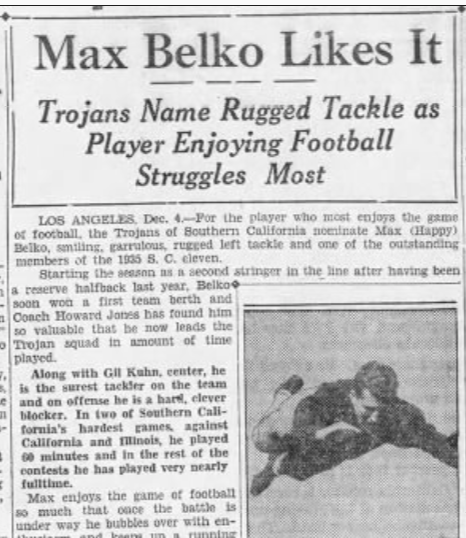
By then, Belko had left Arroyo Grande for a teaching position in Hanford. But the war would sweep him up, as well. The clipping below is from the August 14, 1944 edition of the Arroyo Grande Herald-Recorder.
There have been, of course, thousands of games played—volleyball and basketball—and hundreds of school dances and scores of plays in that old gym since Coach Belko’s time. And that’s been a long time ago. You wonder if the hopes and disappointments of the young people who once lived brief parts of their lives within its walls aren’t somehow still there, imprinted but invisible, invisible but powerful.
Among my favorite human beings are my high-school classmates Julian Brownlee and Mike Knecht. Mike is a writer and a (real) cowboy; Julian—named for his grandfather, Cal Poly President Julian McPhee—a standout athlete (football, baseball) with a marvelously dry sense of humor with whom I smoked my first cigarette, a Marlboro, in the St. Patrick’s Parish Hall in 1965.
That wasn’t very humorous, but it was my owned damn fault. I turned green.
And then—to show you how obstinate I am—the same thing happened shortly after, this time with a cigar called a Rum Crook, in the Fair Oaks Theater, during a film in which the Disney actress Hayley Mills (the original Parent Trap) appeared in a scene that revealed her nude rear end. That, and the Rum Crook, proved too much for me to tolerate. I think somebody—I don’t really remember who—found me sprawled on the sidewalk beneath the Coming Attractions, took pity on me, and drove me home to Huasna Road.
A little later, in high school, I found that there was a little knot of us in the AGHS Class of 1970—Julian, Joe Loomis, John Porter and me—who all shared January birthdays as well as given names that began with “J.”
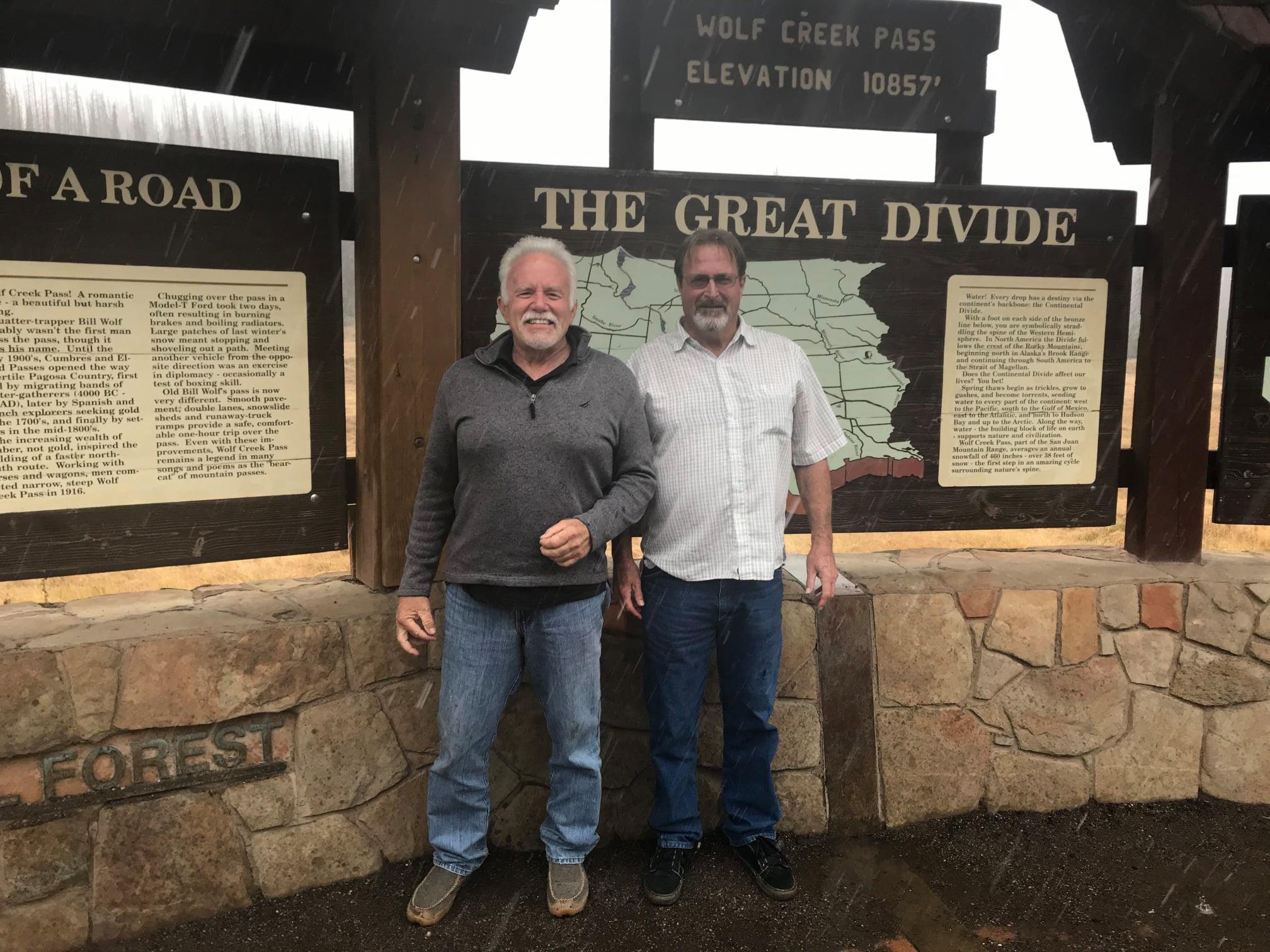
Anyway, Mike and Julian are currently on that road trip—Mike’s posting from time to time on Facebook—from San Luis Obispo County to North Carolina for a wedding, in Julian’s Subaru. (A fine car; we’ve owned three.)
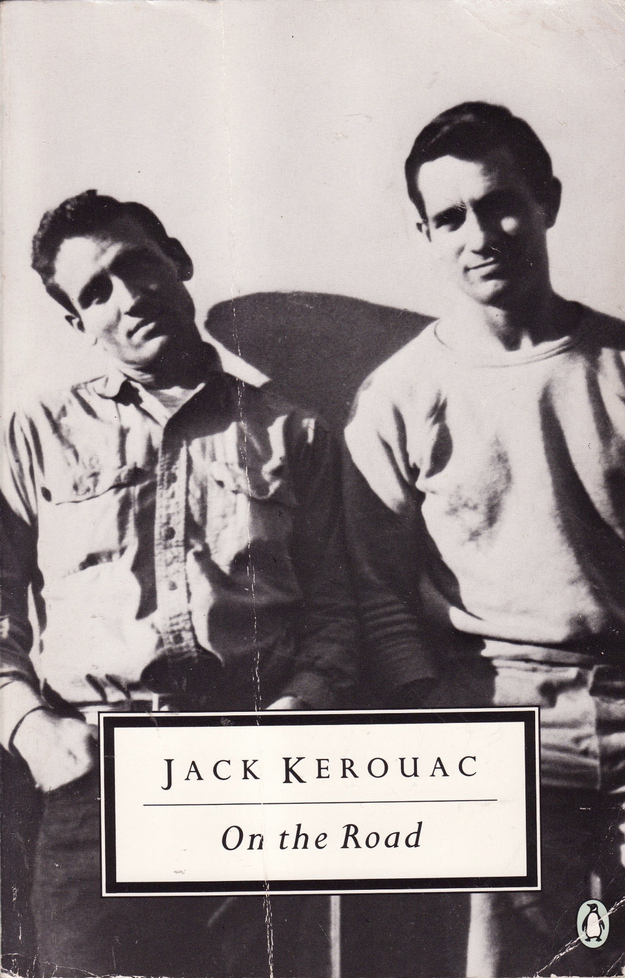
The photo shows them at the Great Divide. It has just occurred to me that they, heading east instead of west, are doing a Reverse Kerouac. These two may not know it, but not only are they are among my favorite human beings, but On the Road is among my favorite books.
Neal Cassady, left, and Jack Kerouac
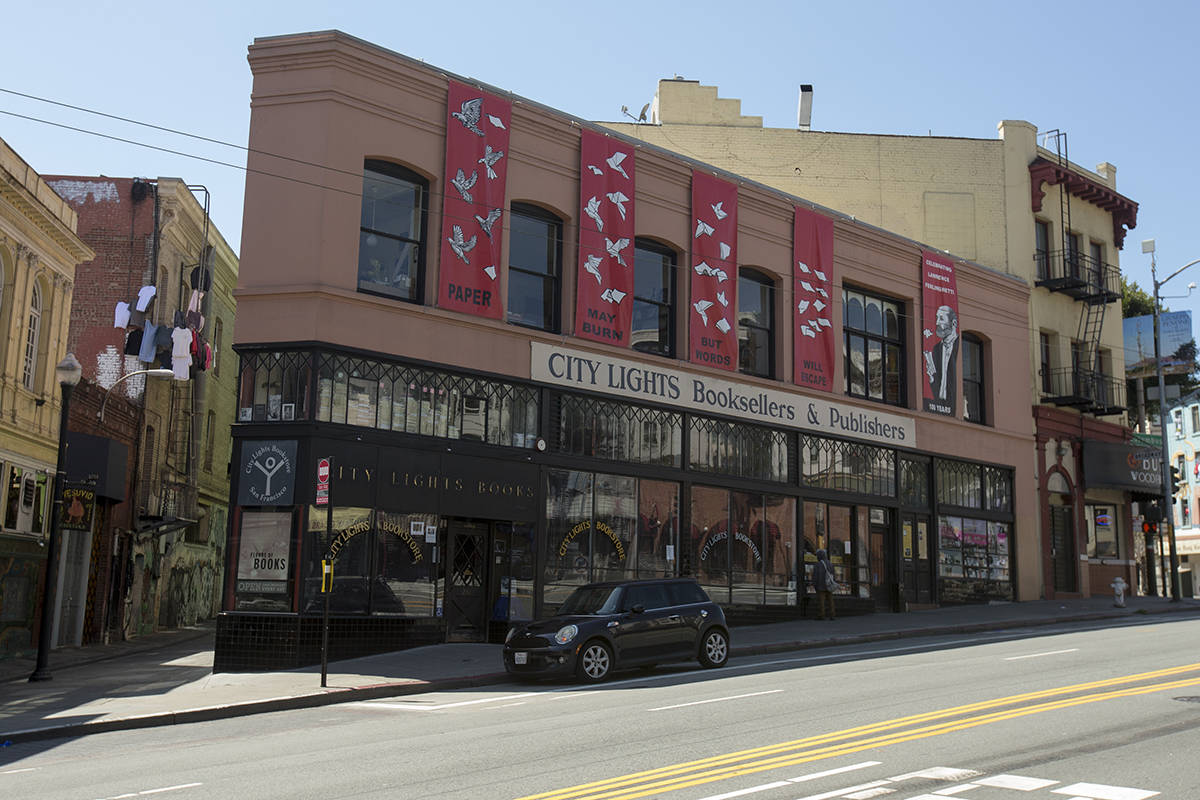
And Kerouac, while working as an SP brakeman, lived in San Luis Obispo for a short time. I get all Kerouacky when I go to my much-beloved San Francisco and visit the City Lights Bookshop, where another one of my favorite human beings, my former AGHS history student Erin Messer, works.
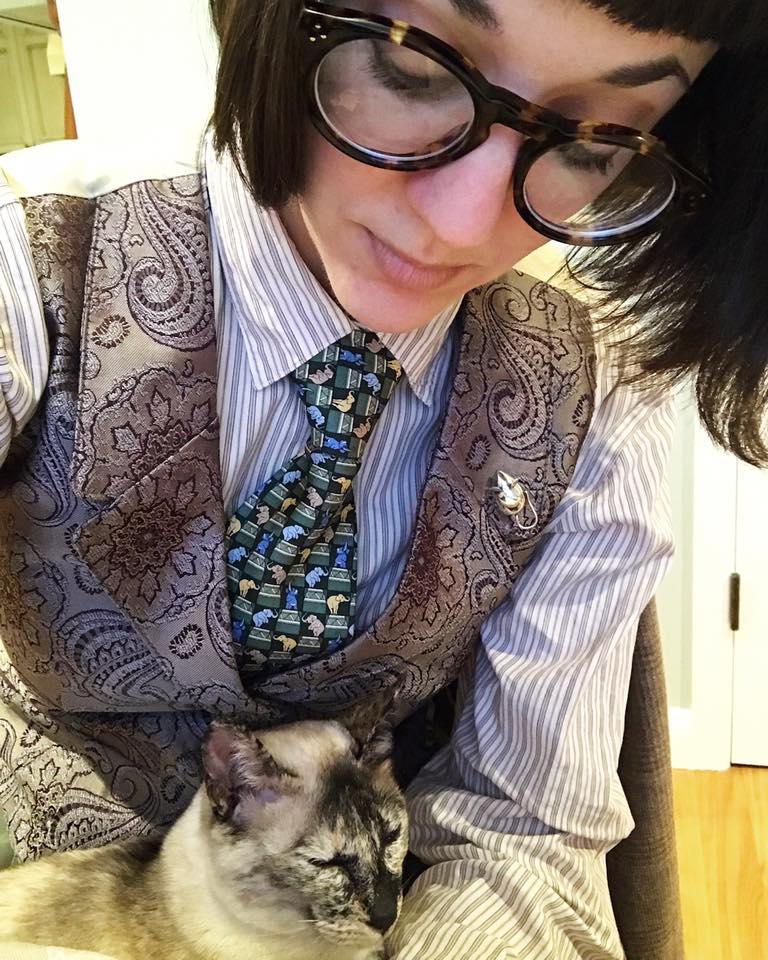
This is my favorite photo of Erin. We both like cats. Elizabeth and I acquired two cats early in our marriage, both calicos, named Hadley (after Hemingway’s first wife) and Bumby (the nickname for Hemingway’s eldest son).
It was a major gathering place for the Beats, including Kerouac, Cassady, Ginsberg and the City Lights founder, the poet Lawrence Ferlinghetti, who died recently.
I believe that he was more or less 140 years old.
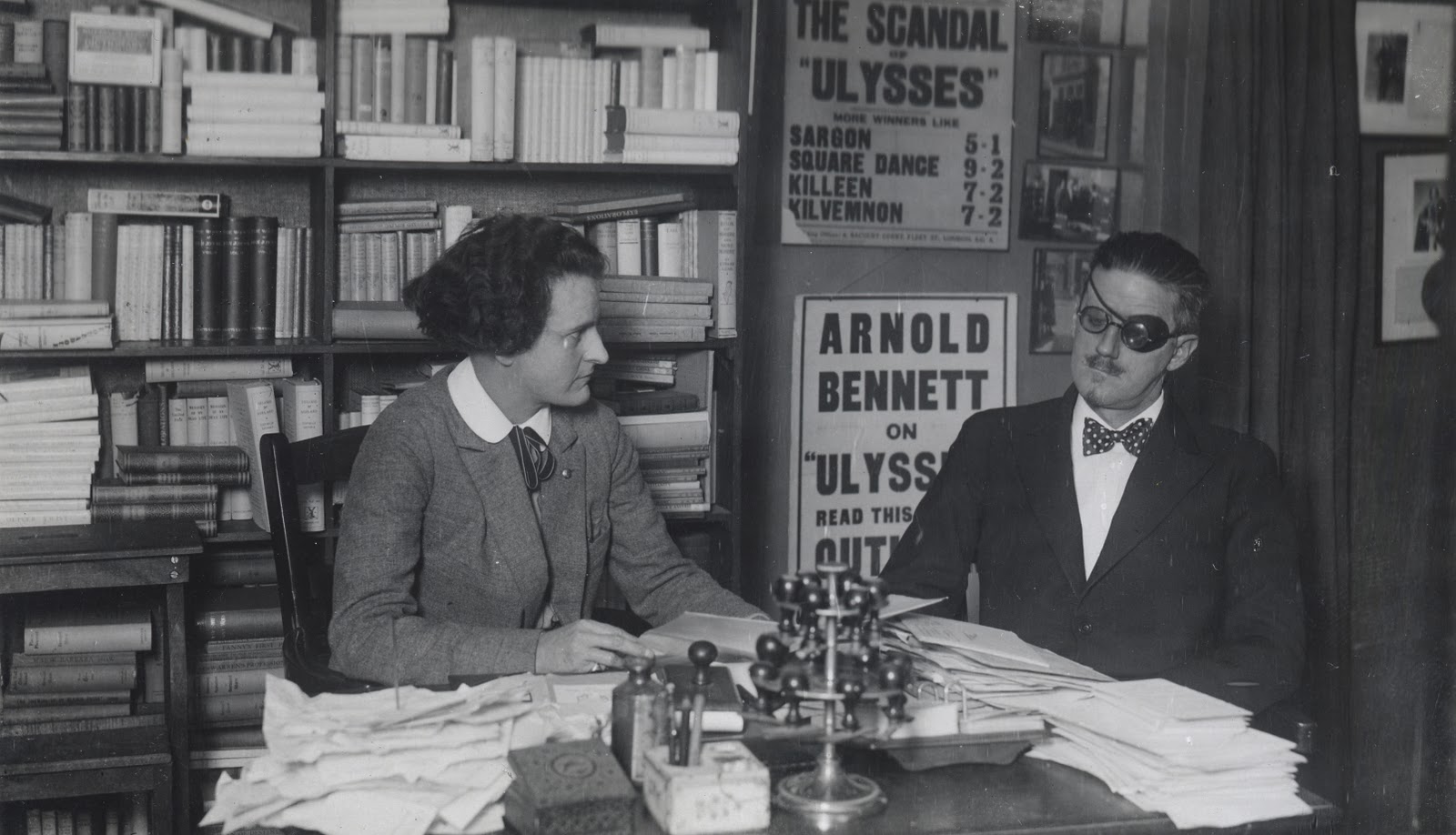
The only bookstore that comes close to City Lights is Shakespeare and Company, founded by Sylvia Beach–from Altadena, California, of all places–and it stands just across the Seine from Notre Dame. I’ve been to Paris twice, but I was too intimidated to actually go inside the bookstore that was once frequented by Ernest Hemingway, Scott Fitzgerald, John dos Passos, Ford Madox Ford, Pablo Picasso, Gertrude Stein and Ezra Pound. I’m just a little fellow.
It was enough for me to sip a latte the size of a soup bowl at a sidewalk cafe, Les Deux Magots, and gaze fondly at Shakespeare and Company’s facade. (Hemingway would’ve done the same, but with a Pernod, a pad of yellow lined paper and a dozen #2 pencils sharpened with his pocketknife.)
After I’d finished my latte, I got moderately but happily lost in the Latin Quarter, the old university section, with my nose almost against the glass of shop windows and looking around corners up narrow alleyways—an alley, in Europe, is called a “close”— once prowled by belligerent university students, thinking it was Poly Royal, armed with cudgels and fortified by red wine. The alleys, always in shadow, are 14th-century relics that somehow escaped Baron Hausmann’s reconstruction of Paris in the time of Napoleon III.
That was a good Lost. I think Mike and Julian are reasonable navigators, so they won’t get lost. They might run into a little culture-shock, like the time the guy hollered at me from a pickup truck in the Ozarks:
“Hey, boy!”
Actually, it was more like:
Sylvia Beach and James Joyce inside Shakespeare and Company
“Hey, BOY!“
I was 25 years old and walking to a hamburger stand in Licking, Missouri, for some French-fried mushrooms, an Ozark delicacy. I looked nervously for the Easy Rider Rifle Rack in the pickup’s cab, but it turned out that the man was just asking for directions.
But that’s another story. As to this current road trip with Mike and Julian, I don’t know which one is Kerouac and which is Neal Cassady. I don’t think that’s very important. It’s more important to have friends like these. We don’t see each other very much anymore, but every time Mike posts, our friendships are renewed.






















 A Work in Progress