
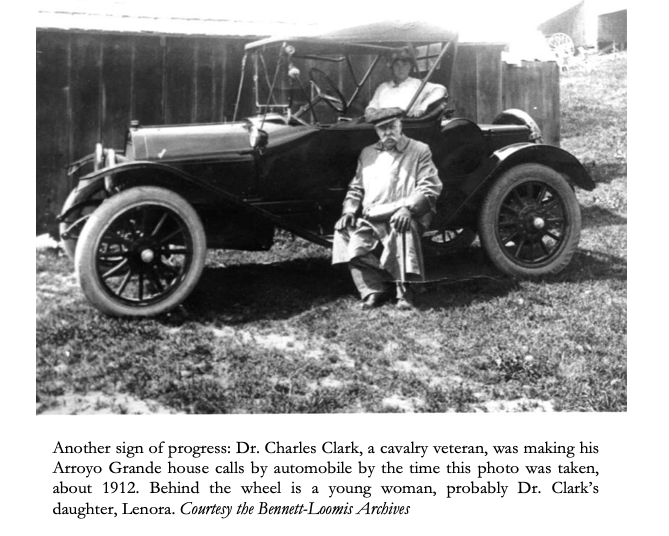
Dr. Charles Clark was Arroyo Grande’s “baby doctor” for many years until his death in 1916.
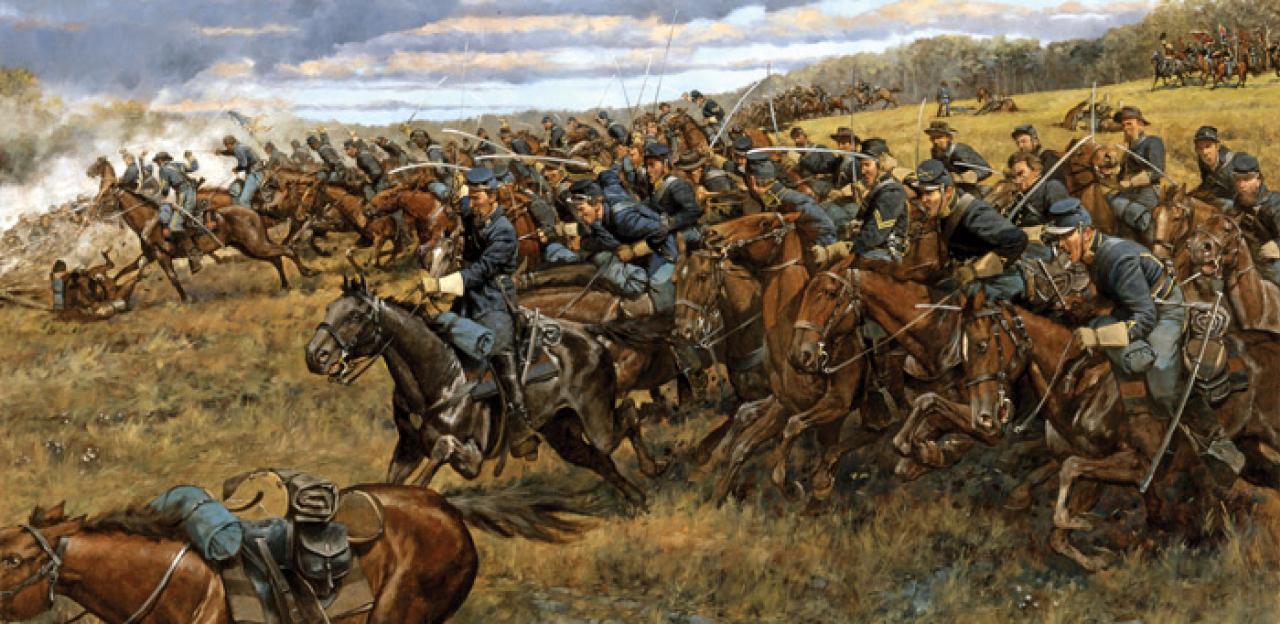
During the Civil War, he was a seventeen-year-old member of the 1st New Jersey Cavalry under George Custer–and he fought at Sailor’s Creek in 1865, the battle depicted in the painting.
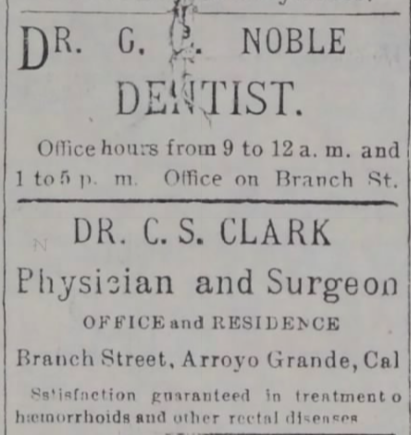
I’m seeing how much I can find about his practice–his office was on Branch Street, I think near today’s Branch Street Deli–and it’s kind of shocking. Doc Paulding seems to have been the town’s primary doctor–he was a superb orthopedist–but even pediatrician Clark had to sew up the occasional adult who had an extra smile added to his cheek, the result of a knife fight. (This one was the result of an argument between farm laborers in the Upper Arroyo Grande Valley.)
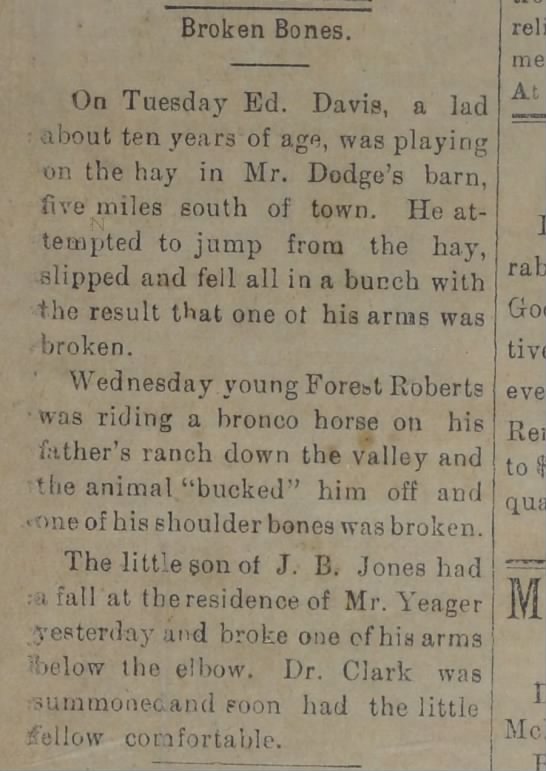
Being a child in the early 1900s wasn’t all that safe, either. I’m finding injuries caused to children by a mower (a bean-cutter killed one of our Civil War veterans in the Huasna Valley. He fell into it and his horses dutifully kept pulling), accidental shootings, runaway horses, burns caused by “manufacture of a steam engine out of a carbide can” by some future scientist (maybe not); he tended to his own son, Ed, a printer at the Arroyo Grande “Herald” whose fingers were caught in a press.
The most tragic incident, because it could’ve happened to any of us, came when a young mother, tending to her kitchen, left her toddler alone in the parlor for a moment. The little girl fell into the fireplace. Clark was unable to save her life.
[Fire was a terrible hazard for Victorian and Edwardian widows. A year of mourning called for widow’s reeds of black taffeta, easily set alight by the open flame of a gas jet used to illuminate homes. All that was expected of widowers was a thick black silk armband around the sleeve of a suitcoat.]
Cars are dangerous, (Dr. Paulding never mastered his–it was dangerous when he was out and about on house calls) but so was travel by wagon. Clark tended to the victims of two wagon accidents. In one, a woman and daughter in a funeral cortege were thrown to the pavement and knocked unconscious when the wagon started suddenly and the rear seat tipped.
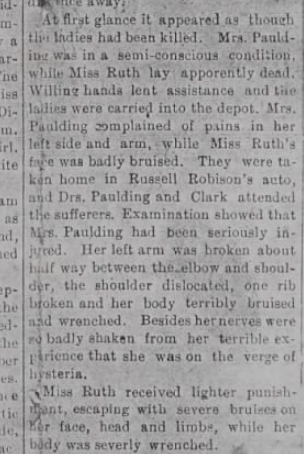
And in 1912, a PCRR electric utility car T-boned the carriage containing schoolteacher Clara Paulding and her daughter, future schoolteacher Ruth Paulding, for whom the middle school is named. The carriage was reduced to splinters–the horse, an admirable one, stayed in its traces–and Clark helped attend to the Pauldings. The family got a nice settlement from the railroad.
His death was an untimely one; he died at 70 on September 27, 1916. Two tears later, the Spanish Flu would arrive in Arroyo. The Paulding home became a temporary hospital, housing up to sixteen patients at a time, so my guess is that Dr. Clark was sorely missed.
 A Work in Progress