

Thursday, October 21, is a big day in history.
–USS Constitution was launched on this day in 1797. A 44-gun heavy frigate so well-designed that, during a ship-to-ship duel with the British frigate Guerriere, cannonballs bounced off her hull, earning her the nickname “Old Ironsides.”
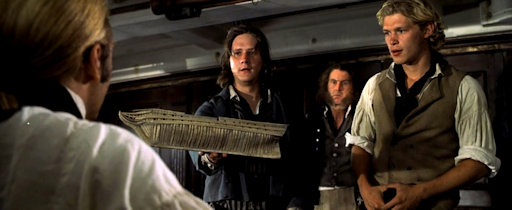
There’s a moment in the film Master and Commander when Russell Crowe, as Captain Jack Aubrey, studies a model of his nemesis, the Yankee-built frigate Acheron, a stand-in, I think, for Constitution. Aubrey is impressed with the ship’s construction.
“What a fascinating modern age we live in,” he remarks.
Life aboard in Aubrey’s time was, of course, terrible. In addition to the corporal punishment, casks of water soon became befouled, the salt pork that was the standard meat issue became so hardened the sailors carved ship models out of hunks of pork, and ship’s biscuits became home to weevils–it was standard practice to rap your biscuit on the tabletop to serve notice to the weevils that they were about to be evicted.
Which reminds me of another scene from Master and Commander, where Aubrey victimizes his dear friend, Dr. Maturin, with the worst pun of all time.
Beyond the flying splinters and boarding parties, the books and film are fascinating for the unlikely friendship between Aubrey and Dr. Maturin. When teaching the Romantic movement, I used Kirk (the Romantic, driven by hunches, passionate loyalty and the pursuit of Space Dates) to demonstrate Romanticism and Spock, the epitome of rationality, the earlier Enlightenment. The passionate Aubrey and Maturin, the scientist, demonstrate the same dichotomy. What unites them, even when they quarrel, is the power of their friendship.
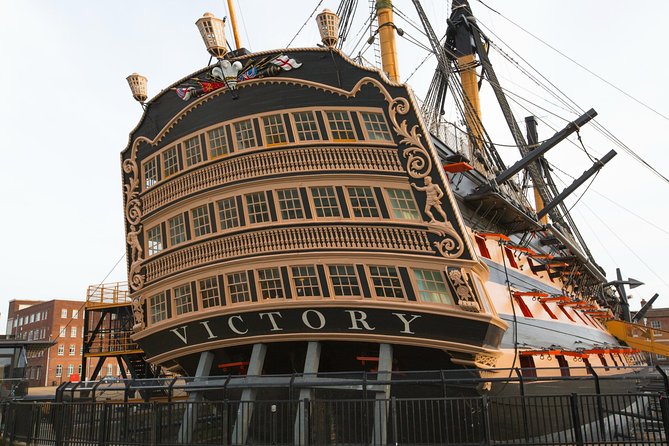
–On this day in 1805, Lord Admiral Horatio Nelson won his greatest victory–and his last, for he was fatally shot by a French sniper–at Trafalgar, off the Spanish coast. Nelson’s flagship that day, HMS Victory, a 104-gun ship of the line, is in dry-dock as a museum in Portsmouth, and I got to visit it.
It was kind of a big deal.
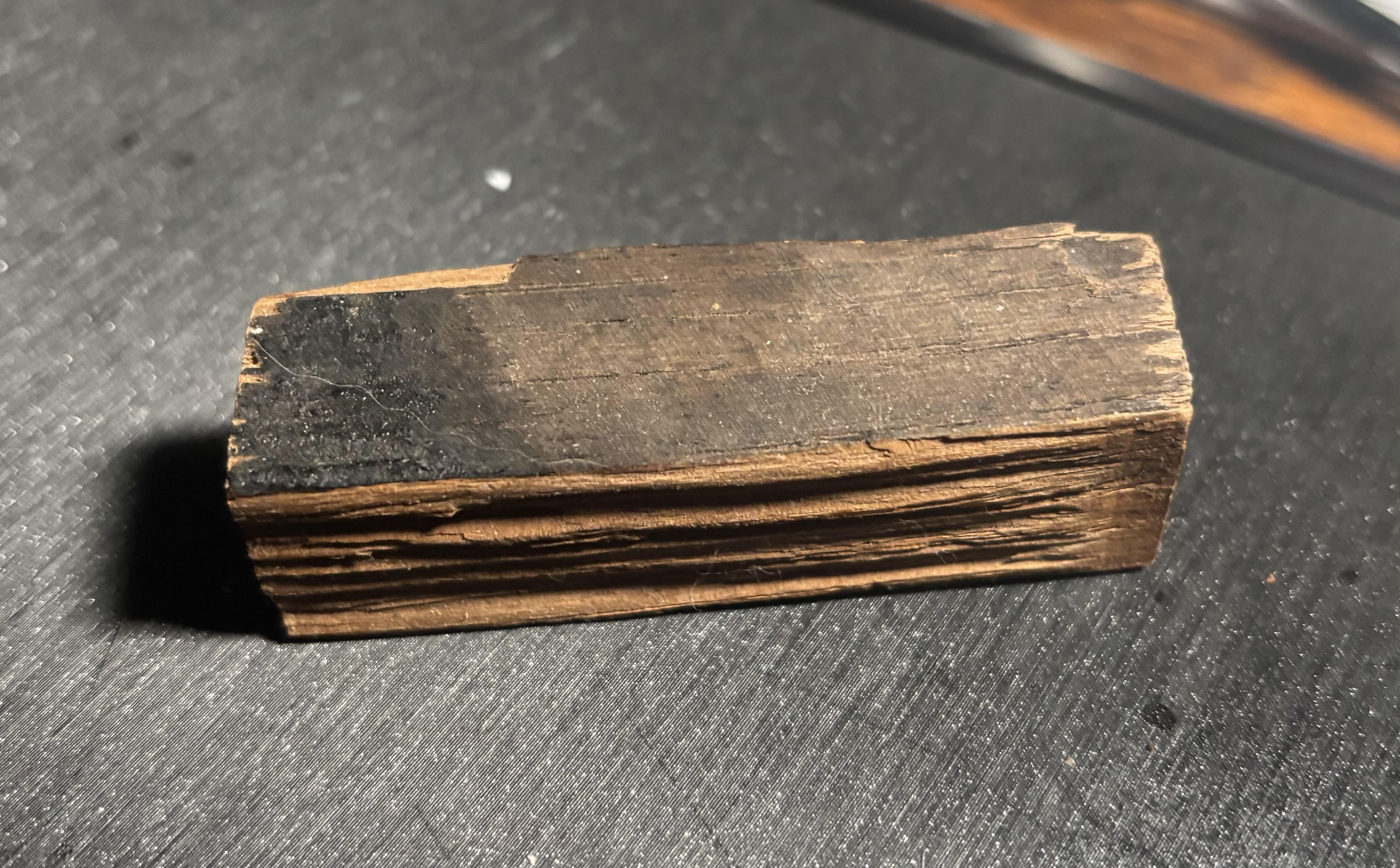
When Nelson was killed, they put his little body (he was about 5′ 4″) in a cask of spirits to preserve it on the voyage back to England. Rum on Royal Navy ships was known grimly thereafter as “Nelson’s Blood.” His coffin, carved from the mast of a French ship he’d defeated in battle, was immense–as is his tomb in St. Paul’s–both indicative of his ego, not his stature. He insisted on wearing his array of medals—only North Korean generals have more—which is what made the sniper pick him out. Shot in the spine, he died belowdecks on Victory, where the spot commemorated with a simple brass plaque.
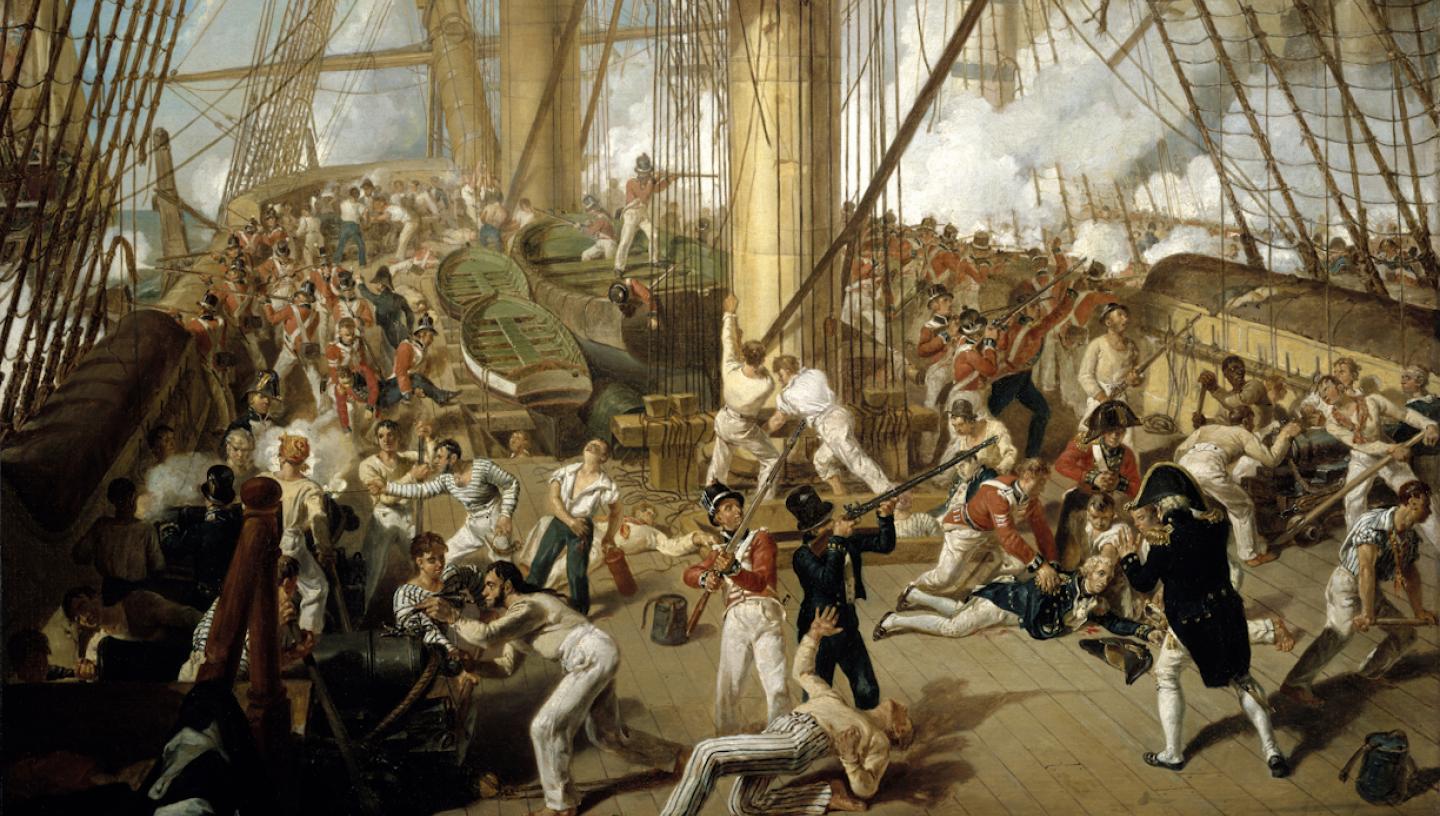
In his years of service, he’d lost an arm and an eye. At the Battle of Copenhagen, the admiral commanding signaled the British fleet to withdraw. Nelson aimed his telescope at the flagship, but he was looking through it with his blind eye. “I see no such signal,” he remarked. And proceeded to win the battle.
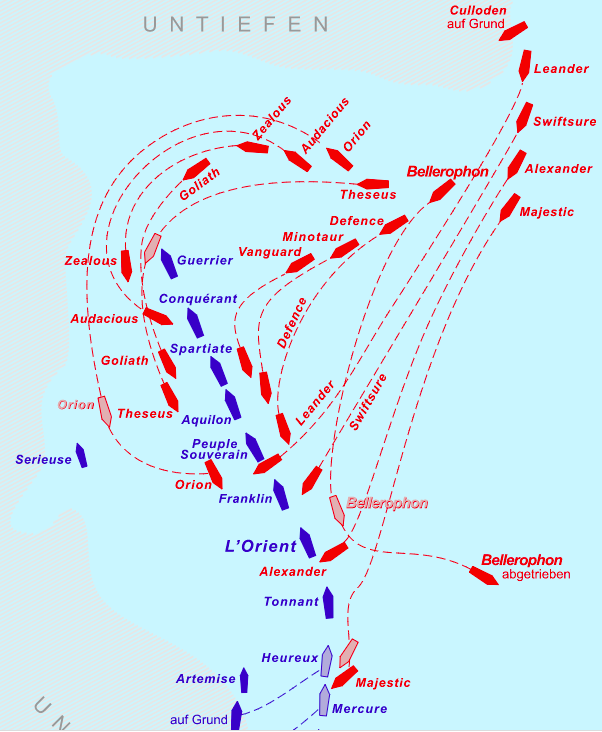
And, earlier, at the Battle of the Nile, the combined French/Spanish fleet anchored their battle line in shoal water, close to the Egyptian shore. No ship, they thought, could outflank them to engage their larboard guns. That’s exactly what Nelson did, risking grounding his ships and having them blown to splinters as a result. The British lost no ships that day; they sank four enemy ships and captured nine more.
The little admiral’s life ashore was scandalous. He began a torrid affair with Emma Hamilton, the wife of a British diplomat. Eventually the two lived as man and wife, doing their daughter the great disfavor of naming her “Horatia.” When, during World War II, the film That Hamilton Woman was made—Olivier as Nelson, Vivien Leigh as Emma, it’s said that the PM, Churchill, wept copiously at its conclusion.

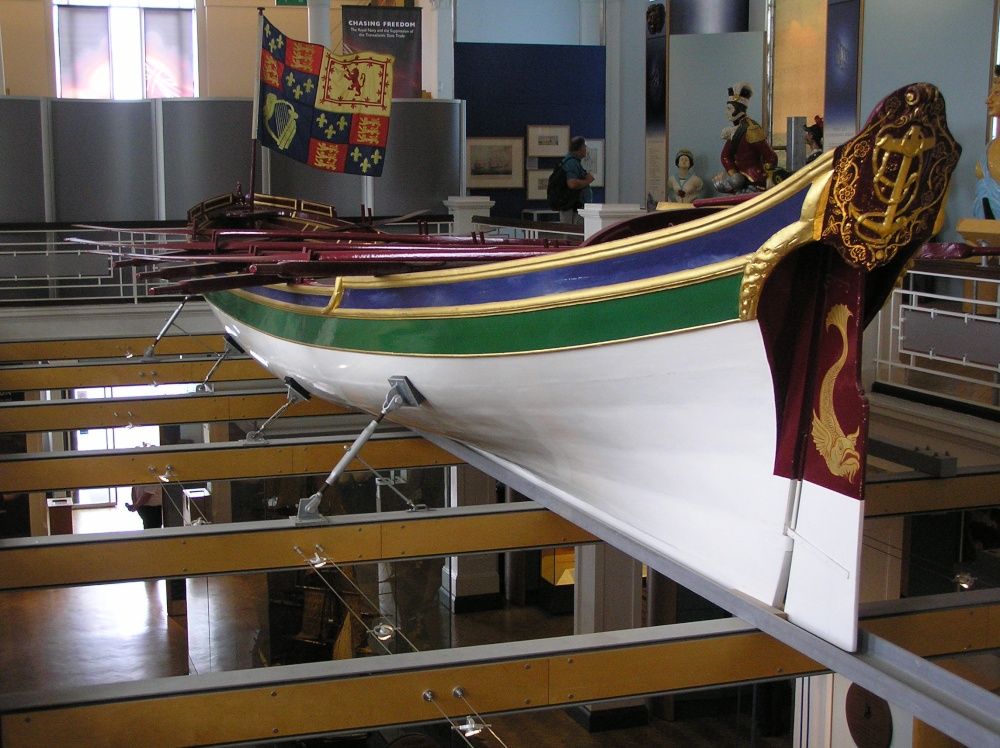
The Royal Naval Museum even has Nelson’s funeral barge on display–it processed up the Thames to St. Paul’s–and one of my favorite Horatio Hornblower moments, in Hornblower and the Atropos, has him, as a young officer, commanding the barge crew. It springs a leak and the crew has to bail desperately to prevent Nelson’s coffin from sinking into the Thames and so into the deep mud of the riverbed.
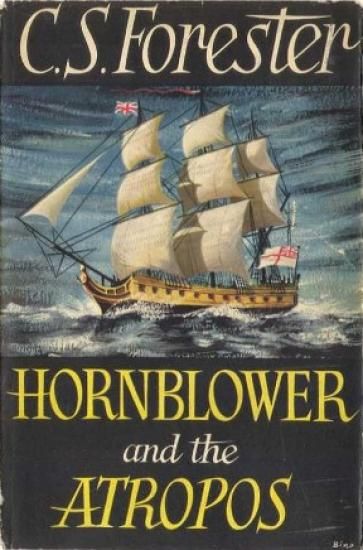
Hornblower had hard luck with leaks.(Like Nelson, he was also prone to violent seasickness.) As a young lieutenant, his first command was a French merchant ship taken as a prize; he was to bring it into port. Unfortunately, the ship’s hull was holed, and it began to flood. Even more unfortunate, the ship’s cargo was rice, which, of course, expands when wet. Goodbye, first command.
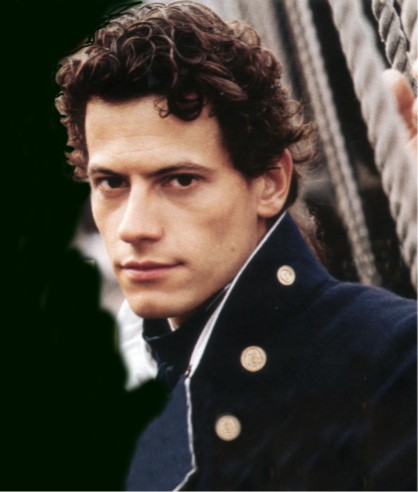
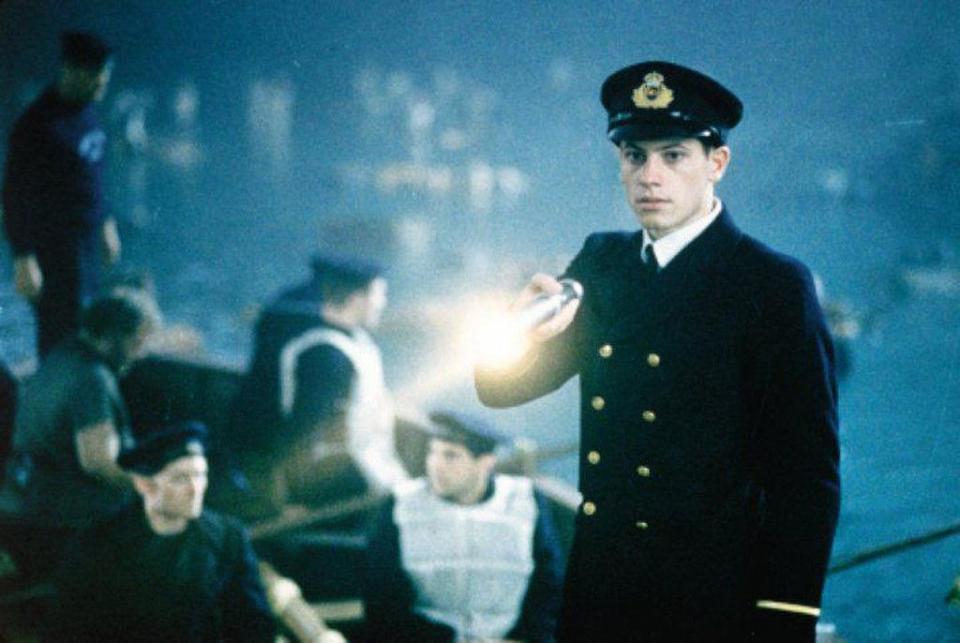
Ioan Gruffudd was the young Welsh actor who did a fine job as Hornblower in a television miniseries. Gruffudd has a nautical background–the commanded the lifeboat that rescued Rose in Titanic.
The Hornblower novels were my first “adult” reading. Dad brought a set home from the war, published by Little, Brown. Dad got to see “Victory,” too, when he was a soldier, and we had a tin, once home to a nest of hard candies. Mom used for her sewing kit; on its lid was a beautiful painting of the ship. I wish we still had it.
Victory fired cannonballs weighing 12, 24 or 32 pounds, any one of which could ruin your whole day. Gun crews worked belowdecks where the interior hull was painted red to soften the shock of casualties. Here she is delivering a rolling broadside, from bow to stern.
In a way, the Nelson-era navy lives on. Some expressions we get from the times:
Turn a blind eye: At the 1801 Battle of Copenhagen, Nelson’s superior hoisted signal flags ordering a withdrawl. When this was pointed out to Nelson, he raised his spyglass to his blind eye and announced that he saw no such signal. He continued fighting. The British won the battle.
Three squares a day: Royal Navy sailor were served their meals on square plates.
Groggy: The effect of having a bit too much “grog,” or rum. The standard issue was one-eighth of an imperial pint per day. The stuff was 95 proof (!), so it was diluted with water.
Three sheets to the wind: Another way of indicating a grog overdose.
Over a barrel: Not a good place to be. Sailors were wrapped around a cannon carriage for corporal punishment
Let the cat out of the bag: The “cat” was the cat o’ nine tails, a whip with nine knotted rope ends that could inflict terrible wounds. It was kept in a canvas bag only to be drawn out, for dramatic effect, when a ship’s company witnessed the whipping of a miscreant shipmate.
Freeze the balls off a brass monkey: A “monkey” was the receptacle–shaped a little like the holder for billiard balls–on which cannonballs were stacked. Iron contracts in cold weather, and sometimes the cannonballs would come tumbling off their stack.
Pipe down! The bosun’s mates blew a shrill whistle at 8 p.m. That was signal to glow belowdecks and rig your hammock.
Clean slate: The officer of the watch would note conditions–ship’s speed, wind direction course corrections–on a black slate. When a new officer assumed watch, the slate was wiped clean.
And, finally, two reminders of what these incredible men endured.
Flying splinters: In Master and Commander, the French superfrigate Acheron emerges from dense fog to ambush Aubrey’s HMS Surprise.
What lifts this film above your typical escapist fare is the friendship between Aubrey and his dearest friend, the ships’ doctor, Maturin. The two are replicas of Kirk and Spock: Aubrey’s passionate Romantic is pushing aside Maturin’s Enlightenment scientist. Only two things bind the two: their love for each other and their love for music. This just might be my favorite scene. Aubrey has just captured his nemesis, Acheron, only to discover that he’s been hoodwinked. So, since they have plenty of time, given this Age of Sail, Aubrey and Maturin turn to Boccherini.
 A Work in Progress
As always, your latest essay both educated and entertained me. I especially enjoyed your glossary of nautical terms that have found permanent, safe harbor in modern English. Thank you, Jim!
LikeLike
Thank you so much, John! Coming from you, this means a lot to me, my friend.
LikeLike