This is a story I heard today. I won’t get the details exactly right, but even so, this is a true story.
A young woman went to visit her friend, afflicted with cancer. When she entered the sickroom, she knew immediately that the end was pretty close.
–Would you like to go outside for a bit?
–Yes. I’d like that.
So the visitor wheeled her friend out to the garden where there would be sunlight and warmth and a little breeze.
There would be flowers.
There were two dragonflies flitting about the flowers. The visitor pointed them out, but her friend, Dawn, had seen them first.
She knew who they were. Her father and grandmother had come to be with her, she announced with confidence from her wheelchair.
I think that death confers on people who’ve lived good and unselfish and courageous lives—all of these describe the Dawn’s life, the young woman in the wheelchair— a wisdom near the end that we cannot understand. It gives them a clarity of vision that allows them to see what we cannot see.
It wasn’t long until death came. The visitor—a real friend, the friend of this person, now dying—Dawn had always drawn people to her the way flowers draw dragonflies—-came to visit on the last day. It would be presumptuous to call it the “final” day, because I believe that all of us will embrace each other again someday, and it will be a long time before we let go and step back, smiling, to regard each other in perfect wonder.
But when that day was over, when Dawn summoned the courage to give up her struggle, the visitor left the sickroom and walked into the sunlit garden.
Just above her shoulder, there was a dragonfly.
“Hello, sister,” the visitor whispered.
This is Hozier, and he’s singing an old Irish song of farewell, “The Parting Glass.”
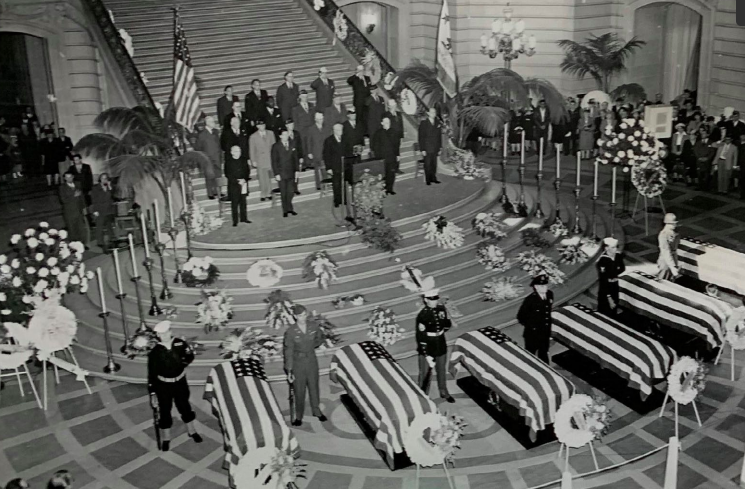
The first World War II American casualties to be repatriated, San Francisco, October 1947.US Dept. of Veterans’ Affairs
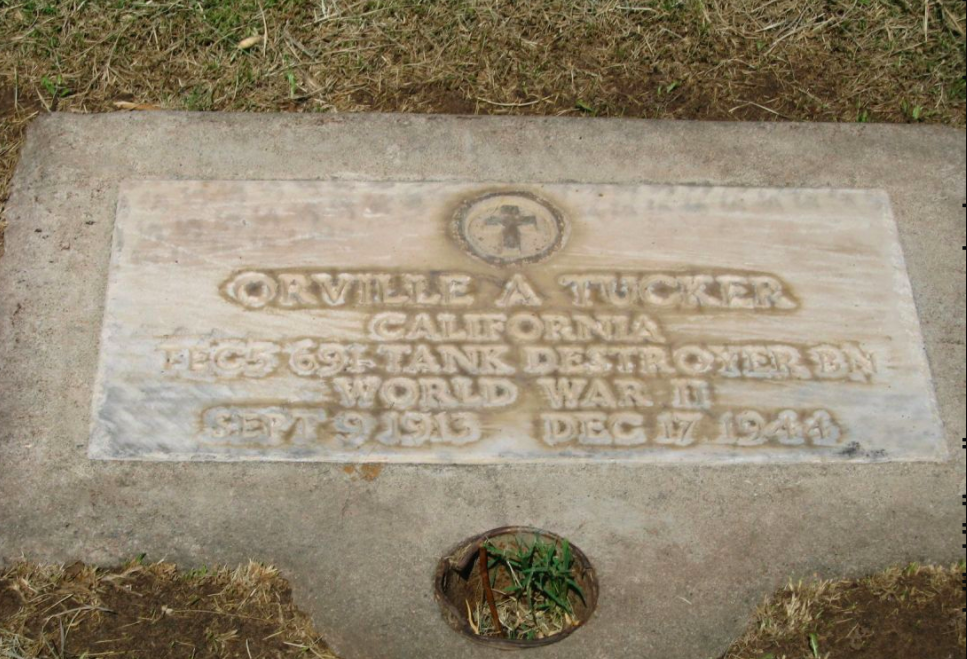
Of course I didn’t expect to meet him, but T5 Orville Tucker’s death crossed my life today. Here’s his grave, in the Arroyo Grande District Cemetery.
And there were a lot of things that struck me about him. The first was his date of death, and dates mean something to historians. We lost this American on the second day of Operation Wacht am Rhein, in what we now call the Battle of the Bulge.
It struck me, too, that he was part of a tank destroyer unit, like Frank Gularte, another Arroyo Grandean I know much better. Tucker was a member of the 691st TD Battalion, Gularte was part of the 607th. And the two soldiers died only days apart. Here’s what I wrote about Gularte on a website that memorializes fallen GI’s, killed in the war my father’s generation fought:
Sgt. Gularte served with the 607th Tank Destroyer Battalion and was killed in action 28 November 1944 near Metz, possibly outside the town of Merten. His son was born five days later in San Luis Obispo County, California. A memorial Mass was said in Sgt. Gularte’s memory at St. Patrick’s Church, Arroyo Grande, San Luis Obispo County, on Wed., 13 December 1944. Sgt. Gularte, before the war, was employed by E.C. Loomis and Son, a farm supply company; Gularte and his family were and are well-known and highly respected in the Arroyo Grande area.
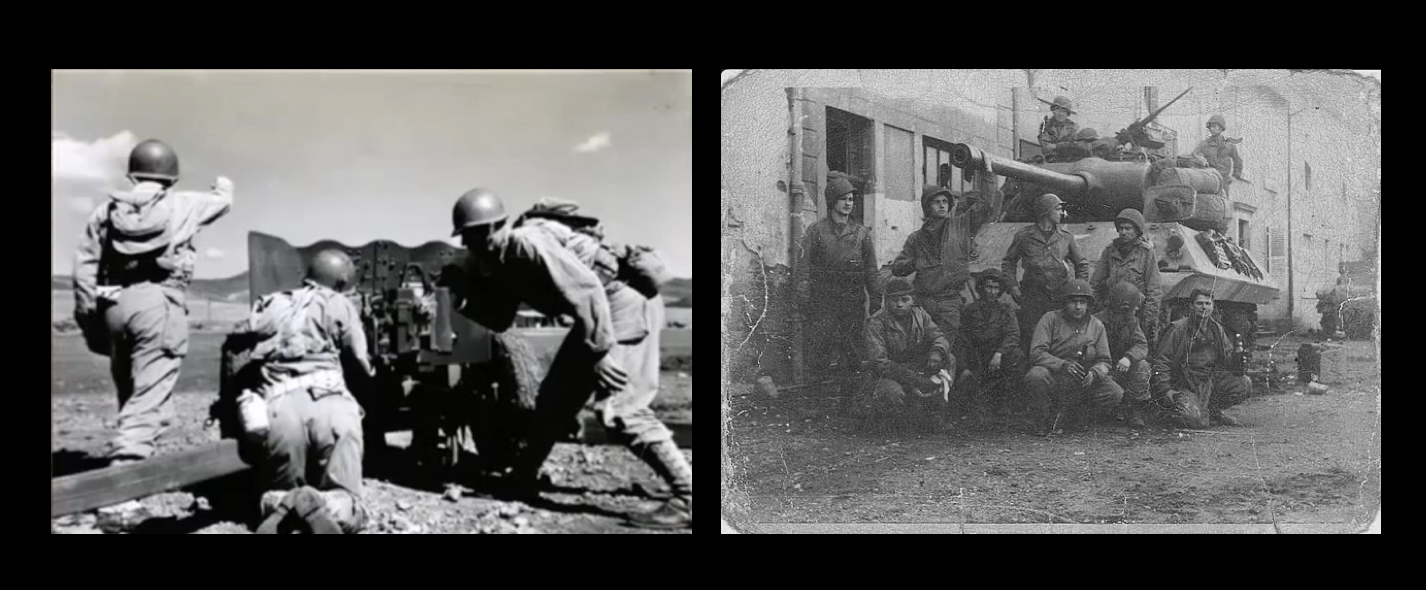
At the time of his death, Tucker’s battalion was still fighting enemy armor with the 57-mm artillery piece, like the one at left being manned by soldiers training at Camp San Luis Obispo in 1944. Frank’s 607th had graduated to the M36 tank destroyer–that’s a 607th TD in the other photo—built on the chassis and hull of the famed Sherman tank, but with a much more robust 90-mm gun.
But it was likely a Mauser rifle that killed Frank, in the hands of a German sniper, during an attack by the 607th that was to have been supported by infantry. They didn’t show, so Frank’s company went into action alone. German fire disabled three tank destroyers edging into Merten—a beautiful mountain town— and the American attack bogged down. Chaos ensued and it claimed Sgt. Gularte.
I don’t know yet how Orville died, but he’s got another tie to the Gularte family.
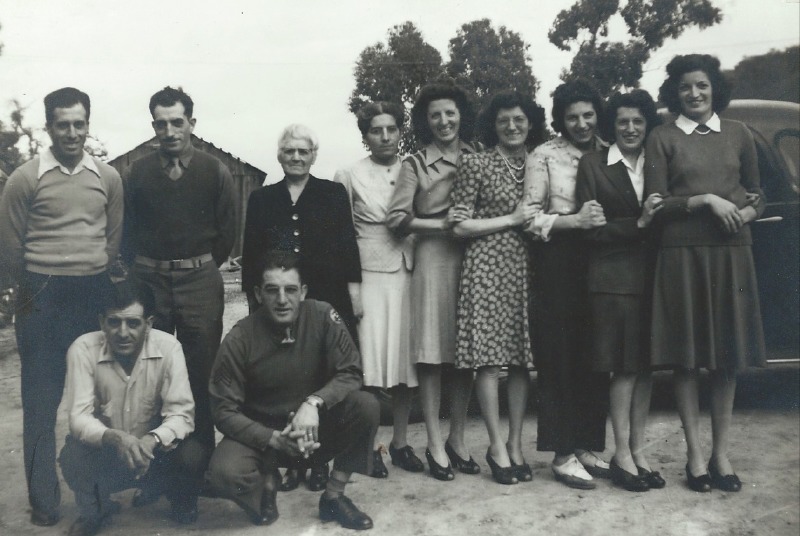
A family barbecue at the Gularte Ranch, behind the site of the IDES Hall just below Crown Hill. Manuel Gularte is standing; Frank is kneeling: Both are about to go to war in Europe.
As near as I can tell, in the opening hours of the Battle of the Bulge, Orville Tucker’s battalion was attached to the 28th Infantry Division. They were defending St. Vith, a Belgian town directly in the enemy’s line of advance and at the seam of two powerful German armies. Twenty-two thousand Americans were in the way of 100,000 Germans and their armor, including 500 tanks. The units that attacked St. Vith on December 17 included the 1st SS Panzer Division Leibstandarte SS Adolf Hitler, an SS unit that had it origins as the dictator’s bodyguard.
Their assignment was to take St. Vith by midnight December 17. It didn’t work out that way, partly in thanks to Orville Tucker and partly because of Frank’s brother, Manuel, also fighting to defend St. Vith. (Two Arroyo Grande settlers, Civil War veterans, had fought in separate regiments within 300 yards of each other at Gettysburg.) Manuel’s field artillery unit–they tended big 155-mm guns, updated versions of the artillery that stood guard over San Luis Bay here at home–and it was the accuracy and ferocity of their fire that delayed the German advance.
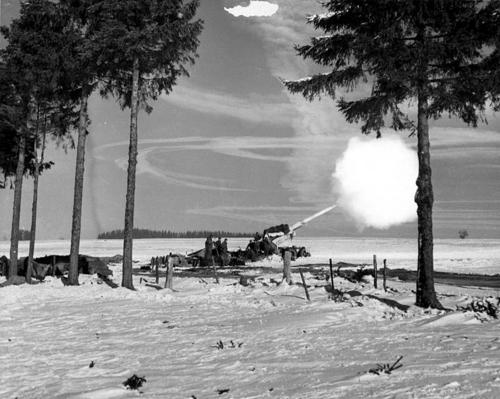
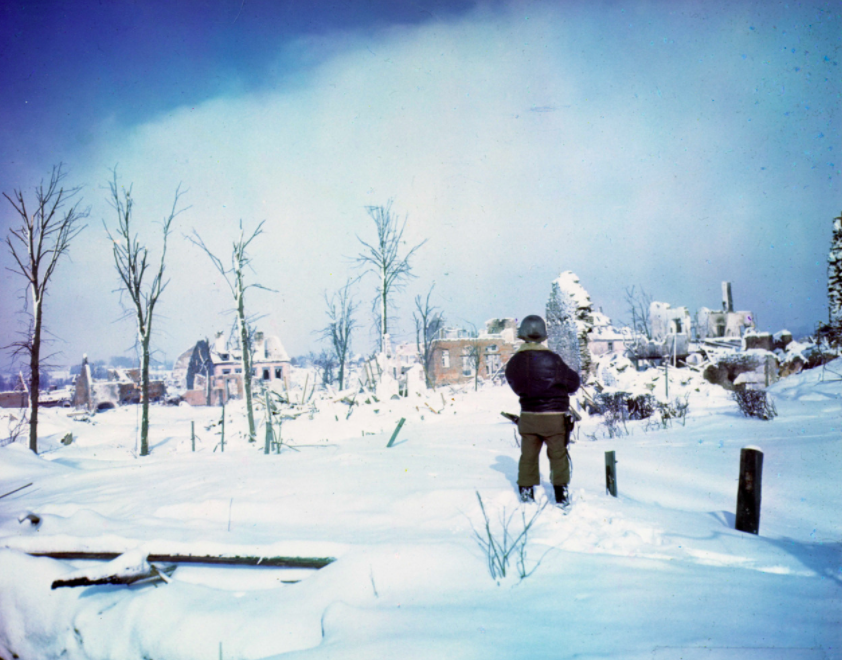
A 155-mm gun in action during the Battle of the Bulge; a GI on the outskirts of St. Vith in January 1945.The Battle of the Bulge was fought during the coldest winter in Europe in thirty years.
“Delay” was exactly what was needed. The panzers were fuel-poor (because Germany was: Berlin taxis were running on firewood in 1944) and the success of the Battle of the Ardennesdepended on speed, on objectives seized promptly, even on the hopeful seizure of vast American stockpiles of gasoline.
Those might’ve been dispatched to the battlefield by my father, a lowly Quartermaster second lieutenant whose responsibilities included providing the African-American gasoline supply companies that kept the American army on the move.
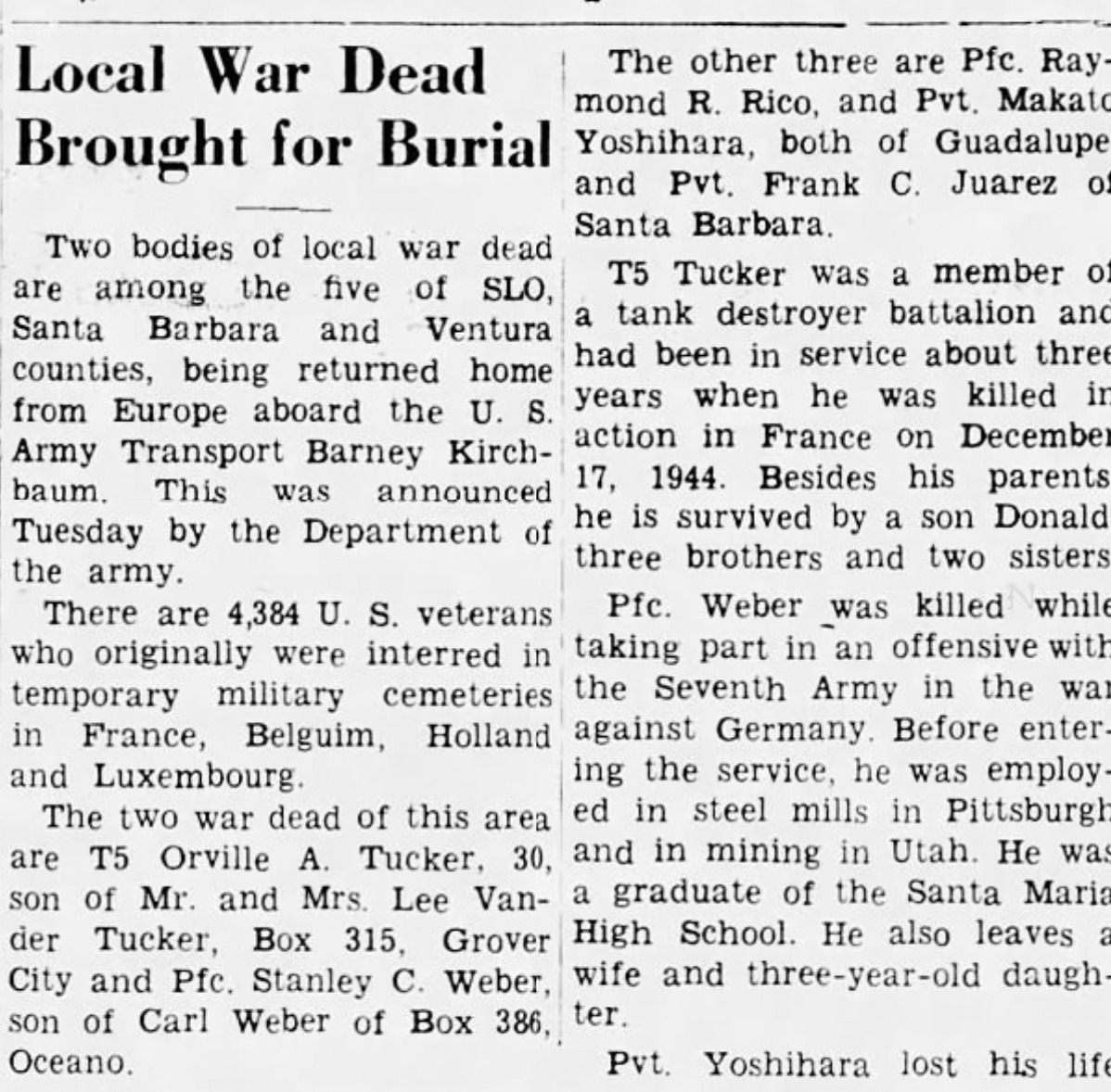
By the time the American army had stopped moving—backward—and flattened the Bulge salient, 20,000 GI’s were dead, among them Orville Tucker. And though he died 5,000 miles away, Tucker was evidently one of the first local GI’s to come home. This is from the December 31, 1948, edition of the Arroyo Grande Herald-Recorder:
A sniper killed Yoshihara on the German frontier as the young man, a medic, was trying to save a brother soldier.
And the ship that brought Orville’s body home, the Barney Kirschbaum, named for an American merchant mariner killed in a 1943 U-boat attack, was a Liberty Ship, one of the miracles of the war, one of 2,710 such freighters launched from American shipyards during the war. Kirschbaum would’ve looked exactly like San Francisco’s Jeremiah O’Brien, tied up at Pier 45. (In 1994, O’Brien had the distinction of returning to the European Theater—to Normandy, no less—where she’d been part of D-Day fifty years before.)
The war dead intersect with my father’s life, as well. Once the war had ended, his duty shifted to training GI’s, nineteen-year-olds, some of them grads from Class of ’44. They’d come to Europe prepared the fight Germans, but the war was over, so Dad’s work, and theirs, was in Graves Registration. He trained these soldiers in the ghastly work of identifying the young Americans the war had claimed. Those young men—forever young— were then to be buried in one of a network of American military cemeteries. Many of those casualties, like Orville Tucker, would eventually come home.
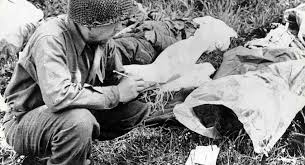
A Quartermaster, part of a Graves Registration unit, records the identities, soon after battle, of fallen soldiers.
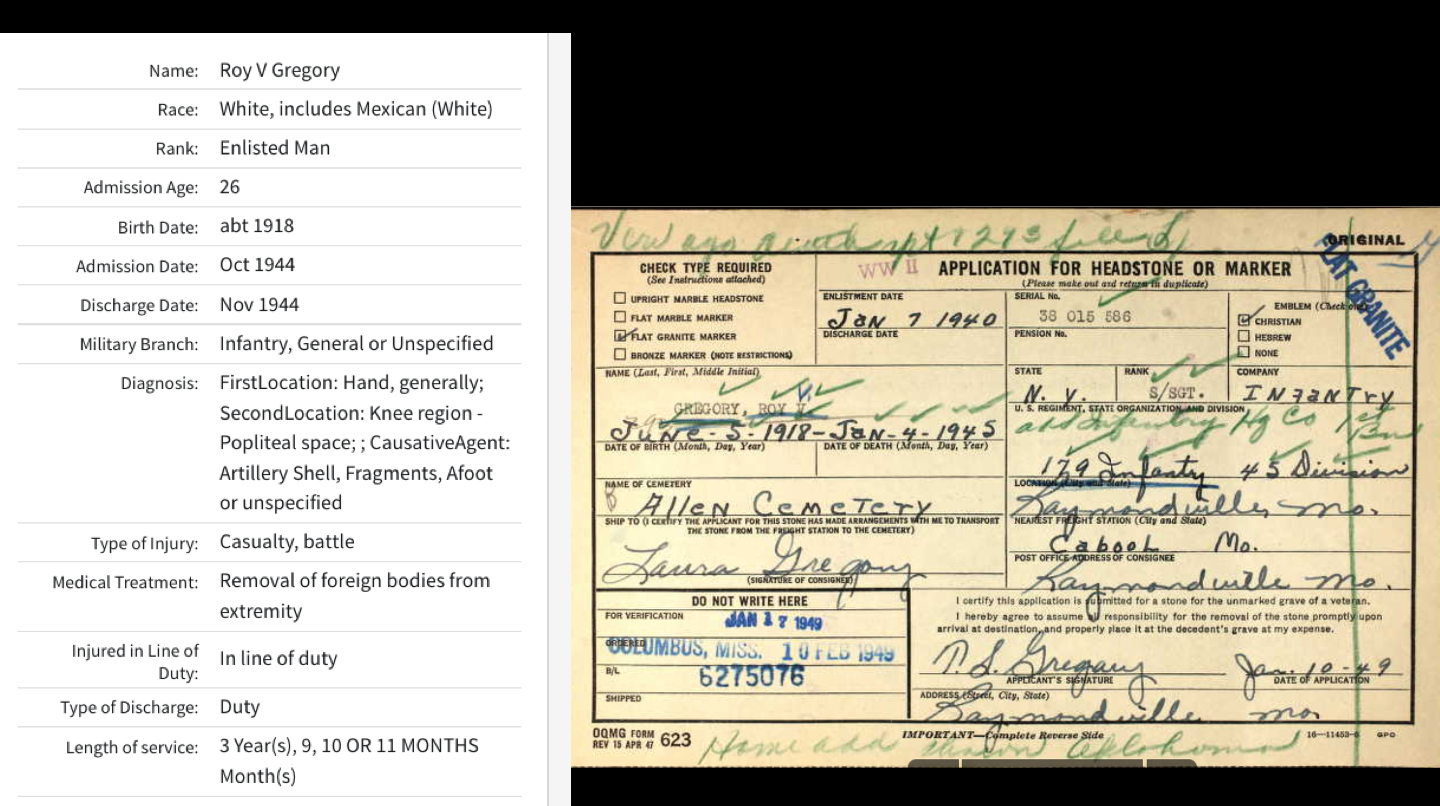
One of the soldiers who came home after the war—in my family’s case to rural Missouri— was my father’s cousin, Roy.
Roy was discharged from a field hospital, where he’d been treated for shrapnel wounds, in November 1944. He went back into action in Alsace, where, in January 1945, another elite SS unit essentially wiped out the headquarters company to which he was attached.
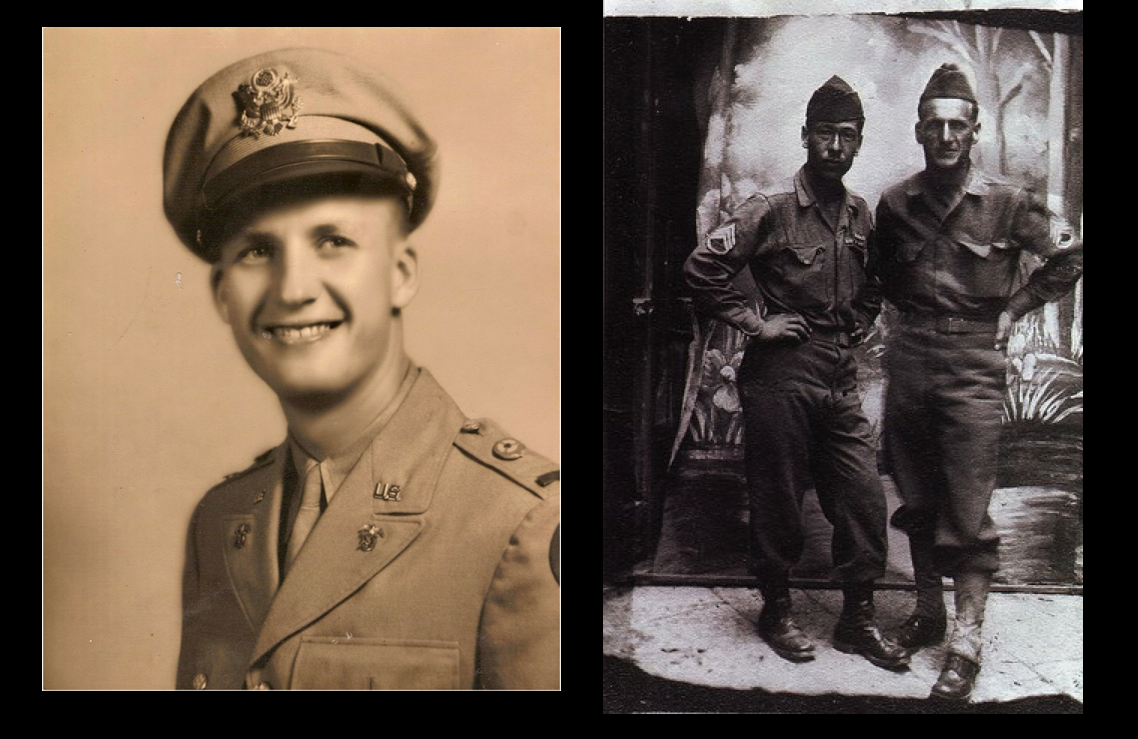
Roy—who’d fought with his buddy, Sgt. Chew, in Sicily, Italy, and finally France–looks remarkably like my Dad.
Sgt. Gregory’s hospital record; the family’s application for a military headstone. He is buried near my grandfather, John Smith Gregory.My father as a lieutenant; Sgts. Chew and Gregory in a studio photograph taken in Italy.
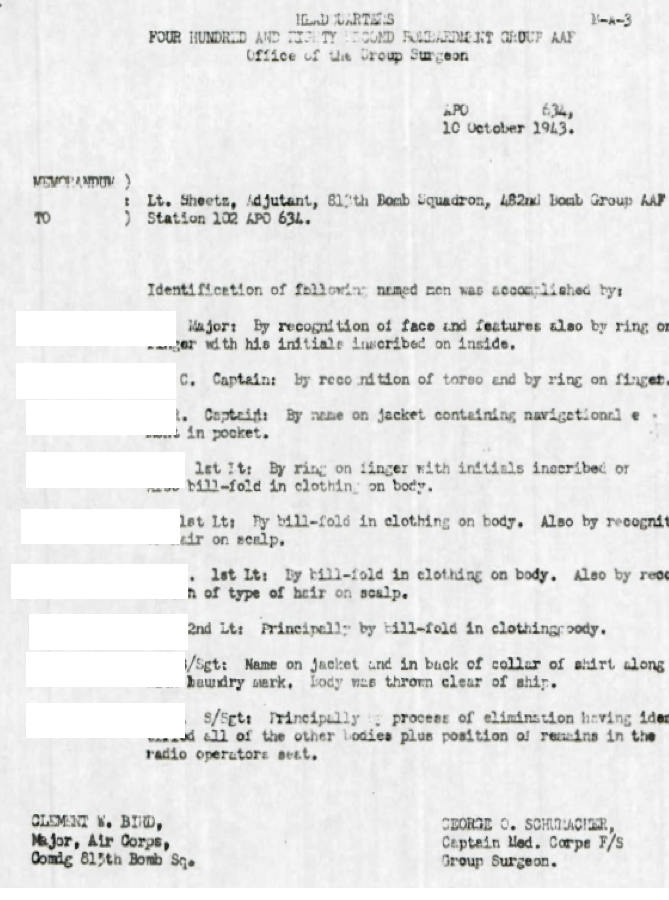
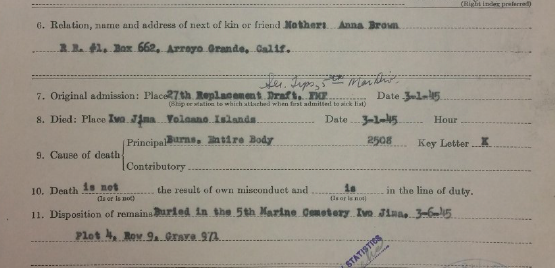
Graves registration work was ghastly, of course, because of the way these young men had died. Sometimes, in the Army Air Forces, when the flight surgeon of a bomb group had the duty of identifying the dead, the clues were circumstantial and almost always, as in the case of this Marine killed on Iwo Jima, the deaths were violent beyond imagination.
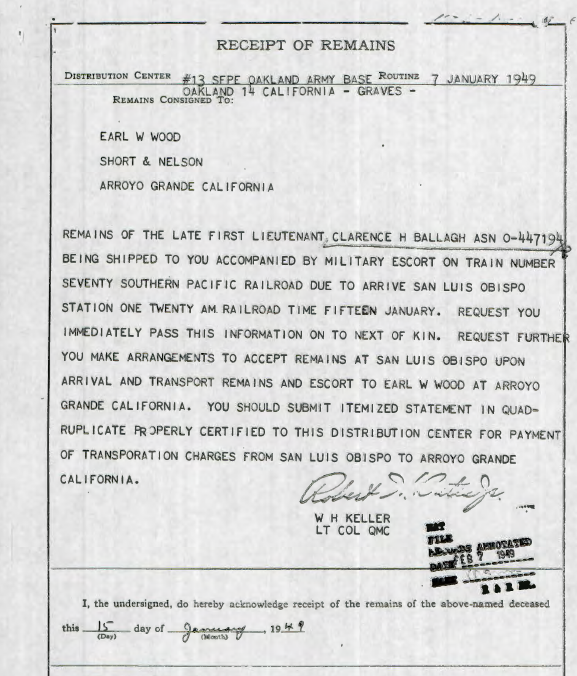
The dead recorded from this B-17 accident in northern England include Clarence “Hank” Ballagh, a young man whose ancestors came to Arroyo Grande in a covered wagon. He was the AGUHS valedictorian in 1938 and graduated from Cal with an engineering degree.
This young Marine, Louis Brown, was a farmer’s son from Corbett Canyon.
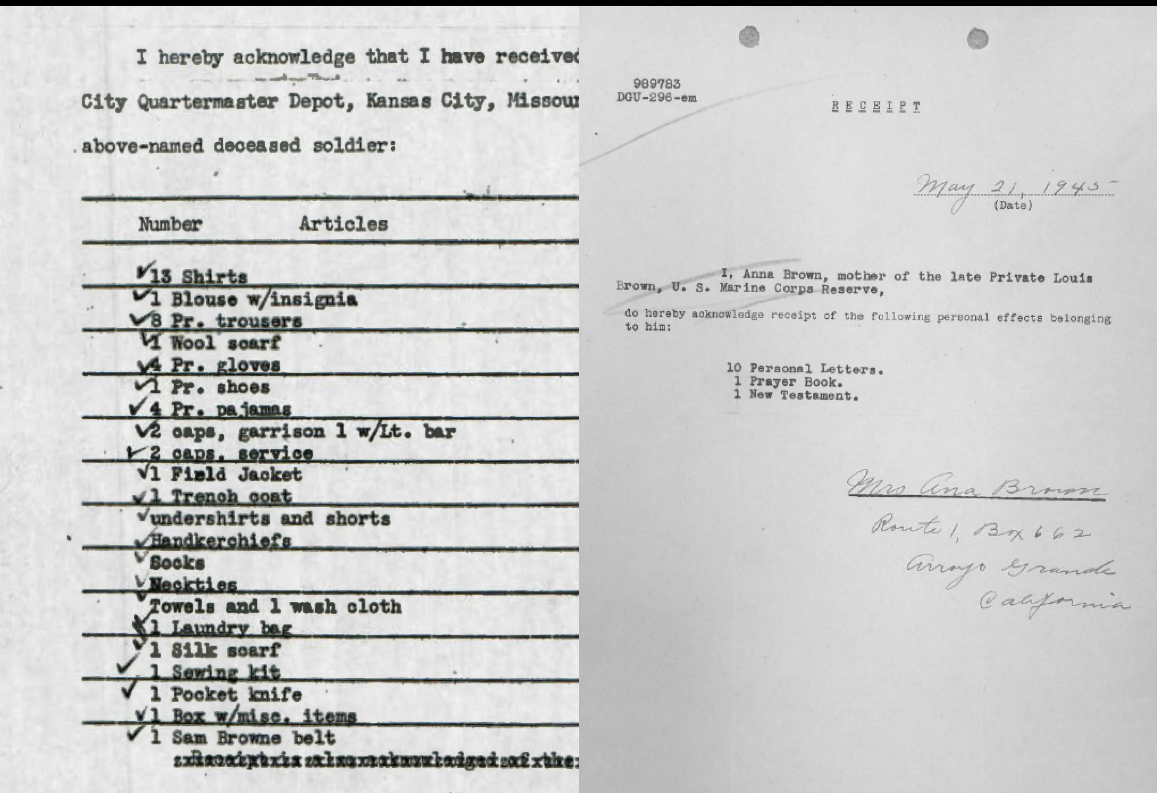
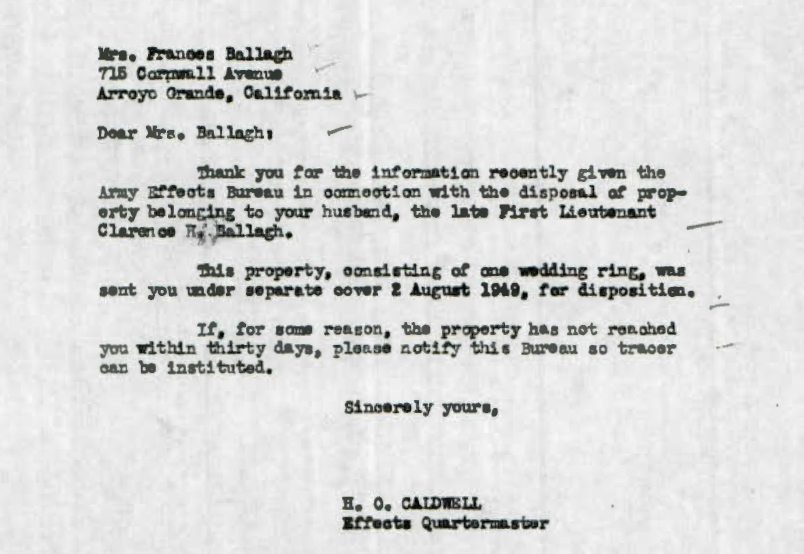
The Quartermasters also took charge of cataloguing a fallen man’s personal effects, and these reveal—with the possible exception of the Army Air Forces, where the sharp lines of rank blurred among bomber crews—that there remained a vast social gap between officers and enlisted men. These are the personal effects of Lt. Ballagh, the Berkeley grad, and Private Brown, who, like 64% of Americans in 1940, hadn’t finished high school:
Brown’s Rosary is listed in a separate Navy Department letter to his mother.
Ballagh was killed when his plane flew into the side of an English mountain; fragments of the B-17 remain there today. Brown was killed, most likely by a Japanese land mine, no more than 48 hours after he went into action on Iwo Jima. Both came home to Arroyo Grande, in a bureaucratic ballet in quadruplicate steps, that was unmistakably human. There’s no mistake that the Army wants Lt. Ballagh, even in death, to come home safely.
The records of the dead, I think, are important: they force us to confront a war now safely confined to history books and television screens. Beyond that, they reveal the terrible price that the living had to pay, as well.
Since Halloween is approaching, here’s a story I don’t mind repeating. At all.
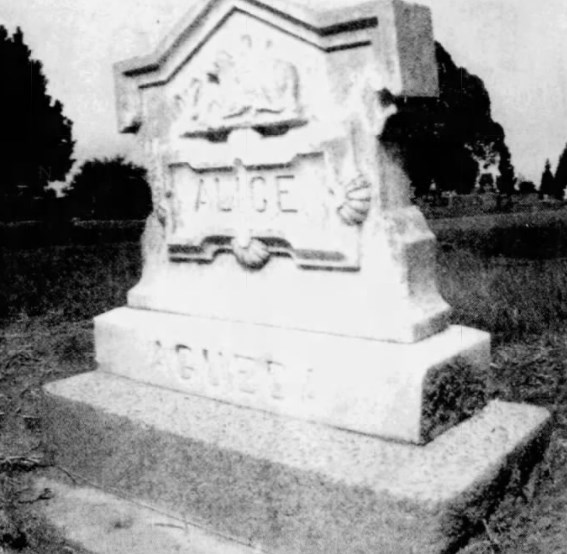
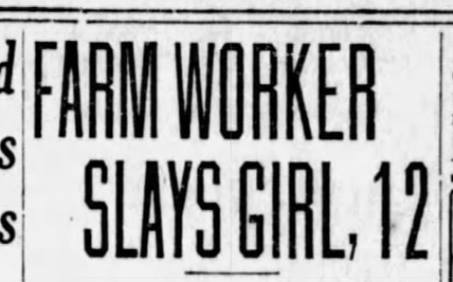
Alice Agueda–buried in the Arroyo Grande Cemetery–was brutally murdered in December 1926 by a farmworker on the Agueda place along Huasna Road. She was twelve years old.
The accused allegedly died after attempting suicide. He shot himself. Five times. Ahem.
The San Francisco Examiner, January 1, 1927
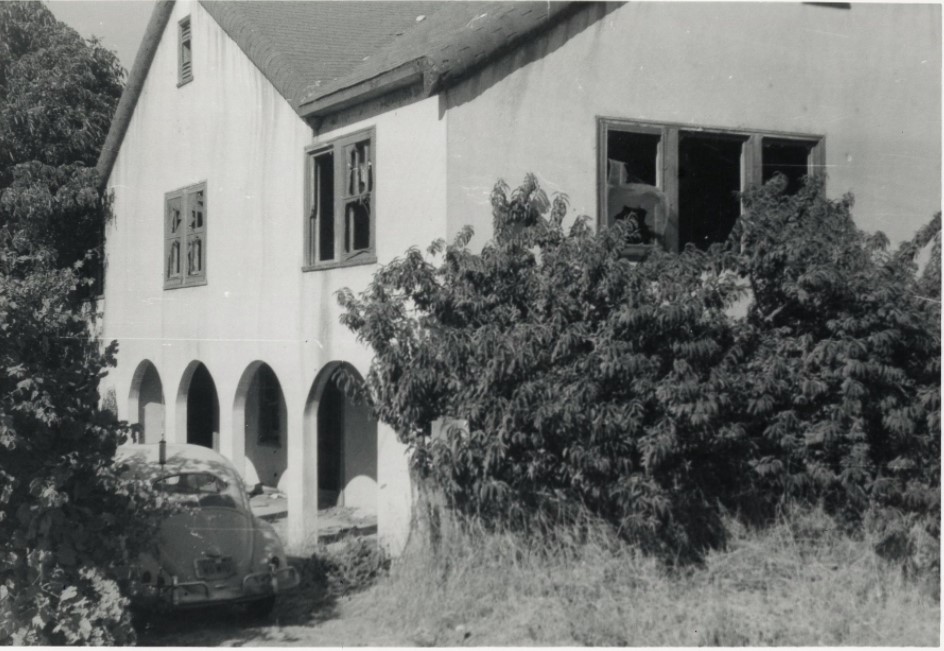
The Agueda home is still with us–it’s the old Conrad Adobe, partly hidden behind a stand of cactus just before a sharp left bend in Huasna Road, about a half-mile beyond the new Branch School. (The term “new” Branch School indicates my advanced age, of course. Guilty as charged.)
The home, the subject of many newspaper articles over the years, is notoriously haunted. My friend David Cherry lived in it when we were AGHS students, and the adobe bricks are visible, down to their straws, in the basement, where Dave and I shot pool. The Cherry family several times heard soft footsteps on the basement staircase and then the door to the kitchen atop the staircase would slowly open.
Many years after, there were new owners who heard the same sounds the Cherrys had heard. There’s a driveway big enough for an RV and these folks had friends visit from San Diego and, of course, since they were friends, the new owners told them ghost stories about Alice.
After their visit, the friends drove the RV home to San Diego. After they got home, they went to bed. That’s when they heard the RV’s doors open and then the sound of soft footsteps. They risked a look in the dark and found nothing. But when they investigated again the next morning, everything inside the RV had been moved around.
The friends, husband and wife, looked at each other with the same thought. It was Alice. She liked them. She liked them so much that she’d followed them home.
So they drove all the way back, from San Diego to Arroyo Grande, pulled up into the big driveway that fronts the Conrad Adobe, and had a talk with Alice. We like you, too, they explained, but this is Arroyo Grande. This is your home. You need to be home, Alice.
When they drove back to San Diego, they turned off the engine and except for the clicks a cooling engine emits when it’s turned off, they never heard another sound from the empty RV again.
The story’s stuck with me.
And there’s an added element: After I’d posted this on Facebook a few years ago, a woman named Ciaran Knight shared the childhood experience of a friend of hers who’d lived in the old house. He had an imaginary playmate he called “Alice.”



 A Work in Progress