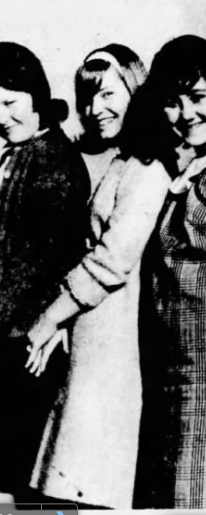
Bonnie was in my ninth-grade art class on Crown Hill at Arroyo Grande High School in 1966. She was so lovely and so kind that I was immediately entranced by her. Not in the way you think. She was another guy’s girl. What I felt for her was more in the line of admiration rather than romance.
Of course, that previous sentence was a baldfaced lie, but there’s more to Bonnie than that.
Some people have the gift of reflecting your own worth back at you. I was never convinced, growing up, of my worth, but Bonnie saw it and communicated it without words. Sketching beside her on big sheets of newsprint bequeathed the most immense sense of belonging, at fourteen, that I’d ever felt.
She came to art class one day fighting tears because she was just a freshman and was therefore barred from going to the Christmas Formal with her boyfriend, an upperclassman.
And then some time in the spring, Bonnie didn’t come to class anymore. She vanished.
I found out later that she vanished because she was pregnant. Other than the whispers, which lasted just a short time, Bonnie was never heard from again.
I missed her so much that twenty years later, as a history teacher, I talked about her, when teaching American cultural history, to my students. They were appalled by the way she’d been treated, which, in their disgust at cruelty and hypocrisy, is yet another one of the dozens of reasons for why I love teenagers.
When I was growing up, a three-times-a-year treat for my family was driving from Arroyo Grande to Morro Bay for fish and chips at Bob’s on the Embarcadero. My goodness, you could still get abalone and chips at Bob’s. It took up a full Sunday, and, for somebody who grew up amid the cabbage fields of the Upper Arroyo Grande Valley, Morro Bay was exotic and enchanting. Abalone steak dipped in Tartar sauce–we drove out to the Rock to eat our lunches and to watch the fishing boats surge over the breakwater–was sublime.
So was the smell of the sea. Morro Bay was doubly enchanting when local farmers had just added a generous layer of turkey fertilizer to the row crops of the Upper Arroyo Grande Valley.
It had to be than twenty years gone before I went back to Bob’s for fish and chips—the abalone, of course, was gone, but the calamari was wonderful—and this time it was with Elizabeth, my wife. I guess we’d gone there a couple of times before but the third time, I recognized the waitress immediately.
It was Bonnie, and it was twenty years later, when I had the audacity to use her as a Primary Source in my classroom, and there she was with her short waitress skirt and order pad and pen. I could’ve easily been appalled, as was a brilliant friend of mine, a classmate, now a lawyer, when she found me working as a liquor-store clerk in the years when I was recovering from the end of a career and the end of a relationship. Most of my recovery was not recovery at all; my life lay instead in the consistent and generous anesthetization that the liquor store’s stock supplied
So my friend, the lawyer, stared blankly for a moment at me, ashamed, behind the counter. “Oh, Jim.” was all she said.
I never saw her again.
But when Elizabeth and I saw Bonnie, she was radiant. She blushed, as I had in the presence of my lawyer friend, for just moment, but the weekend rescued her. It was Poly’s graduation and the child that had been inside her in ninth grade was later that day to graduate with an engineering degree.
She was just as beautiful as I remembered and I saw in her eyes the validation I’d remembered in ninth grade. She was proud of me and proud of us, of Elizabeth and me, as a couple.
I don’t remember, of course, the rest of the meal at Bob’s.
It would be many years later when I learned that Bonnie had died. The news hurt doubly, because I learned that she’d taken her own life, and we teacher types frequently confuse ourselves with Jesus. Surely, I thought, there could’ve been something I could have said or done. Or something I could have done without saying anything at all: Didn’t she see, in the moment before she took our order that day at Bob’s, how immensely proud I was of her?
When we got to the 1960s in my U.S. History classes in the years after that day, I told my Bonnie story again, but I added Graduation Day as the ending I’d never had before. A good teacher can sense when he or she has touched the students in their care; Bonnie touched mine. She inspired them.
As much as teenagers hate cruelty and hypocrisy, they love righteousness. Teaching history, after all, is really about teaching the future, and Bonnie’s story resonated because it gave them the hope that the future in their care would be righteous.
Bonnie resonates to me, too, because she died the same way my mother did. I spent many years in therapy after I lost my Mom until I quit it when the psychiatrist opined that my mother, in taking her own life, was a selfish person.
That’s the last word I would use to describe either my mother or my friend Bonnie. Nobody can understand the immense power of clinical depression and the seductiveness that self-destruction promises when it’s the only reasonable, rational way left for you to fight back.
A high-school administrator—my boss— once smugly confided to me that she could never imagine taking her own life. She was taken instead by cancer. I doubt that she could ever have imagined that, either. But clinical depression and Stage Five cancer are coequals when it comes to conferring death.
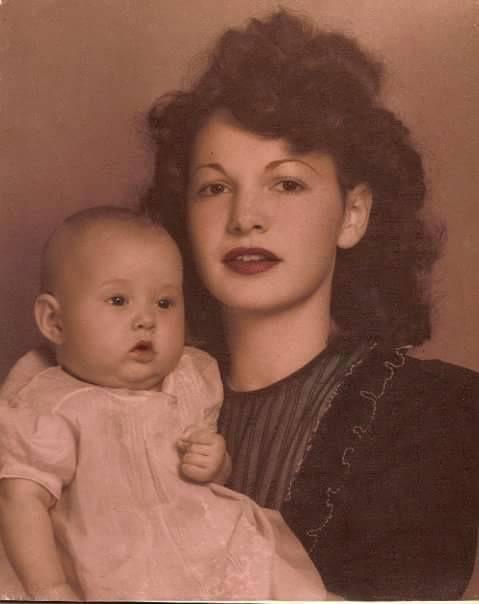
I keep a photo of my mother, holding my big sister when she was a baby, atop our mantle. She is breath-taking. So was Bonnie, in her white embroidered apron and red waitress mini-skirt and scuffed white tennis shoes, on the day that Poly graduated her daughter. I don’t know that there is a Heaven–I guess I’ll have to find that out on my own–but if there is, I want to hold my Mom very close. And then I want to ask directions.
Where is Bonnie?
And then, given God’s grace, I will hold her very close, and tell her, in a private voice just above a whisper, how much her life has meant to me. And then, given God’s grace, we will get the chance to sketch again, holding soft-lead pencils that drift noiselessly across the paper of big newsprint pads, We’re close together, sitting on high stools. Every once in awhile, Bonnie might look at my sketchpad, then look at me, and smile.
 A Work in Progress