
My earliest memory is typical of me and my inimitable physical grace: I fell down the steps of my grandparents’ home in Williams, Colusa County, and cut my knee open. I still have the scar. That was sixty-six years ago.
My Gramps, Grandpa Kelly, was once a Taft police officer. Some time in the 1940s, he was walking his beat, rattling storefront doorknobs to make sure they were locked, when he was jumped by three oilfield roughnecks waiting for him in an alley. Within about a minute, Gramps remained vertical while the roughnecks abruptly became horizontal.
But to us, Gramps was a gentle man–I once wrote that “he was able to talk whimsy with children unencumbered”– and I can still see the concern in his face. He scooped me up and held me in his arms until my Grandma Kelly, a pragmatic German-Irish woman, came out with the iodine, which probably made me shriek even louder.
But she’d saved me, too, just a little earlier. I was a baby in Taft when the Tehachapi earthquake hit in 1952; it was her turn to scoop me up. She sprinted into the street, clad only in her slip, which had come slightly disarrayed, and so my grandmother provided the neighborhood with a sight they could never unsee.
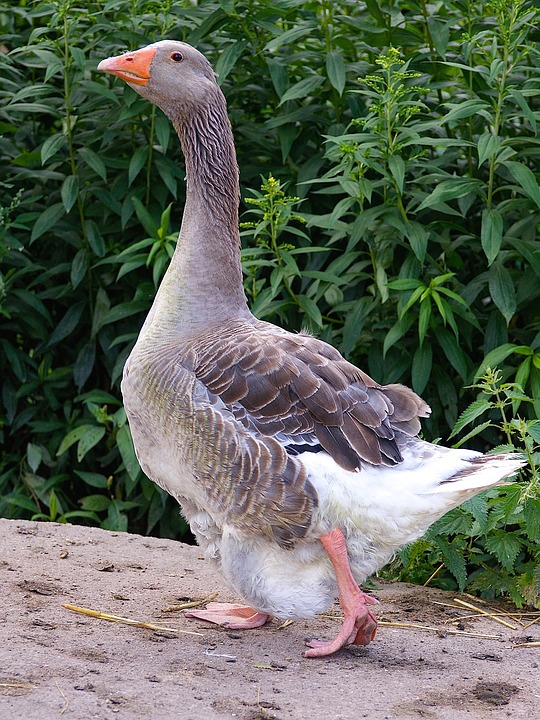
I adored my grandparents. And we all adored Gus, a gander, who followed us kids all around their almond ranch in Williams. I can’t quite remember him; I was pretty little.
(I don’t know quite why they called it a “ranch.” What do you say to almonds? “Hey! Giddyup, little almonds?” And what do you do with the “l” in “almonds?” Grandma Kelly and Gramps left it out.)
Anyway, Gus thought he was a Kelly, too, and since we were Kelly grandkids, he welcomed us into his flock, which consisted of one goose and three children.
I don’t have much experience with ganders, other than the ones at San Luis Obispo’s Laguna Lake, and they are obnoxious.
I do have a far richer experience with Thanksgiving turkeys. Both of my parents were marvelous cooks, and the only things better than their Thanksgiving turkeys (and Mom’s dressing) were the three days of leftovers that followed.
I loved Thanksgiving.
But I was maybe three years old when the best Thanksgiving ever was served up at my grandparents’ farmhouse–or ranch house–in Williams.
The turkey was moist and tender and a little sweet and my mother put her knife and fork down momentarily and told her mother, my Grandma Kelly, that this was the most extraordinary turkey she’d ever had in her life.
“Oh, honey!” Grandma replied. “This isn’t turkey. It’s Gus.”
Mom stared down at her knife and fork, which remained untouched, except for absently pushing around the peas and mashed potatoes into little hillocks and valleys, for the rest of the meal.
I think the other Gregorys pretty much concluded their meals, too, maybe except for me. I was too little to understand that the turkey that tasted so good was the fellow who’d walked so amiably beside me just a day or two he became the centerpiece of the Thanksgiving table.
My family talked about Gus the Goose for twenty years after that Thanksgiving. The pain in their voices as they told the story, every year, was palpable.
Someday, some Thanksgiving, since I taught “Scarlet Letter” for so many years at Mission Prep High School in San Luis Obispo, I might wear a scarlet “G” pinned to my shirt to the Thanksgiving meal. It would be the decent thing to do to atone for such a sinful sin.
Gus, I am so sorry.
 A Work in Progress