
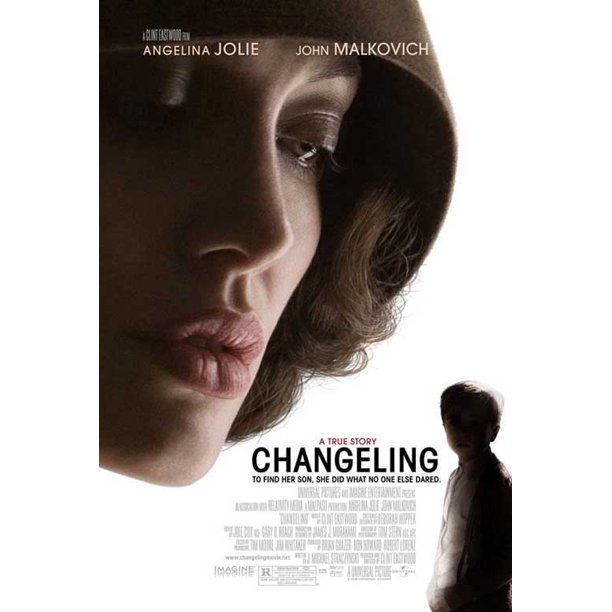
I tend to obsess over films. I watched this one, Changeling, again yesterday for probably the fourth time. It’s directed by Clint Eastwood—impressively, the music, including the closing title, is written by him, as well—and, while it’s not the best of his films, I find it absorbing. That’s because it’s set in 1920s L.A., and the first half of the twentieth century in Los Angeles is a time and a place that I find fascinating.
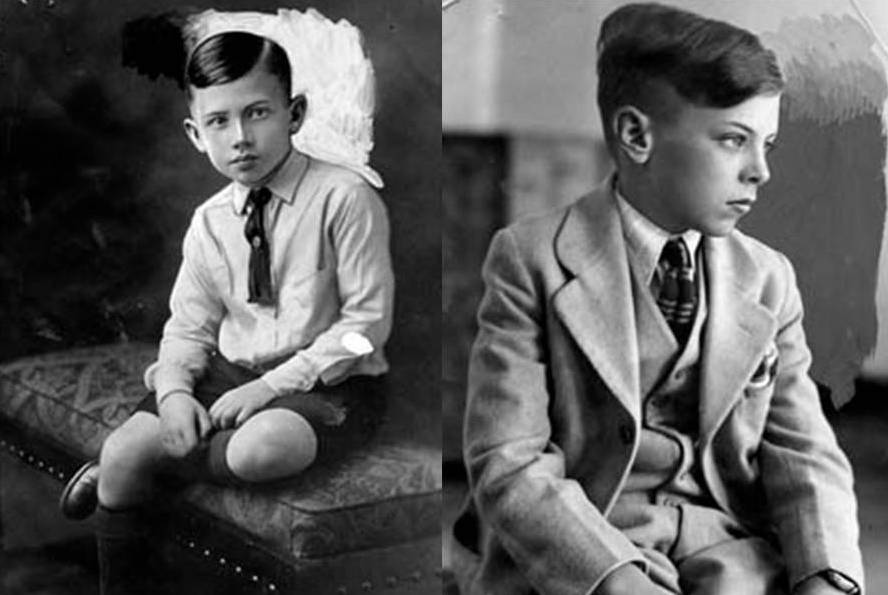
The story, based on real events, is horrific. A little boy named Walter Collins disappears and the LAPD, under Chief Jim Davis, makes a grand show of returning him to his mother, played in the film by Angelina Jolie, an actress whose fit is somehow perfect for the late 1920s.
The problem is that the little boy isn’t her son. The more she protests, the more she threatens the LAPD with the truth, the more mercilessly they behave toward her. She is eventually confined to an insane asylum because she is so vehement in her protests. She knows her little boy, and the one the cops brought home isn’t her son. (Among the “duh” clues the LAPD missed: Walter wasn’t circumcised. The little boy returned to Mrs. Collins was.)
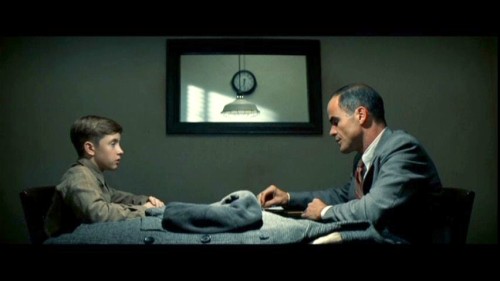
A chance lead forces a child welfare officer—superbly and compassionately played by Michael Kelly, interrogating a runaway in the scene below—to investigate a chicken ranch in Wineville, California. He concludes that Walter is more than likely among twenty boys who have gone missing only to wind up brutally murdered in remote Wineville–today’s Mira Loma. And his discovery eventually confirms Mrs. Collin’s protests. The little boy the LAPD brought home is an impostor.
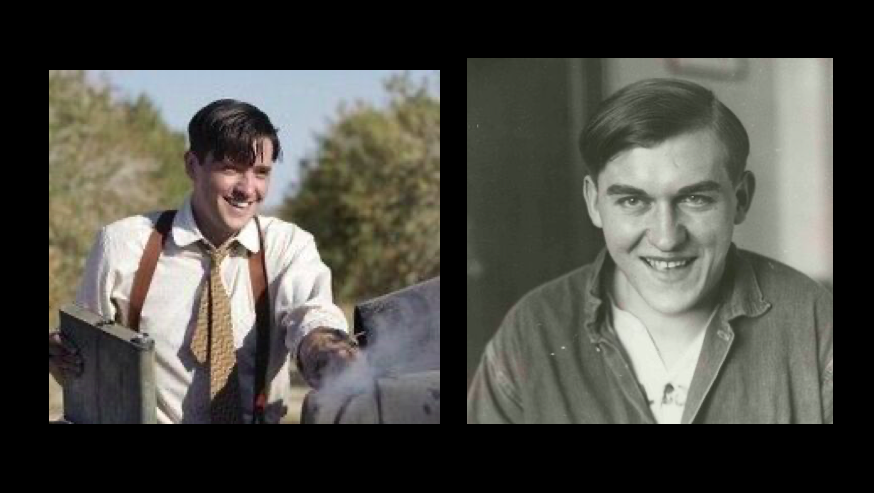
The suspected child killer, Gordon Northcott, a Canadian psychopath who’d relocated to the chicken ranch east of Los Angeles where he carried out the murders—the “chicken coop murders,” after the place where the little boys were confined— is eventually arrested. The actor who plays the 23-year-old Northcott, Jason Butler Harmer, is terrifying, given to leers and bursts of laughter, eager, after his arrest, to be the center of attention.
Northcott fired his attorneys and represented himself at his trial. A mistake, just as it was here, in San Luis Obispo County recently, where a serial child molester—sadly, a former student of ours—insisted on representing himself because he knew, as Northcott did, that he was smarter than everyone else. That person was sentenced to 280 years in prison. Northcott was hanged at San Quentin, where it took him eleven minutes to die.
Christine Collins spent the rest of her life looking for Walter. In the film’s closing scene, a little boy who had escaped from Northcott has been found and returned to his parents. Jolie, as Mrs. Collins, tearfully watches the reunion at a police precinct and afterward says goodbye to Kelly’s officer. Here, Eastwood’s score is melancholy and lovely, and the computer-generated background, down to the Red Car, is evocative.
This will never be among the greatest of films, but it’s extraordinary nonetheless because it transported me so convincingly to a Los Angeles I know and yet don’t know.
Another film, one of the finest of its generation, would likewise take me to the Los Angeles of another time—a decade after the events in Changeling—in Polanski’s Chinatown.
The two films, neo-noir summonings of an old Los Angeles—the Los Angeles of Double Indemnity and The Big Sleep— brought the city back to life, and have so arrested me that I can’t let them go.
 A Work in Progress