
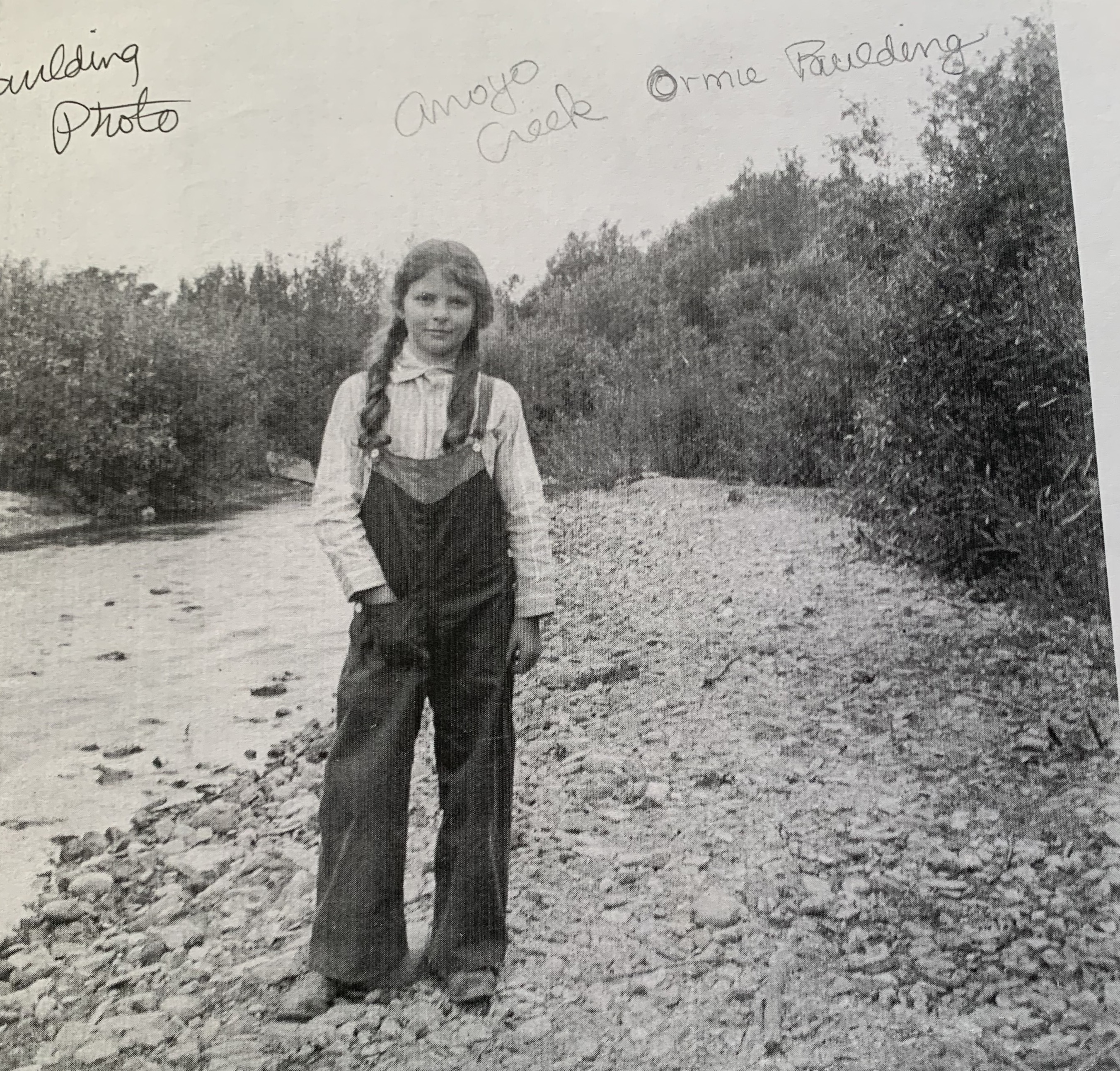
She was born in 1883. As a nearly seventy-year-old who loves his sons but who’s bereft of daughters, I would have adopted her, given the chance. And had I a time machine able to go back to her time at about her age–perhaps twelve–I would’ve had a monstrous crush on her. The combination of overalls and pigtails would’ve been enough to reduce me to silly putty.
She grew up in a little farm town, Arroyo Grande, nourished by a beautiful creek which housed, in season, steelhead fighting upstream to spawn and, in another season, floods that once, in 1911, carried away a fourteen-year-old boy named Sam to his death.
She had the comfort of intelligence–a dubious comfort, admittedly. Both her father and her uncle were medical doctors (another uncle was a pharmacist) the sons of missionaries, born in Syria, whose homes, if her uncle Dr. Ed’s is any indication, were filled with artifacts from the Neolithic Holy Land and Chumash California; homes dense with books, homes full of creative energy inside. Her uncle’s, outside, was bounded by an enormous garden—in dirt her Uncle Dr. Ed found joy— to the point where her Aunt Clara added a bathroom that made it impossible for her husband to re-enter the house without a bathtub stop first. It was only the second bathtub in Arroyo Grande. Sometimes Aunt Clara would hear a soft knock at the door. The folks on the porch asked politely if they could come in and see Ed and Clara’s bathtub.
Ormie’s Aunt Clara, as the saying goes, was a piece of work. She was Arroyo Grande’s foremost schoolteacher; she arrived here in the 1880s and began a career that lasted forty years. She was the descendant of the Puritan divine Jonathan Edwards, but she was an agnostic who just loved going to church. Ormie’s father was the medical director of Santa Barbara County who, in 1918, had the audacity to shut down the bars to stop the spread of the killer flu. He was not beloved.
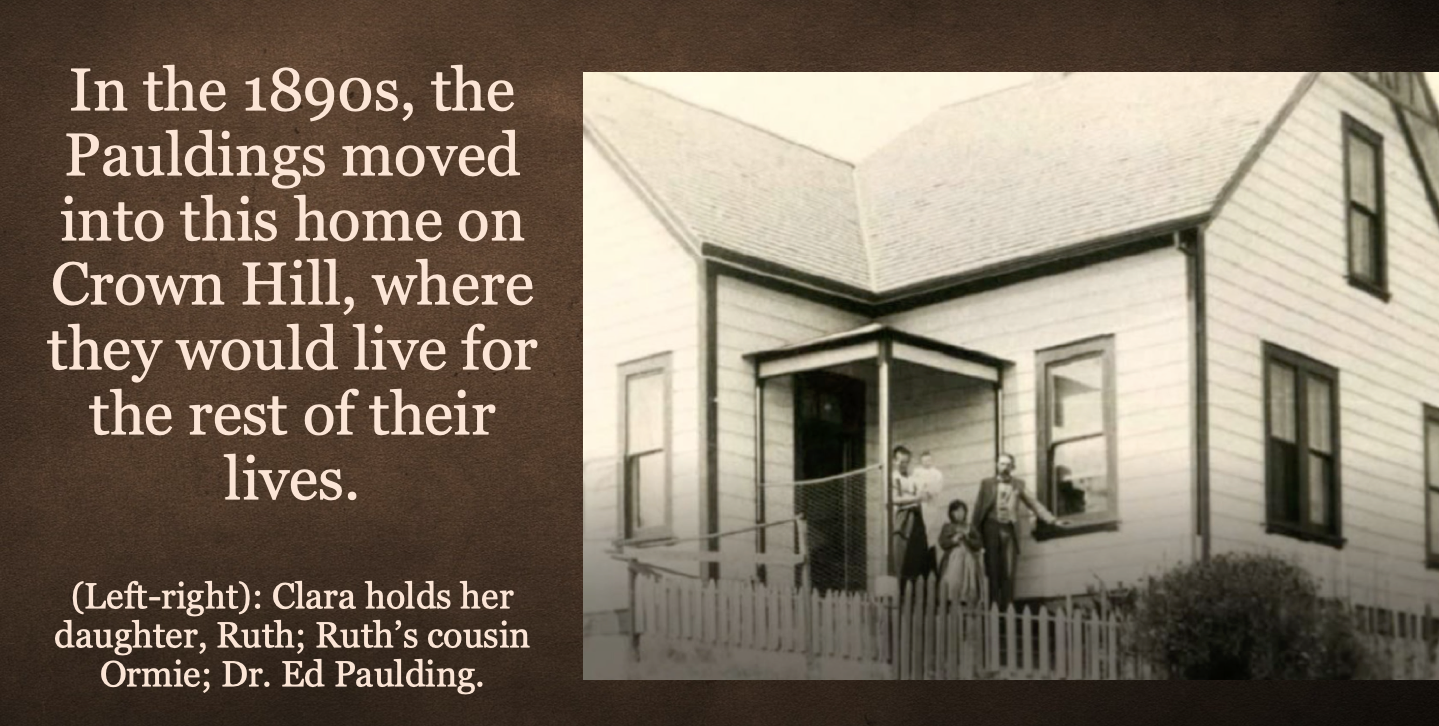
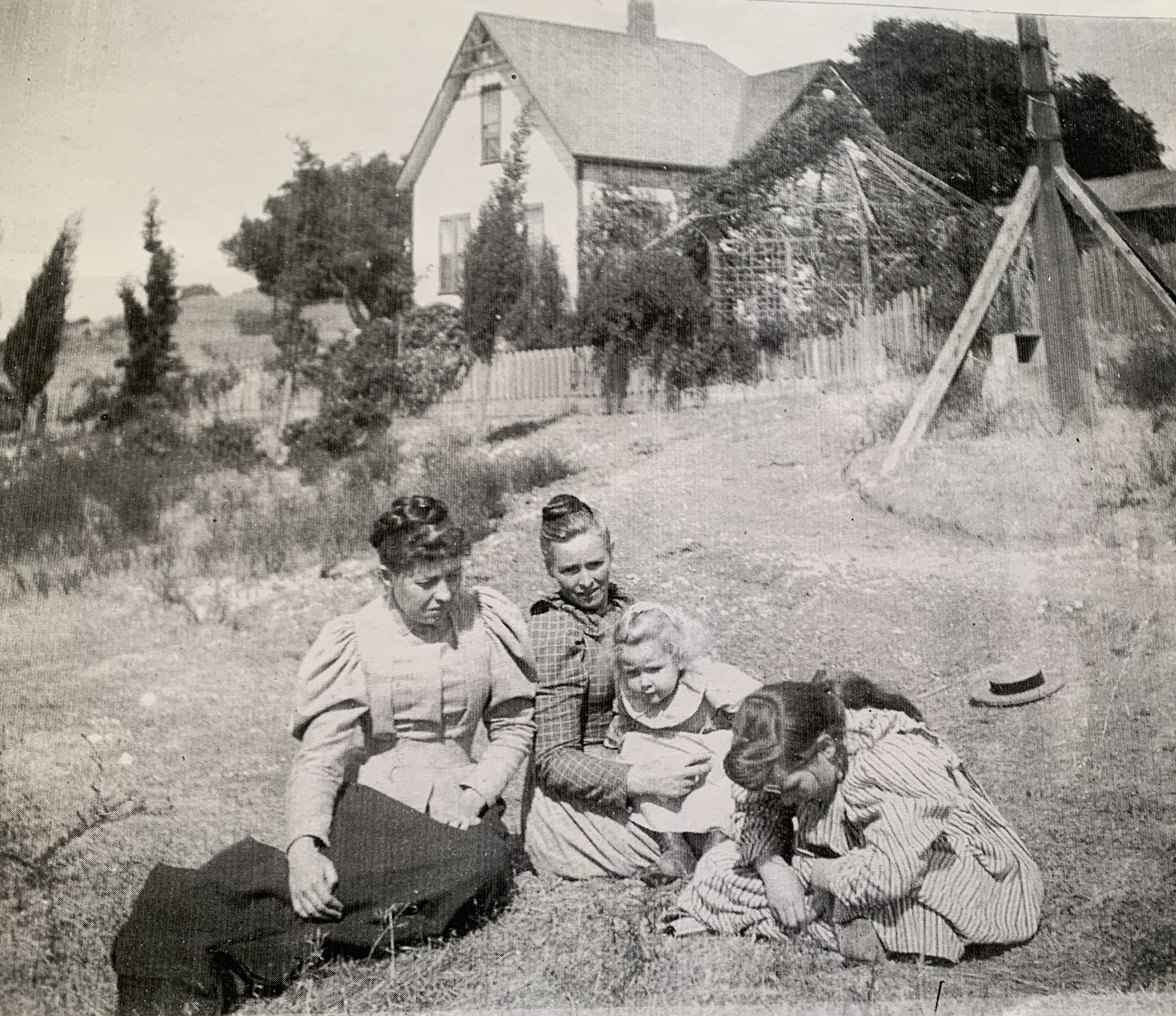
Ormie’s cousin, Ruth was very much beloved. She became such a transformative teacher, of languages, at the Arroyo Grande Union High School (where her commute, atop Crown Hill, consisted of walking across the street) that they would decide to name a middle school after her. That’s baby Ruth, the little blonde. Possibly that’s her cousin Ormie, on the right. The group is posed in the yard of the Paulding home, one that still stands today.
The scene is idyllic, but life, in the 1890s, wasn’t always. Ormie had another cousin, a little boy, the one who was to be first-born, but he was stillborn instead. Her uncle, Dr. Ed, buried him in the garden where he would be close to his parents. Ed planted flowers that gave life to the son who was robbed of the chance to live his.
Ormie would move away from Arroyo Grande—but not very far, only twenty minutes or so today, by car—south to Santa Maria, where she would become a Santa Maria High School Saint, and then, years later, the high school’s librarian and then, after that, she worked for the Post Office.
She died in 1955. Here is Ormie’s tombstone:
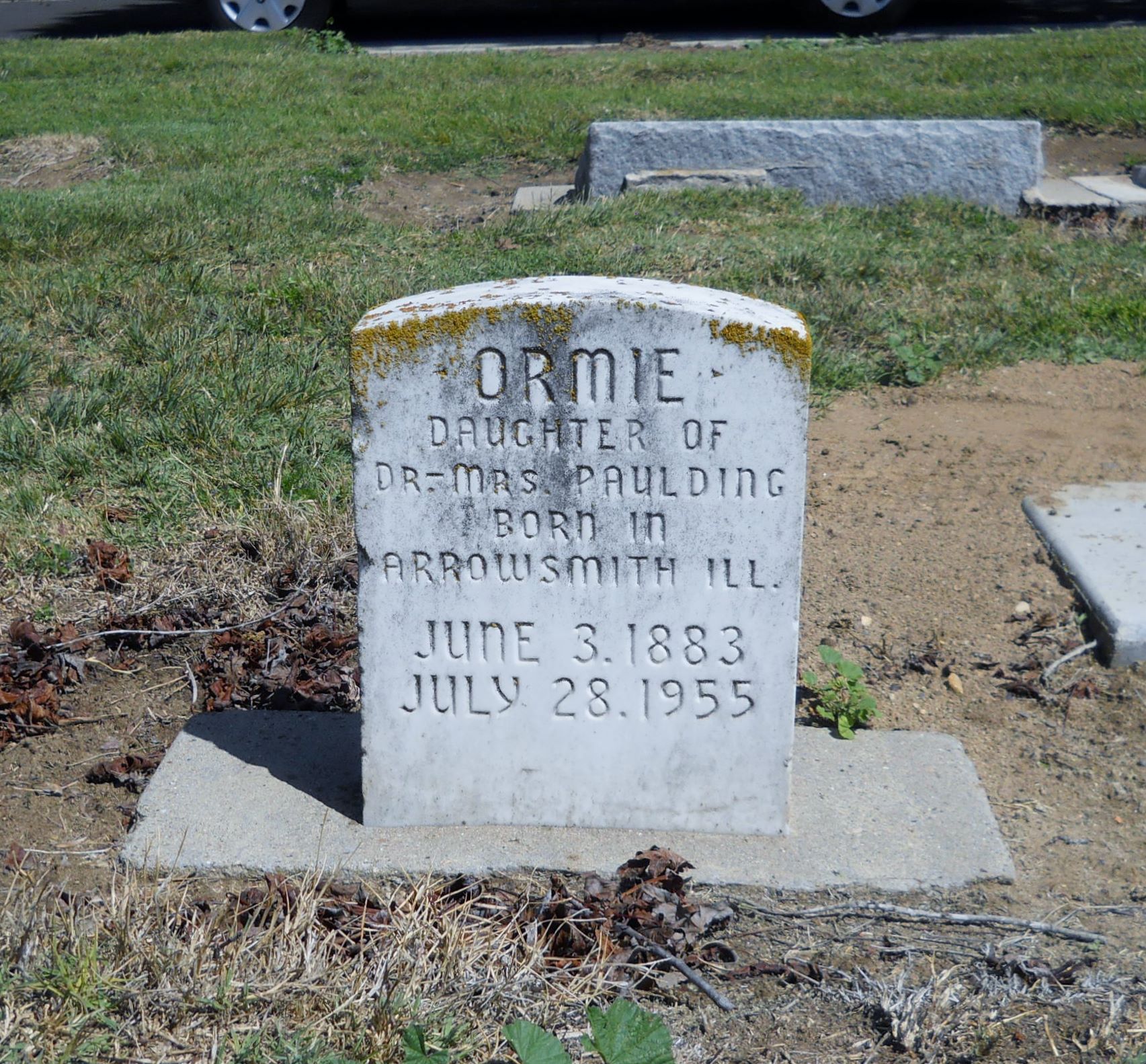
Death be not proud. The Arrogant Male in me regrets that she lived her life as a “Miss,” but this is what she did with her life: She served young people, who, if you haven’t noticed, are sometimes insufferable, and maybe introduced one, thanks to the school library, to The Arabian Knights or Willa Cather’s My Antonia or—on the chance that the Santa Maria High School Library even had it on their shelves–The Autobiography of Frederick Douglass. The power of school librarians is immense and compassionate, which is why the Far Right hates them so much.
And then she worked at the Post Office. Her obituary hints that even this seemingly mundane career gave her the chance to light up other lives. Post office patrons, it suggests, looked forward to buying a book of stamps from Miss Paulding. I think she had the power to reflect a person’s life back at him, in the instant of her look. You saw yourself welcomed in Miss Paulding’s eyes and so you were validated. I’ve known people like that. A friend who met the South African bishop, Desmond Tutu, a small man shaped, in his vestments, like a church bell, told me that he had that power.
In fact, her cousin, fragile and wheelchair-bound when I knew her, had the same kind of power, too. When I received communion at St. Barnabas, the Arroyo Grande Episcopal church, as a teenager, I would glance at the aged and fragile Miss Ruth Paulding as I returned to my pew. A smile from MIss Ruth carried the same freight as a priest’s blessing.
When World War II came, Ormie added a task not on her Post Office job description: She wrote hundreds of letters to servicemen overseas.
Hundreds.
The effort and the generosity of spirit implied in that task is a little overwhelming to me, living in a country where we observe a day—January 6—when patriotism and generosity were so debased.
Ormie’s generosity was boundless.
She loved animals. She was a charter member and a driving force in the Santa Maria Humane Society, and the lives she couldn’t save with letters, lives of young men lost in combat, she saved in the lives of the dogs and cats carelessly put aside. I can see her framing an abandoned mongrel’s face in her hands and looking into his eyes: the dog understands and looks back in the way dogs do, in absolute and unconditional adoration.
Hers was the same look that Ormie’s Post Office patrons saw.
And so she died a spinster—a terrible word—and I was born far too late to propose marriage to her, which I would have done, on the spot, when I was twelve. She didn’t need me. Women don’t need men to live lives that are graced by love, and filled by it, too. I think Ormie’s life was like that.
The life represented in that image, the little girl in overalls and pigtails, turned out to be more than a little miraculous. Women don’t need children any more than they need husbands. But without her knowing it—because I believe that kindness has the power to cross generations and so inform even unborn lives—we are, in a way, Ormie’s children.
 A Work in Progress