It’s pretty much impossible for me to tell you how much I love this band. Between Los Lobos and my Latin American History concentration—especially in Mexican history—next to getting (finally) my college diploma and loving teenagers in thirty years of being their high-school history teacher—scoring 96% on the Facebook “How Mexican Are You?” quiz remains one of the proudest achievements of my life.
They’re coming to Santa Maria April 8, and I think I need to get tickets. Elizabeth and I saw them at the Santa Barbara Bowl many years ago, and we danced our cabooses off for the entire set. So did everybody else.
I’ve never heard such straight-ahead rock and roll that also had so much meaning to me. Here they are at Watsonville High School in 1989, performing “La Bamba.” At one point, I think you can see a teardrop escape from beneath Cesar Rojas’s sunglasses. This performance is so joyful, even though it’s punctuated by dancing gabacho Hippies who have seemed to have misplaced the decade in which they belong, that it makes me tear up, too.
There is no song I love as much as this one, but it’s still not my favorite Los Lobos song. “Will The Wolf Survive?” about crossing the Border, is one of the most meaningful and beautiful songs of my life.
PBS once aired a documentary on the work that welfare agencies and coroners on this side of the Border do in identifying the remains of migrants lost in the desert—the dignity the coroners exhibited in their work, with human remains that look, after months in the desert, like driftwood—and the effort they put forth in trying to return them home, was incredibly moving.
So, too, were the candlelit wakes, the brightly-decorated caskets, and the tears of the families on the rare cases when their brothers or sisters, sons or daughters, husbands or wives, finally came home again.
So this is my favorite Los Lobos song:
And this, from an old blog post, is why:
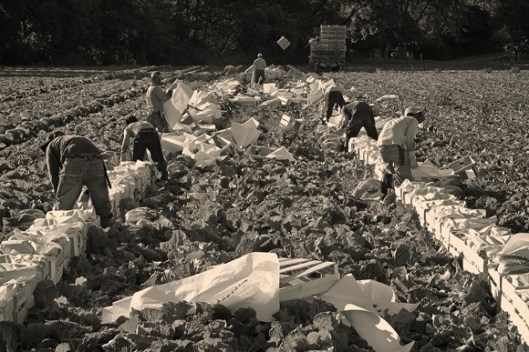
Cabbage harvest, Upper Arroyo Grande Valley. New Times
It’s a story I’ve told a million times, but it speaks volumes about why I love my Mom and why, 43 years after her death, I still miss her. She was pruning her roses and a farmworker–they called them braceros–came into our yard from the field next door and pantomimed filling a gallon jug with water. She nodded, filled it and handed it to me–I was about five: “Help him carry it back.”
That was the day I first fell in love with Mexicans. Not with Brussels sprouts, which is what they were harvesting that day, talking easily with me, as they snapped the sprouts off their stalks with their thumbs, in a language I didn’t think I understood.
“…fell in love with Mexicans.” It amazes me how that might shock some folks (Oh. Doesn’t he mean “Latinos?” or “Hispanics?” We’ve turned an entire people into a pejorative, the butt of ignorant, heartless jokes.) When our family went with the St. Pat’s youth group to Tijuana to help build a home, the mission director asked why we’d come, and there were many moving religious answers. When my turn came:
“I just like Mexicans.”
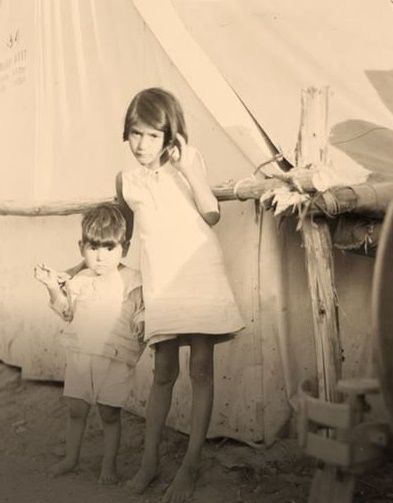
Migrant children, Nipomo, 1936, by Dorothea Lange. The little girl’s knock-knees are symptomatic of rickets, a nutritional disease.
My brother and I once spent an hour in one of George Shannon’s bunkhouses with some of his field workers (George Shannon deserves his own novel. One of the hardest-working and kindest human beings I’ve ever known, an unpretentious man who married into the Hall family, which, around these parts, is like some guy named Lincoln marrying into the Todds.) and they spread out religious medals and family snapshots and pocketknives, toys and firecrackers and belt buckles and, I think, one stuffed baby armadillo, and we chattered away the whole time, each side understanding about every eleventh word, until George came in, smiling, and told us it was time for us to go home for dinner. It was one of the happiest hours of my life and I think it was for them, too, because somehow my brother and I reminded them of family and home and they missed both.
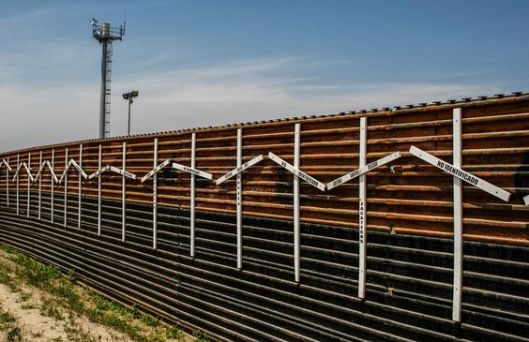
Border fence, Tijuana. The crosses represent migrants lost in the desert.
They missed both. This Mexican was drunk but he was not incoherent. The mission directors were showing us the border fence, with clusters of white crosses at intervals, memorializing the deaths of those–one, a 17-year-old girl–whose coyotes had abandoned them in the desert, and a 13-year-old had started a trash fire at another point as a diversion so a small group of friends might have time enough to vault the fence to what was NOT the promised land, which was the drunk guy’s point.
You think I want to live in your country? he demanded of us, wide-eyed teenagers (and adults). He was drunk but also very angry, which made him clearer than a sober man. You people think we’re invaders? I don’t want to be in your country! I don’t want to be an American. I LOVE MY COUNTRY. I LOVE BEING A MEXICAN! I love my family and that is why I cross over and get arrested by La Migra and then cross over again. I hate it! But I am a man with a man’s responsibilities and if washing dishes in Chula Vista or working melon field in Indio is what it takes for me to be a man, I will do it. I love my country. Not yours. Not yours.
He wandered off and continued the talk with himself alone in that little park where the border fence meets a fetid stretch of Pacific Beach. We were stunned.
We met deportees at a la migra detention center, too. They were flesh and blood, just as the Woody Guthrie song had always suggested.
“Deportees” (Plane Wreck at Los Gatos)
The crops are all in and the peaches are rott’ning,
The oranges piled in their creosote dumps;
They’re flying ’em back to the Mexican border
To pay all their money to wade back again
Goodbye to my Juan, goodbye, Rosalita,
Adios mis amigos, Jesus y Maria;
You won’t have your names when you ride the big airplane,
All they will call you will be “deportees”
My father’s own father, he waded that river,
They took all the money he made in his life;
My brothers and sisters come working the fruit trees,
And they rode the truck till they took down and died.
Some of us are illegal, and some are not wanted,
Our work contract’s out and we have to move on;
Six hundred miles to that Mexican border,
They chase us like outlaws, like rustlers, like thieves.
We died in your hills, we died in your deserts,
We died in your valleys and died on your plains.
We died ‘neath your trees and we died in your bushes,
Both sides of the river, we died just the same.
The sky plane caught fire over Los Gatos Canyon,
A fireball of lightning, and shook all our hills,
Who are all these friends, all scattered like dry leaves?
The radio says, “They are just deportees”
Is this the best way we can grow our big orchards?
Is this the best way we can grow our good fruit?
To fall like dry leaves to rot on my topsoil
And be called by no name except “deportees?”
And, finally, a few years after that mission trip, I led some of my students to the American Cemetery at Colleville-sur-Mer, above Omaha Beach. We were looking for a G.I. named Domingo Martinez.
We found him. Because of the ocean breeze, the marble crosses and Stars of David in this impossibly beautiful cemetery are cold to the touch—it’s almost shocking—but if you let your hand rest against the marble for a moment, it begins to warm.
This is about Private Martinez.
https://drive.google.com/file/d/1H38UVxeRzTHAX7iC2Qn6cFmv6Zxh_0SM/view?usp=sharing
 A Work in Progress