• About
  • The Germans

A Work in Progress

A Work in Progress

Monthly Archives: April 2022

The Little House on XXXX Street

13 Wednesday Apr 2022

Posted by ag1970 in Uncategorized

≈ Leave a comment

Every once in awhile we historians get research requests from real estate agenst. Which helps to prove, I guess, that we have some practical value. Here’s one:

Dear XXXX,

I am honored to be recommended by XXXX Since, as a historian, I am nosy by nature, I glanced at XXXX’s listings and found the home you cited. If that’s not the property, I will now blush.

I can’t ascertain whether 1930 is the right construction date, but the home once belonged to one of Arroyo Grande’s most prominent families, the Briscos.

Charles Brisco and his wife, Etta, moved to Arroyo Grande in 1902; they had three children. One of them, Leo (1892-1987), was a whirlwind. He owned one of the early garages in town, which would’ve stood about where the IOOF Hall parking lot is today.

Leo married the granddaughter of Huasna rancher and Union Civil War veteran Adam Bair–nearly sixty veterans like him are buried in our cemetery, where I give Civil War tours–

 who fought in the deadliest year of the war, Grant vs. Lee, in 1864-65.  If I start to feel sorry for myself, all I need to do is glance at the regimental flag of Bair’s 60th Ohio as it looked at the end of the war.

When the Norwegian lumber freighter Elg ran aground off Oceano in 1938, the captain had to jettison the cargo to get his ship afloat again. Pretty much the whole South County ran to the beach to get free lumber–one young man drowned and another, future World War II fighter pilot Elwyn Righetti, nearly did. And that’s how Leo Brisco got into the lumber and construction business.  It’s said that many of the homes and businesses along Brisco Road are constructed from Elg lumber.  Leo also bought the building, in the 1940s, that now houses Cafe Andreini; it’s sometimes referred to as the Brisco Hotel.

Leo was blind in one eye and wore a shaded eyeglass lens, so that’s him at Brisco Lumber today.

He was also one of the founders, along with my Dad, Albert Maguire, Walter Filer and others, of Mid-State Bank, today’s Mechanics’ Bank.
On Etta Brisco’s death in 1939, the home was inherited by her daughter-in-law, Marietta (1908-2001), who married a business partner of Leo’s, Frank Bosch (1902-1987). Here’s an advertisement from 1941 (I included the cow because I kind of liked the ad:

Sadly–if irrelevantly–Mary Agueda’s daughter was murdered in 1926, which has provided the Arroyo Grande area with its most poignant ghost story:

https://jimgregory52.wordpress.com/2021/10/01/little-alice/

Frank Bosch stayed in the service station/auto repair business and kept it in his brother-in-law’s name:

Mrs. Bosch was the head of the local Red Cross and spent countless hours in volunteer work and in teaching first aid classes, most notably during World War II.

Sometime in the 1950s, the home was acquired by Mrs. J.H. (Gertrude) Thurlwell. She moved away from Arroyo Grande in the mid 1950s but returned to the home to live out the final three months of her life in 1959.

Tragically, she lost a son, Vernon (upper left in this photo from the 1917-18 Arroyo Grande Union High School yearbook) who had been accepted to Stanford but was trying to enlist in the Army. The 1918 flu claimed him instead. (And, parenthetically, that hit Arroyo Grande hard, too, as the story in the link below describes):

https://drive.google.com/file/d/1libbJd0azm2ZpdUJoBti7G_DUjHFJlv5/view?usp=sharing

Incidentally, a tool that just might bring up several conversation pieces between agents and their clients is this, an interactive history map of Branch Street. Enjoy, and feel free to share, courtesy of the South County Historical Society.


www.historicbranchstreetarroyogrande.com


I hope that some of this is helpful, and the Society and I wish you great success! We, in turn–as we battle our way back from over two years of Covid–welcome the support of the real estate community!

My best,
Jim Gregory, President
toptitle32.png

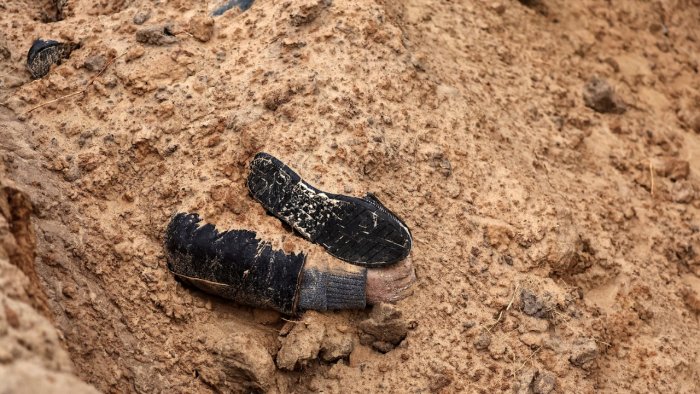
Bucha, Ukraine, 2022; Wounded Knee, South Dakota, 1890

06 Wednesday Apr 2022

Posted by ag1970 in Uncategorized

≈ Leave a comment

Like most of you, I’ve been veering between rage and despair over Ukraine.

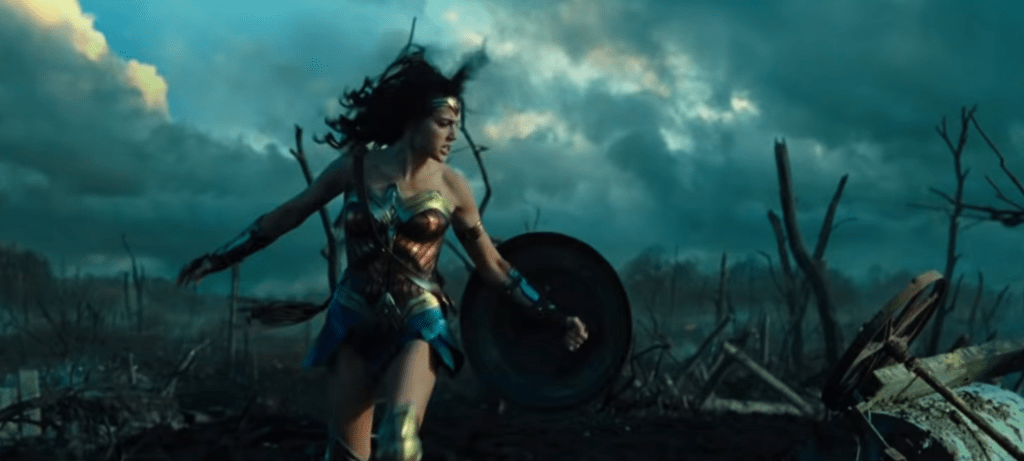
I’m even resorting to movie fantasies to comfort myself–like when Diana rescues the village from the Germans in Wonder Woman–another writer saw that scene evocative of what was then happening in Syria, with the assistance of the Russians– or, far more violent, envisioning the First Air Cav of Apocalypse Now’s Robert Duvall delivering a spectacular napalm strike on the Russian columns as they head east toward the Donbas.

I can be a bloodthirsty little bastard when I’m angry.

Even moreso when I’m helpless.

We seem, among world figures and self-important commentators, to be quibbling over the term “genocide.” The term applies here, to what’s being done to the people of Ukraine. I’ve written about genocide, at some length, in our own history, and some of it involved Arroyo Grande settlers.

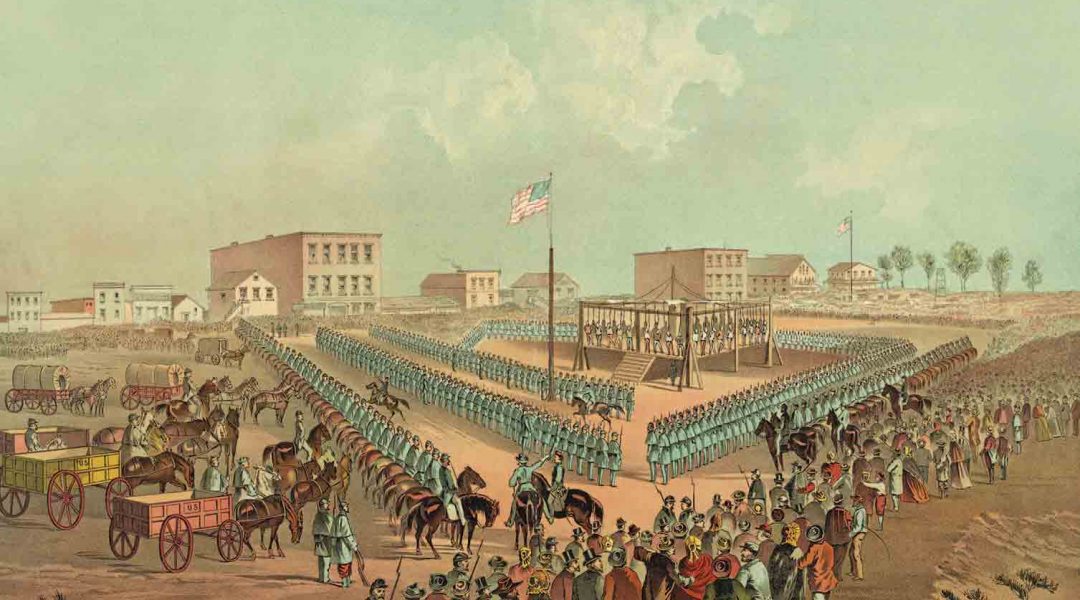
–In 1862, when the government, which had already reduced the size of the Woodland Sioux reservation in Minnesota, thus depriving them of game, also withheld the reservation’s meat and grain allotment, a war broke out. It began with some hungry young men stealing a hen’s eggs from a farmer in Meeker County–where my Irish ancestors, no strangers to hunger, later homesteaded–and ended with the largest mass execution in American history, of thirty-eight Sioux fighters, hanged in Mankato. Over three hundred had originally been sentenced to hang until Lincoln intervened. John Rice, who build a home from Los Berros stone on Myrtle Street, was a soldier who witnessed that execution as a member, mounted that day, of F Company, 10th Minnesota Infantry.

The hangings happened the day after Christmas, 1862. The Sioux sang as they climbed the scaffold and stood on the plank that would be collapsed on the signal of a settler whose family had been murdered. Their hands were bound, but the condemned men tried desperately to touch each other in that final moment.

One of the fighters who died that day was named Chaksha. A White woman had intervened on his behalf at one of the perfunctory military tribunals because he had saved the life of the woman and her children as they were about to be killed by Chaksha’s comrades. But a mistake in record-keeping killed Chaksha. The same mistake, thanks to the similarity in names, spared the life of Chaksey-etay, a Sioux condemned of raping and murdering another woman.

When a warder went into the Mankato jail on December 27 calling Chaksha’s name for his release, a voice called out simply, “You hanged him yesterday.”

The execution at Mankato, 1862. The bodies were disinterred soon after they’d been buried; one became the office skeleton for the father of the physicians who founded the Mayo Clinic.

–In the Treaty of Laramie in 1858, the Powder River Country was promised to the Lakota and Cheyenne until the end of time. Then gold was discovered there. When miners began getting picked off, the Army sent in a punitive expedition that included two Arroyo Grande settlers, James Dowell and Thomas Keown, under the command of a general, Patrick Connor, who promised “to kill every male Indian over the age of twelve.” It didn’t work out that way, especially when, on the first night of the expedition, Dowell and Keown’s commander pitched camp between two villages whose leaders were Red Cloud and Sitting Bull.

“The Sioux fell on them like angry badgers,” one historian wrote. Dowell and Keown survived the expedition, but just barely, and as infantrymen. They’d had to eat their horses.

–Harrison Marion Bussell, First Colorado Cavalry, is buried in our cemetery. It was only a matter of luck that his company was left behind at Fort Lyon when a detachment of cavalry, under Col. John Chivington, fell on a village of Cheyenne and Arapaho at Sand Creek, Colorado, in 1864. The horse soldiers from the volunteer regiment that accompanied the First mutilated the genitals of the dead to bring home souvenirs–the troopers of the First, regular army soldiers, had to be forcibly restrained from opening fire on the volunteers, who killed, over the course of eight hours, 230 women and children.

The volunteers killed at close range. The First Colorado–Bussell’s comrades–had brought mountain howitzers along for the expedition and when they opened fire on the camp, witnesses noted that the shells detonated harmlessly in mid-air, high above the Native Americans who were going to die anyway. The soldiers of the First had cut the shells’ fuses short.

The leader at Sand Creek, Black Kettle, would escape. Six years later, on the Washita, he was flying an American flag, a gift from President Lincoln, outside his tipi when Custer’s Seventh–the regimental band was playing the Seventh’s theme, “Garryowen,” the merry old Irish drinking song– rode into the village and began killing everyone in sight. Black Kettle was among them.

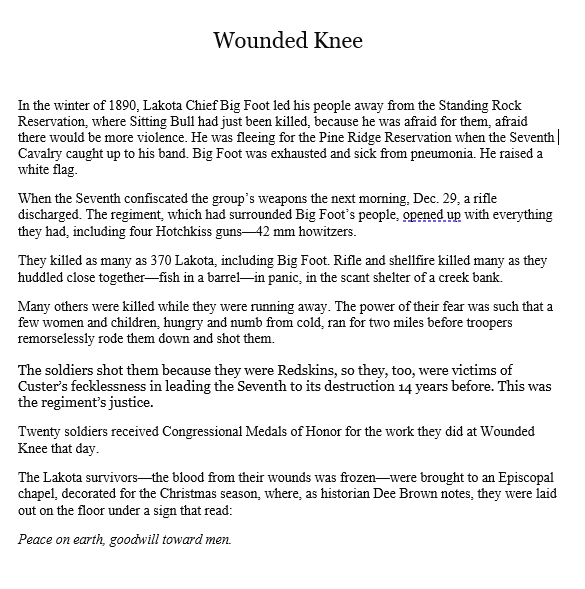
And then there’s Wounded Knee. This is from a piece I wrote eight years ago.

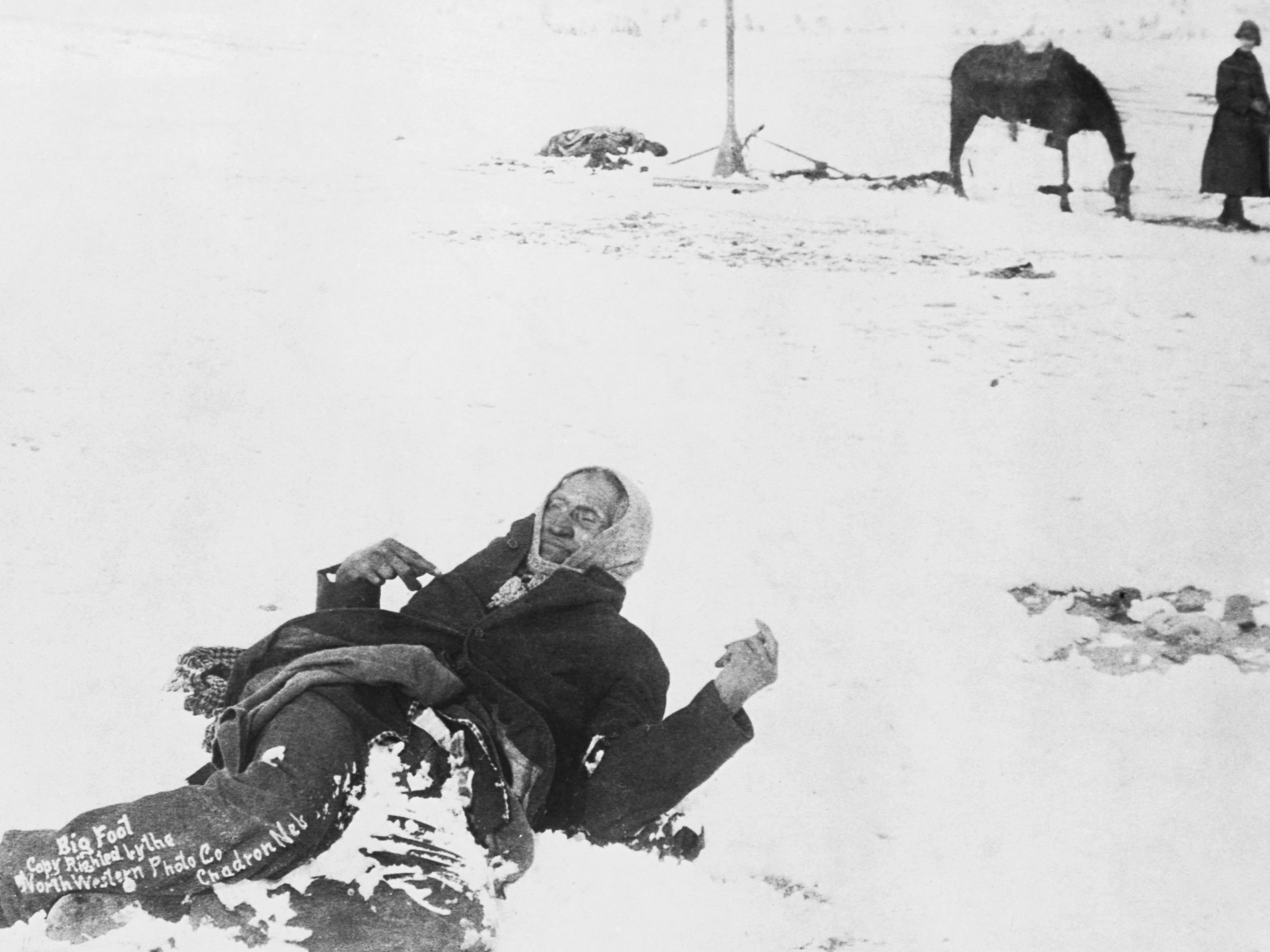
Big Foot in Death.

So don’t call what’s happening in Ukraine–the extermination, both haphazard and deliberate–of a people considered “inferior”–anything other than genocide. Don’t bullshit me. Don’t equivocate.

I know genocide when I see it.

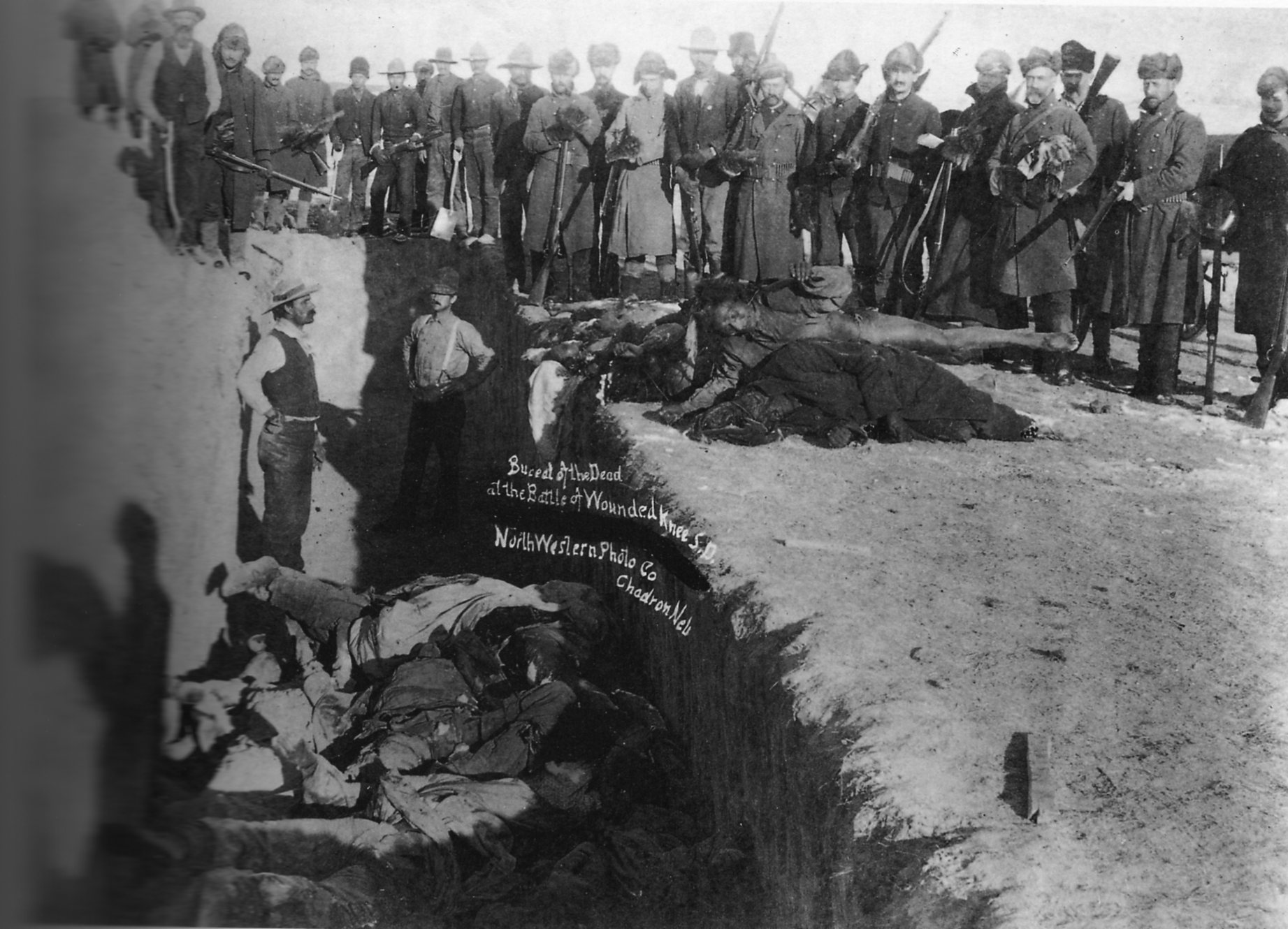
Mass graves: Wounded Knee and Bucha.


Subscribe

  • Entries (RSS)
  • Comments (RSS)

Archives

  • January 2026
  • December 2025
  • November 2025
  • October 2025
  • September 2025
  • August 2025
  • July 2025
  • June 2025
  • May 2025
  • April 2025
  • March 2025
  • February 2025
  • January 2025
  • December 2024
  • November 2024
  • October 2024
  • September 2024
  • August 2024
  • July 2024
  • June 2024
  • May 2024
  • April 2024
  • March 2024
  • February 2024
  • January 2024
  • December 2023
  • November 2023
  • October 2023
  • September 2023
  • August 2023
  • July 2023
  • June 2023
  • May 2023
  • April 2023
  • March 2023
  • February 2023
  • January 2023
  • December 2022
  • November 2022
  • October 2022
  • September 2022
  • August 2022
  • May 2022
  • April 2022
  • March 2022
  • February 2022
  • January 2022
  • December 2021
  • November 2021
  • October 2021
  • September 2021
  • August 2021
  • July 2021
  • June 2021
  • April 2021
  • March 2021
  • February 2021
  • January 2021
  • December 2020
  • November 2020
  • August 2020
  • July 2020
  • June 2020
  • May 2020
  • April 2020
  • January 2020
  • December 2019
  • November 2019
  • October 2019
  • September 2019
  • August 2019
  • May 2019
  • April 2019
  • March 2019
  • February 2019
  • January 2019
  • December 2018
  • November 2018
  • October 2018
  • September 2018
  • July 2018
  • June 2018
  • May 2018
  • April 2018
  • March 2018
  • February 2018
  • January 2018
  • December 2017
  • November 2017
  • October 2017
  • April 2017
  • March 2017
  • December 2016
  • November 2016
  • October 2016
  • September 2016
  • August 2016
  • July 2016
  • June 2016
  • April 2016
  • March 2016
  • February 2016
  • January 2016
  • December 2015
  • November 2015
  • October 2015
  • September 2015
  • August 2015
  • July 2015
  • June 2015
  • May 2015
  • April 2015
  • March 2015
  • February 2015
  • January 2015
  • December 2014
  • November 2014
  • September 2014
  • August 2014
  • July 2014

Categories

  • American History
  • Arroyo Grande
  • California history
  • Family history
  • Film and Popular Culture
  • History
  • News
  • Personal memoirs
  • Teaching
  • The Great Depression
  • trump
  • Uncategorized
  • World War II
  • Writing

Meta

  • Create account
  • Log in

Blog at WordPress.com.

  • Subscribe Subscribed
    • A Work in Progress
    • Join 68 other subscribers
    • Already have a WordPress.com account? Log in now.
    • A Work in Progress
    • Subscribe Subscribed
    • Sign up
    • Log in
    • Report this content
    • View site in Reader
    • Manage subscriptions
    • Collapse this bar
 

Loading Comments...