
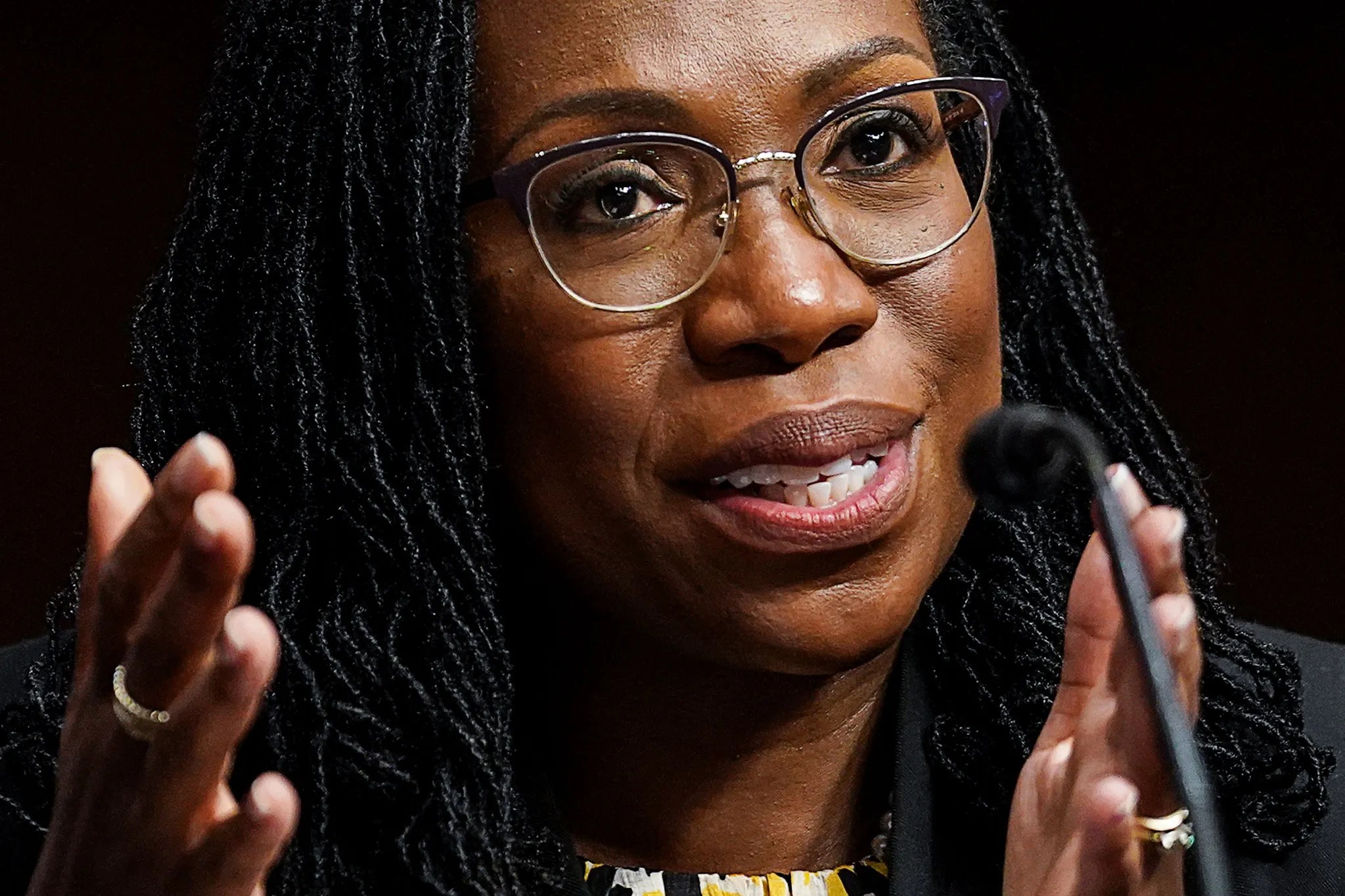
In only her second day of oral arguments, Supreme Court Justice Ketanji Brown Jackson is, to put it bluntly, dazzling.
The case in question is called Merrill v. Milligan. Bearing in mind that I am no Constitutional lawyer, this is what I understand.
The background: Alabama redrew its seven Congressional districts. Only one of the seven (as a percentage, 14% of the districts) has a Black majority. Twenty-seven percent of Alabama’s citizens are African American.
An appeals court that included two Trump appointees agreed that this deprived Black Alabamians of fair representation. The court threw out the new map, opining that an additional Black-majority Congressional district was appropriate.
Alabama appealed, arguing that 1) It cannot be proven that Alabama legislators were considering race in their redistricting and 2) the constitutionality of Section 2 of the Voting Rights Act, which prohibits any effort to discriminate against voters of color, is in question.
In fact, they argue, because it is explicitly considers race, Section 2 violates the equal protection clause of the 14th Amendment itself.
In fact, the traditional states’ rights argument has been this: The Constitution was and is meant to be color-blind, so any law that is specifically formulated on the basis of race is inherently unconstitutional.
Of course, this argument is a new one. It wouldn’t have been popular in Jim Crow Days.
So, in short, if Alabama wins its appeal, the Voting Rights Act is diluted even more than it has been..
Enter Justice Jackson. She’s addressing herself and her fellow justices, but formally her remarks are intended for Alabama’s Solicitor General. I’ll let her take over, in quotes taken from an article by journalist Travis Gettys:
“I don’t think that we can assume that just because race is taken into account that that necessarily creates an equal protection problem, Jackson began, “because I understood that we looked at the history and traditions of the Constitution and what the framers and the founders thought about, and when I drilled down to that level of analysis, it became clear to me that the framers themselves adopted the Equal Protection Clause, the 14th Amendment, the 15th Amendment, in a race-conscious way. That they were, in fact, trying to ensure that people who had been discriminated against, the freedmen, during the Reconstruction period, were actually brought equal to everyone else in society.
“Those post-Civil War amendments were explicitly drawn up and ratified to expand and protect the rights of the Black citizens who had been enslaved in Confederate states,” Jackson argued, and she backed her claims with statements made by the legislators who wrote and voted on those bills.
“I looked in the report that was submitted by the Joint Committee on Reconstruction, which drafted the 14th Amendment, and that report says that the entire point of the amendment was to secure rights of the freed former slaves,” Jackson argued. “The legislator who introduced that amendment said that, quote, ‘Unless the Constitution should restrain them, those states will all, I fear, keep up this discrimination and crush to death the hated freedmen.’
“That’s not a race-neutral or race-blind idea, in terms of the remedy, and even more than that, I don’t think that the historical record establishes that the founders believed that race neutrality or race blindness was required, right?” she continued. “They drafted the Civil Rights Act of 1866, which specifically stated that citizens would have the same civil rights as enjoyed by white citizens. That’s the point of that act, to make sure that the other citizens, the Black citizens, would have the same as the white citizens.
“They recognized that there was unequal treatment,” Jackson added. “People based on their race were being treated unequally and, importantly, when there was a concern that the Civil Rights Act wouldn’t have a constitutional foundation, that’s when the 14th Amendment came into play. It was drafted to give a constitutional foundation for a piece of legislation that was designed to make people who had less opportunity and less rights equal to white citizens.
“So with that as the framing and the background, I’m trying to understand your position that Section 2, which by its plain text is doing that same thing, is saying you need to identify people in this community who have less opportunity and less ability to participate and ensure that that’s remedied, right? It’s a race-conscious effort, as you have indicated. I’m trying to understand why that violates the Fourteenth Amendment, given the history and –and background of the Fourteenth Amendment?“
* * *
You are next on the tee, Mr. Alabama Solicitor General, sir.
 A Work in Progress