
An impassioned Facebook post I saw today demanded that local school board spend more on campus security and less on junk like CRT (Critical Race Theory) and Gender Studies. So, yes, it’s election time, and factuality is irritating and inconvenient at important times like this one.
But let me make a few points:
1. CRT is taught at places like Berkeley Law. It is not taught in Lucia Mar. When I taught U.S. History, I did teach my AGHS students about the 54th Massachusetts, about the Harlem Renaissance, about Rosa Parks and Mamie Till. I also showed them Bull Connor’s firehoses knocking down Black teenagers in Birmingham.
The damndest thing happened. Seeing those Black kids in Birmingham getting knocked down and helping each other up again made my White kids in Arroyo Grande and Grover Beach proud to be Americans. Prouder. So did the gravity of the Little Rock coed walking through a dense crowd of White abusers, their faces contorted, or the obvious enjoyment of White boys with butch haircuts and D.A.’s as they poured creamer and sugar and ketchup over the impassive Black boys who had merely come to the Woolworth’s counter for service.
The assessment at the end of the unit had them planning, writing and publishing, using computer software, a 1920s newspaper about what they’d learned. Invariably, every newspaper–every newspaper–had an article about Louis Armstrong. Watching him perform and listening to him talk about his life–the son of a New Orleans prostitute who’d learned to play a battered cornet in juvenile hall- had enchanted my students.
If that’s what the Facebook poster meant by Critical Race Theory, then I guess I’m for it.
2. I know of no such course called “Gender Studies” in Lucia Mar. I could be wrong. But if you removed the theme of “gender studies” from the AP European History course I taught at AGHS for nineteen years, then you’ve also removed about eight percent of the course content.
(My students would never learn, for example, that there were almost no illegitimate births in rural Tudor England. There were many, many marriages recorded in parish registers that were followed, with rapidity, by christenings. It wasn’t that young people were virtuous; it was that food was such a scarcity that community pressure forced the marriage so that responsibility would be taken for the extra mouth to feed.
(They would never about Victorian mourning customs, when middle-class widows wore black crape, highly flammable, for a year. They lived in homes lit by open gas jets.
(They’d never learn that the safety bicycle–coaster brakes–liberated Edwardian women from the whalebone corset; bicycles in turn threatened men so much that they threw rocks at parties of women cycling in the countryside. They’d never see the grainy, choppy moment of Edwardian film that shows the suffragist Emily Wilding Davison throwing herself under the King’s horse at the Derby.
(They’d never learn that the Russians whom the Nazi invaders feared the most were actually Ukrainian. They were snipers. They were women.)
But maybe studying the lives of women isn’t that important, after all.
3. As to campus security, maybe we do need a higher profile. But, God forbid, in the event of a shooting event on a local campus, you’re condemning those new district hires to death. Unless they, too, are armed with assault rifles, they don’t stand a chance against the shooter. At Uvalde, where police were armed with assault rifles, they didn’t take the chance to stop the shooter.
At any rate, I’m not sure I want my Alma Mater (AGHS ’70) to look like downtown Tijuana, where sixteen-year-olds in cheap security guard uniforms reflexively rub the trigger guards of their assault rifles. The place is crawling with them.
And there were 1,972 murders in Tijuana in 2021. So far this year, 1,500 have gone missing in Tijuana. Only some of them are Americans.
So, now that I think about it–maybe there’s another way to stop mass-casualty shooters, but we just haven’t hit on it yet– maybe I’ll move security guards a little lower down on my list of school priorities.
I keep coming back to what I taught, lessons that are embedded in some way in every discipline in every school curriculum in America.
School are places where we have the chance to teach values like these: We belong to each other, so we need to learn to cooperate with each other. Human life has value, so every human should be treated with dignity. Life has meaning, so there is reason for hope.
And, as infuriating as it can be, our system of democracy belongs to us; it, too, has value and dignity and meaning. And, God willing, it has hope.
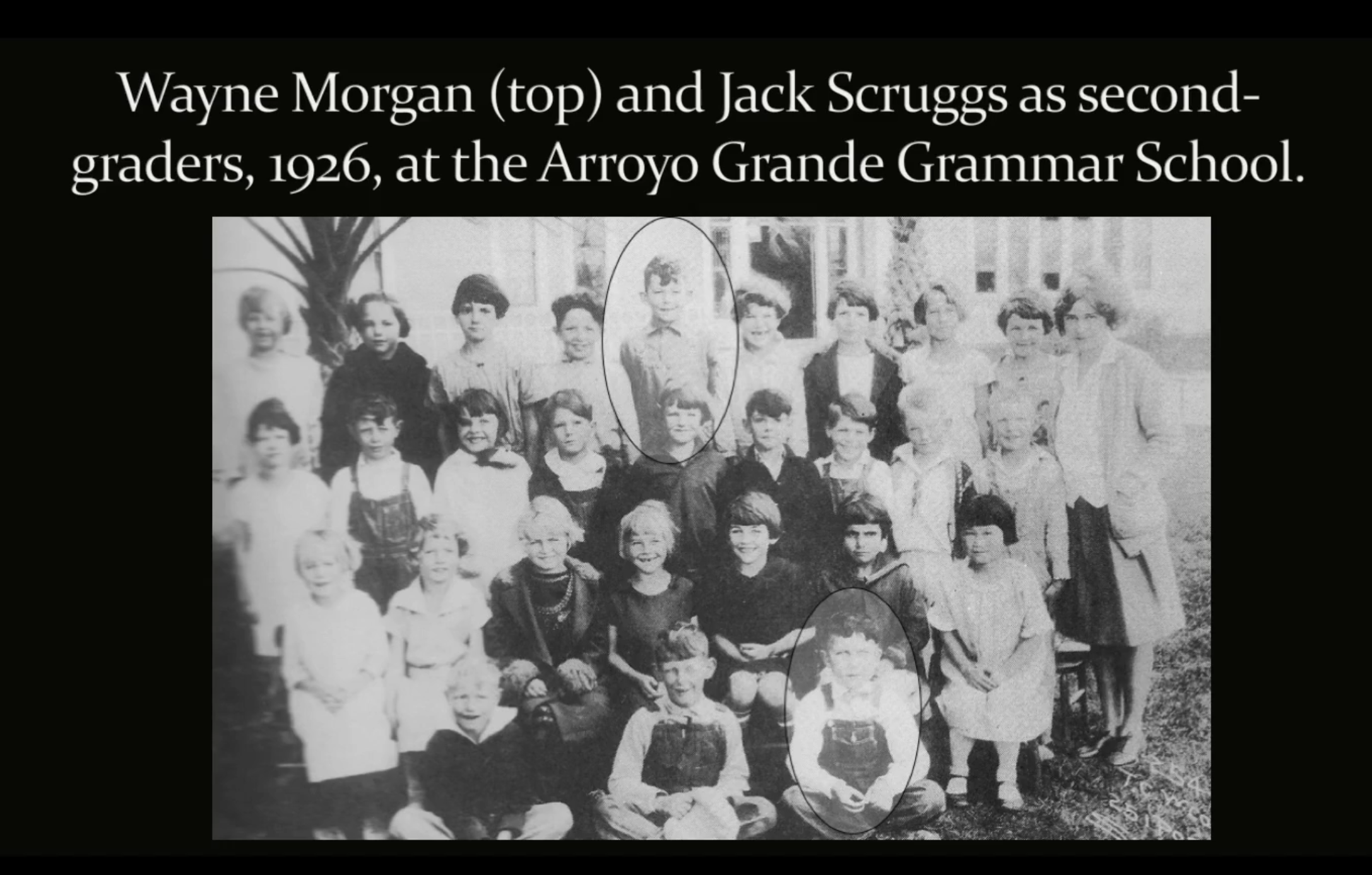
Schools are places to learn lessons like these. They are places, too, where boys and girls have the chance, in the confines of a little second-grade classroom, to build friendships that last for life. The two little boys below were second-grade friends at Arroyo Grande Grammar School in 1926.
Good friendships build good nations.
Fifteen years later, on battleship Arizona, both were killed in action. The last day of their friendship had meaning, because losing them drove an entire generation of schoolroom friends into the war that saved democracy.
I think we owe these two little boys something. The lessons of their lives, of duty and selflessness and sacrifice, need to be woven into the lives of our children– and of children yet born, to whom we owe just as much.
 A Work in Progress